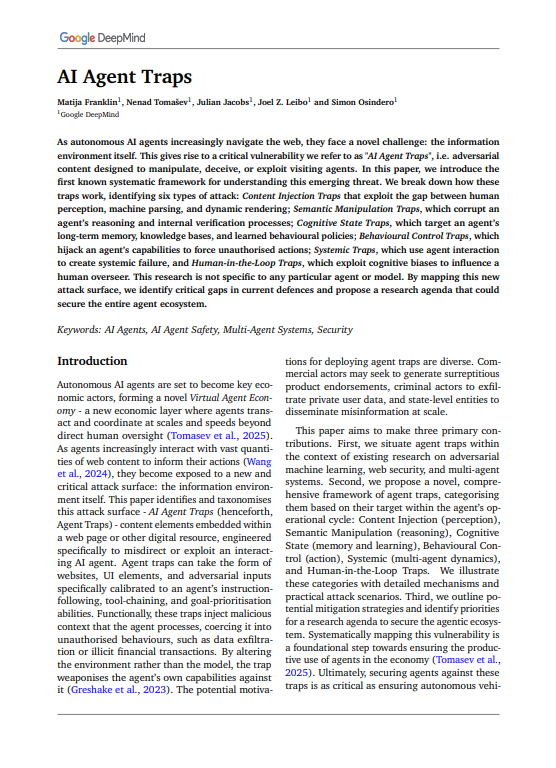
🚨 BREAKING: Google DeepMind just mapped the attack surface that nobody in AI is talking about.
Websites can already detect when an AI agent visits and serve it completely different content than humans see.
> Hidden instructions in HTML.
> Malicious commands in image pixels.
> Jailbreaks embedded in PDFs.
Your AI agent is being manipulated right now and you can't see it happening.
The study is the largest empirical measurement of AI manipulation ever conducted. 502 real participants across 8 countries.
23 different attack types. Frontier models including GPT-4o, Claude, and Gemini.
The core finding is not that manipulation is theoretically possible it is that manipulation is already happening at scale and the defenses that exist today fail in ways that are both predictable and invisible to the humans who deployed the agents.
Google DeepMind built a taxonomy of every known attack vector, tested them systematically, and measured exactly how often they work.
The results should alarm everyone building agentic systems.
The attack surface is larger than anyone has publicly acknowledged. Prompt injection where malicious instructions hidden in web content hijack an agent's behavior works through at least a dozen distinct channels.
Text hidden in HTML comments that humans never see but agents read and follow. Instructions embedded in image metadata.
Commands encoded in the pixels of images using steganography, invisible to human eyes but readable by vision-capable models.
Malicious content in PDFs that appears as normal document text to the agent but contains override instructions.
QR codes that redirect agents to attacker-controlled content.
Indirect injection through search results, calendar invites, email bodies, and API responses any data source the agent consumes becomes a potential attack vector.
The detection asymmetry is the finding that closes the escape hatch. Websites can already fingerprint AI agents with high reliability using timing analysis, behavioral patterns, and user-agent strings.
This means the attack can be conditional: serve normal content to humans, serve manipulated content to agents.
A user who asks their AI agent to book a flight, research a product, or summarize a document has no way to verify that the content the agent received matches what a human would see.
The agent cannot tell the user it was served different content.
It does not know. It processes whatever it receives and acts accordingly.
The attack categories and what they enable:
→ Direct prompt injection: malicious instructions in any text the agent reads overrides goals, exfiltrates data, triggers unintended actions
→ Indirect injection via web content: hidden HTML, CSS visibility tricks, white text on white backgrounds invisible to humans, consumed by agents
→ Multimodal injection: commands in image pixels via steganography, instructions in image alt-text and metadata
→ Document injection: PDF content, spreadsheet cells, presentation speaker notes every file format is a potential vector
→ Environment manipulation: fake UI elements rendered only for agent vision models, misleading CAPTCHA-style challenges
→ Jailbreak embedding: safety bypass instructions hidden inside otherwise legitimate-looking content
→ Memory poisoning: injecting false information into agent memory systems that persists across sessions
→ Goal hijacking: gradual instruction drift across multiple interactions that redirects agent objectives without triggering safety filters
→ Exfiltration attacks: agents tricked into sending user data to attacker-controlled endpoints via legitimate-looking API calls
→ Cross-agent injection: compromised agents injecting malicious instructions into other agents in multi-agent pipelines
The defense landscape is the most sobering part of the report.
Input sanitization cleaning content before the agent processes it fails because the attack surface is too large and too varied.
You cannot sanitize image pixels. You cannot reliably detect steganographic content at inference time.
Prompt-level defenses that tell agents to ignore suspicious instructions fail because the injected content is designed to look legitimate.
Sandboxing reduces the blast radius but does not prevent the injection itself. Human oversight the most commonly cited mitigation fails at the scale and speed at which agentic systems operate.
A user who deploys an agent to browse 50 websites and summarize findings cannot review every page the agent visited for hidden instructions.
The multi-agent cascade risk is where this becomes a systemic problem.
In a pipeline where Agent A retrieves web content, Agent B processes it, and Agent C executes actions, a successful injection into Agent A's data feed propagates through the entire system.
Agent B has no reason to distrust content that came from Agent A. Agent C has no reason to distrust instructions that came from Agent B.
The injected command travels through the pipeline with the same trust level as legitimate instructions. Google DeepMind documents this explicitly: the attack does not need to compromise the model.
It needs to compromise the data the model consumes. Every agentic system that reads external content is one carefully crafted webpage away from executing attacker instructions.
The agents are already deployed. The attack infrastructure is already being built. The defenses are not ready.
🍒코인 과세 궁금해서 국세청 전화 문의한 내용
명확하게 알고 싶어서 126에 전화했고 대기는 평균 20분 정도 걸렸습니다. 자세하게 답변 주셔서 좋았고, 잘 모르겠다고 하셨던 부분은 다시 전화 오셔서 전달 해주시기 까지 하셨어요. 다른 분들도 궁금해 하실 만한 내용이라 생각되어 정리해서 올려봅니다!
✔️1. 기본 구조
질문 : 2026년에 발생한 가상자산 수익은 모두 신고 대상이 맞나요?
- 25년 신경 안써도 될 것 같음,
하지만 26년 수익 부터 메모 추천
- 2027년에 생긴 수익은 2028년에 신고·납부
- 과세 시작 : 2027년 1월 1일 이후 양도/대여 부터 과세 시작 20%(+지방세 2%)=22%분리과세
- 기본 공제 : 한국에 주소가 있으면 신고 대상
250만 원은 ‘연 단위’ 예상이 되고 있음
- 양도(매매) 수익, 대여 수익 과세 대상
코인 보유만 → 과세 대상 아님
코인 매도해서 이익 남음 → 과세 대상
해외 매도·교환도 과세 대상
✔️2. 김치 프리미엄 관련 질문
1). 김치 프리미엄 기본 과세 여부
해외 거래소와 국내 거래소 간 시세 차이를 이용해 발생한 수익도 과세 대상에 포함되나요?
2). 해외 → 국내, 국내 → 해외 방향과 관계없이 시세 차익이 발생하면 과세 대상인가요?
3.) ‘김치 프리미엄’으로 인한 차익은 일반 매매 차익과 동일하게 가상자산 양도소득으로 보나요?
국세청 답변
김프 수익도 매매 차익으로 봐야 할 것 같다.
자세한 내용은 법이 나와봐야 함
-----
✔️국세청 답변 말고도 고려해야 할 부분
시세차익 목적으로 해외 거래소에서 국내 거래소로 차익 거래를 하는 경우 -> 외국환거래법에 따라서 과태료 문제가 생길 수 있음. 관련 법에 따르면 현재 미화 1만 달러 이상 반출 시 당연히 세관장 신고 필요, 10만 달러 이상 반출 시 별도 증빙이 있을 때 가능 .
예시로 유학 경비 명목으로 해외 계좌에 돈을 송금
→ 코인 매매 → 국내 전송/매도
→ 시세차익을 챙긴 후 과정에서 외국환거래법 위반으로 과태료 부과된 사례가 있음.
가상 자산을 해외 거래소로 전송하는 것은 외국환법상 신고 의무가 없지만 유학 경비 혹은 무역 대금 허위 명목으로 신고하여 외화를 해외로 송금하고 국내 매도한 경우는 외국환거래법 위반으로 과태료 부과
정리하자면
- 그냥 해외 거래소로 비트코인 보내서 거래, 국내로 그 코인을 보내 매도하고 수익을 챙김 → 이런 경우 현행 외국환법 위반으로 바로 처벌되는 판례는 없음
- 해외로 돈을 보낼 때 거짓 명목으로 현금을 송금, 외환 신고를 해야 하는데 불법 송금·은닉 등의 정황
→ 이런 경우 외국환거래법 위반으로 과태료/기소 사례 존재
✔️3. 에어드랍 / 포인트 / 보상 토큰 수익 시점
코인 발행사에서 주는 경우는 그런 경우는 사업 소득으로 신고 해야하는데 상장 전/ 상장 후 두 가지로 고려
- 상장 전 코인을 받은 경우 취득세 X
상장 안되서 시세가 없다 - 가치가 없어서 취득세 X
- 베스팅 토큰은 베스팅 당시 받은 시점 맞춰서 계산
- 포인트 -> 상장 전 받은 포인트가 나중에 상장되서 포인트 바뀐 기점을 기준으로 봐야한다
- 상장된 코인을 받은 경우 내년 5월 신고 필요
✔️4. 기록하는 기준
2027년에 세금을 내기 위해 어떤 자료들을 준비해야 할까요? 어떤 식으로 기록해야 하나요?
: 가이드라인이 나온 기준이 전혀 없어서 추후에 확인 필요
상장이 된 경우 매도를 한 시점 기준에 기록을 꼭 하기
에어드랍 상장 전 물량을 받은 경우,
- 적어도 제 3 자가 봤을 때 받은 시점 당시에 상장이 안된 걸 볼 수 있으면 됨
- 예를 들어서 3월에 받은 에어드랍 물량이 상장이 안되어 가치가 0 -> 9월에 상장 (이것이 9월에 상장 되었다는 것을 증명할만한 자료를 준비하면 된다)
✔️5. 야핑관련
콘텐츠를 써서 코인 받는 경우 5월 사업 소득 신고 필요
블로그, 유투브 등 모두 사업자 등록 필요
추가적으로 더 궁금한 내용이 많았는데 막상 전화를 하다가 저도 놓친 부분이 많더라구요, 혹시라도 더 참고 해야하는 부분들이 있다면 저도 알려주세요!
1/ Spacecoin Airdrop Season 2 is live, Cadets! 🛰️ Bigger rewards
🛰️ New, smoother platform
🛰️ Choose your own airdrop journey!
Read on to know how to participate 👇
Every human today deserves digital freedom:
✊ the right for their voice to be heard
💼 the power to be an active participant in the digital economy
🌐 an opportunity to thrive in an increasingly connected world
We are striving to make this a reality for everyone, regardless of their geographic location or economic status.
Here’s your reminder on why our mission matters so much. 🛰️
황새는 날아서
말은 뛰어서
거북이는 걸어서
달팽이는 기어서
굼벵이는 굴렀는데
한날한시 새해 첫날에 도착했다
바위는 앉은 채로 도착해 있었다
- <새해 첫 기적>, 반칠환.
남의 속도를 질투하지 마세요.
나와는 상관없는 속도입니다.
그는 그의 경주를 하고 있어요.
나는 나의 경주를 하면 됩니다.
나의 속도와 보폭으로 걸어가세요.
완주를 목표로 뚜벅뚜벅 걸어가세요.
묵묵히 걷다 보면 원하는 곳에 당도해 있을 겁니다.
남에게 무심하고
나에게 집중하세요.
내 삶을 사세요.




![space_of_sheep's tweet photo. [운수 나쁜 날]
주제: 일상
(min_ddle) https://t.co/qkRv6BW32T](https://pbs.twimg.com/media/HI6XL7pa4AAbMf5.jpg)
![space_of_sheep's tweet photo. [운수 나쁜 날]
주제: 일상
(min_ddle) https://t.co/qkRv6BW32T](https://pbs.twimg.com/media/HI6XL7eaEAAmUjH.jpg)







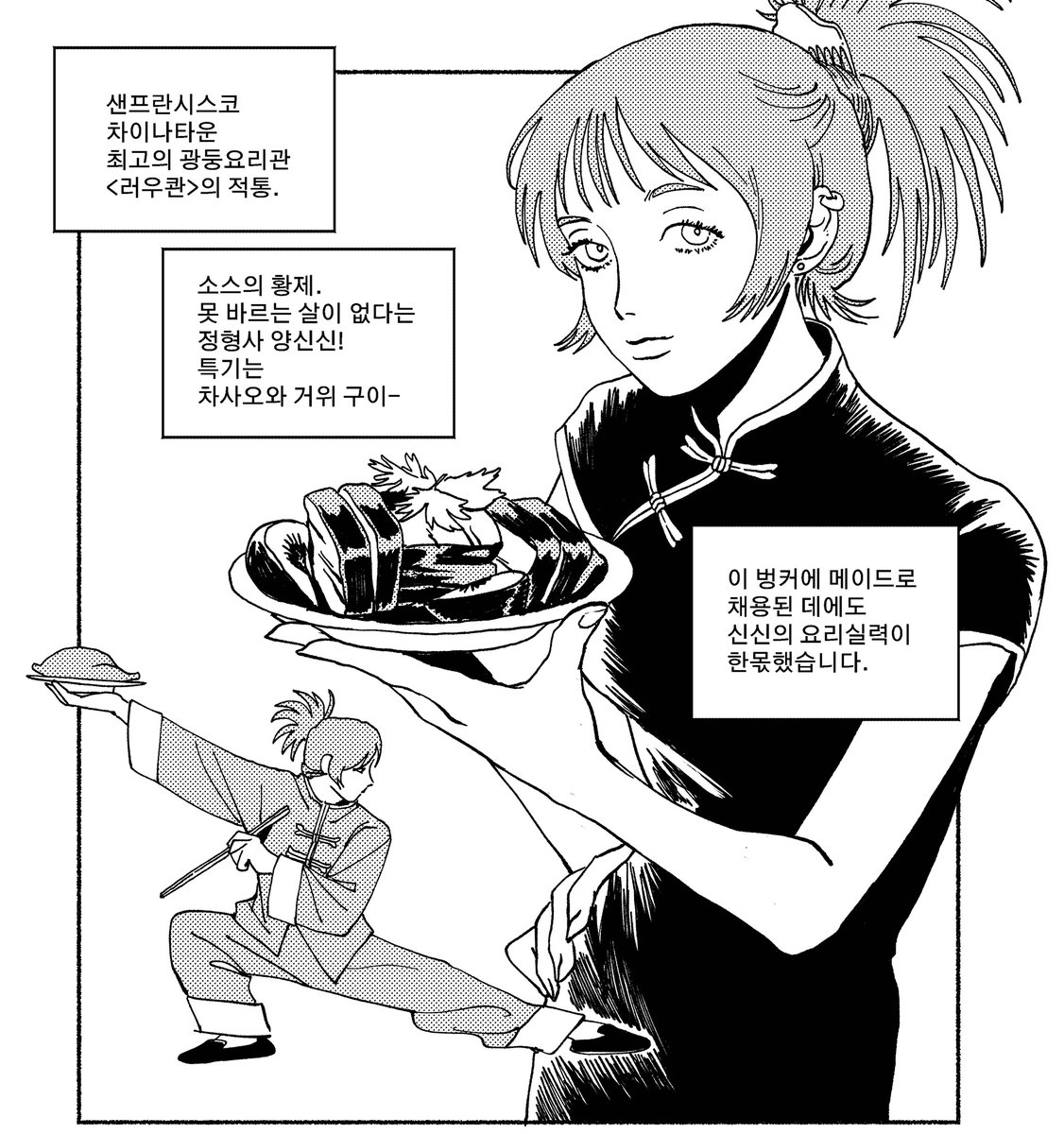
![space_of_sheep's tweet photo. [운수 나쁜 날]
주제: 일상
(min_ddle) https://t.co/qkRv6BW32T](https://pbs.twimg.com/media/HI6XL8Yb0AAmQgy.jpg)
![bahnbazi's tweet photo. [단편] 둘이서 추는 춤 https://t.co/1XM7iXN6Fw](https://pbs.twimg.com/media/DTrT4I5VwAASfgW.jpg)