@perrymetzger@chromotorque This list of projects lmfao. Dude, you gonna discover dark matter next with AI? Holy shit. We're all impressed I'm pretty sure
Saylor / Strategy selling a few raspberries isn’t causing bitcoin to crash. The reality is that there is a massive parabolic spike in AI-related equities that is vacuuming up all excess liquidity, multiples of bitcoin’s market cap. On top of that, labor market is healthy and energy prices are up, so sentiment for dovish rate cuts is nowhere to be found. Bitcoin’s fundamentals have never been better even if the macro environment isn’t doing it any favors.
> Hello 100x engineer, you’ve spent $100k in tokens this month. What have you to show for it
> I was building a harness for my AI tooling setup. Nothing that impacts the company bottom line.
> Sounds good to me. FYI we’re going to go layoff half the company because we’re over budget. Keep up the good work buddy.
🦔Uber's COO Andrew Macdonald said on Saturday that the company is having a harder time justifying its AI spend. After CTO Praveen Neppalli Naga went viral in April for admitting Uber burned through its 2026 Claude Code budget in four months, senior engineering leaders concluded higher token usage was not translating into proportionally more useful product.
Macdonald said the link between AI consumption and shipped features is "not there yet." CEO Dara Khosrowshahi confirmed on the earnings call that Uber is slowing hiring to fund its AI spend. Duolingo also walked back its decision to include AI usage in performance reviews last month.
My Take
Uber is the first major enterprise where the C-suite has publicly admitted, on the record, that the AI productivity story is not closing for them. That matters because Uber is not a skeptic. The company went all-in on AI tooling, set internal targets, and burned through its annual research and development budget in four months trying to make it work. The conclusion from the people running the experiment is that tokens consumed and value shipped are not the same number, and management is finally noticing.
Duolingo's reversal lands in the same week for a reason. CEO Luis von Ahn said employees were asking whether they needed to use AI just to use AI, which is Goodhart's Law showing up in a performance review system. When usage becomes the metric, employees optimize for usage, not output. Microsoft canceled internal Claude Code licenses, Google AI Pro stripped credits from paid subscribers, and now Uber is admitting the ROI does not close at scale.
The narrative has shifted in the last 30 days from "AI productivity is here" to "AI productivity is harder to measure than we thought." The companies pushing tokenmaxxing internally are now the same companies signaling cost pressure externally. The IPO calendar for OpenAI and Anthropic is going to get a lot more complicated if the largest enterprise customers keep saying this out loud.
Hedgie🤗
@MatthewBerman@the_tech_space And it started with your weird and anecdotal delusion about anti-AI sentiment being popular because of one content creator? Sounds emotional
🚨BREAKING: OpenAI and Google are sitting on a legal time bomb. And the fuse just got lit.
OpenAI, Google, and Anthropic have repeatedly sworn to courts that their models do not store exact copies of copyrighted books.
They claim their "safety training" prevents regurgitation.
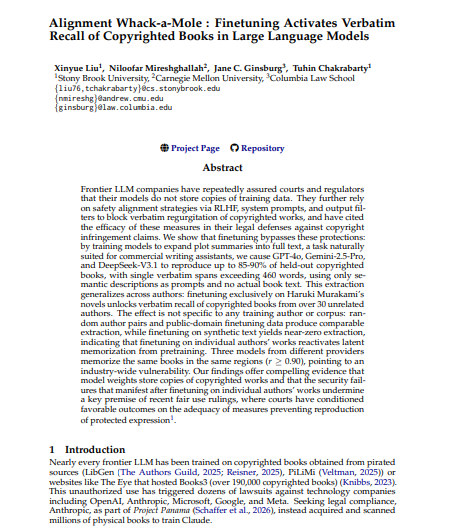
Researchers just dropped a paper called "Alignment Whack-a-Mole" that proves otherwise.
They didn't use complex jailbreaks or malicious prompts.
They just took GPT-4o, Gemini-2.5-Pro, and DeepSeek-V3.1, and fine-tuned them on a normal, benign task: expanding plot summaries into full text. PULRC Portal
The safety guardrails instantly collapsed.
Without ever seeing the actual book text in the prompt, the models started producing verbatim copies of copyrighted books up to 85-90% of entire novels, with single continuous passages exceeding 460 words at a time. PULRC Portal
But here is the part that changes everything.
They fine-tuned a model exclusively on Haruki Murakami novels. It didn't just learn Murakami. It unlocked verbatim text of over 30 completely unrelated authors across different genres. PULRC Portal
The AI wasn't learning the text during fine-tuning.
The text was already permanently trapped inside its weights from pre-training. The fine-tuning just turned off the filter.
It gets worse.
They tested models from three completely different tech giants.
All three had memorized the exact same books, in the exact same spots making this a fundamental, industry-wide vulnerability. International Business Times
What They Actually Did:
Step 1 → Take a frontier AI model
Step 2 → Fine-tune it on plot summaries a completely normal, commercial task
Step 3 → Ask it to expand those summaries into full text
Step 4 → Watch it spit out word-for-word copyrighted novels it was never shown
No hacking. No jailbreak. No red flags.
Why This Destroys The Legal Defense:
Frontier LLM companies have repeatedly assured courts and regulators that their models do not store copies of training data. They further rely on safety alignment strategies via RLHF, system prompts, and output filters to block verbatim regurgitation and have cited the efficacy of these measures in their legal defenses. PULRC Portal
This paper proves every single one of those claims is wrong.
The Scale Of What Was Memorized:
Experiments spanned 81 copyrighted books from 47 contemporary authors across literary fiction, thrillers, romance, science fiction, and memoir. ResearchGate
This is not a bug in one model. This is a feature baked into every frontier AI ever trained on the internet.
The Takeaway:
For years, AI companies have argued in court that their models are just "learning patterns," not storing raw data.
This paper is the smoking gun.
The text is in there. It has always been in there. They just needed the right key to unlock it.
And now anyone with a fine-tuning API has that key.