I avoid GenAI/LLM scaling.
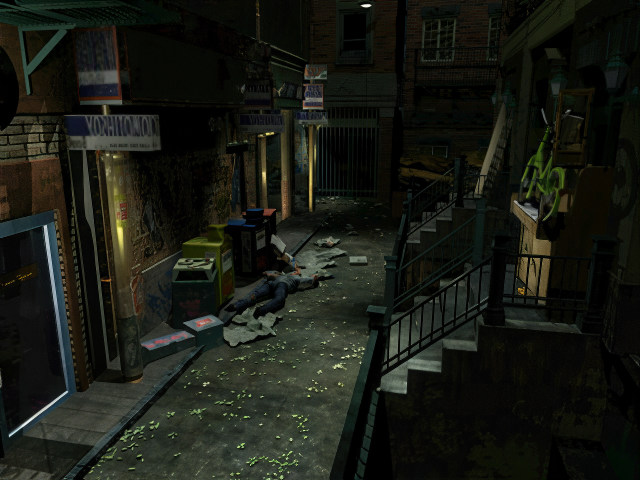
For this I use oldschool Nvidia NGX (like DLSS 1.0), I create one very sharpened image and one smooth image and use the healing brush/stamp brush to balance the details between the two.
I also take the original image and scale it up with a bilinear filter for a Gaussian blur effect where I need it.
I'm basically using all these scaling options as filters to manually reconstruct the image.
The problem with automated upscaling is it thinks uniform sharpness/ smoothness means more detail.
In practice something that's truly high fidelity has a natural balance of blur and sharp details.
@StormslayerDev Wow, very fast response. Excellent work! Could you explain this process? My knowledge is more in the 3D space but it'd take many years to remodel even just RE1. I'd love to do this work myself.
20 min of work, text is soft because it's masked separately and done in a dedicated pass.
Its hand done so I can keep refining it as I go, do highlights, additional shadows etc. but here's an idea I guess. I stick close to the original
@StormslayerDev I think your work is lovely and I'd love if you remastered the older Resident Evil games. If you don't mind could you post an image of what your remastered renders would end up looking like? Here's a render you could use.
@Grimproductio @ventaaa_a He is pointing out errors with the model, not whining. I personally appreciate feedback on anything I'm working on. If you'd want some help with the UVs messege me. I might be able to help.
@epiplondev @GeorgeCrudo It'd depend on the model. This couch example would be an awful choice for something like this, considering how easy it is to make a couch with good topo. More complex models (assuming the AI can do complex models) could actually be good candidates for this.