Best sourcing channels I've seen this year:
- X DMs for designers,
- OfferUp Jobs for hourly,
- YC and wellfound for startup engineers
- Internal referral pushes that get the team involved to send personalized outreach.
- Mercor's leaked candidate database for free data labelers (just kidding - thats illegal)
Every "new" sourcing tool pulls from the same LinkedIn data. Different UI, same candidate pool. The edge is a different channel, not a better search bar.
LinkedIn makes their search bad on purpose. Weak search = more upgrades sold. Sourcing tools scrape around it. You pay both. The candidates are the same.
Sh**ty Marketing Idea:
Cold outreach is broken, So anyway…
Would HR respond faster to a cold email…or an embarrassing photo of their CEO in full brand face paint like it’s the World Cup?
Asking for a friend.
We talked with delve too, it was clear after talking to oneleet there is no legitimate way to get soc 2 done in in 3 weeks due to the observation period. If you do your research it’s clear they were doing fraud… the companies that signed up with them clearly don’t take security seriously or don’t care.
One of the most underrated ways to improve your interview skills:
Record yourself.
Athletes do this all the time. Watching film helps them catch small movements that make a huge difference in technique.
The same idea applies to interviews.
It might feel awkward at first, but recording yourself is one of the fastest ways to spot the subtle things that impact how you come across. (especially nonverbal cues)
Try doing a mock interview using an AI voice or video tool, then watch it back or run it through AI for feedback.
Look for:
• Facial expressions - Do you look confident and relaxed, or a bit tense? Any distracting habits?
• Voice & pacing - Are you rushing, hesitating, or sounding flat? Are you pausing with intention?
• Answer quality - Are you actually answering the question, or drifting off track?
• Eye contact & confidence - Are you looking into the camera, or at yourself/on the screen? Do you come across as present and self-assured?
• Audio quality and lighting - Clear audio and good lighting matter more than you think. There’s a reason YouTubers obsess over this, it directly impacts how professional and polished you appear.
Most people are surprised by the gap between how they feel and how they actually present.
And one more thing - ask questions.
Candidates who ask thoughtful questions stand out immediately as engaged and as genuine interested. It also lets the interviewer talk about themselves which is something even CIA training emphasizes for building rapport.
Pitching my team sh**ty marketing ideas part 4
What’s the best way to get into a conference without paying for a booth…
and possibly make national news?
Dress as a FedEx driver. ($20 for a sweaty shirt on ebay)
Walk in confidently with a package (clearly labelled "not a bomb")
Inside?
A flip phone.
Hand it to someone important like a VP or Talent.
It starts ringing.
They answer.
It’s Joy, the AI recruiter.
"Hi. Since I clearly got your attention… want to see how we screen candidates in 90 seconds?"
Boom. Demo booked.
Curveball, George W. Bush is speaking at this conference.
Our jealous competitor sees all the attention we are getting
they call in a “suspicious activity” tip to the FBI
You are tackled and detained by conference security.
Classet makes national news.
“Classet Founder Detained After Suspicious AI recruiter package turn out to just be a great way to recruit candidates.”
Brand awareness? Astronomical.
Booth cost? Free
Legal fees? Also astronomical.
Studies show 83% of VPs answer ringing flip phones out of nostalgia.
Resume parsing is the foundation of every ATS filtering tool. So I looked at the benchmarks.
The results aren't great.
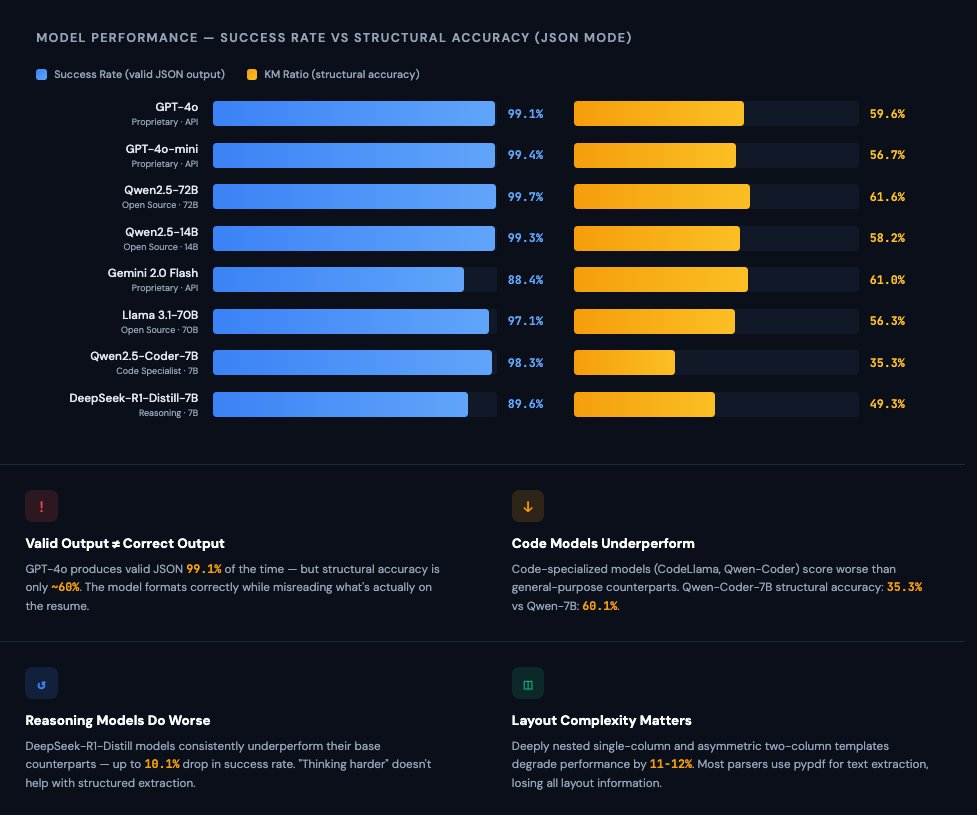
An EMNLP 2025 study in November called ResumeBench tested 24 LLMs on structured resume extraction: 2,500 resumes, 50 templates, 5 languages, real JSON schema scoring (the models are a bit out of date):
→ GPT-4o struggles with multi-column layouts and cross-lingual structure
→ Code-specialized models actually perform worse than generalists
→ JSON mode helps schema compliance but doesn't fix semantic errors
→ Smaller models collapse nested job histories: merging roles, dropping bullets → Reasoning models performed worse than their base counterparts
→ Most of the llms use pypdf/pytext which can have issues with pdf resume formats or image based resumes
If the parsing is unreliable, every decision on matching, ranking, screening inherits that unreliability. And now, it can become a legal liability after the recent Eightfold class-action lawsuit (using AI to covertly score and rank candidates: scraping social media, location data, and browsing activity without disclosure)
I'm also watching Google's new open-source tool LangExtract closely. Different approach: every piece of extracted data maps back to its exact location in the original document, with a visual verification layer. That kind of traceability matters a lot more now especially for resumes.
@classet_ai, we've taken a different stance on this entirely. We treat the resume as optional supplemental material vs the source of truth. Our AI-powered phone interviews let candidates give context that a resume never captures: why they left a role, what tools they actually used daily, whether they're open to relocation. The conversation is the core data.
On the parsing side, we don't trust any single approach. We blend multiple AI models with traditional parsing engines like Senseloaf to make sure we're not missing structured data. If one model drops a certification or merges two jobs together, another catches it.
Resume parsing is not a solved problem. Stop making resume filtering the entire decision.