May seem like an old problem, but the nonlinear PBE is not easy to solve! (Soon-to-graduate) PhD student Mauricio came up with a beautiful way to make our lives easier by finding optimal relaxation factors throughout nonlinear iterations. Check it out! https://t.co/oYm2PQg2NZ
Using PINN to solve the PB equation. You can include experimental data too! New awesome paper from grad student Martín Achondo in collaboration with Zeb Chaudhry (UNM): https://t.co/gCLjLi34Uf
Beautiful collaboration that started as a random conversation between graduate students Sergio Urzúa and Scarlett Aguilera (USACH). Using PB to understand the role of pH in the design of electrochemical sensors! https://t.co/H6vDnOOIUw
Former student and first author of https://t.co/GCGqT5N5HK, Stefan Search, came into my office with 3D printed versions of the solvent-excluded surfaces used in our paper. They look so cool!
New paper out! We explored some of the challenges related with using diffused interfaces for the PB equation in molecular electrostatics. Turns out it is not that easy! First first-author paper for PhD student Mauricio Guerrero! https://t.co/gtXJtD45Np
A Christmas present! Overcoming some of the limitations of BEM in molecular electrostatics with the PB equation by coupling it with FEM. Just out! https://t.co/83Ru0o3qpJ
📢 Estamos emocionados de presentar a Christopher Cooper, como uno de nuestros speakers de #PyConChile23.🇨🇱🐍
Acompáñanos en su charla en línea este Domingo 26 de noviembre. ¡Una sesión imperdible para los entusiastas de #Python!
Regístrate aquí:👇
https://t.co/PfAWcURIid
Finally out! Computing electrostatic forces with Poisson-Boltzmann can be tricky, and here we study a few methods to do it. We also found one that is super accurate! Check it out!
Which are the most accurate methods to calculate electrostatic forces with the Poisson-Boltzmann eq❓ What about comp. efficiency of those methods❓In our @NewPreprint we present a novel formulation to calculate E at the molecular surface and compare it to prev. methods... [1/2]
What are the factors affecting the redox activity of hydrogenases on electrodes? Manuel Ruiz (PhD student @polimi funded by @Conacyt_MX), @cooperchrisd, @guidoraos and coworkers have modeled them in their recent work: https://t.co/IHtk0GPMF9
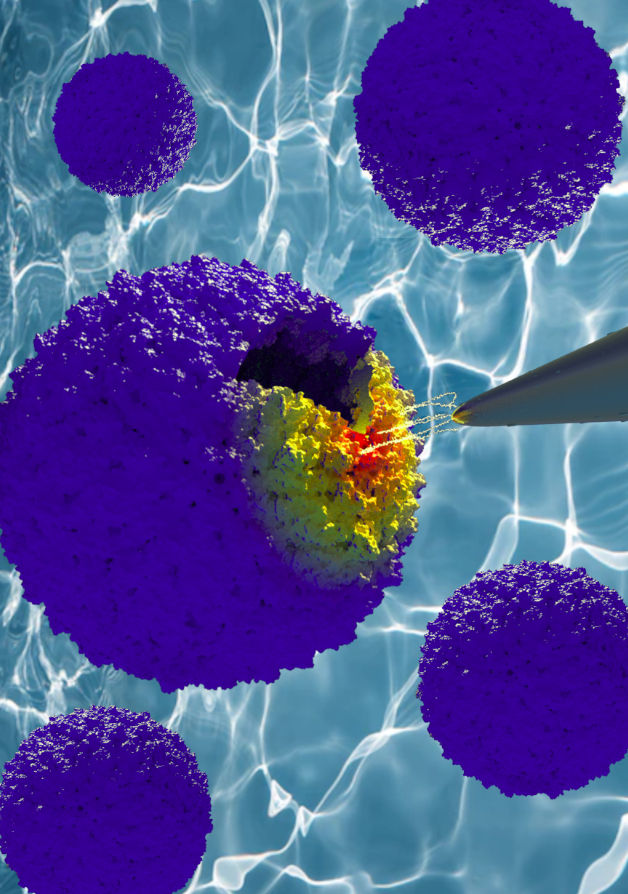
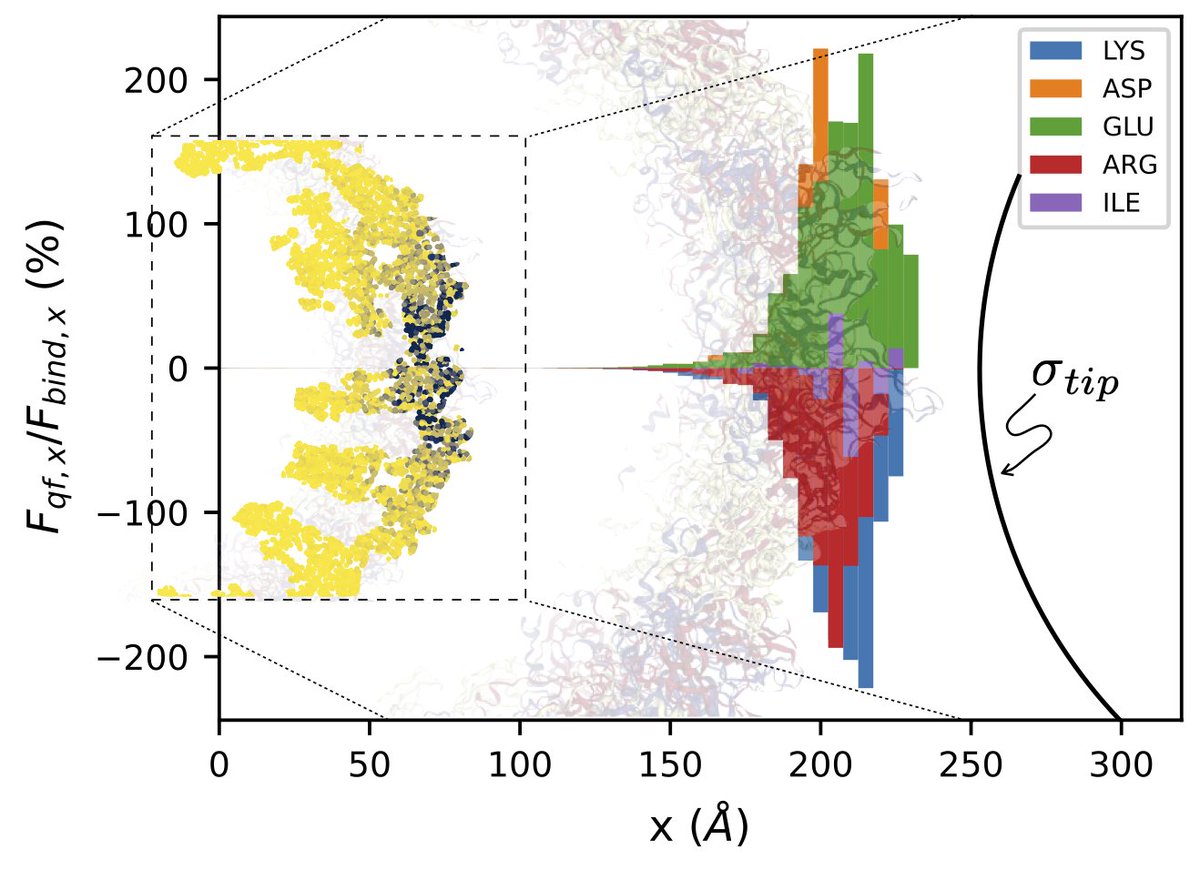
New theoretical model captures the local electrostatic forces between a nanoprobe-capsid, boosts the emerging field of high resolution phys. virology, according to a recent study in @nanoscale_rsc by Dr Guzman (@whoratz) & Cooper! Read more here 👉 https://t.co/3uuzQic5z6
New paper out! Here, we study the electrostatic force of an AFM tip on a virus capsid. Big thanks to @whoratz and twitter-less @usantamaria student Ian Addison-Smith!
How local is the role of electrostatic interactions in virus capsids 🧶❓Here we analytically/comp show that the electrostatic forces between nanoprobe-capsid has 3 main contributions: charge distribution, dielectric-jump and ions in the solvent @nanoscale_rsc#compchem 1/3 ⬇️
Experiments & computations meet to explain why the catalytic activity of trypsin-covered surfaces depends on an applied potential at adsorption, & to show the power of electrostatics to control how trypsin orients. @microanalytic11 + @cooperchrisd labs
https://t.co/JhhIKjXMzm
The orientation of adsorbed proteins can now be predicted using a simple electrostatic model - thanks @cooperchrisd for the opportunity to collaborate on this!
https://t.co/RE73jTfG0o
Big personal news, tweeps—I got a call from the Rector (Provost) of @usantamaria, my undergraduate alma mater, to personally congratulate me because the university decided to award me its greatest honor: the title of Doctor Honoris Causa
As part of the international evaluating scientific committee, it is my time to congratulate @_firion and his supervisor @cooperchrisd for the solid presentation of his thesis defense and a promising future work in #virusResearch!





![whoratz's tweet photo. Which are the most accurate methods to calculate electrostatic forces with the Poisson-Boltzmann eq❓ What about comp. efficiency of those methods❓In our @NewPreprint we present a novel formulation to calculate E at the molecular surface and compare it to prev. methods... [1/2] https://t.co/qE9F5Z2yXe](https://pbs.twimg.com/media/FmXnenUXkAIhO0u.jpg)