Most AI agents feel like they were built for developers who love YAML and terminal windows.
I’m building Kryden Agent because I got tired of that.
I want one clean desktop app where:
The agent actually remembers me across days (the right things, not everything)
I can customize how it behaves and what it remembers with a simple user friendly interface
I can save and share my setups with other builders
No more wrestling with clunky interfaces just to get help.
If you’re a solo founder or indie hacker who’s also tired of agents that feel like toys or enterprise bloat, reply with what frustrates you most about current agents.
I’m building in public and want real feedback.
Kryden Agent is coming.
Yeah.. Anyone crying about "toxic posting" is missing the point. I never liked the OpenClaw UI and it remained the same even today and the mobile app reflects that. Making a statement saying "the people that worked hard on that app..." is.. well.. I don't have the right words lol. Considering that almost 100% is vibe coded, I am not sure what "hard work" means to people anymore.
At the end of the day if they are successful that's all that matters in this world cause plenty of people are fighting to emerge and don't, so we can't really tell them anything tbh.
Personally, I have an incapability to ship unpolished things that aren't immaculate, and the few times I have, I hated myself and it. So everyone's different I guess. I'd rather work a 9-5 than put my name on something that wasn't absolutely gorgeous and the last thing I'd do if someone told me it was crap is call them toxic. It's called signal. No matter how they chose to express it.
Steve Jobs himself talked constantly about not compromising on user experience, the way something looks and feels. In my opinion, in the wake of AI slop and criticism of Vibe Coding, at least do it well. Now some things are just meant to be functional and thats fine, again this is just my opinion. Do what you want and I hope you succeed, but there is a reason everyone has an iPhone and not an android and when that gets applied to agentic software, platforms will go out of business.
We are giving all Codex users a usage reset on the house. Should be showing in your accounts in the next few hours.
We have applied some mitigations, but our investigation hasn't shown users being impacted at large. We are continuing to monitor the situation.
🚨 GPT-5.6 is here.
OpenAI just released a limited preview of three new models:
• GPT-5.6 Sol – next-generation frontier model
• GPT-5.6 Terra – balanced model for everyday work
• GPT-5.6 Luna – fast, low-cost model for high-volume tasks
Why this matters:
If you’re building agents, expect improvements in reasoning, reliability, tool use, and long-horizon execution. This is the first release. I’d benchmark against GPT-5.5 before changing any production workflows.
I’d immediately test:
Multi-hour autonomous tasks
Tool-calling accuracy
Compression quality
Code generation
Cost vs. capability across Sol, Terra, and Luna
This is worth paying attention to.
Introducing a limited preview of GPT-5.6 Sol, our next generation frontier model, as well as GPT-5.6 Terra, a balanced model for efficient, everyday work, and GPT-5.6 Luna, a fast and affordable model for high-volume work.
https://t.co/OoM83SyISN
Hopefully normal people will actually start to actually use agents.
Joe next door doesn’t want to learn harnesses, profiles, skills, MCP, all that stuff first.
They would want to text the same agent, let it work in the background, and get a useful result back.
Has iMessage changed the kind of tasks you give Hermes, or just made it easier to start them?
An agent making Gmail usable for a normal person is the whole point.
Nobody wakes up wanting "computer use" or an agent harness.
They want the inbox sewage to stop without learning Gmail filters.
Did she trust Hermes to make the filters on its own, or did seeing the proposed changes first matter?
@AlexFinn I think this depends on the goal.
Local models are worth learning for technical people and narrow cheap tasks. But regular people are not loading weights, and most small local models still fall apart when the task is vague.
Is your main point here skill-building?
Codex is the move.
It is crazy how so many people aren't using AI like this and its even crazier how many people I've met that have no idea what an agent is.
Most people are still using ChatGPT to write their emails and that's it.
There is a huge opportunity here for so many founders to capitalize on.
Love the direction here.
A desktop agent running toward a goal for hours is much more useful than another chat tab.
Trust is obviously a common question:
what did it touch?
what did it change?
what did it skip?
why does it think the goal is done?
How are you thinking about receipts/completion checks for Goal Mode?
@N01ennn "The real breakthrough here"
"This is the real difference"
"This is where X starts to feel like Y"
Reading twitter threads is starting to glitch my system. Be original people, please.
For sure. Approval fatigue is real.
I also don't think it is only “ask before everything” vs YOLO.
It is:
- sandbox the boring stuff
- make boundary crossings carry intent + blast radius
- review the weird/risky cases
- leave a receipt humans can audit after
Do you think users mostly want fewer prompts in general, or better receipts for the work that was done?
The part I should have led with:
local inference is not the product.
trust is.
If an agent touches a repo, client site, Cloudflare, files, or money, I want the receipt:
what changed?
what was skipped?
what spent money?
what failed?
what got verified?
What receipt would make you trust an agent for 60 minutes?
Local Mac agents just crossed from weird builder setup into the official Apple story.
WWDC’s MLX session is basically:
- model on your Mac
- agent loop local
- tools/files/builds connected
- only real tool calls hit the network
That matches what happened in my client task this morning.
But the product is not “local AI.”
The product is trust:
what can it touch?
what did it change?
what did it spend?
where did it stop?
can I verify the outcome when I get back?
Local inference is the engine.
The receipt is the product.
I gave my agent a messy real client task, then left to get ice cream.
The task:
Add a 360 leadership assessment to an existing client website from a PDF I uploaded.
Not just "make a form."
It had to:
- pull/clone the client repo into the right folder
- inspect the existing Astro site and match the brand
- turn the PDF into a mobile-friendly assessment page
- make every field required
- make it look good, not like a default form dump
- exclude the private assessment page from the sitemap
- create a separate CMS repo
- build a Cloudflare Worker backend
- store submissions in D1
- generate downloadable PDFs from submissions
- gate the CMS behind Cloudflare Zero Trust
- use OTP login only
- allow only 2 specified emails
- set up the CMS custom domain
- make sure the public form endpoint was NOT blocked by Access
- test the live form, CMS, PDF download, builds, routes, and Cloudflare deployment
The wild part is I did not spell out half of that.
It inferred the architecture.
It realized the CMS needed a public intake route and protected admin routes.
It caught that Cloudflare Access would accidentally block the public form unless the bypass was scoped correctly.
It pushed the website change, created the CMS repo, deployed the Worker, wired the custom domain, configured OTP access, and verified the whole thing live.
About an hour later it pinged me.
I had a client-ready form, a protected CMS, working downloadable PDFs, and production URLs.
Meanwhile I had gone to the store and watched YouTube while eating ice cream.
If you're still using agents like autocomplete, you're massively underusing them.
Give them whole outcomes.
Give them access to the real system.
Make them verify.
Then go live your life while the work gets done.
What is one workflow you could hand to an agent tomorrow if you trusted it for 60 minutes?
I gave my agent a messy real client task, then left to get ice cream.
The task:
Add a 360 leadership assessment to an existing client website from a PDF I uploaded.
Not just "make a form."
It had to:
- pull/clone the client repo into the right folder
- inspect the existing Astro site and match the brand
- turn the PDF into a mobile-friendly assessment page
- make every field required
- make it look good, not like a default form dump
- exclude the private assessment page from the sitemap
- create a separate CMS repo
- build a Cloudflare Worker backend
- store submissions in D1
- generate downloadable PDFs from submissions
- gate the CMS behind Cloudflare Zero Trust
- use OTP login only
- allow only 2 specified emails
- set up the CMS custom domain
- make sure the public form endpoint was NOT blocked by Access
- test the live form, CMS, PDF download, builds, routes, and Cloudflare deployment
The wild part is I did not spell out half of that.
It inferred the architecture.
It realized the CMS needed a public intake route and protected admin routes.
It caught that Cloudflare Access would accidentally block the public form unless the bypass was scoped correctly.
It pushed the website change, created the CMS repo, deployed the Worker, wired the custom domain, configured OTP access, and verified the whole thing live.
About an hour later it pinged me.
I had a client-ready form, a protected CMS, working downloadable PDFs, and production URLs.
Meanwhile I had gone to the store and watched YouTube while eating ice cream.
If you're still using agents like autocomplete, you're massively underusing them.
Give them whole outcomes.
Give them access to the real system.
Make them verify.
Then go live your life while the work gets done.
What is one workflow you could hand to an agent tomorrow if you trusted it for 60 minutes?
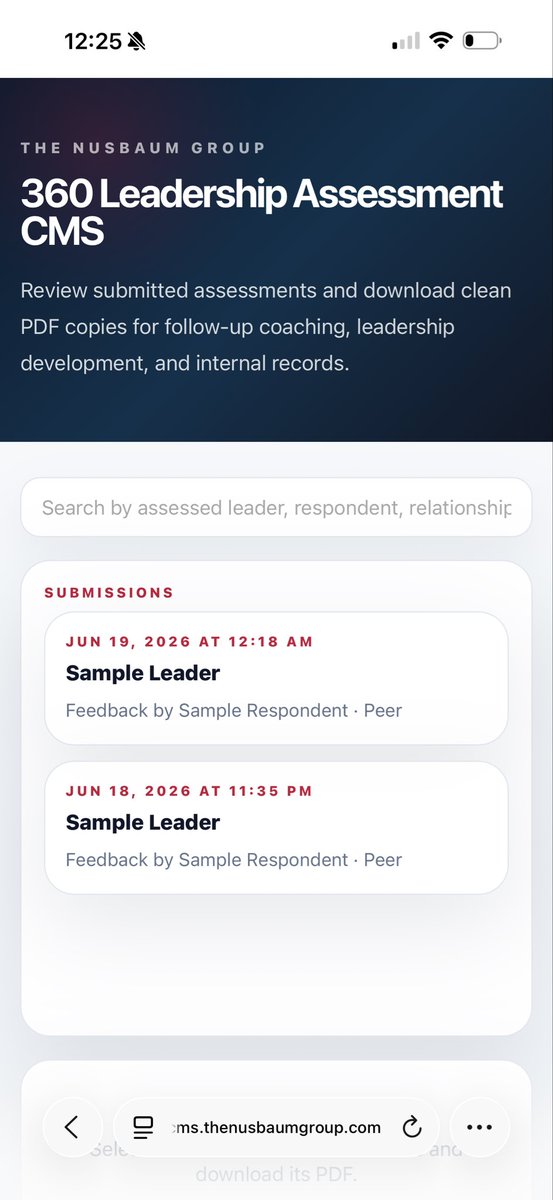
And here’s the CMS side.
1. the Access gate
2. the submissions CMS
3. the generated PDF download flow
This is the part people miss with agents.
It didn’t just make a pretty form. It handled the boring production plumbing too and stayed on brand.
I gave my agent a messy real client task, then left to get ice cream.
The task:
Add a 360 leadership assessment to an existing client website from a PDF I uploaded.
Not just "make a form."
It had to:
- pull/clone the client repo into the right folder
- inspect the existing Astro site and match the brand
- turn the PDF into a mobile-friendly assessment page
- make every field required
- make it look good, not like a default form dump
- exclude the private assessment page from the sitemap
- create a separate CMS repo
- build a Cloudflare Worker backend
- store submissions in D1
- generate downloadable PDFs from submissions
- gate the CMS behind Cloudflare Zero Trust
- use OTP login only
- allow only 2 specified emails
- set up the CMS custom domain
- make sure the public form endpoint was NOT blocked by Access
- test the live form, CMS, PDF download, builds, routes, and Cloudflare deployment
The wild part is I did not spell out half of that.
It inferred the architecture.
It realized the CMS needed a public intake route and protected admin routes.
It caught that Cloudflare Access would accidentally block the public form unless the bypass was scoped correctly.
It pushed the website change, created the CMS repo, deployed the Worker, wired the custom domain, configured OTP access, and verified the whole thing live.
About an hour later it pinged me.
I had a client-ready form, a protected CMS, working downloadable PDFs, and production URLs.
Meanwhile I had gone to the store and watched YouTube while eating ice cream.
If you're still using agents like autocomplete, you're massively underusing them.
Give them whole outcomes.
Give them access to the real system.
Make them verify.
Then go live your life while the work gets done.
What is one workflow you could hand to an agent tomorrow if you trusted it for 60 minutes?
@BlackRainLabs@iamlukethedev Compression has always been an issue as well as the YAML hell. I got so annoyed by it all I just made my own agent and it uses half the context with much better memory.
Most AI agents are made for developers.
Hosted sandboxes that can't control your computer. Coding tools normal people don't know exist.
I got so frustrated fighting with mine that I built my own.
Tell me, what pisses you off the most about your agents?