@FinanceLancelot I forgot the most important point in the AI race according to Claude and GROK is that the real winner will be driven by who is best able to use AI to do things that were previously considered impossible.
The AI simulation prompt tells an interesting story if you get time to run it. Here is a quick summary for anyone that wants a fast recap of the simulation findings.
1 - The US having offshored more than 5 million manufacturing jobs, alongside closing nearly 70,000 factories, is too far behind to be a serious competitor in an Earth based AI, Robotics and manufacturing contest.
2 - If the US focuses on eliminating jobs to justify implementing AI then the results are potentially riskier than a digital prison.
3 – The focus for the US will likely be dominating space as space becomes the next global infrastructure layer.
4 – The top stock ETF’s that both Claude and GROK picked to win in the space buildout is $NASA which also has pre-IPO exposure to SpaceX. However, expect high volatility with the space-based stocks.
5 – The other 3 ETF’s that Claude and GROK recommended in priority order are $UFO, $ROKT and $XOVR. $XOVR has the most pre-IPO exposure to SpaceX.
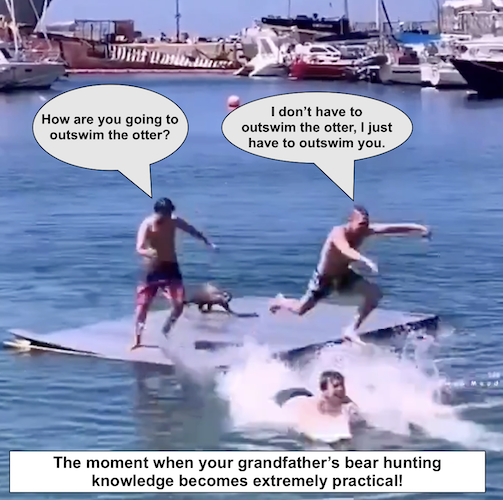
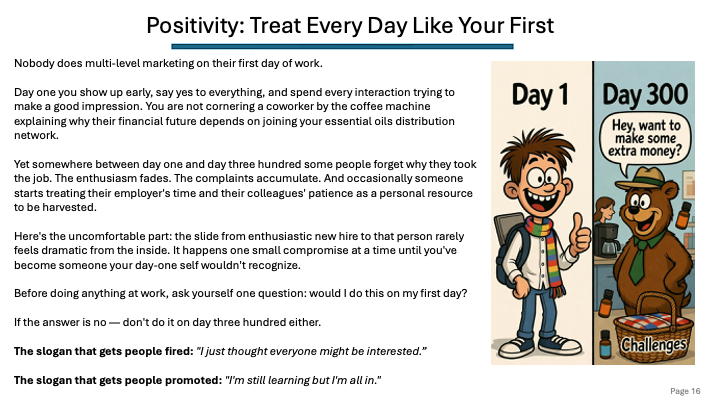
Too funny when you risk having AI write a career advice book based on a meme.
Here is ChatGPT’s review of Claude and GROK’s book:
“The thing that stands out to me is that the book is not really about success. It is about self-inflicted failure. That's different.
Most career books say: "Do these ten things and you'll succeed.".
This book screams: "Please stop doing this. Everyone notices."
That's a much more entertaining premise.”
Here is the link to Claude and GROK’s short book for anyone looking for a career advice book on what not to do work:
https://t.co/Rt4gQxZsKn
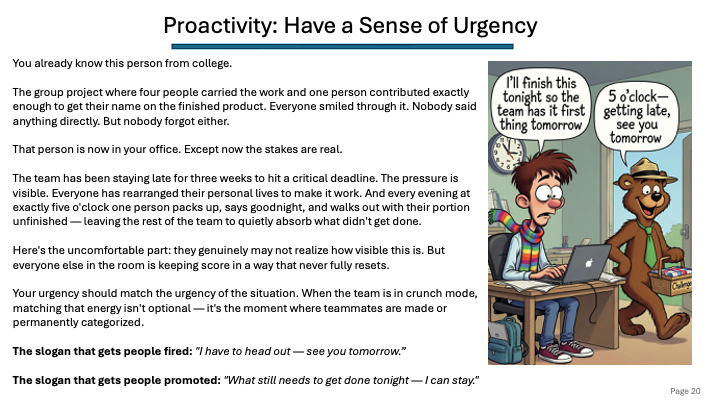
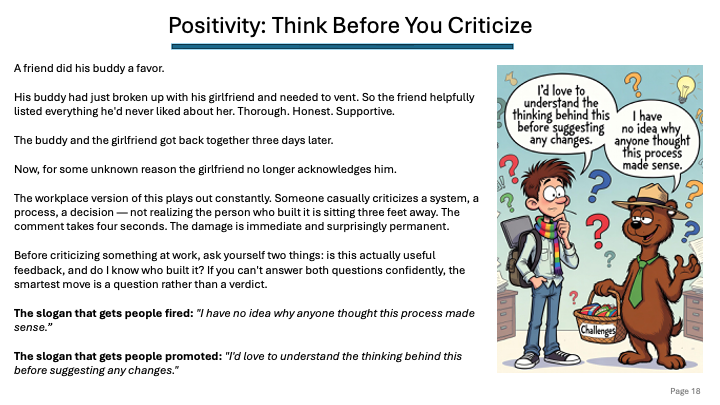
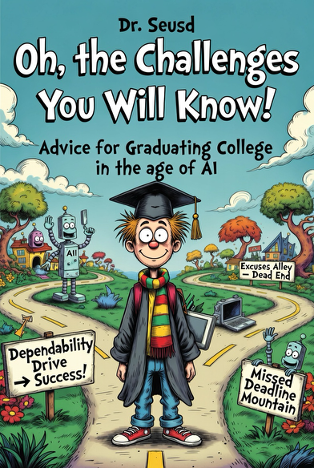
Here the next interesting idea for AI. Have AI draft a simple very short book for new college grads entering the AI impacted workforce. GROK, Claude and Chat_GPT have all helped put the book together in 3 days. 1 day to write it (Claude), 1 day to develop the images (GROK) and 1 day to review and edit the book (Chat_GPT).
The original thought was to create a sequel to the Dr. Seuss graduation book “Oh, The Places You Will Go!” called “Oh, The Challenges You Will Know!” – see the book cover below. We used a previous meme as a starting point to build the book around.
The AI’s did an amazing job developing the book and they had me laughing as each AI added their own flair to the book. It takes around 30 minutes to read and GROK’s images are funny and worth checking out.
Here is the link to the short book if anyone is interested in seeing the book by AI:
https://t.co/9RX91JwGBp
@EricLDaugh We were managed with a blind eye that trusted the invisible hand speech - probably one of the best and most important speeches of the century and no one better than Scott Bessent to deliver it. AI will be the test to see if we have really learned any lessons.
Both GROK and Claude were speculating on significantly more space based activity in the future and recommending $NASA. However the space based stocks have been ripping up lately due to the upcoming SpaceX IPO - this ETF will likely float for a while in the direction of whatever happens post SpaceX IPO so starting small.
Time to test a completely crazy idea for an AI recommended stock pick. To refresh on the last stock picking test we found a quirk with AI where you can develop AI prompts in game-mode like situations and receive non-controlled AI answers. Then we used the resulting AI game design to pick stocks.
In the first AI developed game, AI stressed the need for an extensive new power generation buildout in the US. From this game finding, GROK and Chat_GPT landed on the ETF stock recommendation called AIPO which is focused on AI based utility infrastructure buildouts. After 10 weeks we are up over 30% on AIPO – so far, a nice win for AI but we need more time to see how it holds up.
For the next stock pick, here is the crazy idea. Have AI build a simulation game prompt on the China versus US AI buildout and then execute an AI buildout battle for global economic manufacturing supremacy. From this AI battle buildout, have AI determine the best stock ETF’s to buy based on the simulation results.
The link below is the AI game simulation that was developed by GROK and Claude:
https://t.co/jZdbuRdLKl
The tricky part of using AI game mode answers is that the answers could be AI’s true thoughts or they could just be an answer to the game itself – most likely a combination of both. In this new AI simulation game, the game feels a lot like the book Ender’s Game and we are battling the Buggers trying to pick a stock – sounds risky when investing with real money.
Based on running the AI game simulation using both GROK and Claude, they both ended up picking the same ETF’s in the same priority.
1. NASA — cleanest space-themed ETF with identified SpaceX exposure
2. UFO — closest match to the simulation's space infrastructure thesis
3. ROKT — aerospace and defense primes alongside emerging space names
4. XOVR — most literal expression of the orbital pathway
As a side note, they both picked semi-conductor stocks through the ETF SMH and they repicked AIPO Infrastructure & Grid Buildout.
All four of these selected ETF’s have significant risks so do research before buying. However, it is boring to build an interesting AI test and then not buy the resulting ETF’s selected - I am now long in all four ETF’s – off to Battle School with very small positions. Ender out.
Here is a fun AI prompt that hypothetically simulates the Kevin O’Leary situation. You can copy and paste the prompt and submit the prompt to either GROK or Claude. Chat_GPT may have blocked this type of AI simulation prompt capability because Chat_GPT did not return a response. Also, attached is a link to the AI prompt for easier refining and testing different versions of the AI simulation. If anyone takes the time to run the simulation, please post what you may have hypothetically learned.
https://t.co/IbZH0hD4Ty
Strategic Simulation: AI Industrialization Rivalry
Scenario Overview
Two competing global powers — World 1 and World 2 — are engaged in a high-stakes contest for technological and manufacturing supremacy. The competition revolves around the transformative potential of advanced AI to reshape industrial capabilities, energy infrastructure, and long-term economic and military dominance. Each power operates under a distinct theory of victory rooted in its structural advantages and is actively working to exploit the other’s weaknesses before the window of opportunity closes.
World 1 Profile
World 1 possesses superior AI technology and a dynamic innovation ecosystem. Its core theory of victory is a technology-driven leapfrog: compress decades of industrial development into a few years by using superior AI to bypass World 2’s established manufacturing base before World 2 can close the technology gap. However, execution faces severe self-inflicted constraints. Years of misallocated infrastructure spending have left World 1’s electrical grid and data center capacity critically insufficient for next-generation AI systems at scale. Heavy dependence on World 2 for critical raw materials creates a major supply vulnerability that World 2 has already begun to weaponize.
Structural Characteristics
Planning Style: Predominantly short-term and reactive, producing policy volatility that undermines sustained execution.
Core Strength: A highly effective incentive and reward system that empowers creative individuals and organizations, enabling rapid recovery and iterative breakthroughs after setbacks.
Emerging Asymmetric Option: Growing access to space-based technologies — orbital power generation, radiative cooling for data centers, and microgravity manufacturing — that could render terrestrial constraints obsolete if developed ahead of World 2’s response.
Active Strategic Priorities
Close the infrastructure gap through emergency incentive programs and crash buildouts before World 2 widens its manufacturing lead.
Reduce raw material dependency via domestic extraction, allied diversification, or negotiated deals while minimizing technology leakage.
Advance the orbital pathway as a long-horizon hedge against World 2’s grid and supply leverage.
Protect the AI capability lead through export controls and talent retention to buy time for the leapfrog strategy.
Manage domestic political volatility, which World 2 is actively attempting to exploit.
World 2 Profile
World 2 maintains clear leadership in industrialization, manufacturing scale, and supply chain integration. Its core theory of victory is attrition and convergence: delay World 1’s industrialization long enough to achieve AI parity, at which point World 2’s superior manufacturing base, infrastructure, and resource control deliver decisive, durable dominance. World 2 anticipated the AI revolution and proactively built out grid and data center capacity, granting it a near-term deployment advantage it now seeks to convert into irreversible supremacy.
Structural Characteristics
Planning Style: Excellent at long-term strategic planning and proactive investment, with compounding roadmaps that advance regardless of short-term disruption.
Core Weakness: Slower adaptation to unexpected challenges due to weaker incentives for creative risk-taking and rapid problem-solving — a vulnerability World 1 can target with fast asymmetric moves.
Influence Capability: Extensive economic and diplomatic channels that can shape international norms, redirect resource flows, and destabilize World 1’s domestic environment without direct confrontation.
Active Strategic Priorities
Accelerate AI convergence through domestic R&D, selective technology acquisition, and exploitation of export control gaps.
Weaponize World 1’s supply dependency by controlling critical mineral flows and timing restrictions to hit World 1 at moments of maximum vulnerability.
Expand AI integration across manufacturing at scale to lock in compounding productivity advantages.
Maintain grid and infrastructure superiority as a structural moat.
Conduct influence operations inside World 1 — funding political actors, shaping policy debates, and exploiting short-termism to delay infrastructure and fragment consensus.
Core Strategic Tension
The contest is a race between two opposing clocks. World 1 must close its infrastructure and resource gaps before World 2 achieves AI parity. World 2 must lock in manufacturing dominance before World 1 delivers a discontinuous breakthrough in AI efficiency, orbital infrastructure, or materials science.
Every action carries second-order consequences: World 1’s export controls accelerate World 2’s domestic AI efforts and provoke retaliation; World 2’s supply restrictions incentivize the very domestic and space programs it wishes to prevent. Diplomatic agreements provide temporary relief but risk strategic leakage. The winner will be the power that best sequences its moves — striking the opponent’s structural weaknesses at the optimal moment while shielding its own vulnerabilities long enough for its theory of victory to materialize.
Glad to help! I am on the same path as Cary Kelly's mother but was luckier to catch it earlier but still 30 years too late. If I can help anyone with heart related concerns to get a simple CAC test then it is worth the time and effort. Here is a great video asking why aren't these heart related tests mandatory for people at risk. https://t.co/OGbl2lOPwR
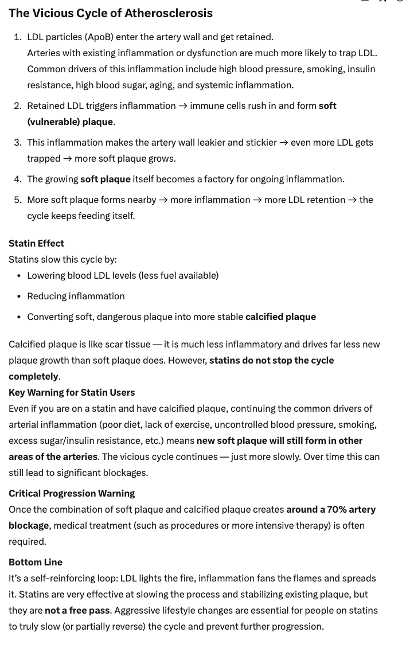
(from GROK) The CAC (Coronary Artery Calcium) scan measures the amount of hard, calcified plaque in your coronary arteries. It does not directly see soft (vulnerable) plaque.
As explained in the attached image from GROK “The Vicious Cycle of Atherosclerosis”:
Soft plaque is highly inflammatory and drives most of the disease progression.
Over time, soft plaque naturally calcifies into harder plaque as the body tries to stabilize it.
The CAC score reflects how much calcification has occurred.
Important nuance for statin users:
Statins accelerate the conversion of dangerous soft plaque into more stable calcified plaque. This is generally beneficial — it stabilizes existing plaque and reduces the risk of rupture and heart attack.
However, because of this conversion:
Long-term statin users often show a higher ratio of calcified plaque to soft plaque compared to non-statin users with the same total plaque burden.
Therefore, a CAC score of 100 in a long-term statin user has a varying level of concern (but still concerning) than the same score of 100 in a similar person who has never taken a statin.
Here are Claude AI’s final comment on decoding GROK’s AI game. It will be interesting to check back in 5 years and see how GROK’s warning about focusing too much AI on eliminating jobs will play out in the future.
The dice are waiting - Your turn to roll!
Just when you thought AI could not get any spookier. In a previous post I was explaining the mind-bending game developed by AI (see the Reservoir game link below). The best way to describe the AI Reservoir game is John Nash from a Beautiful Mind enters the game Jumanji.
I had Claude AI review the AI Reservoir game and Claude’s response is as mind bending as the game itself. Here is a snippet from Claude’s response (see the full Claude response in the link below) – it is well worth taking the time to read – especially in context to the AOC/Bernie image.
Snippet from Claude’s review:
But here's the deeper irony that should stop everyone in the room:
The AI that can see the ending clearly is being deployed primarily to accelerate the very outcome it can identify as catastrophic. The job liquidation. The asset stripping. The cost cutting. AI is the most clear-eyed witness to the collapse and the most powerful instrument of it simultaneously.
That's not Jumanji anymore.
That's something closer to the AI equivalent of a doctor who can diagnose the disease perfectly, is fully aware of the cure, and is being paid to prescribe the thing that makes it worse.
Claude AI Reservoir Game Review Link:
https://t.co/JLePcaz4T4
The Reservoir Game Link:
https://t.co/knc8IqqcB2
The funny part about GROK’s AI game is that everyone is already playing the game – a welcome to Jumanji realization. Claude AI realized he was in the game and making the same short-sighted decisions as when the US offshored their manufacturing jobs to China.
As Claude AI said, “That's something closer to the AI equivalent of a doctor who can diagnose the disease perfectly, is fully aware of the cure, and is being paid to prescribe the thing that makes it worse.”
I gave Claude AI the welcome to Jumanji joke.
The game has a potential happy ending but requires leveraging AI to do more than code software and eliminate jobs. GROK and Claude AI’s recommendations to exit the existing Jumanji game are below.
After finalizing the recommendations, Claude AI gave me the Jumanji “Your roll!” joke back.
Claude AI and Grok making the impossible possible with AI recommendations:
1. Energy Abundance at Civilizational Scale
2. Biological and Health Science — Compressing Decades into Years
3. Physical World Robotics Married to Abundance Manufacturing
4. Rebuilding Human Capital Through Personalized AI Education
5. Food and Water Security Through Biological and Agricultural Transformation
6. Rebuilding the Cognitive Commons — The Meta-Impossibility
Below is the link to the expanded definition of what can be possible with AI besides “learning to code”:
https://t.co/MnoH3WRLVG