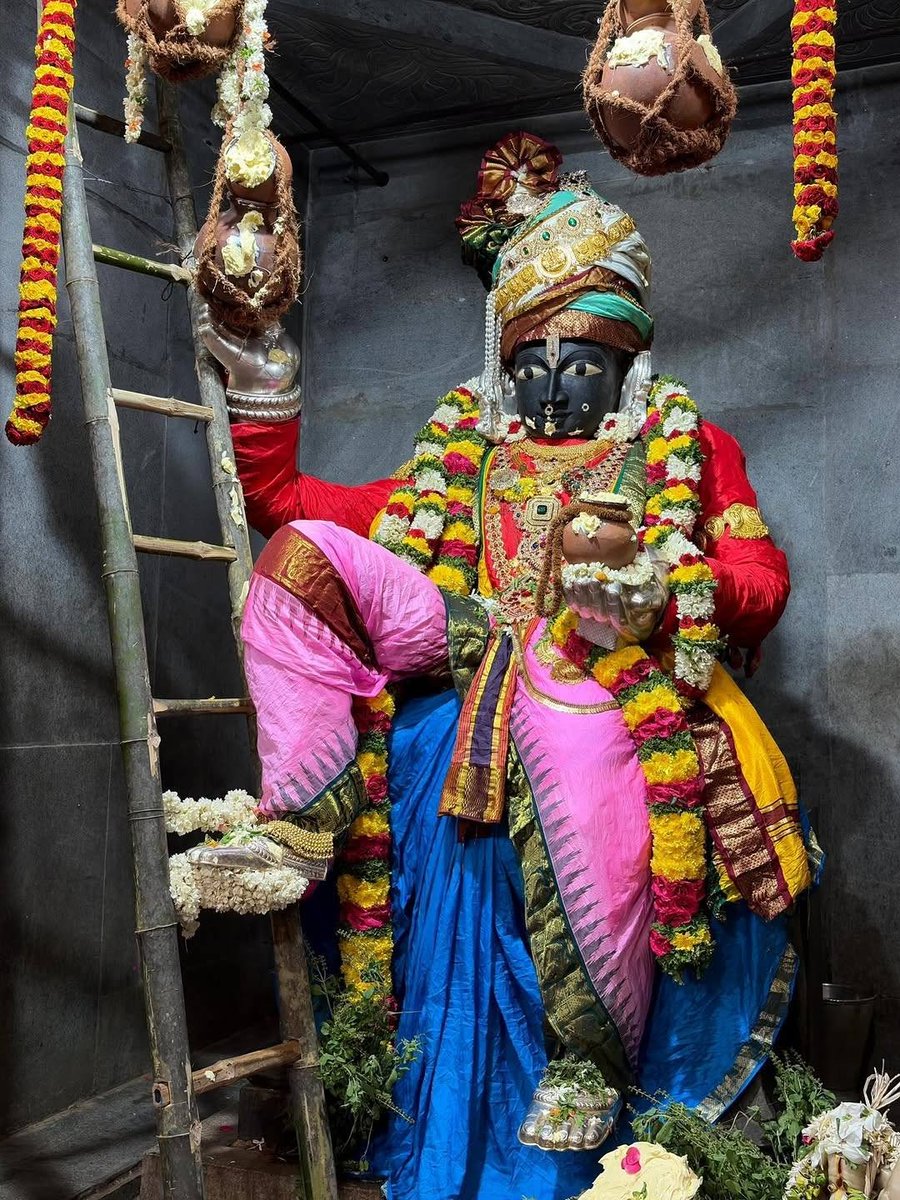
@Gharkombada I don't know why but Lord Hanuman is all powerful Ashta siddhi and nava nidhi. Why does he gets defeated every time. 🥲. Or is this just a leela 🙏.
|| Shri Navnath Bhaktisar Chapter 15 ||
Meanwhile, Gorakshanath and Kanifnath spent twelve long years performing rigorous penance at the Badrika ashram. Upon successfully completing their austerities, they set off in different directions to search for their respective Gurus.
However, when they could not find them even after wandering for a long time, they became deeply anxious. Overwhelmed by the agonizing separation from their masters, tears streamed endlessly from their eyes. In this distraught state, they resumed their search, traveling across various lands.
During his search, Gorakshanath arrived in the town of Helpattan in the region of Gaud Bengal. He set up his camp near the village outskirts. When the village guards came and respectfully bowed to him, Goraksha inquired if anyone matching Machindranath's description had visited their town.
The guards replied, "The Gosavi (ascetic) you are describing has never come to our village. However, a mighty ascetic named Jalandar did come here. His appearance was as radiant and blazing as the Sun. Mysteriously, he used to carry a bundle of grass that floated in mid-air above his head. He would bring grass from the forest and feed it to the cows. He stayed here for about a year, but it has been ten years since he suddenly disappeared." Hearing this, Goraksha suspected that Machindranath might have visited the village under a different name.
Later, when it was time for alms, Goraksha went into the town of Helpattan to bhiksha. Coincidentally, he walked right past the exact spot where Jalandarnath had been buried alive. Standing near the adjacent house, Goraksha called out, "Alakh Niranjan!" to ask for alms. Instantly, from deep beneath the earth, a voice responded with the Nath greeting, "Adesh!" Startled, Gorakshanath immediately recognized the call of a fellow Yogi. He asked the voice, "Who are you?"
The voice from under the ground replied, "My name is Jalandar! What is your name?"
Goraksha answered, "I am Goraksha, the disciple of Guru Machindranath. But how did you end up buried under the earth?"
Jalandarnath then narrated the entire tragic story of Queen Mainavati, her son King Gopichand, the Queen's treacherous conspiracy, and how the King had buried him alive in a pit filled with horse dung.
Hearing this horrific tale, Gorakshanath erupted in absolute fury. He declared, "Maharaj! Give me the command! I will severely punish this arrogant King who dared to treat you this way!"
However, calmly dissuading him, Jalandar said, "Do not do anything right now! Whatever has happened is ultimately beneficial for the growth and glory of the Nath Panth. Do not speak a word of this to anyone here. When you leave, you will eventually meet Kanifa. Tell him everything. He is the one who will come here, bless the King, elevate the glory of the Nath Panth, and finally pull me out of this pit."
Respecting Jalandarnath's wise command, Gorakshanath left the town and proceeded towards Jagannath Puri.
Meanwhile, Kanifnath had been traveling from village to village, preaching and imparting spiritual wisdom. Over time, he had gathered an impressive following of seven hundred disciples. Wandering together, they eventually arrived near the borders of the mysterious Kingdom of Women (Stree-Rajya).
Everyone knew the terrifying legend that no man who entered the Kingdom of Women survived, so no one dared to cross its borders. Some of Kanifnath’s disciples, who possessed absolute faith in his holy feet, thought, "When we have wholeheartedly surrendered our body, mind, and wealth to our Guru, why should we fear for our lives?" These devoted disciples strictly followed Kanifnath’s commands. However, many others were terrified and began plotting to run away.
1/ 🧵
Citadel Securities just put institutional weight behind what the AI bulls won't say out loud.
In a new macro note titled "Tokenomics," Citadel makes the argument plainly: even the most powerful technology on earth still has to pass through the boring discipline of cost curves, capacity limits, and marginal returns.
The evidence is piling up:
– Amazon removed its token usage leaderboard
– Microsoft cancelled Claude Code subscriptions
– Multiple companies reporting unexpectedly massive token bills
Their conclusion is the part that matters.
Adoption is no longer about what AI can do in principle. It's becoming about the price and scarcity of the inputs needed to run it at scale. Compute. Power. Cooling. Memory bandwidth. Inference budgets. All real, all binding constraints.
And here's the kicker from the chart.
The Silicon Data LLM Token Expenditure Index, a benchmark for how much the market is actually spending on AI tokens, has started rolling over. Citadel reads it as a shift toward cheaper models. Companies substituting away from expensive frontier AI toward "good enough" alternatives.
That's economics 101 doing what it always does. When the price of something rises, people use less of it, or find a cheaper version.
Citadel sees a bifurcation forming. Frontier AI concentrated among a few firms with the balance sheets to absorb the cost. Everyone else quietly downgrading to simpler, cheaper models.
This is the part of every technology revolution the early narrative ignores.
The technology being real was never the question.
The question was always whether the economics could carry the valuations.
When one of the most sophisticated trading firms on earth starts writing about AI in the language of cost curves and rationing instead of limitless demand, the conversation has quietly changed.
The hype was about what AI could do.
The reckoning is about what it costs.
The world will soon experience a tremendous amount of liquidity transfer from retail to investors.
Some investors and funds are going to become v rich.
The retail buyer is going to be stuck with a valuable over priced asset on the basis of projected revenue.
In sometime - this projected revenue will be adjusted not because of lack of demand but availability of computing power.
Power is currently less than what is needed for computation. That is the next frontier. Privatisation of power creation and distribution. Next comes water and cooling solutions.
The biggest problem of them all - the use of AI for everything from the mundane to the necessary reducing the ability to think independently.
The habit will become more expensive as resources grow and the dumbing down is permanent.
It is ironical that in the age of AI - those with the ability to be able to carry out tasks analog hold a superpower.
There was a time when ppl only pursued civil or chemical or industrial engineering. When E& TC and CS came- they took over everything considering the environment and rightly so. They had a glorious run. But now these are getting highly specialised. No room for the average.
The irony of fate. In order to keep them successful- the former sectors will become important again with new world adaptations.
For instance - best AI systems in agriculture need farmers. Real experience to innovate, update and better is invaluable. That skill set will be missing in new age farmers who only use smart manufacturing.
At my foundation- children go crazy seeing fruits on trees. They want to pluck. Their parents say they only see fruits in natures basket. It is not their fault.
The digital world has taken over people’s lives.
If this Ethanol Minister @nitin_gadkari continues his nonsense any further, @narendramodi the nation will see a huge logistical halt when all the vehicles get totalled in the next 5 years.
You need to start Pradhan Mantri ethanol Minister hatao engine bachao Yojana immediately.
Welcome to more cash burn to show higher projected revenues.
Many fund experts will justify this saying this is necessary to reach a level to command significant market share.
Normally yes- assuming you last till the process normalises. How long will your funds bail you out in the hope of lucrative exits? The funds need to give returns; or borrow from banks.
This notification is one of the most important fuel documents of the decade.
Let me explain what just happened.
The government charges a tax called excise duty on petrol. This paper says petrol mixed with 22%, 25%, 27% or 30% ethanol will pay zero excise duty.
Zero tax is the government's way of telling oil companies, start blending more ethanol, we will make it worth your investment.
This was coming.
On May 15, the Bureau of Indian Standards quietly notified IS 19850:2026, the official specification for E22, E25, E27 and E30 petrol. So they have mentioned the standard, and then the tax exemption.
But why is the government in such a hurry?
Three reasons;
Reason 1
The programme has been a genuine success on its own terms. India hit 20% blending in 2025, five years ahead of the original 2030 timeline.
Twenty years ago we could barely manage 5%. Crude imports fell, foreign exchange was saved, and over ₹1.18 lakh crore has gone to farmers through ethanol purchases.
For a country that imports most of its oil, every litre of ethanol is a litre of crude oil we did not buy from abroad, making us self-sufficient in our crude oil needs.
Reason 2
There is a supply glut because distilleries went on an expansion spree. India's installed ethanol capacity is close to 20 billion litres a year, with 4 billion more coming, while E20 needs only about 11 to 12 billion litres.
So we have built double the capacity we need. Those plants took loans. They need buyers. The only buyer big enough is the petrol pump.
E20 cannot absorb the supply, so the blend has to go up. The push to E30 is partly climate policy and partly capacity bailout.
Reason 3
Maize has now overtaken sugarcane as the biggest ethanol feedstock, supplying nearly half of all ethanol. The farm lobby behind this programme is now two crops.
But all of this has come at a cost;
When E20 rolled out, regular car owners paid the cost.
A government-funded study by ARAI and Indian Oil found fuel economy dropping up to 6% on E20 depending on the vehicle.
Owners of older cars reported worse.
So even though ethanol is cheaper than petrol. The blending saved money only for oil companies. The pump price you paid did not fall.
On top of that, you got no choice. Most pumps stopped offering plain petrol or E10.
E27 and E30 raise the same questions, with higher stakes. Cars sold in India were made E20-compatible only from around 2023.
There are crores of vehicles on the road before that were never designed for 27 or 30% ethanol. The industry's own target is E30 rollout between 2028 and 2030, which means a huge chunk of today's fleet will still be running when the new fuel arrives.
Brazil is the comparison everyone uses, and it is worth understanding properly.
Brazil runs E27 with nearly universal flex-fuel vehicles. Their cars were built for it over decades. The fuel and the fleet moved together.
So, we are moving the fuel first and hoping the fleet catches up.
So in nutshell, the notification tells oil companies and distilleries to blend more, and it says nothing to the car owners.
Three questions deserve clear answers before E27 petrol shows up at our neighbourhood pump.
1. Will pump prices actually fall this time, since both the ethanol and now the tax are cheaper? Will the zero excise duty gain disappear into oil company margins again?
2. Will older vehicles get a protected option, a pump that still sells E10 or E20 for cars that cannot handle more blending?
3. And will mileage loss be communicated honestly, with numbers, instead of being discovered by drivers at the fuel station?
The ethanol programme is one of the few Indian policies that has been implemented at a break neck pace.
Farmers have earned, imports have fallen, and an entire industry has been built in a decade. That deserves credit.
But going from E10 to E20 strained the system. Going from E20 to E30 with an unprepared vehicle fleet will most likely break it.
30 crore vehicle owners are waiting for answers.
Viceroy Gor needs to be called in ! Period ! All negotiations on trade deal need to stop. There is a limit of America to keep attacking India Manned crews !
Who the hell is United States to decide what is sanctioned where will i get my oil from. It is now time to defy & assert !
Chinese tankers & shadow fleet is also going, but Americans dare not touch it !
This is not done @narendramodi & @DrSJaishankar ! Atleast speak up for your men. Name USA call it out. Just for few Oligarchs their business dealings, National interests cannot be sacrificed !
Zoho keeps doing things the rest of Indian tech has decided are impossible.
They just built its own computer server, but the way they did it is so fascinating.
First, let's understand what a server is. It is the big computer sitting in a data centre that runs your apps. Every time you use Gmail or WhatsApp, a server somewhere does the work.
Almost every server running in India is designed by foreign companies. Indian firms just buy them.
Zoho decided to design its own. And I cannot stop thinking about how they went about it.
They set up the project in Nagpur.
Now, Nagpur had no experienced hardware engineers at all. So Zoho did not hire experts from Dell or HPE. They started a training programme called SETU, hired freshers straight out of engineering colleges, and gave them one hard problem to work on for five years.
Think about that. Every big IT company in India complains that freshers are unemployable.
Zoho took those same freshers, in a smaller city, and got a working server out of them. They have filed more than five patents on the designs, and the key parts were designed fully in-house and put together by Indian manufacturing partners.
So the talent has always been there. A company patient enough to train people was the missing piece.
But why build your own server at all?
Zoho runs all its apps on its own machines. Until now, every server they bought from a foreign company included that company's profit and licence fees.
By designing their own, they get the same performance while using 12 to 18% less electricity, and the total cost of owning each machine drops by 20 to 30%.
With a few hundred servers, that saving is small. But Zoho plans to move all its apps worldwide onto these machines.
Also there is an AI angle. Running AI is expensive because AI needs huge computing power. Zoho's plan is to run smaller, focused AI models on its own servers in its own data centres, to manage costs.
Most companies rent computing power from Amazon or Google but Zoho is attacking the bill at the machine level.
The timing is important too.
In 2023, the Indian government put restrictions on importing hardware like servers. Zoho had already started its server team in Nagpur back in 2020.
Three years before the government rule arrived, Zoho was preparing for a world where India cannot simply import its computers.
So, they moved on their own belief.
The best part is that the design is fully owned in India, Zoho does not depend on any foreign company for security checks, software updates, or licences.
If some country imposes sanctions or a licensing fight breaks out tomorrow, nobody abroad can switch off Zoho's machines.
Zoho has been honest about the fact that the chip inside the server is still an Intel processor, and Intel helped in the development.
That is fine. Every country that builds hardware starts this way. China's server companies started by assembling other people's parts and slowly went deeper. The chip is the next decade's problem.
What I love most is how Zoho-like this whole thing is.
> This company took no investor money in 25 years.
> It opened offices in villages and small towns.
> It hires school students and trains them.
> It built its own browser and its own AI model.
> Now its own server.
Now compare this with the big Indian IT companies. TCS, Infosys, Wipro, HCL.
Together they earn over $250 billion. They have managed the world's computers for decades. But not one of them designed a server of their own.
Even the name is a nice touch. Nathu La is the mountain pass in Sikkim through which India traded with the world on the old Silk Route.
Naming your first server after a trade gateway, while building it so India depends less on imported tech, shows someone thought about this for years.
They have a few hundred servers running today and want 2,000 by the end of the year. Small numbers. But the team is trained, the design works, and the path is proven.
Indian software companies spent 30 years building on other people's machines.
One of them finally built the machine. :)
🚨Zoho enters hardware with India-designed server Nathu La, eyes lower AI and data centre costs
The Chennai-headquartered software company, known for products under the Zoho and ManageEngine brands, said the server was designed by its engineering team in Nagpur and developed in collaboration with Intel using Intel Xeon 6 processors.
"Hardware is one area where we have traditionally relied on global OEMs. But infrastructure has become foundational and if compute becomes foundational, we should own it," said Ramprakash Ramamoorthy, Director of AI Research at Zoho Corp, to Moneycontrol
By @BhavyaDKumar
https://t.co/pRuW17DVu9