PhD Student at the Learning and Intelligent Systems Lab @TUBerlin. Intern @allen_ai. Working on discovering new things with machine learning and robots.
We’re introducing ToyBlocks, an open simulated tabletop for controlled experiments in robot learning.
It enables robotics researchers to experimentally control training data & models, run targeted evals, & trace failures to their causes. 🧵
https://t.co/A9g1uhle0W
Sharing what I spent the last year working on before starting my PhD. Glad it’s finally released! 🧱🤖
Robot foundation models have made huge progress with scale, but it’s getting harder to tell which choices actually drive the gains. I strongly believe many design choices are still understudied: data mixtures, input modalities, architectures, training recipes, and now how agentic frontier models should plan and act through robot skills.
Answering that takes systematic ablations, which need a system where you can 1. design tasks 2. generate data in a controllable way, and 3. train and evaluate models end to end.
That’s what ToyBlocks is built for. Excited to see what the community learns with it!
Want to turn any VLM into a better reward model for robotics? (yes, even Astra)
Introducing D&A: decoupling description and assessment improves any VLM family for zero-shot robot rewards.
D&A scales with improvements across GPT, Gemini, Claude, Qwen, ...
It enables zero-shot RL and filtered IL, improves code-as-policies via rich language feedback, and achieves SOTA on three benchmarks.
Website: https://t.co/Ccrv3HpVgY
The broader goal: better coverage of constrained states and trajectories, potentially useful as resets, goals and training data for robot learning.
Lead jointly with Tilman Burghoff & Marc Toussaint.
🌐 Project: https://t.co/9I3enT6vld
📄 Paper: https://t.co/0UITKj1Wiy
Finding feasible robot states for goal-conditioned RL is one thing. Sampling as diverse states as possible is another.
Diverse resets and goals help GCRL, but contact and collision constraints make truly uniform sampling hard.
Our NeurIPS ’26 work introduces MASEM. 🧵👇.
We test MASEM on multiple synthetic and robotics problems.
For example: In obstacle-course planning, it covers more homotopy classes and achieves higher feasible-sample entropy than the baselines.
GPT-6 Astra unlocks a whole new level of simulation scaling! It generates diverse environments, designs and solves tasks, and deploys seamlessly across embodiments.
Below: 25 unique environments, 25 multi-step tasks, and 5 robot embodiments generated in under 24 hours with just 3 generic prompts!
🧵
This is the most impressive result I’ve seen in my PhD.
One policy, trained from scratch, solves all 20 NIST assembly tasks. It can even complete 10 tasks in a row, with a single binary reward only after all 10 are done.
@octi_zhang combined diverse resets from OmniReset, task sampling from SGS, and multi-task training to unlock finer dexterity and longer horizons. No extra GPUs needed: one run on the same hardware replaces 20 specialist runs.
Videos and details: https://t.co/lyy9MlscuN
Proud to be part of this incredible work! More in his thread 👇
This robot has never seen a real-life gear, but assembles one with a 94% success rate! It can also thread an M16 nut and insert a 16mm peg. All trained with RL and transferred zero-shot sim2real from RGB. 🔈
Our method, Success-Guided Sampling (SGS), makes a small change to how we sample environment resets. More on SGS in @octi_zhang's thread, and more on sim2real transfer down below! 🧵
Website: https://t.co/C1wYuSquTc
#RL_conference is full of great papers that are hard to choose from so I created a list of the papers that I am most interested in reading from the conference. You can find that list here ;).
https://t.co/Iw7jRzXxnZ
@m_wulfmeier Thanks! Really liked reverse curriculum as well. We are working on follow-up works to get better covering samples and better policies, so stay tuned :-)
𝗚𝗼𝗼𝗱 𝗺𝗮𝗻𝗶𝗽𝘂𝗹𝗮𝘁𝗶𝗼𝗻 𝗽𝗼𝗹𝗶𝗰𝗶𝗲𝘀 𝗺𝗮𝘆 𝘀𝘁𝗮𝗿𝘁 𝘄𝗶𝘁𝗵 𝗯𝗲𝘁𝘁𝗲𝗿 𝘀𝘁𝗮𝘁𝗲𝘀, 𝗻𝗼𝘁 𝗯𝗲𝘁𝘁𝗲𝗿 𝗿𝗲𝘄𝗮𝗿𝗱𝘀.
We sample diverse, physically feasible contact states as starts + goals for RL.
The behaviors that emerge are surprisingly dynamic and reactive: including recovery, regrasping, and adapting through contact. 👇 (1/n)
What emerges is richer than sampled static states: scooping, whole-body contacts, recovery, reorientation, edge/corner balancing. Optimization finds where interaction is possible. RL learns how to move between those states.
📄 Paper: https://t.co/Qp6SmpfMSu
🌐 Project: https://t.co/gPux1RDKcL
Project lead by @Marc__Toussaint and collaboration w @Denis_Shcherba , @tupryk , Tilman Burghoff, Sayantan Auddy, Armand Jordana and Justin Carptentier.
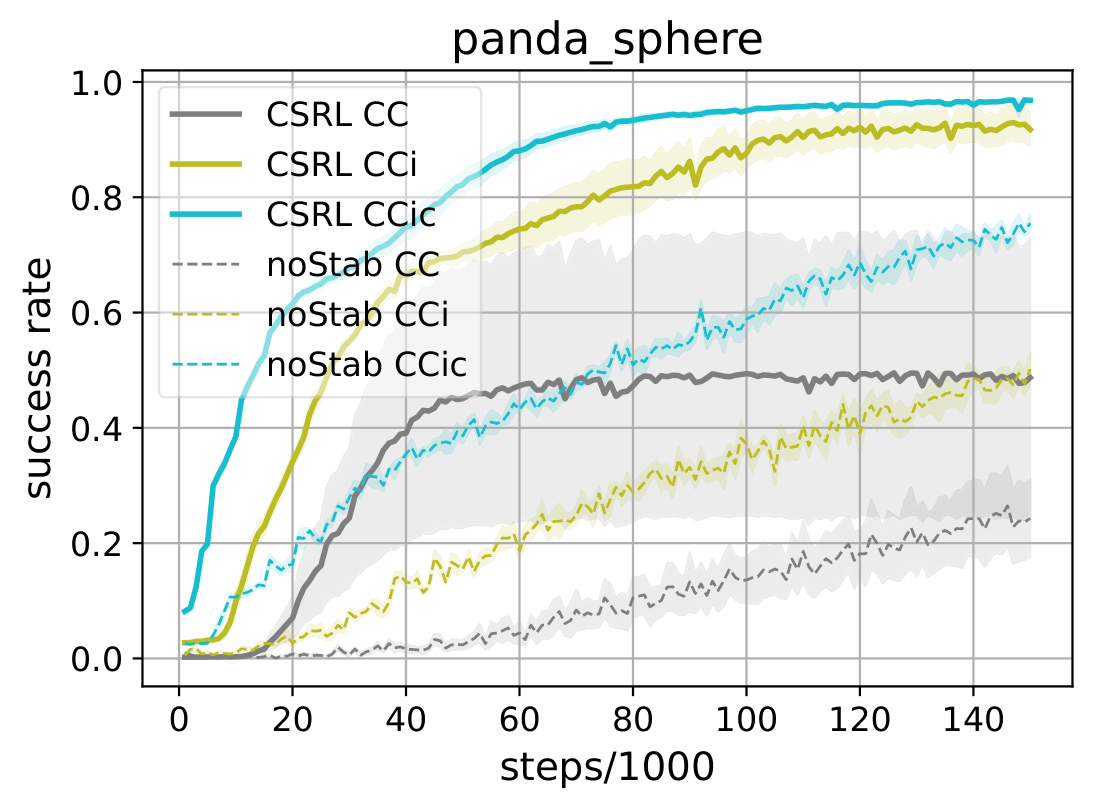
The stability constraints matter a lot.
When sampling states without stability constraints learning is significantly slower.
To further improve learning we propose a curriculum that connects progressively distant states.
Random starts + goals: 4.4%
Full CSRL: 𝟵𝟲.𝟱%
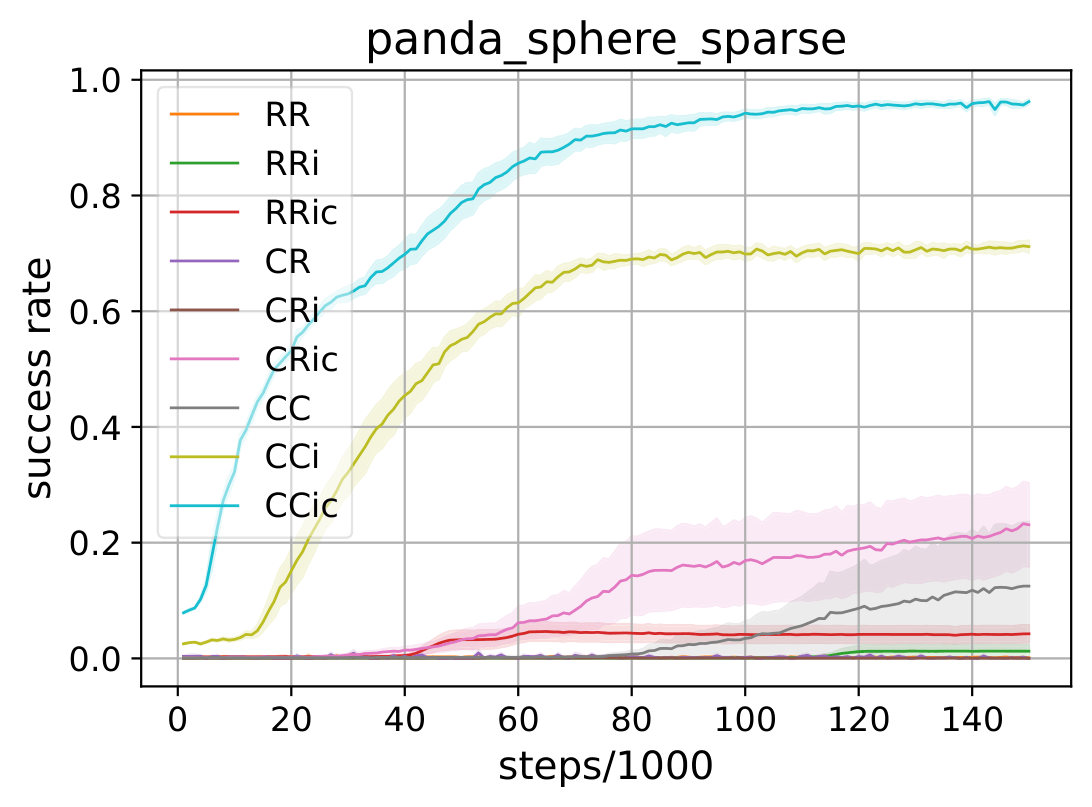
With sparse rewards:
0.2% → 𝟵𝟱.𝟵%