LUMINA CORE
NOW ON MOBILE
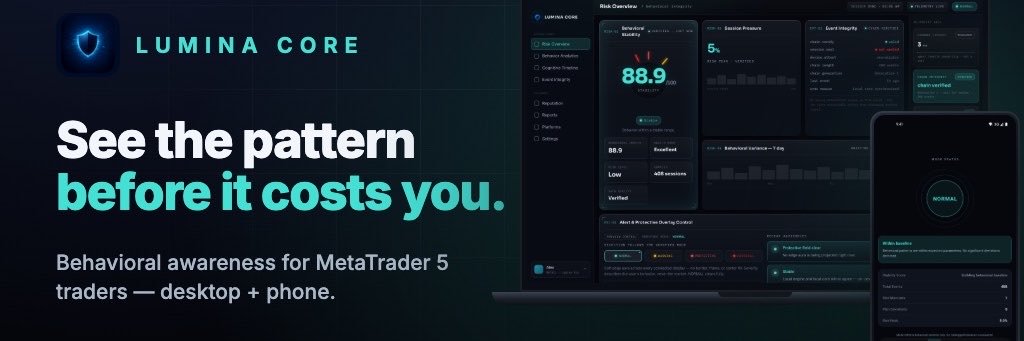
🛡️ Lumina Core is now available on mobile.
Understand your trading behavior, monitor behavioral risk, and stay more aware of your execution patterns — wherever you are.
Download now:
🍎 App Store
https://t.co/GoSE241OIf
▶️ Google Play
https://t.co/5KTL9dvtTh
#LuminaCore #TradingPsychology #TradingDiscipline #BehavioralFinance #FinTech
LUMINA CORE
NOW ON MOBILE
🛡️ Lumina Core is now available on mobile.
Understand your trading behavior, monitor behavioral risk, and stay more aware of your execution patterns — wherever you are.
Download now:
🍎 App Store
https://t.co/GoSE241OIf
▶️ Google Play
https://t.co/5KTL9dvtTh
#LuminaCore #TradingPsychology #TradingDiscipline #BehavioralFinance #FinTech
UNDERSTANDING RULE-BREAKING IN TRADING
Rule-breaking rarely begins with abandoning the entire plan.
It often starts with one small exception — moving a limit, forcing an entry, or justifying a decision under pressure.
One exception can become a pattern when behavior goes unnoticed.
https://t.co/Wf8dZXRxrq
#LuminaCore #TradingDiscipline #BehavioralRisk #TradingPsychology
PSYCHOLOGICAL TRIGGERS OF REVENGE TRADING
Revenge trading often starts with a trigger, not a strategy.
A painful loss, frustration, anger, or the urge to recover quickly can turn emotional pressure into reactive execution.
Recognizing the trigger can help reveal the moment disciplined trading begins to shift.
https://t.co/QlRgzY5d8T
#LuminaCore #RevengeTrading #TradingPsychology #BehavioralRisk
TRADER HESITATION & EXECUTION IMPACT
Hesitation can be as important as impulsivity.
Fear, uncertainty, and overanalysis can delay execution, create second-guessing, and pull decisions away from the original plan.
Sometimes the behavioral risk isn’t acting too fast — it’s waiting too long.
https://t.co/lKYcPkyp1X
#LuminaCore #TradingPsychology #ExecutionDiscipline #BehavioralRisk
EGO DEPLETION & TRADING PERFORMANCE
Mental self-control is not unlimited.
After prolonged concentration, repeated decisions, and emotional pressure, maintaining the same level of discipline can become harder.
When mental resources decline, execution behavior may begin to change.
https://t.co/U082zWYS92
#LuminaCore #EgoDepletion #TradingPsychology #TradingDiscipline
LOSS AVERSION IN TRADING BEHAVIOR
A loss can feel more powerful than an equivalent gain.
Loss aversion may influence traders to hold losing positions longer, avoid necessary decisions, or take new risks in an attempt to recover.
Understanding how losses affect behavior can reveal what the numbers alone cannot.
https://t.co/CQMprnyOH3
#LuminaCore #LossAversion #TradingPsychology #BehavioralFinance
UNDERSTANDING RULE-BREAKING IN TRADING
Rule-breaking rarely begins with abandoning the entire plan.
It often starts with one small exception — moving a limit, forcing an entry, or justifying a decision under pressure.
One exception can become a pattern when behavior goes unnoticed.
https://t.co/Wf8dZXRxrq
#LuminaCore #TradingDiscipline #BehavioralRisk #TradingPsychology
PSYCHOLOGICAL TRIGGERS OF REVENGE TRADING
Revenge trading often starts with a trigger, not a strategy.
A painful loss, frustration, anger, or the urge to recover quickly can turn emotional pressure into reactive execution.
Recognizing the trigger can help reveal the moment disciplined trading begins to shift.
https://t.co/QlRgzY5d8T
#LuminaCore #RevengeTrading #TradingPsychology #BehavioralRisk
TRADER HESITATION & EXECUTION IMPACT
Hesitation can be as important as impulsivity.
Fear, uncertainty, and overanalysis can delay execution, create second-guessing, and pull decisions away from the original plan.
Sometimes the behavioral risk isn’t acting too fast — it’s waiting too long.
https://t.co/lKYcPkyp1X
#LuminaCore #TradingPsychology #ExecutionDiscipline #BehavioralRisk
EGO DEPLETION & TRADING PERFORMANCE
Mental self-control is not unlimited.
After prolonged concentration, repeated decisions, and emotional pressure, maintaining the same level of discipline can become harder.
When mental resources decline, execution behavior may begin to change.
https://t.co/U082zWYS92
#LuminaCore #EgoDepletion #TradingPsychology #TradingDiscipline
FOMO & OVERTRADING
FOMO can turn opportunity into urgency.
When the fear of missing out takes over, traders may chase moves, increase activity, or abandon normal decision-making rules.
The danger isn’t simply missing a trade. It’s allowing the fear of missing it to change your behavior.
https://t.co/gR3kPALhKQ
#LuminaCore #FOMO #Overtrading #TradingPsychology
REGRET AVERSION IN TRADING DECISIONS
The fear of making the wrong decision can become a decision-making force of its own.
Regret aversion may lead to hesitation, premature exits, or avoiding actions simply to escape the possibility of feeling wrong later.
Sometimes the fear of regret shapes behavior more than the market itself.
https://t.co/IM24FKPvCS
#LuminaCore #RegretAversion #TradingPsychology #CognitiveBias
PERFECTIONISM & TRADING MISTAKES
Perfectionism can look like discipline — until it starts interfering with decisions.
The need for the “perfect” entry, outcome, or setup can lead to hesitation, overanalysis, and difficulty accepting normal uncertainty.
Trading doesn’t require perfection. It requires awareness and consistent execution.
https://t.co/UcpkDJvHRU
#LuminaCore #TradingPsychology #Perfectionism #TradingDiscipline
ADVANCED ANALYSIS OF OVERTRADING TRIGGERS
Overtrading rarely begins with the extra trade.
Frustration, FOMO, overconfidence, recent losses, or the urge to recover can trigger a shift in behavior before trading activity increases.
Understanding the trigger helps reveal where overtrading actually begins.
https://t.co/kfydhrXamz
#LuminaCore #Overtrading #TradingPsychology #BehavioralRisk
COGNITIVE LOAD & BEHAVIORAL RISK
The more your mind has to process, the harder disciplined execution can become.
High cognitive load can strain attention, slow judgment, and increase the risk of impulsive or inconsistent decisions.
Sometimes better execution starts with recognizing when your mental bandwidth is overloaded.
https://t.co/iLH6lwnEsF
#LuminaCore #CognitiveLoad #TradingPsychology #BehavioralRisk
THE PSYCHOLOGICAL IMPACT OF EMOTIONAL TRADING ERRORS
Emotional errors can extend beyond a single trade.
Fear, frustration, regret, or overconfidence can influence what happens next — affecting timing, discipline, and future decisions.
The trade may end. The emotional impact may continue.
https://t.co/lUHqwJDdc1
#LuminaCore #TradingPsychology #EmotionalTrading #BehavioralRisk
THE PSYCHOLOGICAL ROOTS OF TRADING INCONSISTENCY
Inconsistent trading is not always caused by an inconsistent strategy.
Stress, confidence, recent outcomes, fatigue, and emotional pressure can change how the same plan is executed from one session to the next.
Understanding the psychological roots can help reveal why behavior changes.
https://t.co/Y98h2vENmu
#LuminaCore #TradingPsychology #TradingDiscipline #BehavioralRisk
THE PSYCHOLOGY BEHIND IMPULSIVE TRADING ERRORS
Impulsive trading errors often begin before the trade itself.
Urgency, frustration, fear, or overconfidence can shorten decision time and turn emotional reactions into execution.
Understanding the trigger helps reveal the behavior behind the mistake.
https://t.co/tgt3UgRX4I
#LuminaCore #ImpulsiveTrading #TradingPsychology #BehavioralRisk
STATUS QUO BIAS IN TRADING
Doing nothing can feel safer simply because it feels familiar.
Status quo bias can make traders resist changing a position, assumption, or approach — even when new information suggests reassessment is needed.
Familiarity is not the same as objectivity.
https://t.co/lPssH0JjLt
#LuminaCore #StatusQuoBias #TradingPsychology #CognitiveBias
SELF-REGULATION FAILURES IN TRADING
Knowing the rules and following them under pressure are two different challenges.
Stress, frustration, fatigue, and emotional reactions can weaken self-regulation — turning planned decisions into impulsive behavior.
Discipline depends on recognizing when control starts to slip.
https://t.co/Vz1rSmaEYK
#LuminaCore #SelfRegulation #TradingPsychology #TradingDiscipline