Core Central’s weekly cadence:
Macro Monday —> big-picture global context, key trends, macro forces shaping markets and the world & their implications for the Central American region.
Trade Tuesday — >trade data & trade negotiations
Words Wednesday —> terms in English & Spanish
Throwback Thursday —> historical context
Fact Sheet Friday — concise regional reference information
2/5 Petroleum import dependence (2023):
Costa Rica: 8.7% of total imports
El Salvador: 14.0%
Guatemala: 14.6% (highest absolute volume)
Honduras: 15.0%
Nicaragua: 14.0%
Panama: 15.0%
Guatemala’s petroleum import bill alone exceeds $4.4 billion. Nicaragua’s is the smallest in absolute terms but still represents 14% of its total imports.
5/5
The data underscores why energy diversification and regional infrastructure matter.
Reducing the 9–15% petroleum share through renewables, biofuels, and efficiency gains would ease balance-of-payments pressure while strengthening resilience.#CentralAmerica#CAFTA#Trade #EnergySecurity
Trade Tuesday | Central America’s Petroleum Trade Reality
1/5 Central America runs a structural petroleum import bill that represents 9–15% of total import value for every country in the region. At the same time, the United States is the dominant supplier of those products under CAFTA-DR.
Here’s what the data shows.
The headliner: The U.S. and Iran said they had agreed terms to end their war and reopen the Strait of Hormuz.
https://t.co/8H8uhH8aPX
Good news for the world and for Central America… but on “wait and see” mode since details of the agreement still forthcoming.
Oil imports are a structural pressure on the balance of payments (BOP) of all Central American economies because they represent a recurring outflow of foreign currency (mainly U.S. dollars) to pay for imported fuels. The impact varies depending on the size of the economy, energy intensity, export earnings, and whether the country has alternative energy sources.
We’re back.
After a 3-month break, we’re excited to return with fresh insights on Central America’s dynamic political and economic landscape.
Much has happened since our last update — and we’re kicking things off with Macro Monday a big-picture context of an issue, key trend or macro force shaping markets and the world & their implications for the Central American region.
Reminder of our weekly Central America geopolitics & geoeconomics.schedule
Macro Monday — big-picture global context, key trends & macro forces shaping markets and the world
Trade Tuesday — trade data & key timelines
Words Wednesday — terms in English & Spanish
Throwback Thursday — historical context
Fact Sheet Friday — concise regional information
Fact Sheet Friday | Mesoamerican Biological Corridor & Central American Integration via SICA
The Mesoamerican Biological Corridor isn't just conservation—it's a flagship for SICA-driven regional integration, linking ecosystems to shared sustainable development & unity.
Key facts:
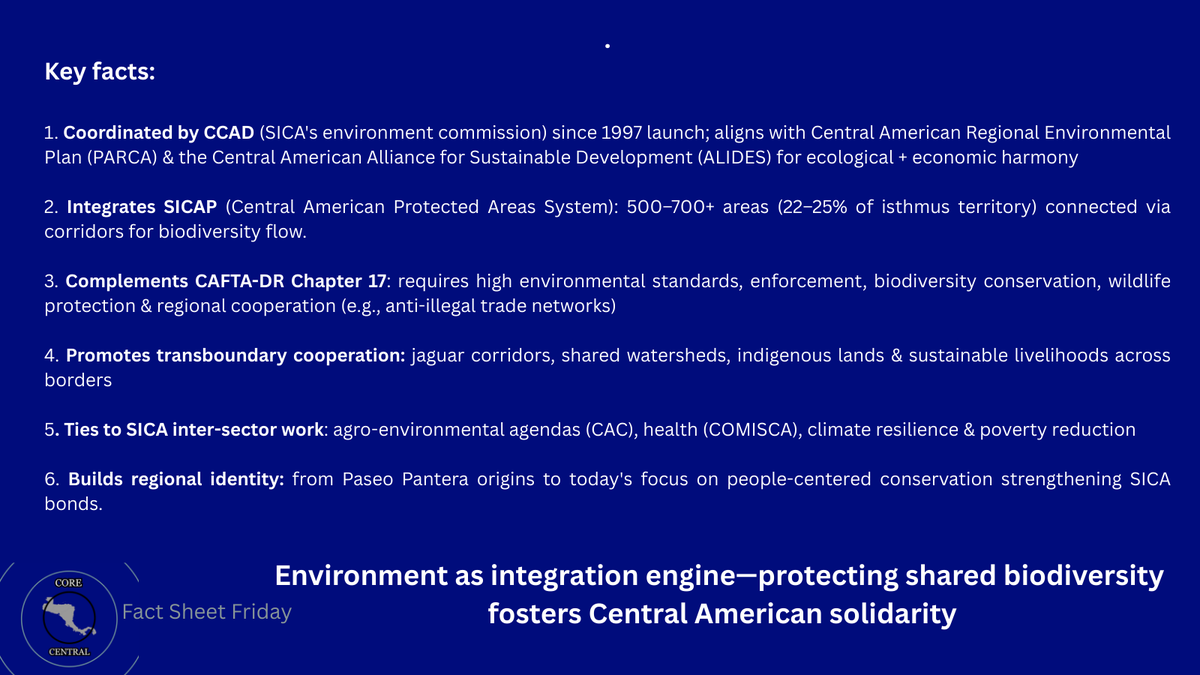
1. Coordinated by CCAD (SICA's environment commission) since 1997 launch; aligns with Central American Regional Environmental Plan (PARCA) & the Central American Alliance for Sustainable Development (ALIDES) for ecological + economic harmony
2.Integrates SICAP (Central American Protected Areas System): 500–700+ areas (22–25% of isthmus territory) connected via corridors for biodiversity flow.
3.Complements CAFTA-DR Chapter 17: requires high environmental standards, enforcement, biodiversity conservation, wildlife protection & regional cooperation (e.g., anti-illegal trade networks)
4.Promotes transboundary cooperation: jaguar corridors, shared watersheds, indigenous lands & sustainable livelihoods across borders
5.Ties to SICA inter-sector work: agro-environmental agendas (CAC), health (COMISCA), climate resilience & poverty reduction
6.Builds regional identity: from Paseo Pantera origins to today's focus on people-centered conservation strengthening SICA bonds.
Paseo Pantera ("Path of the Panther") was the visionary 1990s precursor to the Mesoamerican Biological Corridor. Launched by the Wildlife Conservation Society (WCS) with USAID funding, and led by ecologist Archie Carr III, it aimed to reconnect fragmented habitats across Central America and southern Mexico—creating safe passages for jaguars (Panthera onca) and other wildlife to move between protected areas from southern Mexico to Panama.
Named for the jaguar's iconic role as a wide-ranging apex predator, the initiative followed natural "paths" already used by jaguars (as noted by conservationist Alan Rabinowitz: "We were not creating a corridor; rather, we were looking for one that had already been created by the jaguar"). It emphasized linking core protected zones with buffer areas and sustainable land-use corridors to balance biodiversity conservation with human https://t.co/5p52YT6lqP 1997, this evolved into the officially endorsed Corredor Biológico Mesoamericano (MBC) via presidential agreement, expanding to include social equity, poverty alleviation, and sustainable development—still a cornerstone of regional conservation today.Throwback gem: The original "Path of the Panther" concept helped spark one of the world's largest transboundary ecological networks, protecting not just jaguars but migratory species, cloud forests, and mangroves across eight countries.
Throwback Thursday | Back to the 1990s: The Mesoamerican Biological Corridor (Corredor Biológico Mesoamericano) was first envisioned as "Paseo Pantera" (Path of the Panther) to connect fragmented habitats across Central America + southern Mexico.
Officially launched in 1997 via presidential agreement, it aimed to link protected areas from southern Mexico through Panama, creating a vital land bridge for wildlife migration between North & South America while promoting sustainable development.
Throwing it back to those early visionary days—when connecting core zones, buffer zones, and corridors was meant to balance biodiversity conservation with livelihoods for local communities.Still relevant today:
The MBC helps protect jaguars, migratory birds, cloud forests, and more, while supporting shade-grown coffee, NTFPs, and ecotourism.
What's your favorite "throwback" fact or memory about regional conservation efforts?
#ThrowbackThursday #MesoamericanBiologicalCorridor #CorredorBiológicoMesoamericano #CentralAmericaConservation
Organic (EN) - Orgánico (ES)
Use in Context:
Honduran coffee cooperatives in the MBC sell organic beans to European buyers at higher prices.
Uso en contexto:
Las cooperativas de café hondureñas en el MBC venden granos orgánicos a compradores europeos a precios más altos.
Words Wednesday | Organic (EN) - Orgánico (ES)
Definition:
Agricultural production using no synthetic pesticides or fertilizers, often certified for environmental standards.
Definición:
Producción agrícola sin pesticidas ni fertilizantes sintéticos, a menudo certificada por estándares ambientales.