🔍 C'è un dettaglio che non tutti hanno notato guardando Zverev giocare.
Nei cambi di campo, mentre gli altri bevono o si asciugano il sudore, Sascha si fa un'iniezione di insulina. Lo ha fatto anche durante la finale del Roland Garros 2026, sotto i riflettori del tennis mondiale.
🏥 Alexander Zverev convive con il diabete di tipo 1 da quando aveva quattro anni. Una vita intera, tra allenamenti, viaggi e campo, passata a gestire i livelli di glucosio nel corpo.
Eppure per molto tempo non ne ha parlato. Non per vergogna, ma per una scelta precisa: non voleva che fosse il diabete a definirlo. Non voleva pietà. Lo ha fatto pubblicamente solo nel 2022.
👨⚕️ I medici avevano consigliato a sua madre di fargli cambiare sport: giocare a tennis con il diabete, dissero, sarebbe stato troppo difficile.
Zverev quando è in campo gioca nello stesso momento due partite diverse: quella contro il suo avversario e tenere costantemente monitorato il livello della sua glicemia.
🥵 In partita la glicemia può diventare una roulette: un attimo sei in calo fino al rischio di collasso ipoglicemico, quello dopo lo stress e l’intensità ti spingono in iperglicemia con sete, crampi e confusione, tra performance che crolla e pericoli acuti se non gestita.
Oltre al traguardo sportivo, che per Sascha è stato così atteso, inseguito e a tratti maledetto, questo titolo Slam vale molto più.
💭 È il megafono più potente che potesse trovare per il messaggio che porta avanti attraverso la sua Fondazione: ai bambini con diabete di tipo 1 dice che possono sognare in grande, senza privarsi dello sport e di ambire anche a salire sul tetto del mondo del tennis.
#RolandGarros #Zverev
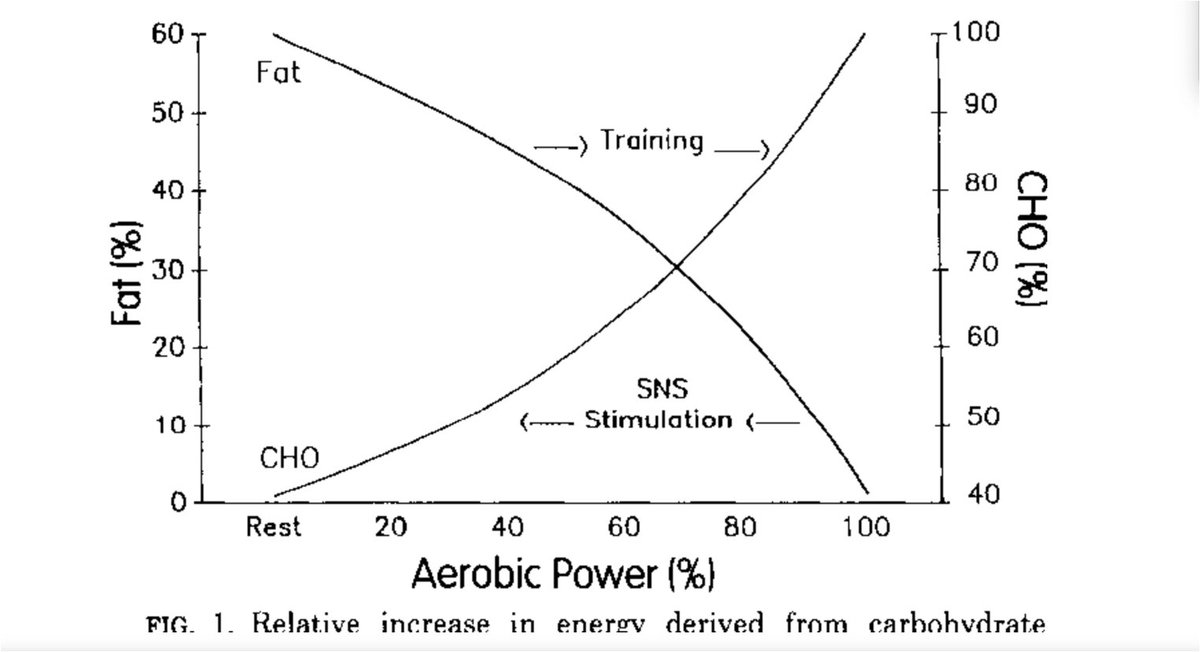
One important misconception around Substrate utilization during exercise is that during low exercise intensities you don’t use CHO as your energy is derived from fat...
When I started performing fat and CHO oxidation assessments in 2005, I was quite surprised by the amount of CHO oxidized (“burned”) even at low exercise intensities.
During rest, CHO contribution to total energy expenditure is ~40% while FAT is ~60%.
As exercise intensity increases, CHO contribution increases as well and by your Zone2 intensity, you are normally already burning slightly more CHO than FAT. At your Zone 3, your fat oxidation declines significantly and at your Zone 4, fat oxidation normally disappears (see picture 2- "the metabolic map").
Picture 1 is data that we presented at ACSM back in 2008. Check that at even low exercise intensities, you oxidize CHO and that at FATmax point you can oxidize ~2-2.5g/min. This is one of the reasons why if we ride at our zone 2 for 4h and don’t eat, you can eventually bonk.
When I started to see these numbers in 2005, I perceived that the current guidelines those days calling for 35-55g/h of CHO were quite low and then I proposed and started to use 80-100g/h, although I was highly criticized by most back then…
Picture 2 shows what I called “the metabolic map” trying to describe different metabolic “events” at different exercise intensities in relation also with muscle fiber recruitment. It is a very simplified version of exercise metabolism but I found through many talks and conferences over the years, that it is useful to many.
Picture 3 is the original figure of the “Crossover Concept” by George Brooks and Mercier where Fat and CHO oxidations are expressed in % of VO2max. You can also see that even at low exercise intensities (50-60% of VO2max), CHO is significantly utilized by muscle.
As an important point for this misconception, graphs haven’t helped as the visual seems that there is more FAT oxidation than CHO at low exercise intensities. At FATmax point, FAT oxidation can be generally ~0.3-0.7 (depending on fitness level). However, CHO oxidation at FATmax can be 2-2.5g/min which is still higher than FAToxidation although in the graphs it sits below…
Hope this helps 😉
🍃 Check out my new headwind and tailwind calculator app for runners! 🍃
https://t.co/FTKYRR5sI6
This app uses state-of-the-art biomechanics and physiology to calculate the effects of headwinds and tailwinds on your pace!
[Brève] Quel impact la crise du coût de la vie a-t-elle sur les #comportements d'achat et la préparation des repas ? 🔍 Une enquête transversale réalisée au Royaume-Uni s'est penchée sur la question en interrogeant 583 adultes 👉 https://t.co/eg1rfKQZEh
Voici Roibbos, mon fidèle berger Australien ; lui est d’humeur égale, il ne me trahira jamais, c’est un fidèle VRAI ami, un soutien psychologique précieux quand tu en as besoin ; l’humain est si faux-cul, vénal, méchant; tes ennemis tu les connais; écarte tes faux vrais amis…
An interesting review on limits of ultra:
Strategies for performance: Even pacing, heat acclimation, hydration, and personalized nutrition are key.
https://t.co/5CpFWEDmRg
Les #cétones: de nbx coureurs en bouffent, d Staffs médicaux gèrent les protocoles; pas que dans les «vilaines» équipes étrangères… On voit ça dans qqs années quand on connaîtra les effets sur la santé?? ET .. que font les Instances? Mon règlement interne en INTERDISAIT l’usage
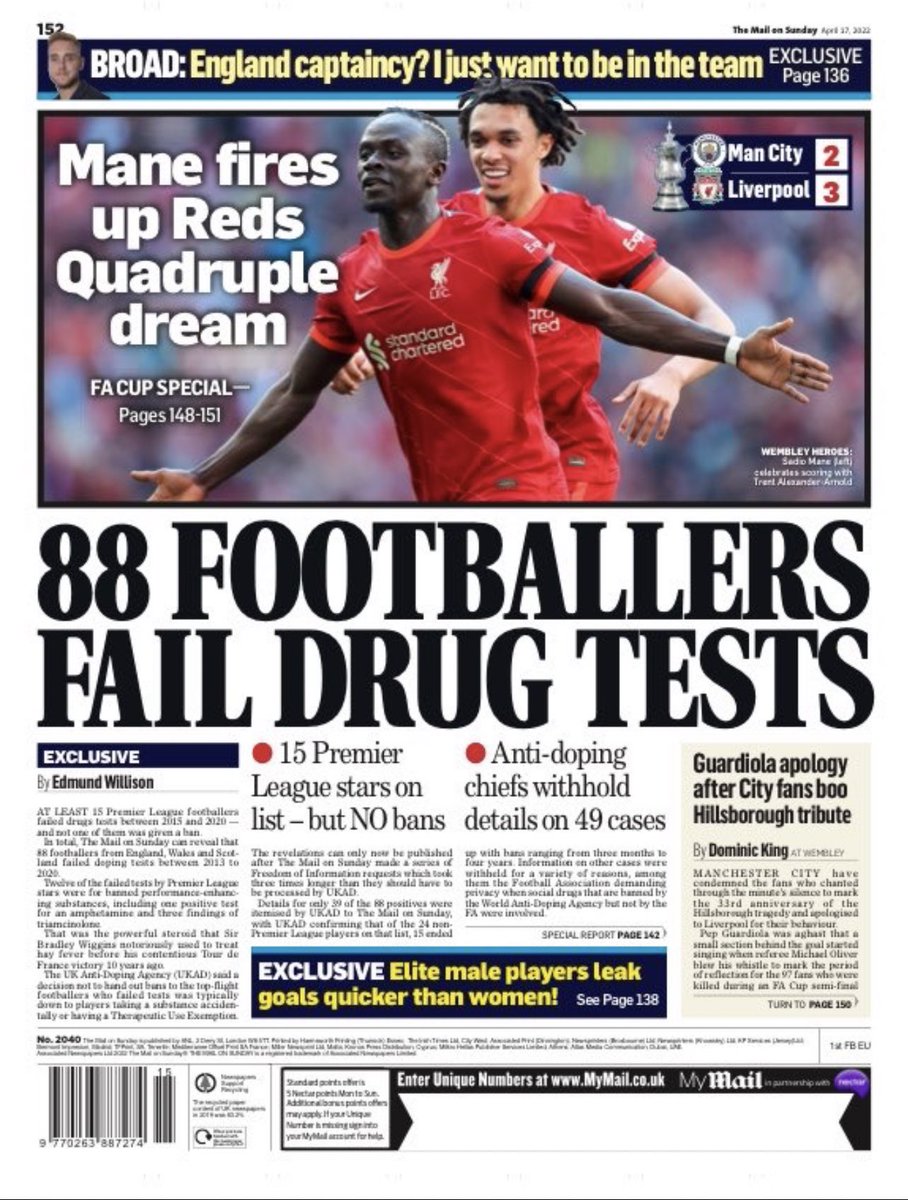
With all of the recent debate about doping in football, after Gary Neville and Roy Keane said that Italian teams they played against weren’t “clean”, I thought I’d do a 🧵on doping in football.
Read along, some of the stories you may know, others you may not.
So let’s begin 🪡
That's a wrap!
👋 If you enjoyed this thread, you might like to join over 17K others on my weekly newsletter, getting actionable insights on heart disease prevention.
Link in bio above ☝️