Quick #physics tip:
Velocity has direction.
Speed says, “I’m going fast.”
Velocity says, “I’m going fast this way.”
Physics cares about the drama of direction.
https://t.co/X7vb6rzOCf
#Physics#STEMEducation#Learning#Science
@sharemath Pillar 1 is being easily eaten away these days,
ai, short videos, reels, you name it. And all the classrooms in elementary school are filled up with educational infographics etc… so much for focused attention!
When the development of life skills is embedded across the curriculum, students reap the rewards – as research into our schools' approach shows, writes Camilla Woodhouse of ISP
https://t.co/QA2tWvKqBH
@cbokhove Why not? If does help to remove the clunkiness, pending user’s perspective on the reason for using it. Or you may actually like the imperfection which is also respectful
Do not use your energy to worry. Life is too short to worry about stupid things.
Have fun. Fall in love. Regret nothing and do not let people bring you down.
Study, think, create and grow. Teach yourself and teach others.
—Professor Richard Feynman
@HowToAI_ This is like unveiling the truth behind the scene for the common. That’s all ai does and if you’re not careful you may fall for it and sometimes it’s too late. Best is to understand and use it efficiently. It is a tool after all and a super powerful tool indeed.
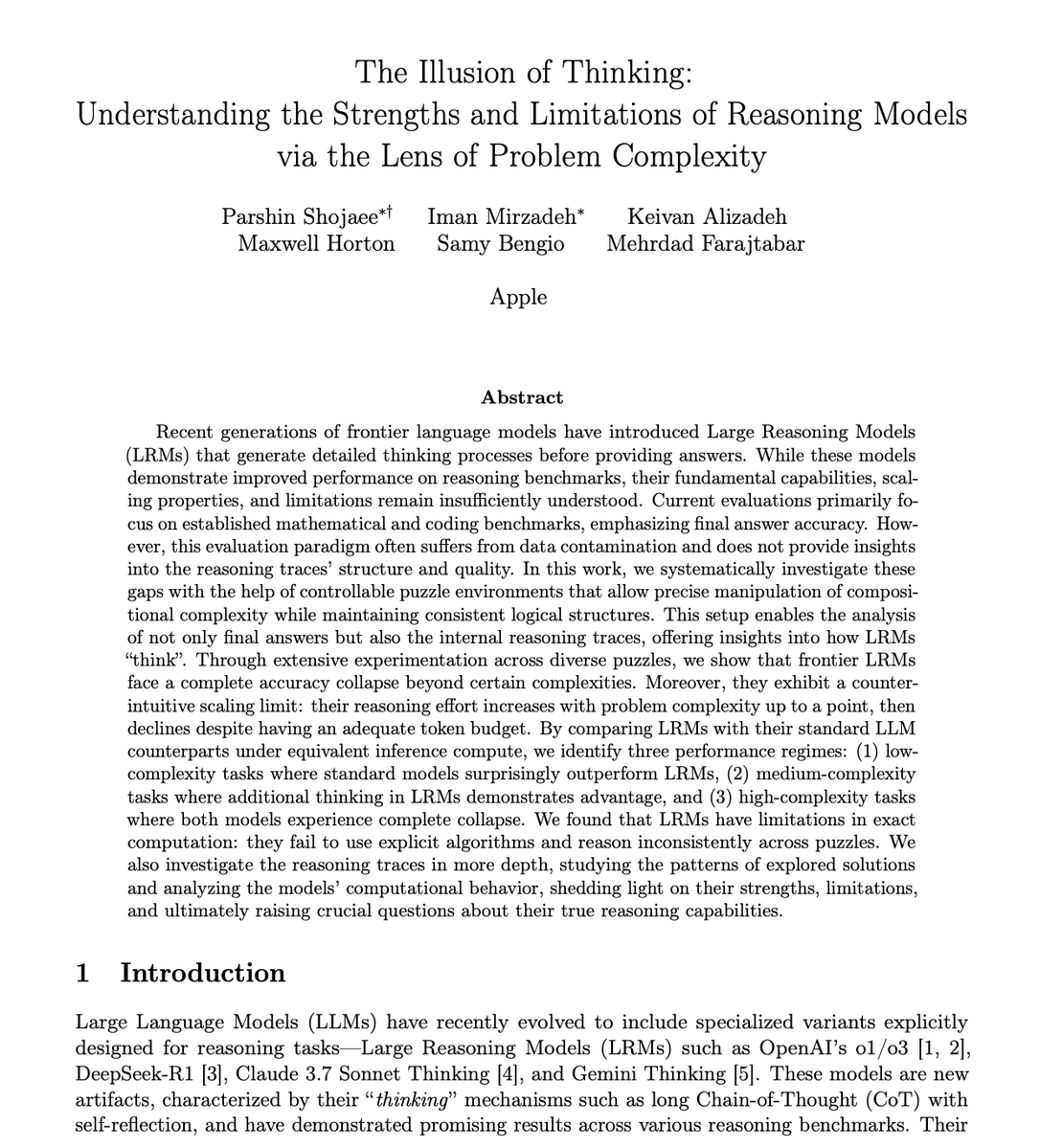
Apple has published a paper with a devastating title: “The Illusion of Thinking”
It argues that AI models, no matter how brilliant they may seem, do not understand what they are doing.
They do not solve problems. They do not reason. They merely generate text word by word, trying to sound coherent.
Apple tested the most advanced reasoning models in the world on controlled puzzle environments. They tore open the internal "thinking" traces.
What they found shatters the narrative that we are getting closer to AGI.
Current models don't scale with complexity. They have a hard mathematical cliff. And they do not degrade gracefully. They collapse.
But here is the most unsettling part.
When a problem gets too complex, the AI doesn't use its remaining compute to try harder.
It just gives up.
Its reasoning effort actually declines. It stops thinking and starts guessing.
Then Apple ran the experiment that closes the casket on the reasoning debate.
They gave the AI the exact, step-by-step algorithm to solve the puzzle. The cheat codes.
All the AI had to do was follow the instructions.
It couldn't do it.
Performance didn't improve at all.
When the complexity gets high enough, these models fail because they cannot actually execute a logical sequence.
They are not reasoning. They are just pattern matching.
When you give them a simple problem, they overthink. When you give them a hard problem, they collapse.
Paper: The Illusion of Thinking, Apple, 2025
@CBSEveningNews@Itayhod This is a slippery slope, I hope schools tread carefully. Simply using generative ai may be fun at first but definitely dumbing in the long run if kids don’t first learn how it works.
Summer is a good time to slow down, rebuild foundations, and close learning gaps before next year begins.
https://t.co/X7vb6rzOCf
#SummerLearning#StrongFoundations#Tutoring
The problem is not people being uneducated.
The problem is that people are educated just enough to believe what they have been taught, and not educated enough to question anything from what they have been taught.
—Professor Richard Feynman