A programmable risk layer for onchain assets, including vault tokens, yield-bearing stablecoins, LSTs, and RWAs
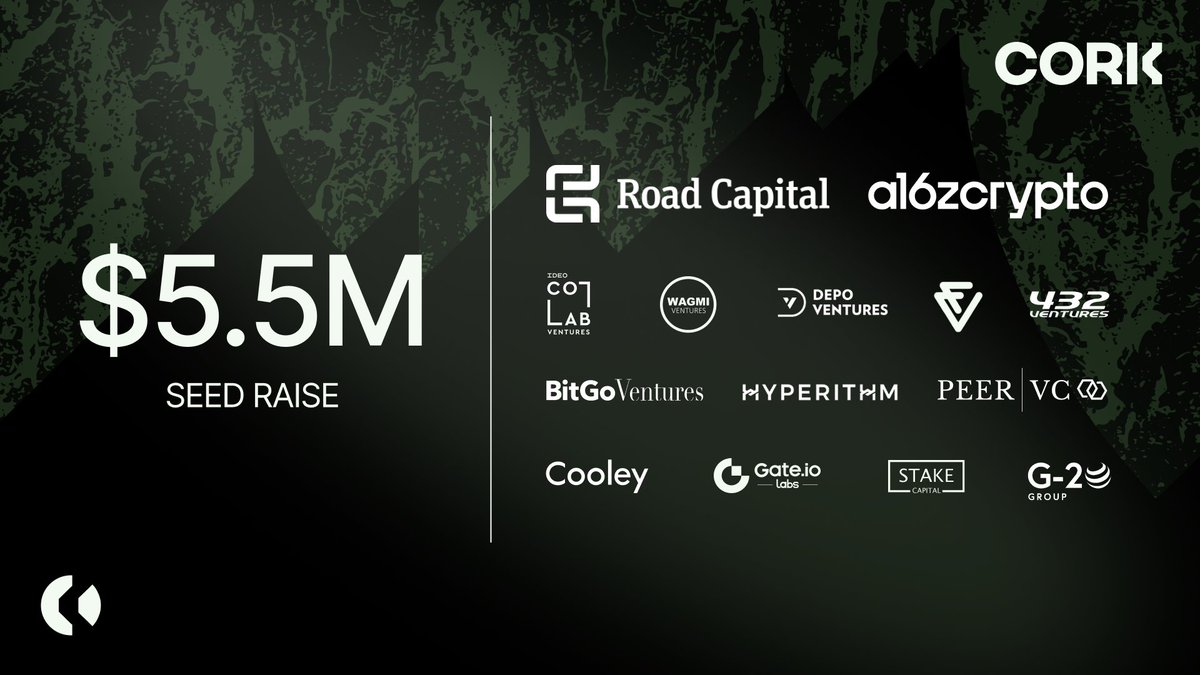
Backed by @RoadCapMgmt and @a16zcrypto CSX
Cork has raised $5.5M to build the missing tokenized risk infrastructure for digital assets.
Led by @RoadCapMgmt and @a16zcrypto CSX, Cork has raised from investors who recognize the market opportunity of introducing tokenized risk into the digital asset ecosystem.
Agents can create risk. Agents can amplify risk. They cannot manage or transfer risk. That is the gap Cork is building for.
Phil Fogel (@philfog), Co-Founder, @CorkProtocol, on programmable risk primitives and what capital formation in agentic finance actually requires:
Bear markets are when these kinds of lists gets built
My top 2: insurance for vault deposits and onchain reputation for borrowers/lenders
One thing missing from this list: risk primitives for agents
Keynoting at @AgenticSummit, hosted by @Microsoft in NYC tomorrow at 4PM ET
Agents are already managing risk onchain but their only tool is exit, and when that's everyone's only tool it turns into a stampede
Cork is building the toolkit they don't have yet
Liquidity used to be something you either kept idle or didn't have.
Our partnership with @Agglayer's Vault Bridge proved liquidity on demand as a solution, instead.
This enabled Vault Bridge the opportunity to utilize their assets to earn yield in Morpho, without stressing that movement on the bridge would create a liquidity crunch.
More earn opportunity for Vault Bridge and more peace of mind for all. Risk managed.
Agglayer's Vault Bridge creates yield on bridged assets instead of letting them sit idle.
Cork Protocol's external liquidity buffer backs withdrawal capacity so capital stays deployed.
Two stress events, with every withdrawal served. See the case study:
OpEd: 🗣️ Tokenized RWAs will thrive during the next crypto downturn because their yield is anchored to real economic activity, not crypto leverage, argue Cork's Rob Schmitt, researcher Borja Neira, and RWA.xyz's Bryan Choe.
https://t.co/CTgKlvInhi
"DeFi yields are a function of leverage demand. Self-reinforcing on the way up. Self-defeating on the way down."
New @CoinMarketCap piece from @robdogeth on why tokenized RWAs break that pattern:
https://t.co/30F5EXt8Gm
We sit next to auditors and security researchers all year. Here’s what’s happening: AI is rapidly increasing the speed at which vulnerabilities can be detected and exploited. The gap between code being shipped and code being broken is shrinking.
Code doesn’t have time anymore to be constantly re-evaluated and patched once something is live.
Agglayer's Vault Bridge creates yield on bridged assets instead of letting them sit idle.
Cork Protocol's external liquidity buffer backs withdrawal capacity so capital stays deployed.
Two stress events, with every withdrawal served. See the case study:
At The Capital Summit, @Philfog ran through five recent failures (Drift, Stream Finance, LayerZero, Kelp, Aave) and asked @itsbhaji whether it's one root cause or many.
Her read: AI is accelerating exploit discovery, and audit-first DeFi can't keep up.
Loops aren't risky because they leverage exposure, they're risky because they leverage the assumption that liquidity will be there when you really need it. It rarely is.
It cost $18,000 for VaultBridge to put their remaining idle cash to work but keep it protected with Cork.
The alternative was nearly $40k in foregone yield.
A month ago, $6-10B tried to leave Aave, driving 99.87% utilization for four days
The new fix: lower the ceiling from 92% to 87%
Same setup, slightly smaller buffer
Memory is short