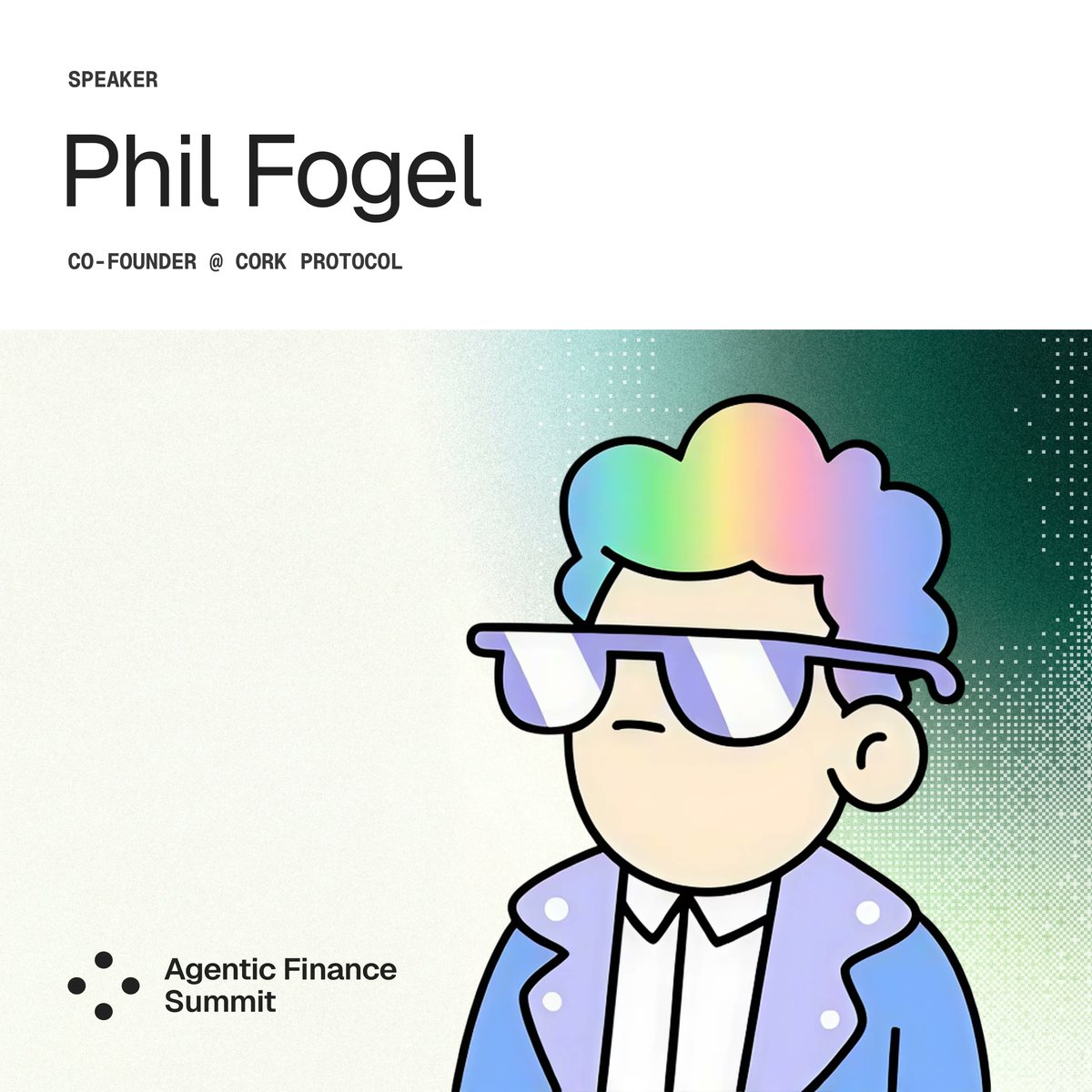
This weekend, my kids asked if they could use some of my crypto stickers to decorate their helmets.
This turned into what will certainly be a real core parenting memory for me!
My 8-year-old son wanted to read each sticker and understand what each one was about.
His favorite was the @Certora "Move Fast. Break Nothing." - because he likes to go fast and crash into things.
My 5-year-old daughter, on the other hand, judged each sticker by how cute it was and ended up with quite a few @SushiSwap stickers.
Couldn’t be prouder!
Keynoting at @AgenticSummit, hosted by @Microsoft in NYC tomorrow at 4PM ET
Agents are already managing risk onchain but their only tool is exit, and when that's everyone's only tool it turns into a stampede
Cork is building the toolkit they don't have yet
Studying history is important, because it lets us understand the shape of how change works.
Make risk markets programmable onchain is going to open up so many new possibilities the same way actuarial science and probability theory did.
The fear of coding agents discovering unknown unknowns is legit.
But quality projects use the same agents to harden everything from the codebase to opsec.
There will definitely be more DeFi issues in the coming months, but once the dust settles, we will be left with a stronger, more resilient ecosystem where there are simply far fewer unknown unknowns.
The real question for the average DeFi user is how do I know the protocol I want to use is deploying all the agentic tools necessary to protect it. There are really one or a few ways:
1. Trust/Brand - this is the same across defi and tradfi and boils down to whether you trust that the team is deploying best practices.
2. Market pricing - not everyone can be an expert on security, nor have access to all the information; a team might not want to share publicly about their security. But if you are underwriting the risk and selling protection, you can and should be an expert with access to additional information.
3. Industry standards - a set of best practices that can be certified by a neutral, reliable third party, in the same vein as SOC2.
PSA: I now consider *all* of DeFi unsafe.
Coding agents are superhuman at finding vulnerabilities, and smart contract security is too asymmetric: defenders need to fix every bug while attackers need just one exploit to steal funds.
PSA: I now consider *all* of DeFi unsafe.
Coding agents are superhuman at finding vulnerabilities, and smart contract security is too asymmetric: defenders need to fix every bug while attackers need just one exploit to steal funds.
PICARD: Data, shields up
DATA: Brilliant! Shields can reduce damage we sustain. Not immunity. Not hubris. Just prudence. It's not precaution—it's strategy.
[camera shakes]
WORF: HULL BREACHES ON NINE DECKS
DATA: Here's what happened: you told me to raise shields, and I didn't
Agglayer's Vault Bridge creates yield on bridged assets instead of letting them sit idle.
Cork Protocol's external liquidity buffer backs withdrawal capacity so capital stays deployed.
Two stress events, with every withdrawal served. See the case study:
we've been speedrunning financial history onchain for a decade. vaults, AMMs, stablecoins, LSTs — every single one is a credit product wearing a different hat
stack enough of them and you've built a beautiful, interconnected pile of unpriced risk
great chat with @therollupco
Wild that this much damage was caused by a single social engineering attack on 1 developer.
Out of pure curiosity I would love to know what the social engineering attack was.
We’re sharing our completed post-mortem on the April 18th incident, prepared with @Mandiant and @CrowdStrike. We are publishing both an executive summary and the full report at the link below.
Over the past four weeks, we’ve worked with hundreds of partners to help them understand their current security posture, and harden it where appropriate. We’ll continue this work, alongside taking additional proactive steps for the benefit of not only our partners, but also the ecosystem as a whole.
We want to extend our thanks to our partners for their support and patience this past month. There’s a reason that over $12 billion has moved across the network in the past four weeks, and why the world’s most valuable asset issuers have stood by our side: they believe in us, in what the LayerZero protocol has to offer, and in the value of modular, isolated, application-controlled security.
The work continues. And we look forward to continue showing up for the applications that trust us with their business, as well as the broader ecosystem.
https://t.co/7bILN6dPJz