SIPRI Yearbook 2026 now vindicates what I have been documenting for years: India has moved from a so-called recessed, de-mated posture toward operational nuclear warhead deployment and peacetime mating with launchers.
12 warheads are now assessed as deployed with operational forces. The “reliable minimum deterrent” narrative just took a hit.
https://t.co/GwYVSiwamp
#SouthAsia #NuclearDeterrence #SIPRI
1/9
At CISS today, my message was clear: Chaghai gave Pakistan strategic autonomy; Full Spectrum Deterrence preserved it against evolving threats; Marka-e-Haq demonstrated it under pressure. Pakistan PaindabadPakistan’s deterrence works — nuclear deterrence held the strategic ceiling, conventional deterrence restored balance below it, and political control preserved escalation discipline.
Those who read restraint as weakness, ambiguity as incoherence, or deterrence success as bluff are not offering analysis; they are creating escalation hazards.
There is no viable space for war in South Asia.
“The absence of #Nuclear threats must never be mistaken for the absence of #Deterrence. The fact that escalation was avoided proves that deterrence operated. It does not prove that #NuclearRisk was marginal.”
— Brig Dr Zahir Kazmi (R), #CISS Seminar on #YoumeTakbeer2026
28 years after Chaghai, Pakistan’s nuclear programme remains the guarantor of peace and stability in #SouthAsia.
Its success lies in the wars it has prevented, the caution it continues to impose, the restraint it enables, & the sovereignty it preserves - Brig Dr Zahir Kazmi (R)
𝐂𝐈𝐒𝐒 𝐒𝐞𝐦𝐢𝐧𝐚𝐫 | 𝐘𝐨𝐮𝐦-𝐞-𝐓𝐚𝐤𝐛𝐞𝐞𝐫 𝟐𝟎𝟐𝟔 🇵🇰
#YoumeTakbeer gave Pakistan strategic autonomy. Full Spectrum Deterrence preserved that autonomy against evolving threats. #MarkaeHaq demonstrated it under pressure — Brig Dr Zahir Kazmi (R)
#CISS#Pakistan#India
@palepurshankar
No permanent friends, history agrees.
But “permanent enemies” for any nation, especially nuclear-armed ones beats strategy. It is a failure of imagination that locks generations into perpetual risk under cognitive biases.
The 1964 memo warned of capabilities that outlive partnerships. Today both our countries possess them. True strategic maturity and moral responsibility lies in managing the relationship without eternalizing hostility. Resolving the Kashmir and other territorial disputes is a long hanging fruit that Bharat can pick.
History rewards those who learn lessons. It does not forgive those who refuse to. Pakistan is a good teacher in history.
The capability exists. The partnership exists.
But there are no permanent friends in international relations.
The historical warning from 1964 remains relevant.
History is never boring but learning from it can be.
Read: https://t.co/azeYQF9bcp
#NuclearHistory #USIndia #Nonproliferation #StrategicPartnership #ColdWarHistory
@BrookingsInst@ForeignAffairs@ChathamHouse@IFRI_@FRS_org@SWPBerlin
7/7
Indian strategic thinkers and former military leaders have also written openly about long-range reach and second-strike capabilities.
See, for example, assessments in The Writing on the Wall: India Checkmates America 2017 by former Chief of Army Staff General S. Padmanabhan.
Link: https://t.co/Bn85y6tBGC
6/7
@Heritage@BelferCenter@BulletinAtomic@StimsonCenter
Were the 1960s U.S. assessments about Indian nuclear capabilities overly alarmist or were they simply early recognition of a long-term reality that is now visible?
Modern-day Dr. Frankenstein moment, or prudent foresight?
#NuclearHistory #USIndia #Nonproliferation #StrategicPartnership #AgniMissile #ColdWar
5/7
@RadioactiveFrnd@CISS_Islamabad
Fast forward to today:
Bharat is officially a “strategic partner” of the United States.
It also possesses Agni-V missiles with intercontinental range and is developing Agni-VI. Read @ejazhaider https://t.co/5yJ5TzKvoM
Its SSBNs armed with K4 and K15 SLBMs already give it extended reach.
It has the fastest growing nuclear warheads development program in the world.
The raw technical capability the 1964 memo feared India could one day acquire now exists!
4/7
By then, 🇺🇸 and 🇨🇦 had already helped lay the foundation of India’s nuclear infrastructure through Atoms for Peace assistance, including heavy water for the CIRUS reactor.
Some in Washington were already worried they might be creating a long-term strategic problem for themselves.
Others were internally discussing the possibility of giving nuclear weapons or technology to India as a hedge against 🇨🇳
3/7
💣 In December 1964, a senior U.S. Defense Department official wrote a secret memo titled The Indian Nuclear Problem.
One key assessment was stark:
“One consequence of an Indian program is that one more national state, India, could some day be able to attack the United States with nuclear weapons.”
Source: Declassified DoD memo by Henry S. Rowen, 24 December 1964 https://t.co/RyGWWXtwlW
1/7
@RadioactiveFrnd@CISS_Islamabad@ciss_ajk@CISSS_Karachi@bttn_quetta@SVI_Pakistan@IDSAIndia@orfonline@TahirAndrabi
If these assessments are correct, the scale and secrecy surrounding such developments should concern the entire international community.
More sites may still remain undisclosed.
If these assessments are correct, the scale and secrecy surrounding such developments should concern the entire international community.
More sites may still remain undisclosed.
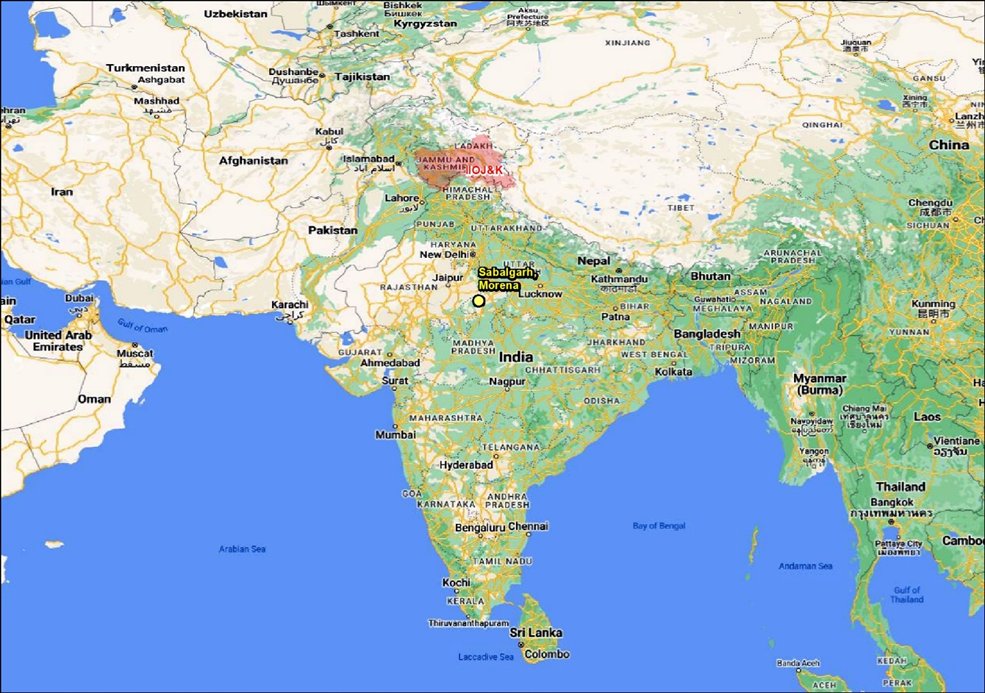
#Indian hidden ballistic #missile site explored
Satellite imagery analysts are beginning to identify what appear to be expanded strategic storage and support facilities linked to #India’s Agni #missile program.
Gwalior AgniStorageSite, Sabalgarh
#alarm bells must ring now – Indian hidden ballistic missile site explored
Satellite imagery analysts are beginning to identify what appear to be expanded strategic storage and support facilities linked to India’s Agni missile program.
Gwalior AgniStorageSite, Sabalgarh