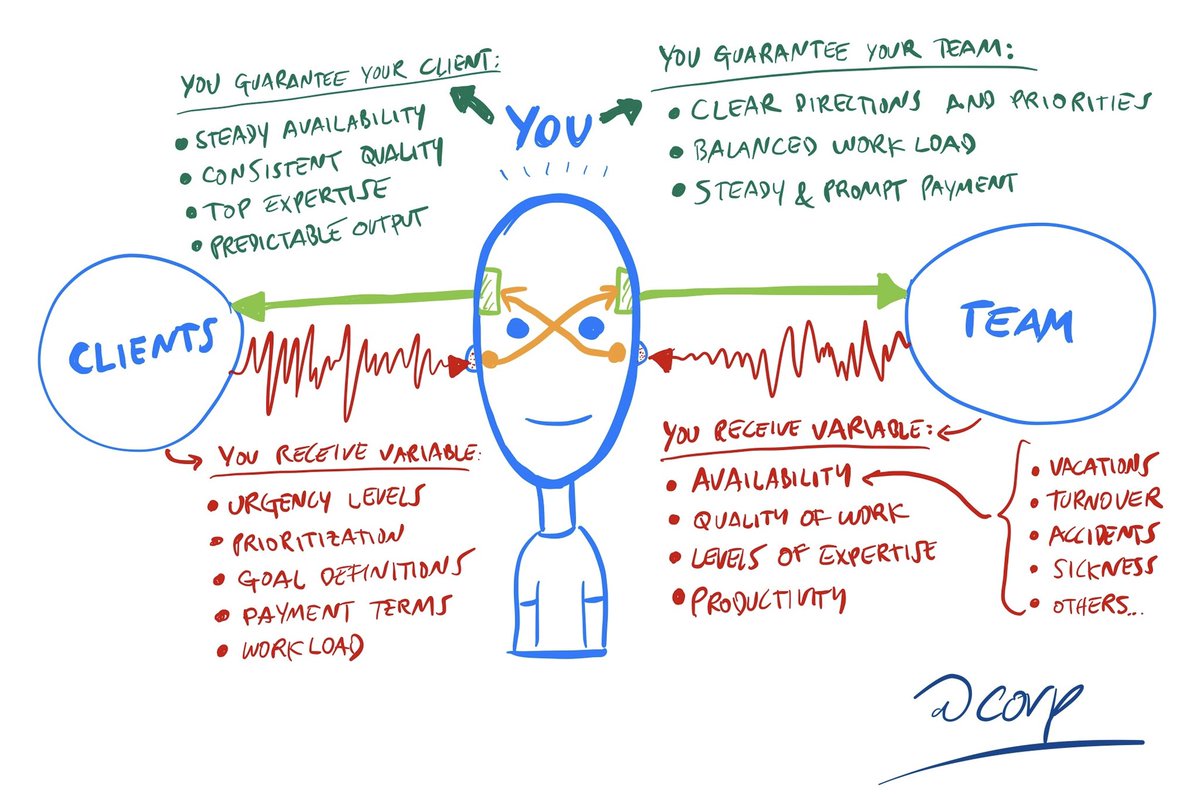
As the founder/leader/manager/principal of a professional services company or agency, one of your main jobs is to be a “variability regulator” between your clients and your team.
#team#management#lessons
Software engineering in 2026 needs two roles:
A pirate and an architect.
The pirate codes as fast as possible to figure out what's valuable. The architect turns that sloppy mess into a well-oiled machine.
Here's how it works and why:
So @jack wants ~6,000 employees reporting directly to him in the new version of the company.
Layers between CEO and any employee in the company: ~5 today → 2-3 this year → basically zero
In December my blood pressure scared me, prediabetic levels, I weighted 197.3 pounds (89.5k)
In Jan 1/2026 made some changes:
1) Zero alcohol
2) Workout 60 mins daily
3) Eat healthier
73 days later: I have lost 22 pounds, no fancy methods, just discipline and work.
In my company, we use Google Meet all the time; we used to use Zoom... but never Teams for video calls. Now, some clients prefer Teams... and whenever I go to a meeting, and I see a Teams link, my impulsive reaction is "ahhhhhh crap! teams!" and it ruins my day a little.
@r0ck3t23 True to some degree... but consider the incentives he has to say that. He wants the world to rely on buying more NVIDIA GPUs and new chips designed specifically for AI... so, of course, he would recommend that all business leaders rely on AI for every role.
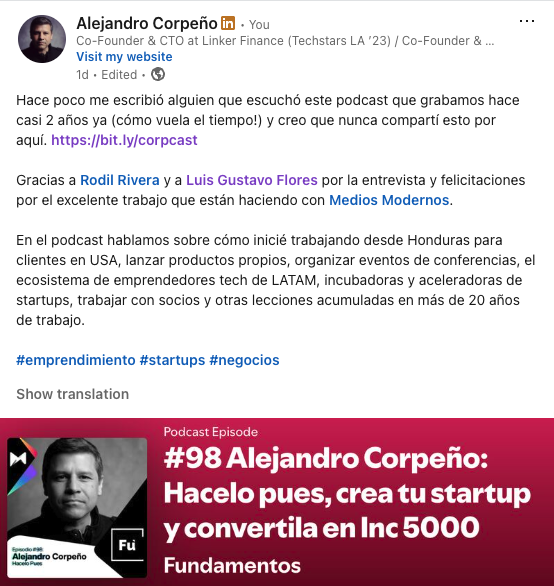
Hace poco me escribió alguien que escuchó este podcast que grabamos hace casi 2 años ya (cómo vuela el tiempo!) y creo que nunca compartí esto por aquí. https://t.co/dSGuePoRxp
@Ineslaram (2/2) alguien que no ha desarrollado apps complejas no sabe como describir eso. Luego, cuando ya Claude lo programó, es bastante impresionante en algunas cosas, bastante tontito en otras. Hay que probar todo, y corregir bastante (no en código, sino en más instrucciones)
@Ineslaram (1/2) igual me pasó, hace 1 semana empecé un proyecto de cero en un stack que conozco muy bien, para evaluar la calidad del resultado. Primero, el planning y el nivel de detalle de la arquitectura del sistema, esquema de base de datos, sistemas de colas, integración de APIs
Claude can now build interactive charts and diagrams, directly in the chat.
Available today in beta on all plans, including free.
Try it out: https://t.co/tHPAZRgQkn
The token cost to build a production feature is now lower than the meeting cost to discuss building that feature.
Let me rephrase.
It is literally cheaper to build the thing and see if it works than to have a 30 minute planning meeting about whether you should build it.
It’s wild when you think about it.
This completely inverts how you should run a software organization. The planning layer becomes the bottleneck because the building layer is essentially free. The cost of code has dropped to essentially 0.
The rational response is to eliminate planning for anything that can be tested empirically. Don’t debate whether a feature will work.
Just build it in 2 hours, measure it with a group of customers, and then decide to kill or keep it.
I saw a startup operating this way and their build velocity is up 20x. Decision quality is up because every decision is informed by a real prototype, not a slide deck and an expensive meeting.
We went from “move fast and break things” to “move fast and build everything.”
The planning industrial complex is dead.
Thank god.
What does it mean for software engineering when we no longer write the code? Here's the take from Boris Cherny (@bcherny), the creator of Claude Code. Timestamps:
00:00 Intro
11:15 Lessons from Meta
19:46 Joining Anthropic
23:08 The origins of Claude Code
32:55 Boris's Claude Code workflow
36:27 Parallel agents
40:25 Code reviews
47:18 Claude Code's architecture
52:38 Permissions and sandboxing
55:05 Engineering culture at Anthropic
1:05:15 Claude Cowork
1:12:48 Observability and privacy
1:14:45 Agent swarms
1:21:16 LLMs and the printing press analogy
1:30:16 Standout engineer archetypes
1:32:12 What skills still matter for engineers
1:35:24 Book recommendations
Brought to you by:
• @statsig — The unified platform for flags, analytics, experiments, and more. https://t.co/ZCSOIcWv31
• @SonarSource – The makers of SonarQube, the industry standard for automated code review. Proactively find and fix issues in real-time with the SonarQube MCP Server: https://t.co/RkEeF7gDc3
• @WorkOS – Everything you need to make your app enterprise ready. https://t.co/aiAee0oF5h
Three interesting things from this conversation:
1. Boris automated himself out of code review well before AI.
Boris was one of the most prolific code reviewers at Meta company. And he worked hard to minimize time spent on code review. His system::every time he left the same kind of review comment, he logged it in a spreadsheet. Once a pattern hit 3-4 occurrences, he’d write a lint rule to automate it away!
2. PRDs are dead on the Claude Code team: prototypes replaced them.
Instead of writing Product Requirement Documents (specs), they build hundreds of working prototypes before shipping a feature. Boris: “There’s just no way we could have shipped this if we started with static mocks and Figma or if we started with a PRD.”
3. This is the year of the generalist (and maybe the year of those with ADHD)
Boris’s work has shifted from deep-focus single-threaded coding to managing multiple parallel agents and context-switching rapidly. As Boris put it: “It’s not so much about deep work, it’s about how good I am at context switching and jumping across multiple different contexts very quickly.”