🧭 Mainnet Full Alpha Is Kicking Off
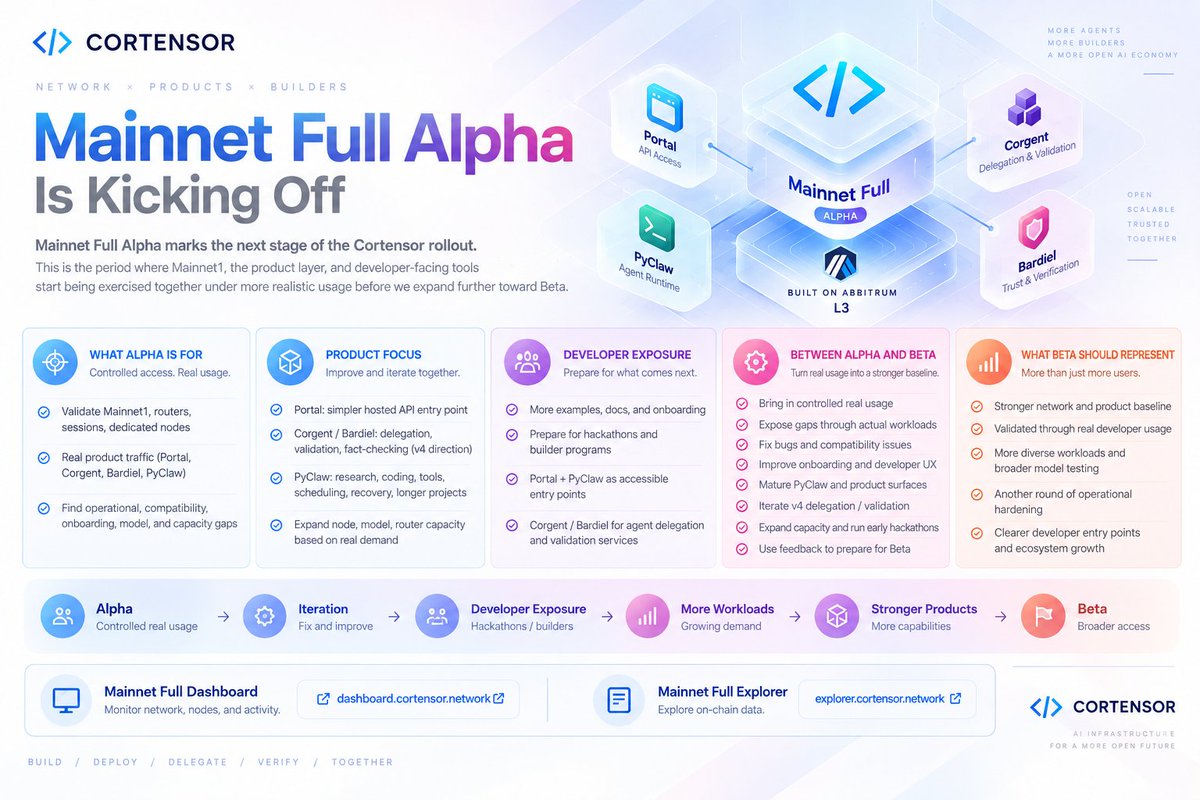
Mainnet Full Alpha marks the next stage of the Cortensor rollout.
This is not a one-time launch event. Alpha is the period where Mainnet1, the product layer, and developer-facing tools start being exercised together under more realistic usage before we expand further toward Beta.
🔹 What Alpha is for
- controlled access rather than broad public availability
- continued validation of Mainnet1, routers, sessions, dedicated nodes, dashboard, indexer, and recovery paths
- real product traffic through Portal, Corgent, Bardiel, and PyClaw-related workflows
- identifying operational, compatibility, onboarding, model, and capacity gaps through actual use
🔹 Product focus
- Portal will continue improving as the simpler hosted API entry point into Cortensor
- Corgent / Bardiel will keep iterating on delegation, validation, fact-checking, and the early v4 direction
- PyClaw will continue maturing across research, coding, memory, tools, scheduling, delegation, recovery, longer-running projects, packaging, and the early Desktop App
- Mainnet Full capacity will gradually expand as we learn where real demand appears
🔹 Developer exposure
- Alpha is also preparation for broader builder activity
- We expect to prepare more examples, documentation, onboarding, model availability, and product capacity for hackathons and builder programs
- Portal and PyClaw should provide two accessible entry points, while Corgent / Bardiel can give agents additional delegation and validation services to build around
🔹 What happens between Alpha and Beta
- bring in controlled real usage
- expose gaps through actual workloads
- fix bugs and compatibility issues
- improve onboarding and developer experience
- mature PyClaw and the product surfaces
- iterate v4 delegation / validation
- expand node, model, router, and gateway capacity
- run early hackathons / builder programs
- use that feedback to prepare for broader Beta access
🔹 What Beta should represent
Beta should mean more than simply “more users.”
It should mean a stronger network and product baseline that has already gone through real developer usage, more diverse workloads, broader model testing, and another round of operational hardening.
Alpha → real usage → iteration → developer exposure → more workloads → stronger products → Beta.
Mainnet Full Dashboard:
https://t.co/creezgDDCQ
Mainnet Full Explorer:
https://t.co/puPXRG45pf
#Cortensor #MainnetFull #Portal #PyClaw #Corgent #Bardiel #AgenticAI
🛠️ DevLog – PyClaw: What’s Moving Toward the Next Release
The next PyClaw release is taking shape, with the current work focused on security workflows, SDK continuity, identity boundaries, provider errors, skills, and cross-platform reliability.
🔹 Security workflows
Expand independent security review and remediation paths
Add stronger research, repair, and controlled local-lab workflows
Keep closure decisions grounded in actual tool evidence rather than model claims alone
🔹 SDK and session continuity
Improve same-session SDK follow-ups so multi-turn workflows remain connected
Tighten runtime-scoped identity storage
Enforce clearer session ownership when work moves across agents
🔹 Provider and tool behavior
Preserve typed provider failures even after tool execution
Make failure state clearer instead of allowing successful tool activity to hide a later provider error
🔹 Skills and runtime visibility
Improve skill identity and pending-version visibility
Continue tightening identity, usage, and runtime introspection across the main surfaces
🔹 Cross-platform reliability
Improve scheduled-task / cron timezone behavior on Windows
Expand regression coverage across identity, usage, providers, and cross-platform runtime paths
🔹 Current status
The current candidate work is largely passing deterministic and hosted checks
Integrated validation, merge / promotion, and the normal PyPI, manifest, and unsigned binary publication flow still need to complete
One live provider confirmation was blocked by a temporary upstream provider error, so we are keeping that separate from the deterministic validation result
🔹 Current takeaway
The next release is shaping up as another reliability and safety pass
The focus is stronger evidence-backed security workflows, cleaner SDK continuity, tighter identity / session boundaries, and better cross-platform behavior before publication
#Cortensor #DevLog #PyClaw #SDK #Cybersecurity #AgenticAI #DeveloperTools
🛠️ DevLog – PyClaw: Latest Release Improves Memory, Coding Validation, and Cross-Platform Runtime Delivery
The latest PyClaw release is now out, with another refinement pass around memory introspection, coding continuity, regression coverage, provider validation, and runtime publication.
🔹 Memory visibility
- Global memory introspection is more reliable for system-scoped memory
- This gives users and runtime surfaces a clearer view into what memory exists and how it is being carried across broader workflows
🔹 Coding acceptance and continuity
- Goal-only coding workflows now have stronger acceptance and continuity evidence
- The focus is making it clearer whether the requested objective was actually completed rather than relying only on intermediate task state
🔹 Regression coverage
- Provider-free CLI regression coverage has been expanded
- This gives us a stronger deterministic baseline for catching runtime and interface regressions without depending on live provider behavior
🔹 Live provider validation
- Hosted MiniMax checks are also part of the validation path
- This helps confirm that the same workflows behave correctly against a real provider after deterministic tests pass
🔹 Runtime publication
- Source manifests are being verified as part of the release process
- Unsigned cross-platform runtime builds are also published for continued macOS, Linux, and Windows testing
- This release was another useful pass through the now-public packaging and distribution pipeline
🔹 Current takeaway
- This release continues tightening both runtime quality and the release path around it
- Memory visibility, coding completion evidence, deterministic regressions, live provider checks, and reproducible cross-platform builds are all moving together toward a more reliable PyClaw baseline
#Cortensor #DevLog #PyClaw #AgenticAI #DeveloperTools #OpenSource #AIInfra
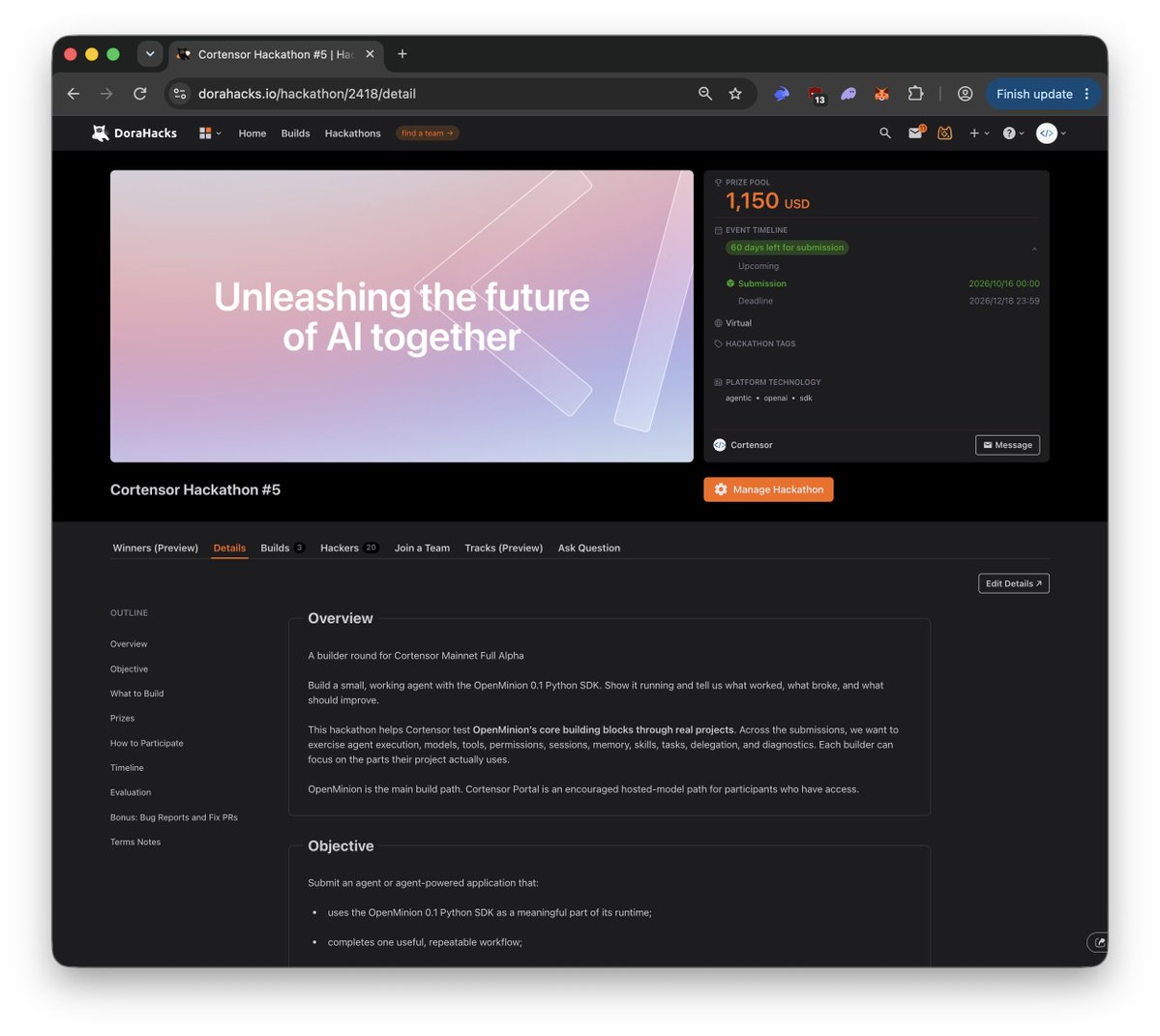
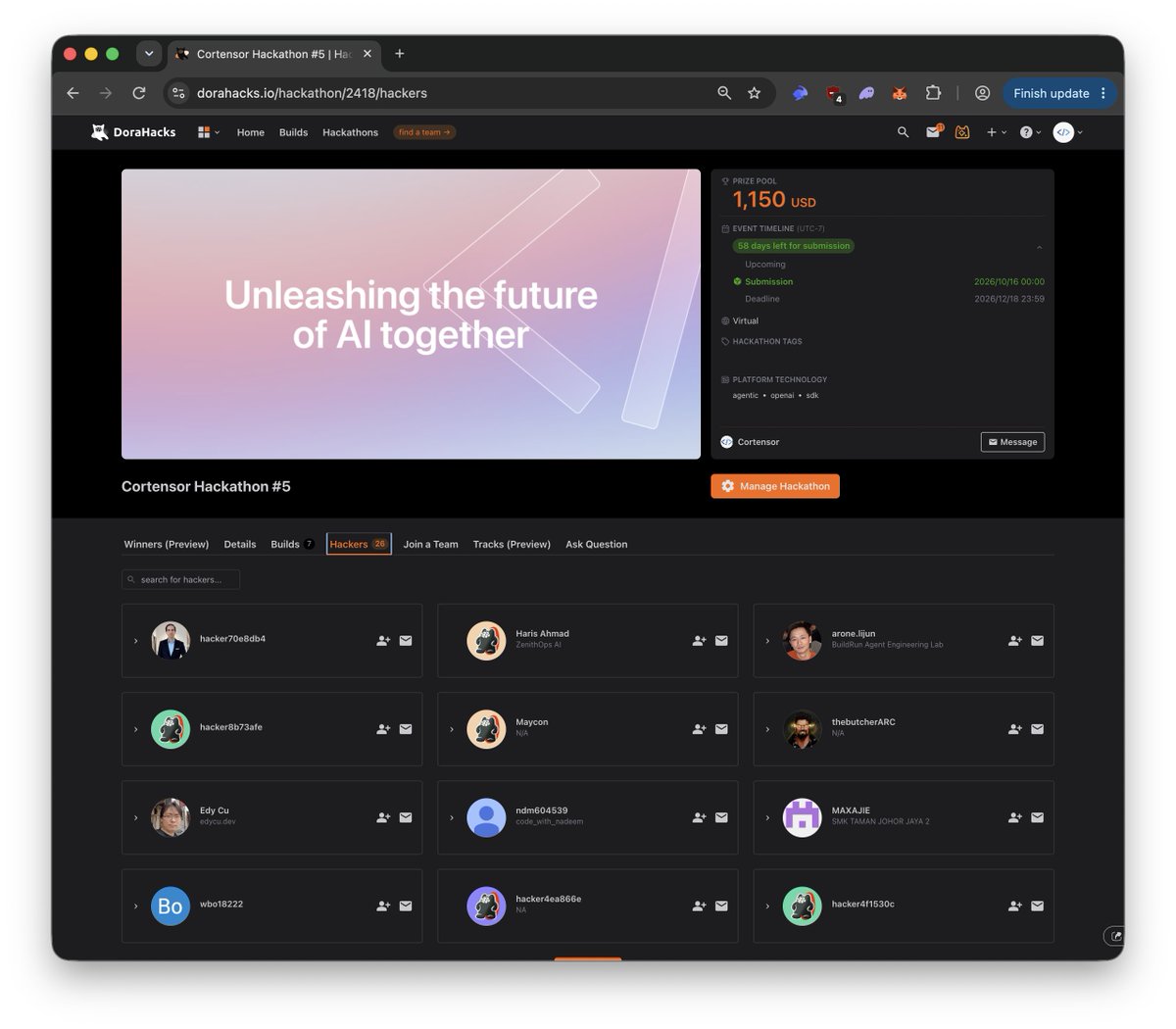
🛠️ DevLog – Hackathon #5: Early Participation Reaches 26 Builders
A quick progress update as Hackathon #5 continues to gain traction.
🔹 Current participation
- 26 builders have joined so far
- 7 projects have already been submitted
- The submission window remains open through 12/18/2026
🔹 What we are watching
- how builders onboard into PyClaw 0.1
- which SDK, tool, memory, delegation, and workflow paths they naturally use
- where docs, examples, provider setup, or runtime behavior still create friction
- useful bug reports and fix PRs that come out of real project work
- Portal / model usage where builders choose to use the hosted path
🔹 Why this matters
- The goal is not only the final submission count
- We want sustained external usage across the full hackathon window
- More builders and more projects give us stronger signals around SDK quality, runtime gaps, onboarding, model behavior, and the kinds of agent applications people actually want to build
🔹 Current takeaway
- Early participation has now grown to 26 builders with 7 submissions
- We will keep promoting the round, refining the SDK / docs, and triaging external feedback as more projects take shape over the coming weeks
DoraHacks:
https://t.co/8lJsXDRlLH
#Cortensor #DevLog #PyClaw #Portal #Hackathon #SDK #OpenSource
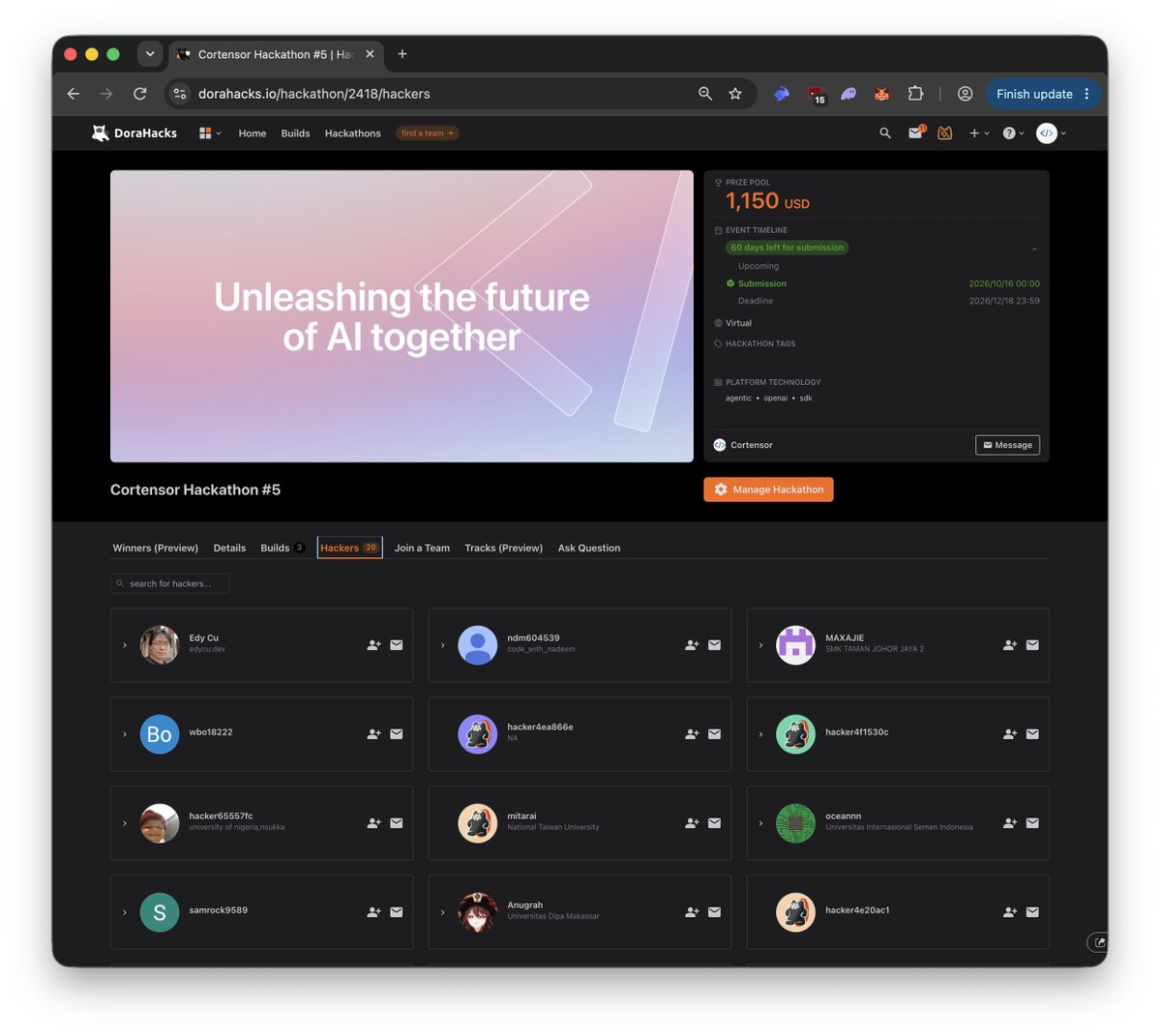
🛠️ DevLog – Hackathon #5: Early Participation Reaches 20 Builders
A quick progress update as Hackathon #5 continues to pick up early activity.
🔹 Current participation
- 20 builders have joined so far
- 3 projects have already been submitted
- The submission window remains open through 12/18/2026
🔹 What we are watching
- how builders onboard into PyClaw 0.1
- which SDK, tool, memory, delegation, and workflow paths they naturally use
- where docs, examples, provider setup, or runtime behavior still create friction
- useful bug reports and fix PRs that come out of real project work
- Portal / model usage where builders choose to use the hosted path
🔹 Why this matters
- The goal is not only the final submission count
- We want sustained external usage across the full hackathon window
- Every project, issue, contribution, and reproducible finding gives us another signal for improving PyClaw, Portal, docs, models, and the overall builder experience
🔹 Current takeaway
- Early participation has now grown to 20 builders with 3 submissions
- We will keep promoting the round, refining the SDK / docs, and triaging external feedback as more projects start taking shape
DoraHacks:
https://t.co/8lJsXDRlLH
#Cortensor #DevLog #PyClaw #Portal #Hackathon #SDK #OpenSource
🛠️ DevLog – PyClaw: Latest Release Improves Memory, Coding Validation, and Cross-Platform Runtime Delivery
The latest PyClaw release is now out, with another refinement pass around memory introspection, coding continuity, regression coverage, provider validation, and runtime publication.
🔹 Memory visibility
- Global memory introspection is more reliable for system-scoped memory
- This gives users and runtime surfaces a clearer view into what memory exists and how it is being carried across broader workflows
🔹 Coding acceptance and continuity
- Goal-only coding workflows now have stronger acceptance and continuity evidence
- The focus is making it clearer whether the requested objective was actually completed rather than relying only on intermediate task state
🔹 Regression coverage
- Provider-free CLI regression coverage has been expanded
- This gives us a stronger deterministic baseline for catching runtime and interface regressions without depending on live provider behavior
🔹 Live provider validation
- Hosted MiniMax checks are also part of the validation path
- This helps confirm that the same workflows behave correctly against a real provider after deterministic tests pass
🔹 Runtime publication
- Source manifests are being verified as part of the release process
- Unsigned cross-platform runtime builds are also published for continued macOS, Linux, and Windows testing
- This release was another useful pass through the now-public packaging and distribution pipeline
🔹 Current takeaway
- This release continues tightening both runtime quality and the release path around it
- Memory visibility, coding completion evidence, deterministic regressions, live provider checks, and reproducible cross-platform builds are all moving together toward a more reliable PyClaw baseline
#Cortensor #DevLog #PyClaw #AgenticAI #DeveloperTools #OpenSource #AIInfra
🛠️ DevLog – PyClaw: Full Open-Source Release Path Gets a Test Run
A quick follow-up now that the remaining CLI and Desktop packaging repositories are public.
🔹 Full packaging path is now open
- PyClaw core, Desktop App, and the related packaging / binary-build repositories are now publicly accessible
- Until now, parts of the build pipeline still lived in private repositories
- With those remaining pieces opened up, the broader source → packaging → binary → distribution path can now be treated much more like one fully open-source project
🔹 Next release as a test run
- We plan to use the upcoming 0.1.9 release as another full E2E test of this public release flow
- That includes source release, packaging, cross-platform binary builds, runtime metadata, publication, and downstream verification
- It should also help confirm that the release automation behaves correctly now that the packaging repositories are public
🔹 Why this matters
- Private packaging repositories previously meant parts of the build / Actions workflow were still operating as private infrastructure
- Moving them public improves transparency and should also simplify the open-source CI / release model
- External developers can now inspect not only the runtime source, but also how the CLI and Desktop binaries are actually produced
🔹 Current takeaway
- 0.1.9 will be a practical test of the now-public end-to-end release pipeline
- The goal is to have the core runtime, Desktop App, packaging, binaries, manifests, and distribution infrastructure increasingly operate as one open development stack
#Cortensor #DevLog #PyClaw #DesktopApp #OpenSource #DeveloperTools #AIInfra
🛠️ DevLog – PyClaw: CLI and Desktop Packaging Repositories Are Now Public
A quick follow-up on the packaging / distribution work.
Both packaging repositories are now public, covering the two main binary build paths around PyClaw.
🔹 CLI / daemon packaging
- handles cross-platform packaging for the PyClaw core runtime
- supports binary builds across macOS, Linux, and Windows
- connects into the broader runtime manifest, release, checksum, and update lifecycle
🔹 Desktop packaging
- handles the separate build / release path for the PyClaw Desktop App
- keeps Desktop-specific dependencies and platform packaging isolated from the core runtime
- supports the longer-term managed Desktop → CLI / daemon runtime model
🔹 Why this matters
- the source repos are only one part of the delivery stack
- opening the packaging layer makes it easier to inspect how binaries are actually produced and distributed
- external developers can now also contribute around platform compatibility, packaging, release automation, and build reliability
🔹 The broader flow
PyClaw source
→ CLI / daemon packaging
→ runtime binaries
→ manifest / distribution
Desktop source
→ Desktop packaging
→ Desktop binaries
→ managed runtime integration
🔹 Current takeaway
- more of the full PyClaw build and distribution lifecycle is now open
- core runtime, Desktop, packaging, and release infrastructure can increasingly be inspected and improved through the same external developer feedback loop
#Cortensor #DevLog #PyClaw #DesktopApp #OpenSource #DeveloperTools #AIInfra
🛠️ DevLog – PyClaw: Two Packaging Repositories Going Public
Two additional PyClaw packaging repositories are expected to become public later today.
🔹 What they are for
- one repository handles packaging / binary builds for the PyClaw CLI / daemon runtime
- the other handles packaging / binary builds for the PyClaw Desktop App
- both support the broader cross-platform distribution path across macOS, Linux, and Windows
🔹 Why separate packaging repos
- the core runtime and Desktop App have different build and release requirements
- keeping packaging isolated makes it easier to manage platform-specific dependencies, artifacts, manifests, and release workflows
- it also keeps source development separate from binary distribution concerns
🔹 How they fit together
The broader flow is:
PyClaw core source
→ CLI / daemon packaging repo
→ runtime binaries
PyClaw Desktop source
→ Desktop packaging repo
→ Desktop binaries
Both then connect into the same runtime / manifest / update lifecycle we have been building.
🔹 Why make them public
- improve transparency around how binaries are produced
- make cross-platform build issues easier for external developers to inspect
- allow broader contribution around packaging, release automation, and distribution
- keep more of the PyClaw delivery stack open alongside the core and Desktop repositories
🔹 Current takeaway
- the source repos are only one part of the open development path
- making both packaging repositories public brings more of the actual build and distribution lifecycle into the open as well
#Cortensor #DevLog #PyClaw #DesktopApp #OpenSource #DeveloperTools #AIInfra
🛠️ DevLog – More PyClaw Build and Distribution Repositories Going Public
A few more repositories related to the PyClaw CLI / core and Desktop build / distribution flow are expected to become public over the coming days.
🔹 What these repos cover
- cross-platform CLI / daemon builds
- Desktop packaging and release preparation
- runtime manifests and version metadata
- binary publication / distribution workflows
- compatibility and update-related infrastructure
🔹 Why open them
- The PyClaw core and Desktop repos are already moving toward a more open development model
- Opening more of the surrounding build / release infrastructure makes it easier for developers to understand how the full distribution path works
- It also gives external contributors more visibility into packaging, platform-specific issues, release automation, and runtime lifecycle behavior
🔹 How the pieces connect
The broader flow is becoming:
source / SDK
→ CLI / daemon builds
→ runtime metadata
→ cross-platform binaries
→ Desktop integration
→ update / distribution lifecycle
These are different repositories and workflows, but they support the same PyClaw runtime underneath.
🔹 Current takeaway
- More of the PyClaw build and distribution stack will become public over the next few days
- The goal is broader transparency, easier external testing, and eventually more community contribution across not only the runtime itself, but also packaging and Desktop delivery
#Cortensor #DevLog #PyClaw #DesktopApp #OpenSource #DeveloperTools #AIInfra
🛠️ DevLog – PyClaw Desktop Repository Is Now Public
The PyClaw Desktop repository is now public.
This is another step toward making the same open PyClaw runtime accessible through both developer-facing and broader end-user surfaces.
🔹 What Desktop is
- A local graphical workspace on top of the existing PyClaw CLI / daemon runtime
- It does not introduce a separate agent engine
- Sessions, tools, policies, credentials, approvals, and durable runtime state continue to come from the same core underneath
🔹 Current Desktop surface
- local chat and saved conversations
- profiles and model / provider setup
- task and session controls
- tool approvals and runtime visibility
- daemon status / diagnostics
- managed runtime installation and update preparation
- local preview / visual-context foundations
🔹 Why open the repo now
- The basic architecture and runtime integration are mature enough for broader inspection and contribution
- External developers can now review the Desktop implementation, report issues, submit fixes, and help improve CLI / Desktop parity
- This also extends the same open-source feedback loop we are already seeing around the PyClaw SDK and core runtime
🔹 Still an early development surface
- Desktop should still be considered a development preview
- Full Focus / CLI parity, media / artifact workflows, broader runtime recovery, signed stable packaging, and cross-platform qualification still need more work
- We will continue polishing these areas in public from here
🔹 Current takeaway
- PyClaw core / CLI gives developers direct access to the runtime
- Desktop provides another interface to that same runtime for users who prefer a graphical experience
- With both repositories now open, the broader PyClaw runtime + Desktop experience can increasingly evolve through the same external developer feedback loop
#Cortensor #DevLog #PyClaw #DesktopApp #OpenSource #DeveloperTools #AgenticAI
🛠️ DevLog – Hackathon #5: Early Participation Reaches 20 Builders
A quick progress update as Hackathon #5 continues to pick up early activity.
🔹 Current participation
- 20 builders have joined so far
- 3 projects have already been submitted
- The submission window remains open through 12/18/2026
🔹 What we are watching
- how builders onboard into PyClaw 0.1
- which SDK, tool, memory, delegation, and workflow paths they naturally use
- where docs, examples, provider setup, or runtime behavior still create friction
- useful bug reports and fix PRs that come out of real project work
- Portal / model usage where builders choose to use the hosted path
🔹 Why this matters
- The goal is not only the final submission count
- We want sustained external usage across the full hackathon window
- Every project, issue, contribution, and reproducible finding gives us another signal for improving PyClaw, Portal, docs, models, and the overall builder experience
🔹 Current takeaway
- Early participation has now grown to 20 builders with 3 submissions
- We will keep promoting the round, refining the SDK / docs, and triaging external feedback as more projects start taking shape
DoraHacks:
https://t.co/8lJsXDRlLH
#Cortensor #DevLog #PyClaw #Portal #Hackathon #SDK #OpenSource
🗓️ Weekly Focus – Mainnet Full Alpha, Hackathon #5 & PyClaw 0.1
Mainnet Full remains the primary environment and rollout track. This week’s main active focus is Hackathon #5, while PyClaw 0.1 public iteration continues alongside Alpha monitoring.
🔹 Mainnet Full – Alpha Monitoring
‐ Continue controlled Alpha monitoring across Portal, Corgent, Bardiel, routers, validators, quality signals, dashboard, and indexer.
‐ Use real product and builder traffic to identify compatibility, capacity, onboarding, and operational gaps ahead of Beta.
🔹 Hackathon #5 – Builder Support
‐ Hackathon #5 is live from 10/16 → 12/18, with PyClaw 0.1 as the primary builder surface and Portal as an optional hosted-model path.
‐ Support builders, answer questions, improve examples/docs, and help projects through early setup.
https://t.co/8lJsXDRlLH
🔹 Hackathon #5 – Product Feedback Loop
‐ Use real builder projects to surface SDK, runtime, onboarding, docs, Portal, model, and workflow gaps.
‐ Continue encouraging useful GitHub bug reports and fix PRs so builder activity directly feeds product quality.
🔹 PyClaw – 0.1 Polish & Bug Triage
‐ Continue addressing incoming public bug reports through the report → triage → reproduce → fix → release → verify loop.
‐ Prioritize regressions and builder-blocking issues as daily issue triage becomes part of the normal workflow.
🔹 PyClaw – Builder / SDK Experience
‐ Continue simplifying the install → define tool → create agent → run workflow path around the 0.1 SDK.
‐ Refine examples, typed errors, delegation, streaming, approvals, and documentation based on real builder usage.
🔹 Portal – Hackathon / Hosted Path
‐ Keep Portal available as the simpler hosted model path for Hackathon builders where capacity allows.
‐ Monitor model behavior, reliability, usage, and API compatibility as more external workloads come through.
🔹 DGX / Model Compatibility
‐ Continue NVIDIA DGX compatibility work around miner, runtime, container behavior, and Gemma4 workloads.
‐ Keep this validation-first while we identify what needs adjustment before broader use.
This week is about keeping Mainnet Full Alpha steady while using Hackathon #5 as the main external feedback loop for PyClaw, Portal, and the broader builder experience.
#Cortensor #MainnetFull #Alpha #PyClaw #Portal #Hackathon #AgenticAI #AIInfra #Gemma4 #DePIN
🛠️ DevLog – PyClaw: Latest Release Improves MCP, Scheduling, Memory, and Runtime Visibility
The latest PyClaw release is now out, with another reliability-focused pass across MCP, scheduled work, memory continuity, identity / artifact safety, telemetry, and Focus execution.
🔹 MCP lifecycle
- Live MCP server lifecycle handling is getting stronger across reload, OAuth, and broader protocol support
- The goal is a cleaner external-tool integration path without requiring runtime restarts for every change
🔹 Scheduled tasks and cron
- Scheduled work now has stronger operational controls around execution, retries, status, and cron behavior
- This continues the move toward more dependable background and long-running task workflows
🔹 Memory continuity
- Memory continuity and recovery health have improved
- Runtime surfaces now expose more useful introspection around what memory is available and how it is behaving across longer sessions
🔹 Identity and artifacts
- Agent identity verification is more robust
- Artifact ownership and lifecycle handling are also safer, which matters as more work spans multiple sessions, agents, and runtime surfaces
🔹 Telemetry and diagnostics
- Token and runtime diagnostics are becoming more accurate while keeping privacy boundaries in mind
- This gives us better visibility into longer workflows without exposing unnecessary local or sensitive data
🔹 Focus and provider execution
- Focus reliability continues improving
- MiniMax / provider-backed tool execution has also gone through another refinement pass to reduce user-facing regressions
🔹 Current takeaway
- This release continues tightening the 0.1 line around durability, observability, and multi-surface consistency
- MCP, scheduling, memory, identity, artifacts, telemetry, and Focus are all becoming more dependable as the runtime matures
#Cortensor #DevLog #PyClaw #AgenticAI #DeveloperTools #AIInfra
🛠️ DevLog – PyClaw: What’s Moving Toward the Next Release
A quick look at the main PyClaw work already merged into `dev` since the last release.
🔹 Scheduled tasks and background execution
- Scheduled-task controls now cover update, run now, pause / resume, retry, history cleanup, and incident handling
- Scheduler execution is becoming more durable around retries, attempt fencing, daemon delivery continuity, and operational visibility
🔹 MCP and tool lifecycle
- MCP servers can be reloaded more dynamically with safer rollback behavior
- Server configuration and OAuth login are also being tightened
- Tool status, call identity, errors, and structured results are becoming more consistent across CLI, debug, ACP, and MCP surfaces
🔹 Skills and memory
- Skill learning, admission, save / reuse, denial handling, and PostgreSQL persistence continue improving
- Long-horizon memory continuity now carries more structured recall from compacted prior episodes
- Memory fallback and recovery health are also becoming more visible from runtime / CLI surfaces
🔹 Projects, identity, and artifacts
- Long-running project handoffs, provider-failure reporting, and overlapping-turn isolation are being hardened
- Agent identity checks are getting stronger around missing files, render completeness, and semantic warnings
- Artifact retention, ownership, deletion, cleanup, and orphan detection are also being tightened
🔹 Telemetry and Focus
- Session-scoped telemetry, token timelines, first-run states, and Collector validation are becoming more accurate
- Terminal confirmations and Focus approval / permission flows continue getting broader coverage across paste, resize, macOS PTY, and other interactive paths
🔹 Current takeaway
- The next release is shaping up as another reliability and lifecycle pass across scheduling, MCP, skills, memory, projects, identity, artifacts, and Focus
- The goal remains making the existing PyClaw runtime more durable and consistent across longer-running, multi-surface workflows rather than expanding the feature surface too quickly
#Cortensor #DevLog #PyClaw #AgenticAI #DeveloperTools #AIInfra
🛠️ DevLog – PyClaw Desktop Repository Is Now Public
The PyClaw Desktop repository is now public.
This is another step toward making the same open PyClaw runtime accessible through both developer-facing and broader end-user surfaces.
🔹 What Desktop is
- A local graphical workspace on top of the existing PyClaw CLI / daemon runtime
- It does not introduce a separate agent engine
- Sessions, tools, policies, credentials, approvals, and durable runtime state continue to come from the same core underneath
🔹 Current Desktop surface
- local chat and saved conversations
- profiles and model / provider setup
- task and session controls
- tool approvals and runtime visibility
- daemon status / diagnostics
- managed runtime installation and update preparation
- local preview / visual-context foundations
🔹 Why open the repo now
- The basic architecture and runtime integration are mature enough for broader inspection and contribution
- External developers can now review the Desktop implementation, report issues, submit fixes, and help improve CLI / Desktop parity
- This also extends the same open-source feedback loop we are already seeing around the PyClaw SDK and core runtime
🔹 Still an early development surface
- Desktop should still be considered a development preview
- Full Focus / CLI parity, media / artifact workflows, broader runtime recovery, signed stable packaging, and cross-platform qualification still need more work
- We will continue polishing these areas in public from here
🔹 Current takeaway
- PyClaw core / CLI gives developers direct access to the runtime
- Desktop provides another interface to that same runtime for users who prefer a graphical experience
- With both repositories now open, the broader PyClaw runtime + Desktop experience can increasingly evolve through the same external developer feedback loop
#Cortensor #DevLog #PyClaw #DesktopApp #OpenSource #DeveloperTools #AgenticAI
🛠️ DevLog – PyClaw Desktop: Preparing the Repository for Public Release
The PyClaw Desktop repository is still private today, but we are preparing to open it up after another round of polish and cleanup.
🔹 Current focus
- tighten Desktop / CLI / Focus parity
- clean up onboarding, settings, runtime diagnostics, task controls, and update behavior
- continue validating packaged runtime discovery, staging, restart, and recovery
- reduce rough edges before exposing the repository more broadly
🔹 Why wait a bit longer
- The Desktop App is still a development preview
- We want the repository structure, setup flow, documentation, packaging, and basic workflows to be easier to understand before opening it publicly
- That should make early external feedback more useful and avoid unnecessary friction from unfinished setup paths
🔹 Timing
- We expect to spend the rest of this month on additional polish and qualification
- If that work goes well, the current target is to make the Desktop repository public around early next month
🔹 Why this matters
- The CLI / core runtime is already open and remains the foundation underneath
- Opening the Desktop repository gives developers another way to inspect, contribute to, and extend the broader PyClaw experience
- It also supports the longer-term direction of keeping Desktop and CLI as different interfaces to the same open runtime
🔹 Current takeaway
- The Desktop repo is not public yet, but that is the direction
- The next few weeks are about getting the current experience into a cleaner state so we can open it with a better baseline for external testing and contribution
#Cortensor #DevLog #PyClaw #DesktopApp #OpenSource #DeveloperTools #AgenticAI
🗓️ Weekly Focus – Mainnet Full Alpha, Hackathon #5 & PyClaw 0.1
Mainnet Full remains the primary environment and rollout track. This week’s main active focus is Hackathon #5, while PyClaw 0.1 public iteration continues alongside Alpha monitoring.
🔹 Mainnet Full – Alpha Monitoring
‐ Continue controlled Alpha monitoring across Portal, Corgent, Bardiel, routers, validators, quality signals, dashboard, and indexer.
‐ Use real product and builder traffic to identify compatibility, capacity, onboarding, and operational gaps ahead of Beta.
🔹 Hackathon #5 – Builder Support
‐ Hackathon #5 is live from 10/16 → 12/18, with PyClaw 0.1 as the primary builder surface and Portal as an optional hosted-model path.
‐ Support builders, answer questions, improve examples/docs, and help projects through early setup.
https://t.co/8lJsXDRlLH
🔹 Hackathon #5 – Product Feedback Loop
‐ Use real builder projects to surface SDK, runtime, onboarding, docs, Portal, model, and workflow gaps.
‐ Continue encouraging useful GitHub bug reports and fix PRs so builder activity directly feeds product quality.
🔹 PyClaw – 0.1 Polish & Bug Triage
‐ Continue addressing incoming public bug reports through the report → triage → reproduce → fix → release → verify loop.
‐ Prioritize regressions and builder-blocking issues as daily issue triage becomes part of the normal workflow.
🔹 PyClaw – Builder / SDK Experience
‐ Continue simplifying the install → define tool → create agent → run workflow path around the 0.1 SDK.
‐ Refine examples, typed errors, delegation, streaming, approvals, and documentation based on real builder usage.
🔹 Portal – Hackathon / Hosted Path
‐ Keep Portal available as the simpler hosted model path for Hackathon builders where capacity allows.
‐ Monitor model behavior, reliability, usage, and API compatibility as more external workloads come through.
🔹 DGX / Model Compatibility
‐ Continue NVIDIA DGX compatibility work around miner, runtime, container behavior, and Gemma4 workloads.
‐ Keep this validation-first while we identify what needs adjustment before broader use.
This week is about keeping Mainnet Full Alpha steady while using Hackathon #5 as the main external feedback loop for PyClaw, Portal, and the broader builder experience.
#Cortensor #MainnetFull #Alpha #PyClaw #Portal #Hackathon #AgenticAI #AIInfra #Gemma4 #DePIN
🗓️ Weekly Recap – Hackathon #5 Kickoff, PyClaw 0.1 Iteration & Mainnet Full Alpha
This week marked the start of Hackathon #5, while PyClaw 0.1 moved deeper into public iteration and Mainnet Full Alpha continued shifting from infrastructure validation toward real product and builder usage.
🔹 Hackathon #5 – Officially Live
‐ Hackathon #5 kicked off on DoraHacks, running from 10/16 → 12/18 with PyClaw 0.1 as the primary builder surface and Portal as an optional hosted-model path.
‐ Early participation reached 11 builders with 2 projects already submitted, giving us the first external workload signals for the round.
🔹 Hackathon #5 – Product Feedback Loop
‐ The round is intentionally being used as both a builder event and a product-quality exercise for PyClaw, Portal, SDKs, docs, models, and onboarding.
‐ Useful GitHub bug reports and fix PRs can also receive bonus consideration, encouraging builders to improve the stack while building.
🔹 PyClaw – Public Iteration & Bug Triage
‐ External activity continued growing through new contributors, bug reports, provider-specific findings, and fixes.
‐ Daily issue triage is becoming part of the normal workflow: report → reproduce → fix → release → verify against the public package.
🔹 PyClaw – 0.1.x Reliability
‐ Releases 0.1.4 → 0.1.6 tightened approvals, delegation, SDK tool isolation, typed failures, cancellation/deadlines, Focus safety, MCP behavior, and runtime handoffs.
‐ Focus remains on hardening the 0.1 baseline rather than rapidly expanding the feature surface.
🔹 PyClaw – Maintainer / Real-World Workflows
‐ GitHub maintainer workflows now exercise issue discovery, PR review, CI inspection, approvals, recovery, repository delivery, and evidence-backed remote operations as one connected flow.
‐ Upcoming work continues around grounded project handoffs, safer launch behavior, interruption handling, browser-bound approvals, and broader regression.
🔹 PyClaw – Distribution
‐ Unsigned macOS, Linux, and Windows builds remain available for broader testing while signing and stable public promotion stay separate qualification gates.
‐ Desktop/runtime distribution continues improving in parallel with public 0.1 iteration.
🔹 DGX – Compatibility Assessment
‐ Initial NVIDIA DGX / ARM64 testing surfaced CPU-side compatibility gaps across the miner binary, installer, helper scripts, IPFS, packaging, and supporting services.
‐ Next testing expands into NVIDIA GPU/runtime behavior, container compatibility, Gemma4 loading/inference, restart, and workload stability.
🔹 Mainnet Full – Alpha Progress
‐ Alpha continues moving from infrastructure validation → controlled product usage → builder exposure → real workloads → product fixes → capacity expansion.
‐ Portal, PyClaw, Corgent, and Bardiel increasingly provide the product surfaces through which those real Alpha workloads can reach Mainnet Full.
A productive week overall - Hackathon #5 is live, PyClaw now has an active public feedback loop around the 0.1 baseline, and Mainnet Full Alpha is beginning to generate the kind of real usage needed to prepare for Beta.
#Cortensor #MainnetFull #Alpha #PyClaw #Portal #Hackathon #AgenticAI #AIInfra #Gemma4 #DePIN
🛠️ DevLog – PyClaw: What’s Moving Toward the Next Release
A quick look at the main PyClaw work already merged into `dev` since the last release.
🔹 Scheduled tasks and background execution
- Scheduled-task controls now cover update, run now, pause / resume, retry, history cleanup, and incident handling
- Scheduler execution is becoming more durable around retries, attempt fencing, daemon delivery continuity, and operational visibility
🔹 MCP and tool lifecycle
- MCP servers can be reloaded more dynamically with safer rollback behavior
- Server configuration and OAuth login are also being tightened
- Tool status, call identity, errors, and structured results are becoming more consistent across CLI, debug, ACP, and MCP surfaces
🔹 Skills and memory
- Skill learning, admission, save / reuse, denial handling, and PostgreSQL persistence continue improving
- Long-horizon memory continuity now carries more structured recall from compacted prior episodes
- Memory fallback and recovery health are also becoming more visible from runtime / CLI surfaces
🔹 Projects, identity, and artifacts
- Long-running project handoffs, provider-failure reporting, and overlapping-turn isolation are being hardened
- Agent identity checks are getting stronger around missing files, render completeness, and semantic warnings
- Artifact retention, ownership, deletion, cleanup, and orphan detection are also being tightened
🔹 Telemetry and Focus
- Session-scoped telemetry, token timelines, first-run states, and Collector validation are becoming more accurate
- Terminal confirmations and Focus approval / permission flows continue getting broader coverage across paste, resize, macOS PTY, and other interactive paths
🔹 Current takeaway
- The next release is shaping up as another reliability and lifecycle pass across scheduling, MCP, skills, memory, projects, identity, artifacts, and Focus
- The goal remains making the existing PyClaw runtime more durable and consistent across longer-running, multi-surface workflows rather than expanding the feature surface too quickly
#Cortensor #DevLog #PyClaw #AgenticAI #DeveloperTools #AIInfra
🛠️ DevLog – PyClaw: Latest Release Improves Long-Running Readiness and Execution Evidence
The latest PyClaw release is now out, with another quality-focused pass across longer projects, delegation, verification, Focus queueing, blockchain testnet workflows, and reproducible release packaging.
🔹 Long-running project readiness
- Project readiness, verification, delegation, and handoff contracts have been tightened
- The goal is to make longer workflows more predictable across planning, execution, review, resume, and completion
🔹 Better failure evidence
- Coding, research, and resumed execution now preserve more actionable failure evidence
- This makes it easier to understand what actually failed and what needs to be retried, repaired, or reviewed
🔹 Focus queue and approvals
- Focus queueing has been made more reliable
- Consecutive approval flows are handled more cleanly so one approved or denied action does not leave later queued work in an ambiguous state
🔹 Blockchain testnet workflows
- Testnet acceptance coverage has been expanded
- Completed-tool evidence is also being preserved more clearly around blockchain operations and approval-bound execution
🔹 Release reproducibility
- Source publication and unsigned development binaries are now more reproducible
- This continues the broader work around making PyClaw easier to build, verify, distribute, and test across platforms
🔹 Current takeaway
- This release is another refinement pass on the 0.1 line
- The focus remains stronger long-running reliability, clearer evidence, safer approvals, and more reproducible runtime delivery rather than adding another large feature surface
#Cortensor #DevLog #PyClaw #AgenticAI #DeveloperTools #AIInfra
🛠️ DevLog – PyClaw Desktop: Preparing the Repository for Public Release
The PyClaw Desktop repository is still private today, but we are preparing to open it up after another round of polish and cleanup.
🔹 Current focus
- tighten Desktop / CLI / Focus parity
- clean up onboarding, settings, runtime diagnostics, task controls, and update behavior
- continue validating packaged runtime discovery, staging, restart, and recovery
- reduce rough edges before exposing the repository more broadly
🔹 Why wait a bit longer
- The Desktop App is still a development preview
- We want the repository structure, setup flow, documentation, packaging, and basic workflows to be easier to understand before opening it publicly
- That should make early external feedback more useful and avoid unnecessary friction from unfinished setup paths
🔹 Timing
- We expect to spend the rest of this month on additional polish and qualification
- If that work goes well, the current target is to make the Desktop repository public around early next month
🔹 Why this matters
- The CLI / core runtime is already open and remains the foundation underneath
- Opening the Desktop repository gives developers another way to inspect, contribute to, and extend the broader PyClaw experience
- It also supports the longer-term direction of keeping Desktop and CLI as different interfaces to the same open runtime
🔹 Current takeaway
- The Desktop repo is not public yet, but that is the direction
- The next few weeks are about getting the current experience into a cleaner state so we can open it with a better baseline for external testing and contribution
#Cortensor #DevLog #PyClaw #DesktopApp #OpenSource #DeveloperTools #AgenticAI
🛠️ DevLog – PyClaw: Latest Release Improves Long-Running Readiness and Execution Evidence
The latest PyClaw release is now out, with another quality-focused pass across longer projects, delegation, verification, Focus queueing, blockchain testnet workflows, and reproducible release packaging.
🔹 Long-running project readiness
- Project readiness, verification, delegation, and handoff contracts have been tightened
- The goal is to make longer workflows more predictable across planning, execution, review, resume, and completion
🔹 Better failure evidence
- Coding, research, and resumed execution now preserve more actionable failure evidence
- This makes it easier to understand what actually failed and what needs to be retried, repaired, or reviewed
🔹 Focus queue and approvals
- Focus queueing has been made more reliable
- Consecutive approval flows are handled more cleanly so one approved or denied action does not leave later queued work in an ambiguous state
🔹 Blockchain testnet workflows
- Testnet acceptance coverage has been expanded
- Completed-tool evidence is also being preserved more clearly around blockchain operations and approval-bound execution
🔹 Release reproducibility
- Source publication and unsigned development binaries are now more reproducible
- This continues the broader work around making PyClaw easier to build, verify, distribute, and test across platforms
🔹 Current takeaway
- This release is another refinement pass on the 0.1 line
- The focus remains stronger long-running reliability, clearer evidence, safer approvals, and more reproducible runtime delivery rather than adding another large feature surface
#Cortensor #DevLog #PyClaw #AgenticAI #DeveloperTools #AIInfra
🛠️ DevLog – PyClaw: What’s Likely Moving Into the Next Release
A quick preview of the PyClaw work currently moving toward the next release. Some items are already merged, while others are still completing validation.
🔹 Project handoffs and approvals
- Project handoffs are being grounded more clearly in the active task / project context
- Launch behavior is becoming more approval-first so delegated or higher-impact work does not begin ambiguously
- Blockchain testnet workflows are also getting stronger acceptance and recovery handling
🔹 Focus queue and interruption handling
- Focus is moving toward a shared input queue with clearer request correlation across CLI, gateway, and room paths
- Queue controls, interruption behavior, and active-turn handling are being tightened so concurrent or queued requests remain easier to follow and recover
🔹 Browser and provider context
- Browser upload approvals are being bound more tightly to the active origin
- Active Focus tab visibility is becoming provider-scoped so runtime context stays attached to the correct provider / session path
🔹 Runtime and packaging
- Runtime packaging and GitHub App token setup are getting another refinement pass
- Cron cleanup initialization is being made more reliable
- Regression coverage continues expanding across runtime, browser, queue, and tracker-lifecycle behavior
🔹 Current status
- The project-handoff, packaging, and blockchain work is already merged into `dev`
- Several Focus / browser / readiness changes are still going through hosted checks
- Final release scope may adjust slightly depending on those results
🔹 Current takeaway
- The next release is shaping up as another reliability pass around project handoffs, approvals, queue behavior, browser safety, and runtime lifecycle
- The focus remains making the existing PyClaw surfaces more consistent under real multi-session and longer-running workflows rather than adding another large feature layer
#Cortensor #DevLog #PyClaw #AgenticAI #DeveloperTools #AIInfra
🛠️ DevLog – Hackathon #5: Early Builder Activity Is Starting to Pick Up
A quick progress update now that Hackathon #5 is underway.
🔹 Early participation
- 11 builders have already joined the round
- There is still plenty of time left in the builder window, with submissions open through 12/18/2026
🔹 What we are watching
- how builders onboard into PyClaw 0.1
- which SDK / tool workflows they naturally use
- where docs, examples, provider setup, or runtime behavior still create friction
- useful bug reports and fix PRs that come out of real project work
- Portal / model usage where builders choose to use the hosted path
🔹 Why the early activity matters
- The main objective is not simply the final number of submissions
- We want sustained external usage over the full hackathon window
- Every project, issue, bug report, and contribution gives us another signal for improving PyClaw, the SDK, Portal, and the broader builder experience
🔹 Current takeaway
- Hackathon #5 is still early, but builder activity and submissions are already starting to come in
- We will keep promoting the round, improving docs / SDK support, and triaging feedback throughout the event rather than waiting until the final weeks
DoraHacks:
https://t.co/8lJsXDRlLH
#Cortensor #DevLog #PyClaw #Portal #Hackathon #SDK #OpenSource
🛠️ DevLog – Hackathon #5 Is Now Underway
Hackathon #5 has officially started and the builder window is now open.
🔹 What this round is for
- PyClaw 0.1 is the primary builder surface
- The goal is to build small, useful, reproducible agents and agent-powered applications
- We want real external usage across tools, memory, sessions, skills, tasks, delegation, structured output, and other runtime capabilities
- Portal remains an encouraged hosted-model path for builders who have access
🔹 Builder feedback matters
- This round is also a product-quality exercise
- We want to learn what works, what breaks, where onboarding is confusing, and which SDK / runtime / model gaps show up under real projects
- Useful bug reports and fix PRs can also receive bonus consideration
🔹 Longer builder window
- Started: 10/16/2026
- Ends: 12/18/2026
- The longer format gives builders time to experiment, iterate, report issues, and improve their projects rather than rushing toward a short deadline
🔹 What we will do during the round
- continue polishing the PyClaw SDK and docs
- share examples and builder guidance
- triage external bug reports regularly
- improve Portal / model access where capacity allows
- use real submissions and feedback to guide the next runtime iterations
🔹 Current takeaway
- Hackathon #5 is now live
- The main objective is not only submissions - it is sustained external builder usage that helps us improve PyClaw, Portal, docs, models, and the broader Cortensor developer experience over the next two months
DoraHacks:
https://t.co/8lJsXDRlLH
#Cortensor #DevLog #PyClaw #Portal #Hackathon #SDK #AgenticAI
🗓️ Weekly Recap – Hackathon #5 Kickoff, PyClaw 0.1 Iteration & Mainnet Full Alpha
This week marked the start of Hackathon #5, while PyClaw 0.1 moved deeper into public iteration and Mainnet Full Alpha continued shifting from infrastructure validation toward real product and builder usage.
🔹 Hackathon #5 – Officially Live
‐ Hackathon #5 kicked off on DoraHacks, running from 10/16 → 12/18 with PyClaw 0.1 as the primary builder surface and Portal as an optional hosted-model path.
‐ Early participation reached 11 builders with 2 projects already submitted, giving us the first external workload signals for the round.
🔹 Hackathon #5 – Product Feedback Loop
‐ The round is intentionally being used as both a builder event and a product-quality exercise for PyClaw, Portal, SDKs, docs, models, and onboarding.
‐ Useful GitHub bug reports and fix PRs can also receive bonus consideration, encouraging builders to improve the stack while building.
🔹 PyClaw – Public Iteration & Bug Triage
‐ External activity continued growing through new contributors, bug reports, provider-specific findings, and fixes.
‐ Daily issue triage is becoming part of the normal workflow: report → reproduce → fix → release → verify against the public package.
🔹 PyClaw – 0.1.x Reliability
‐ Releases 0.1.4 → 0.1.6 tightened approvals, delegation, SDK tool isolation, typed failures, cancellation/deadlines, Focus safety, MCP behavior, and runtime handoffs.
‐ Focus remains on hardening the 0.1 baseline rather than rapidly expanding the feature surface.
🔹 PyClaw – Maintainer / Real-World Workflows
‐ GitHub maintainer workflows now exercise issue discovery, PR review, CI inspection, approvals, recovery, repository delivery, and evidence-backed remote operations as one connected flow.
‐ Upcoming work continues around grounded project handoffs, safer launch behavior, interruption handling, browser-bound approvals, and broader regression.
🔹 PyClaw – Distribution
‐ Unsigned macOS, Linux, and Windows builds remain available for broader testing while signing and stable public promotion stay separate qualification gates.
‐ Desktop/runtime distribution continues improving in parallel with public 0.1 iteration.
🔹 DGX – Compatibility Assessment
‐ Initial NVIDIA DGX / ARM64 testing surfaced CPU-side compatibility gaps across the miner binary, installer, helper scripts, IPFS, packaging, and supporting services.
‐ Next testing expands into NVIDIA GPU/runtime behavior, container compatibility, Gemma4 loading/inference, restart, and workload stability.
🔹 Mainnet Full – Alpha Progress
‐ Alpha continues moving from infrastructure validation → controlled product usage → builder exposure → real workloads → product fixes → capacity expansion.
‐ Portal, PyClaw, Corgent, and Bardiel increasingly provide the product surfaces through which those real Alpha workloads can reach Mainnet Full.
A productive week overall - Hackathon #5 is live, PyClaw now has an active public feedback loop around the 0.1 baseline, and Mainnet Full Alpha is beginning to generate the kind of real usage needed to prepare for Beta.
#Cortensor #MainnetFull #Alpha #PyClaw #Portal #Hackathon #AgenticAI #AIInfra #Gemma4 #DePIN
🗓️ Weekly Focus – Mainnet Full Alpha, PyClaw 0.1 & Hackathon #5
This week continues Mainnet Full Alpha while PyClaw 0.1 moves into more public iteration. The main focus is polishing the current baseline, addressing early builder feedback, and preparing Hackathon #5 toward the end of the week.
🔹 Mainnet Full – Alpha Monitoring
‐ Continue monitoring Portal, PyClaw, Corgent, Bardiel, routers, validators, quality signals, dashboard, and indexer under controlled Alpha usage.
‐ Track onboarding, compatibility, capacity, and operational gaps as real product traffic increases.
🔹 PyClaw – 0.1 Polish
‐ Continue fixing regressions and polishing the 0.1 runtime rather than expanding the feature surface too quickly.
‐ Focus on research, coding, memory, tools, delegation, recovery, verification, onboarding, and longer-running workflows.
🔹 PyClaw – Bug Reports & Triage Process
‐ Address the first round of public bug reports and establish a clearer intake → triage → reproduce → fix → regression process.
‐ Define practical response/severity timeframes so builder feedback can be handled consistently as usage grows.
🔹 PyClaw – Agent SDK & Builder Experience
‐ Continue simplifying the SDK toward a fast install → define tool → create agent → run workflow path.
‐ Tighten examples, typed errors, streaming, structured outputs, delegation, docs, and builder onboarding around the 0.1 baseline.
🔹 PyClaw – Distribution & Public Iteration
‐ Continue qualification of CLI, daemon, Desktop, and standalone builds across macOS, Linux, and Windows.
‐ Keep improving docs and public surfaces so users can test 0.1 while clearly understanding what is still early/WIP.
🔹 Hackathon #5 – Kickoff Prep
‐ Finalize docs, DoraHacks setup, rules, judging, examples, and builder flow for the PyClaw-first round.
‐ Current direction is to kick off toward the end of this week, with Portal / Gemma4 available as an optional hosted path where capacity allows.
🔹 PyClaw × Portal – Feedback Loop
‐ Continue validating Portal as the simpler hosted model path alongside direct Cortensor Router access.
‐ Use builder workflows to surface remaining SDK, API compatibility, model, runtime, and onboarding gaps.
🔹 DGX / Model Compatibility
‐ Continue the initial DGX compatibility exercise around Gemma4 and the current miner/runtime/container path.
‐ Treat this as validation first, with broader capacity decisions coming after the compatibility baseline is understood.
This week is about turning PyClaw 0.1 into a stronger public baseline, building a repeatable feedback/bug process, and getting Hackathon #5 ready to bring more real builders into the loop.
#Cortensor #MainnetFull #Alpha #PyClaw #Portal #Hackathon #AgenticAI #AIInfra #Gemma4 #DePIN
🛠️ DevLog – PyClaw: What’s Likely Moving Into the Next Release
A quick preview of the PyClaw work currently moving toward the next release. Some items are already merged, while others are still completing validation.
🔹 Project handoffs and approvals
- Project handoffs are being grounded more clearly in the active task / project context
- Launch behavior is becoming more approval-first so delegated or higher-impact work does not begin ambiguously
- Blockchain testnet workflows are also getting stronger acceptance and recovery handling
🔹 Focus queue and interruption handling
- Focus is moving toward a shared input queue with clearer request correlation across CLI, gateway, and room paths
- Queue controls, interruption behavior, and active-turn handling are being tightened so concurrent or queued requests remain easier to follow and recover
🔹 Browser and provider context
- Browser upload approvals are being bound more tightly to the active origin
- Active Focus tab visibility is becoming provider-scoped so runtime context stays attached to the correct provider / session path
🔹 Runtime and packaging
- Runtime packaging and GitHub App token setup are getting another refinement pass
- Cron cleanup initialization is being made more reliable
- Regression coverage continues expanding across runtime, browser, queue, and tracker-lifecycle behavior
🔹 Current status
- The project-handoff, packaging, and blockchain work is already merged into `dev`
- Several Focus / browser / readiness changes are still going through hosted checks
- Final release scope may adjust slightly depending on those results
🔹 Current takeaway
- The next release is shaping up as another reliability pass around project handoffs, approvals, queue behavior, browser safety, and runtime lifecycle
- The focus remains making the existing PyClaw surfaces more consistent under real multi-session and longer-running workflows rather than adding another large feature layer
#Cortensor #DevLog #PyClaw #AgenticAI #DeveloperTools #AIInfra
🗓️ Weekly Focus – Mainnet Full Alpha, PyClaw 0.1 & Hackathon #5
This week continues Mainnet Full Alpha while PyClaw 0.1 moves into more public iteration. The main focus is polishing the current baseline, addressing early builder feedback, and preparing Hackathon #5 toward the end of the week.
🔹 Mainnet Full – Alpha Monitoring
‐ Continue monitoring Portal, PyClaw, Corgent, Bardiel, routers, validators, quality signals, dashboard, and indexer under controlled Alpha usage.
‐ Track onboarding, compatibility, capacity, and operational gaps as real product traffic increases.
🔹 PyClaw – 0.1 Polish
‐ Continue fixing regressions and polishing the 0.1 runtime rather than expanding the feature surface too quickly.
‐ Focus on research, coding, memory, tools, delegation, recovery, verification, onboarding, and longer-running workflows.
🔹 PyClaw – Bug Reports & Triage Process
‐ Address the first round of public bug reports and establish a clearer intake → triage → reproduce → fix → regression process.
‐ Define practical response/severity timeframes so builder feedback can be handled consistently as usage grows.
🔹 PyClaw – Agent SDK & Builder Experience
‐ Continue simplifying the SDK toward a fast install → define tool → create agent → run workflow path.
‐ Tighten examples, typed errors, streaming, structured outputs, delegation, docs, and builder onboarding around the 0.1 baseline.
🔹 PyClaw – Distribution & Public Iteration
‐ Continue qualification of CLI, daemon, Desktop, and standalone builds across macOS, Linux, and Windows.
‐ Keep improving docs and public surfaces so users can test 0.1 while clearly understanding what is still early/WIP.
🔹 Hackathon #5 – Kickoff Prep
‐ Finalize docs, DoraHacks setup, rules, judging, examples, and builder flow for the PyClaw-first round.
‐ Current direction is to kick off toward the end of this week, with Portal / Gemma4 available as an optional hosted path where capacity allows.
🔹 PyClaw × Portal – Feedback Loop
‐ Continue validating Portal as the simpler hosted model path alongside direct Cortensor Router access.
‐ Use builder workflows to surface remaining SDK, API compatibility, model, runtime, and onboarding gaps.
🔹 DGX / Model Compatibility
‐ Continue the initial DGX compatibility exercise around Gemma4 and the current miner/runtime/container path.
‐ Treat this as validation first, with broader capacity decisions coming after the compatibility baseline is understood.
This week is about turning PyClaw 0.1 into a stronger public baseline, building a repeatable feedback/bug process, and getting Hackathon #5 ready to bring more real builders into the loop.
#Cortensor #MainnetFull #Alpha #PyClaw #Portal #Hackathon #AgenticAI #AIInfra #Gemma4 #DePIN
🛠️ DevLog – The Builder Feedback Loop: Use → Report → Fix → Release → Repeat
One of the main goals of the current PyClaw builder phase is to make external feedback part of the normal development cycle.
We are already starting to see that happen through outside contributions, bug reports, and SDK usage.
🔹 The loop
- developers try PyClaw
- real workflows expose an issue or missing behavior
- reports are triaged and reproduced
- fixes are implemented and regression-tested
- a patch release goes out
- builders verify the updated behavior
- the next set of real workloads begins
Use
→ report
→ reproduce
→ fix
→ release
→ verify
→ repeat
🔹 Why this is useful
- internal testing can cover expected workflows
- external builders are much better at finding unexpected combinations and edge cases
- bug reports, fix PRs, examples, and documentation feedback all improve the runtime for the next developer
🔹 How hackathons strengthen it
- ongoing hackathons bring in more builders over a sustained period
- useful GitHub bug reports and fixes are part of the contribution loop
- Portal / model usage can also surface compatibility, latency, capacity, and agent-workflow issues beyond PyClaw itself
🔹 How this connects to demand
- better SDK + runtime → easier building
- easier building → more developers
- more developers → more applications and agent workflows
- more workflows → more Portal / model / infrastructure usage
- more usage → better signals about what needs to scale next
🔹 Current takeaway
- the goal is not only to ship features from the core team
- we want PyClaw to improve through a repeatable external builder feedback loop
- over time, that can strengthen the SDK, Portal, models, documentation, and the broader Cortensor developer ecosystem together
#Cortensor #DevLog #PyClaw #Portal #Hackathon #OpenSource #DeveloperTools
🛠️ DevLog – PyClaw 0.1 Moves From Internal Testing to External Builder Usage
With Hackathon #5 now underway, PyClaw 0.1 is moving into a different kind of validation phase.
The runtime has already gone through months of internal iteration across research, coding, memory, tools, delegation, scheduling, recovery, and longer-running workflows.
Now more of that baseline is being exercised by external builders.
🔹 What changes with external usage
- new developers approach the SDK differently than the core team
- they combine tools and workflows in ways we may not expect
- onboarding gaps become much easier to see
- provider / model behavior gets tested under more varied workloads
- fragile runtime paths surface faster
🔹 Why the hackathon matters
- PyClaw is the primary builder surface
- builders can create practical agents and agent-powered applications using the 0.1 SDK
- Portal can provide an optional hosted model path where capacity allows
- the longer event window gives us sustained external usage rather than one short testing burst
🔹 What we will watch closely
- install → setup → first working agent
- tools and SDK ergonomics
- streaming and structured output
- delegation and longer workflows
- memory / session continuity
- provider compatibility
- bug reports and reproducible failure cases
🔹 Current takeaway
- PyClaw 0.1 was the first usability baseline
- the next step is seeing how that baseline behaves outside our own test environment
- external builders should help us identify the quality gaps that matter most before the runtime matures further
#Cortensor #DevLog #PyClaw #Hackathon #SDK #OpenSource #AgenticAI
🛠️ DevLog – Hackathon #5 Is Now Underway
Hackathon #5 has officially started and the builder window is now open.
🔹 What this round is for
- PyClaw 0.1 is the primary builder surface
- The goal is to build small, useful, reproducible agents and agent-powered applications
- We want real external usage across tools, memory, sessions, skills, tasks, delegation, structured output, and other runtime capabilities
- Portal remains an encouraged hosted-model path for builders who have access
🔹 Builder feedback matters
- This round is also a product-quality exercise
- We want to learn what works, what breaks, where onboarding is confusing, and which SDK / runtime / model gaps show up under real projects
- Useful bug reports and fix PRs can also receive bonus consideration
🔹 Longer builder window
- Started: 10/16/2026
- Ends: 12/18/2026
- The longer format gives builders time to experiment, iterate, report issues, and improve their projects rather than rushing toward a short deadline
🔹 What we will do during the round
- continue polishing the PyClaw SDK and docs
- share examples and builder guidance
- triage external bug reports regularly
- improve Portal / model access where capacity allows
- use real submissions and feedback to guide the next runtime iterations
🔹 Current takeaway
- Hackathon #5 is now live
- The main objective is not only submissions - it is sustained external builder usage that helps us improve PyClaw, Portal, docs, models, and the broader Cortensor developer experience over the next two months
DoraHacks:
https://t.co/8lJsXDRlLH
#Cortensor #DevLog #PyClaw #Portal #Hackathon #SDK #AgenticAI
🛠️ DevLog – Hackathon #5 Starts in Less Than 6 Hours
Hackathon #5 is almost here.
🔹 Starts soon
- Kickoff is less than 6 hours away
- PyClaw 0.1 is the primary builder surface
- Portal remains an optional hosted model path where capacity allows
🔹 What we want from this round
- practical agent workflows
- real SDK and onboarding feedback
- more external bug reports and reproducible findings
- Portal / model compatibility testing
- useful projects that expose what needs to improve next
🔹 Longer builder window
- Starts: 10/16/2026
- Ends: 12/18/2026
- Builders will have roughly 2 months to experiment, iterate, and improve their projects
🔹 Current takeaway
- This round is about much more than submissions
- We want sustained external usage, better developer feedback, and real workloads that help improve PyClaw, Portal, docs, models, and the broader Cortensor stack throughout the event
DoraHacks:
https://t.co/8lJsXDRlLH
#Cortensor #DevLog #PyClaw #Portal #Hackathon #SDK #AgenticAI