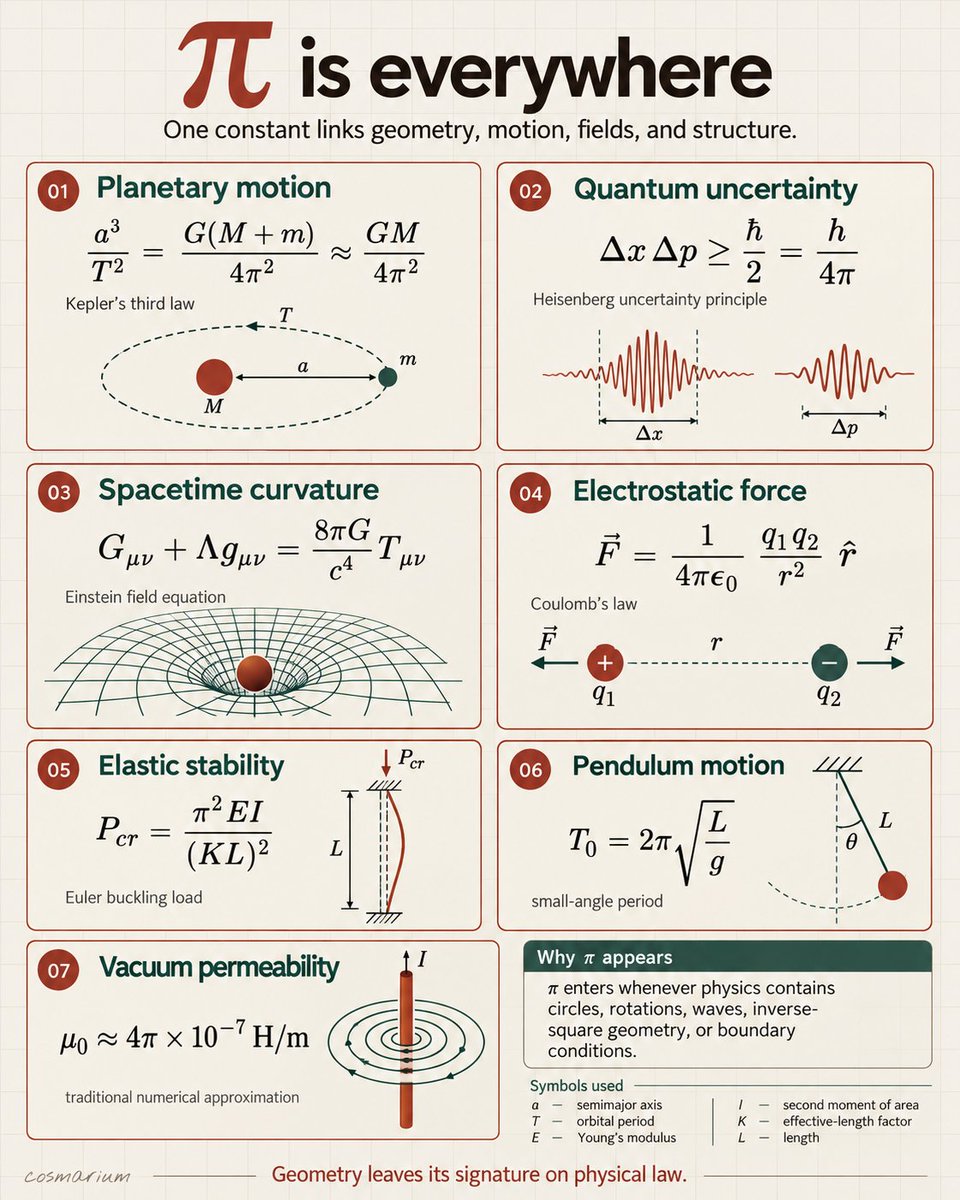
π appears throughout physics because geometry keeps returning. Circles, rotations, waves, and spherical spreading naturally introduce this constant.
It enters orbital motion, quantum uncertainty, electrostatic forces, spacetime curvature, pendulums, and elastic stability. Each appearance reflects an underlying symmetry or boundary condition.
Its repetition is not a numerical coincidence. It is geometry leaving a recognizable signature on physical law.
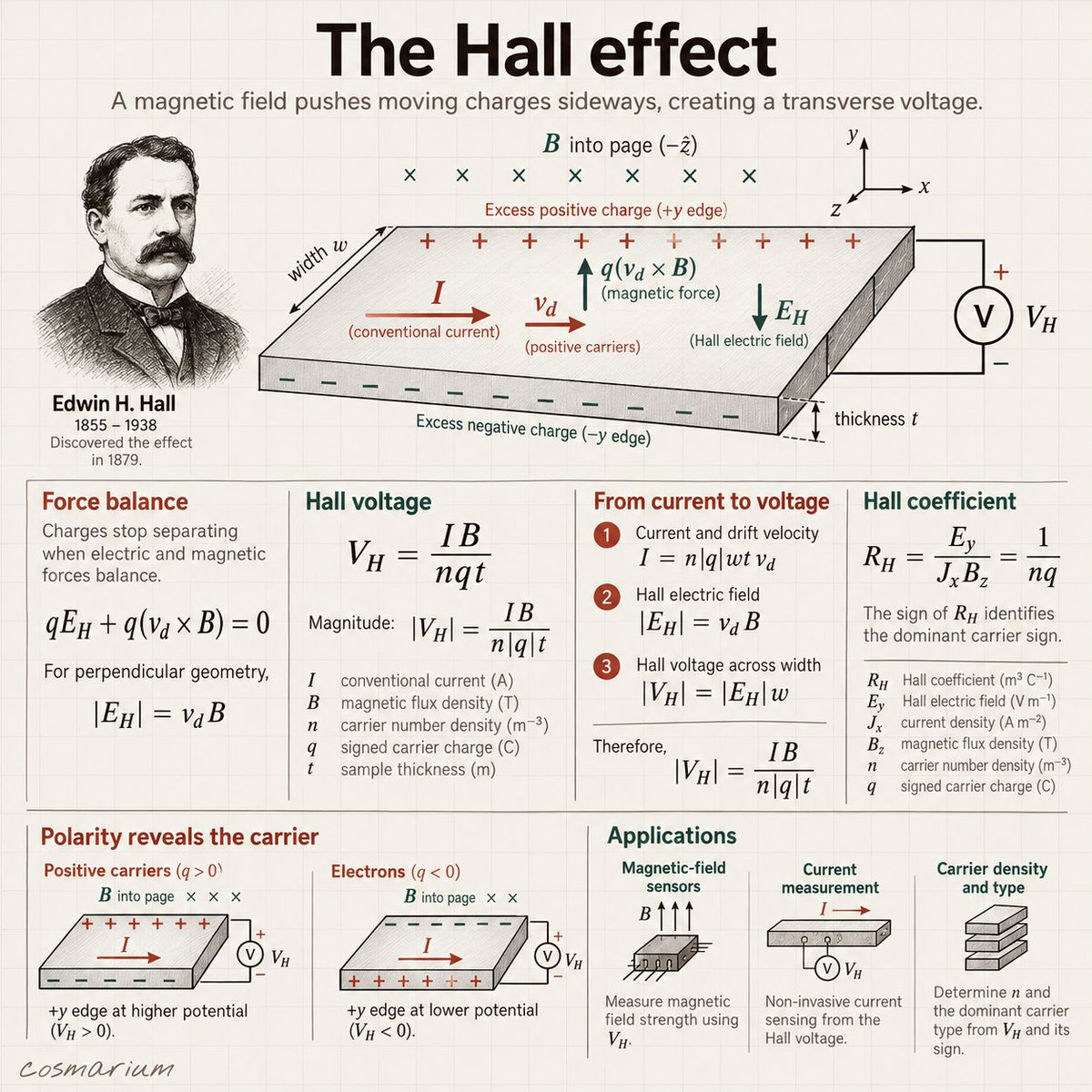
The Hall effect turns sideways magnetic deflection into a measurable voltage. Moving charge carriers are pushed toward one edge of a current-carrying material.
The resulting charge separation creates an electric field that grows until it balances the magnetic force. The voltage across the material is the Hall voltage.
Its magnitude reveals magnetic-field strength and carrier density, while its polarity identifies the dominant carrier sign. This makes the Hall effect useful in magnetic sensors, current meters, and semiconductor analysis.
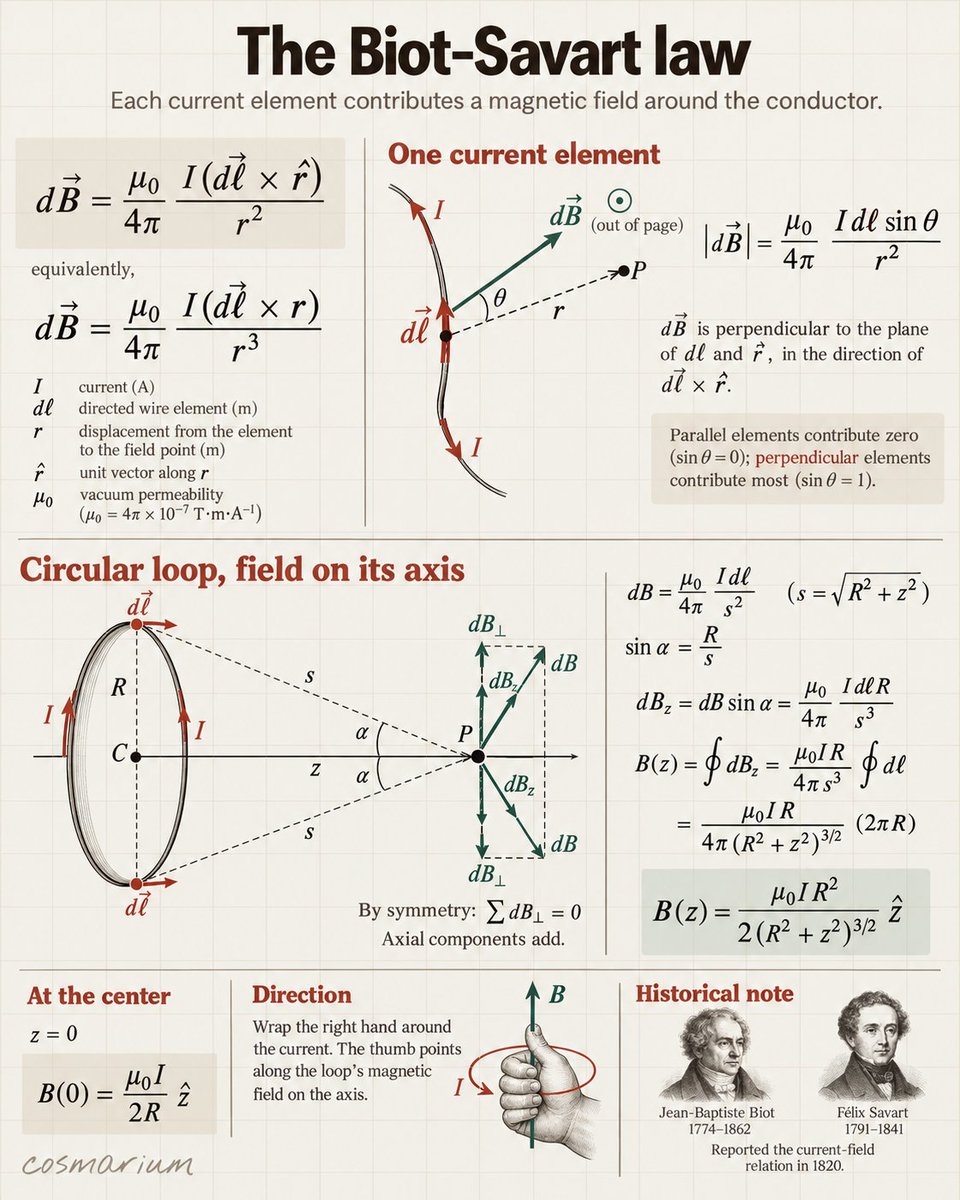
A magnetic field around a wire is the sum of contributions from every small current element. Each contribution depends on the current, distance, and angle to the observation point.
For a circular loop, sideways field components cancel along the axis. The axial components reinforce one another, producing a field strongest at the center.
The right-hand rule gives its direction. This principle underlies magnetic coils, electromagnets, motors, and many sensing devices.
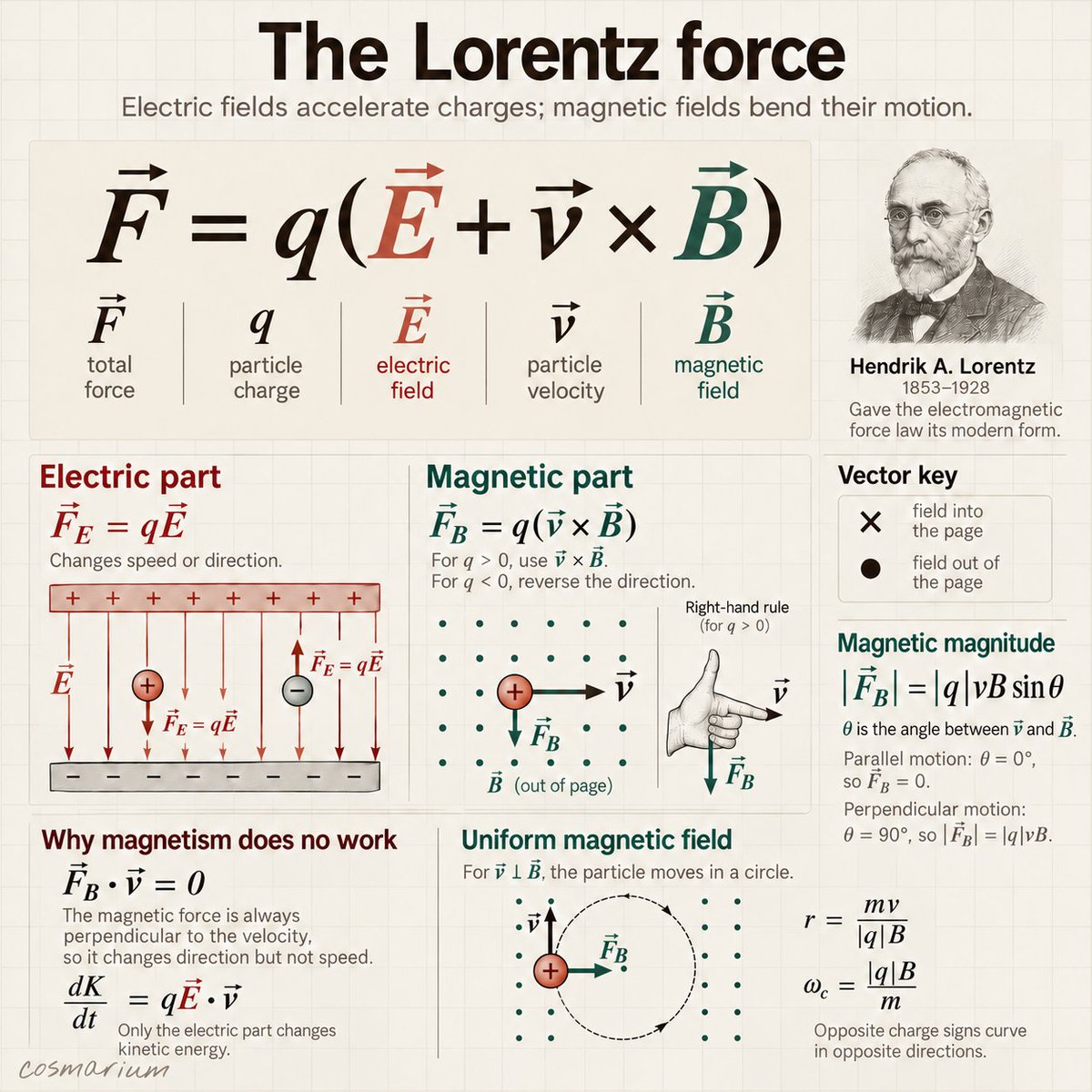
The Lorentz force describes how electric and magnetic fields act on a charged particle. Electric fields can change its kinetic energy, while magnetic fields bend its path.
The magnetic force is perpendicular to both the particle’s velocity and the magnetic field. Because it is perpendicular to the motion, it changes direction without changing speed.
In a uniform magnetic field, perpendicular motion becomes circular. This principle guides charged particles in mass spectrometers, accelerators, and magnetic confinement systems.
At Brewster’s angle, reflected light becomes completely s-polarized at an ideal dielectric interface. The p-polarized component is transmitted rather than reflected.
The angle depends on the refractive indices: tan θB = n₂/n₁. For light traveling from air into glass, it is typically about 56°.
This effect explains why glare from water or glass is often strongly polarized. Polarizing filters use it to reduce reflections and improve optical clarity.
A projectile follows a parabola because two motions occur at once. Its horizontal velocity remains constant, while gravity steadily changes its vertical velocity.
At the highest point, the vertical velocity is zero for an instant, but the projectile is still moving horizontally. Gravity then accelerates it downward.
A 45° launch gives maximum range only when launch and landing heights are equal and air resistance is neglected. Real trajectories differ because drag changes both motion components.
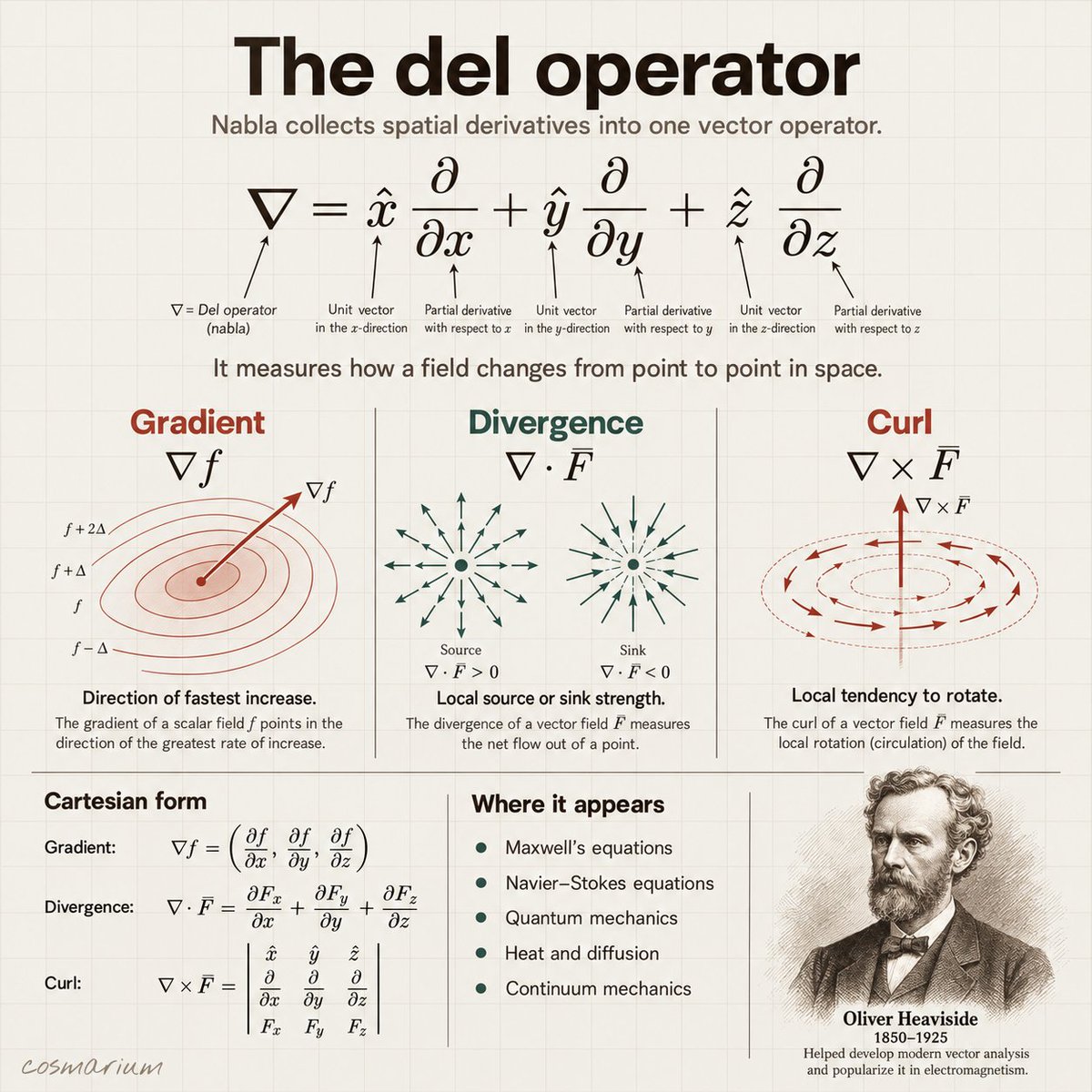
The del operator, ∇, packages spatial derivatives into one compact symbol. It describes how fields vary from point to point.
Applied to a scalar field, it gives the gradient, the direction of fastest increase. Applied to a vector field, divergence measures local spreading, while curl measures local rotation.
These ideas form the mathematical language of electromagnetism, fluid dynamics, heat flow, and quantum mechanics. One symbol connects many ways that nature changes across space.
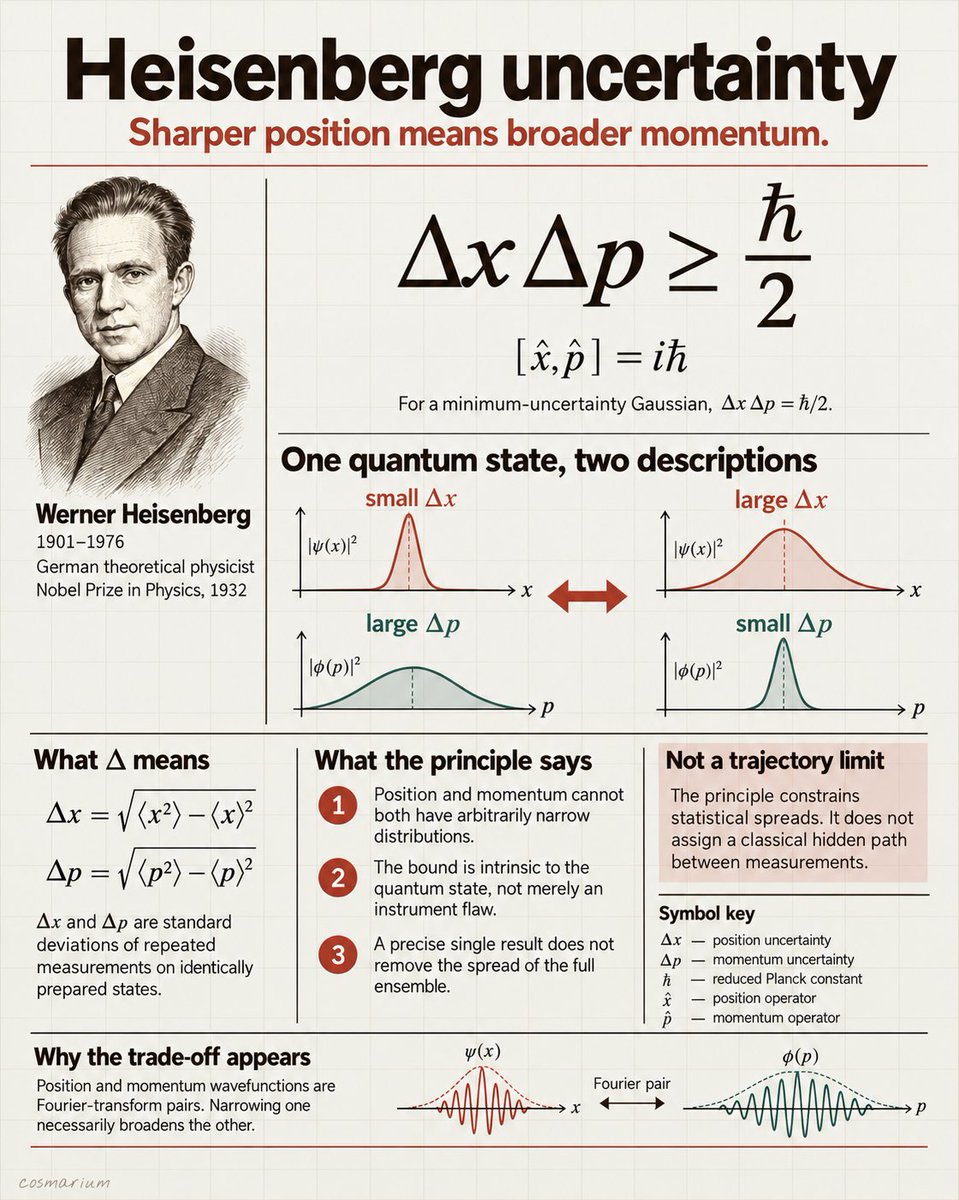
Quantum uncertainty is not caused by imperfect instruments. It is built into the structure of a quantum state.
Position and momentum are linked as Fourier pairs. Narrowing the position distribution necessarily broadens the momentum distribution, with ΔxΔp ≥ ℏ/2.
The principle limits statistical spreads across repeated measurements. It does not describe a hidden classical trajectory between them.
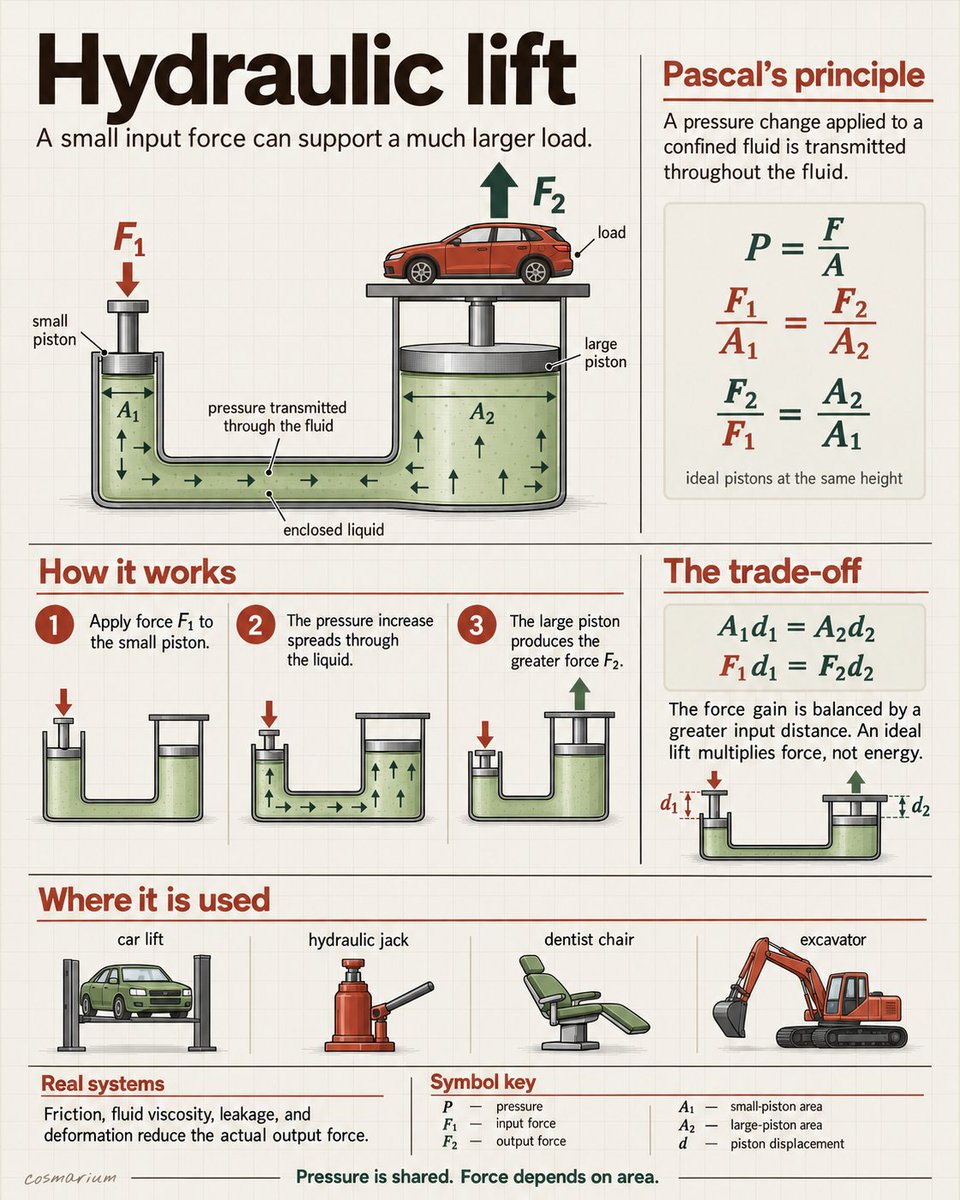
A hydraulic lift turns a small input force into a much larger lifting force. Pascal’s principle makes this possible by transmitting pressure through a confined fluid.
The larger piston experiences the same pressure over a greater area, so it produces more force. The force ratio equals the piston area ratio.
This gain does not create energy. The smaller piston must move farther, while friction, leakage, and fluid viscosity reduce real performance.
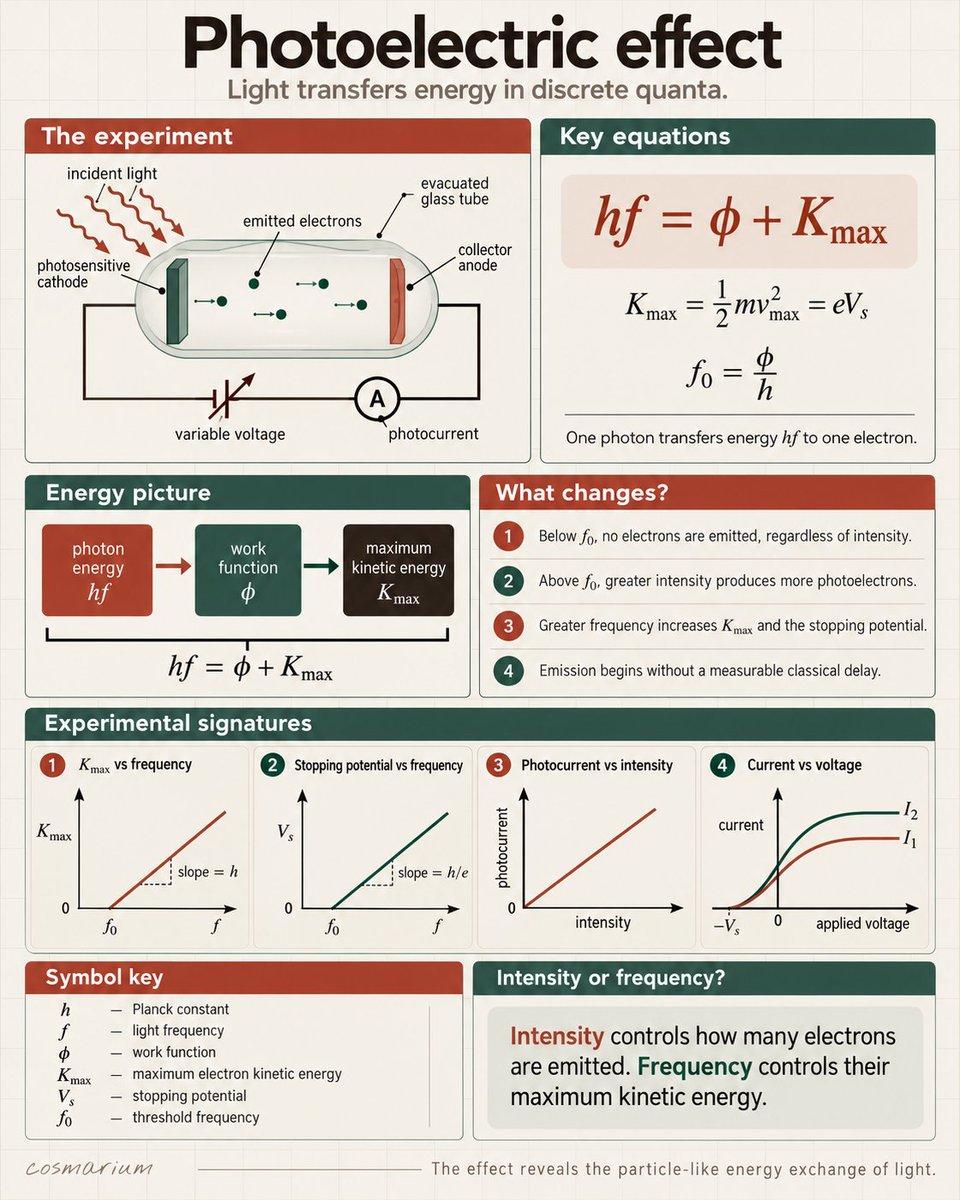
The photoelectric effect shows that light transfers energy in discrete packets called photons. One photon gives energy hf to one electron.
Electrons are emitted only when the light frequency exceeds the material’s threshold frequency. Above that threshold, higher frequency increases the electrons’ maximum kinetic energy.
Greater intensity supplies more photons, so more electrons can be emitted. It does not increase the energy carried by each photon.
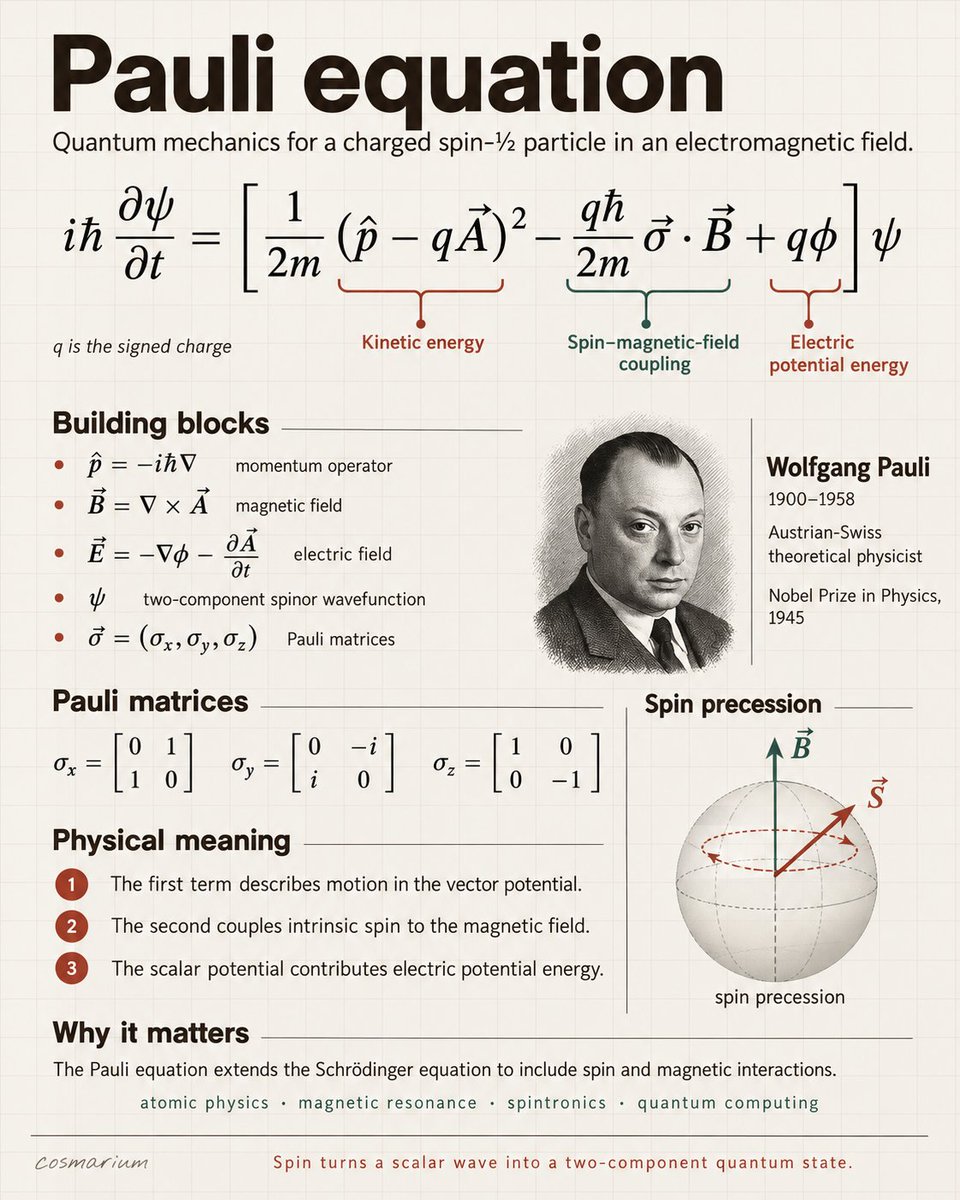
The Pauli equation extends nonrelativistic quantum mechanics to charged spin-½ particles in electromagnetic fields. Its wavefunction has two components that encode the particle’s spin state.
The equation combines motion, electric potential energy, and spin coupling to the magnetic field. This coupling causes spin precession and determines how magnetic fields split spin states.
The framework underlies atomic physics, magnetic resonance, spintronics, and quantum computing. At relativistic energies, the more complete Dirac equation is required.
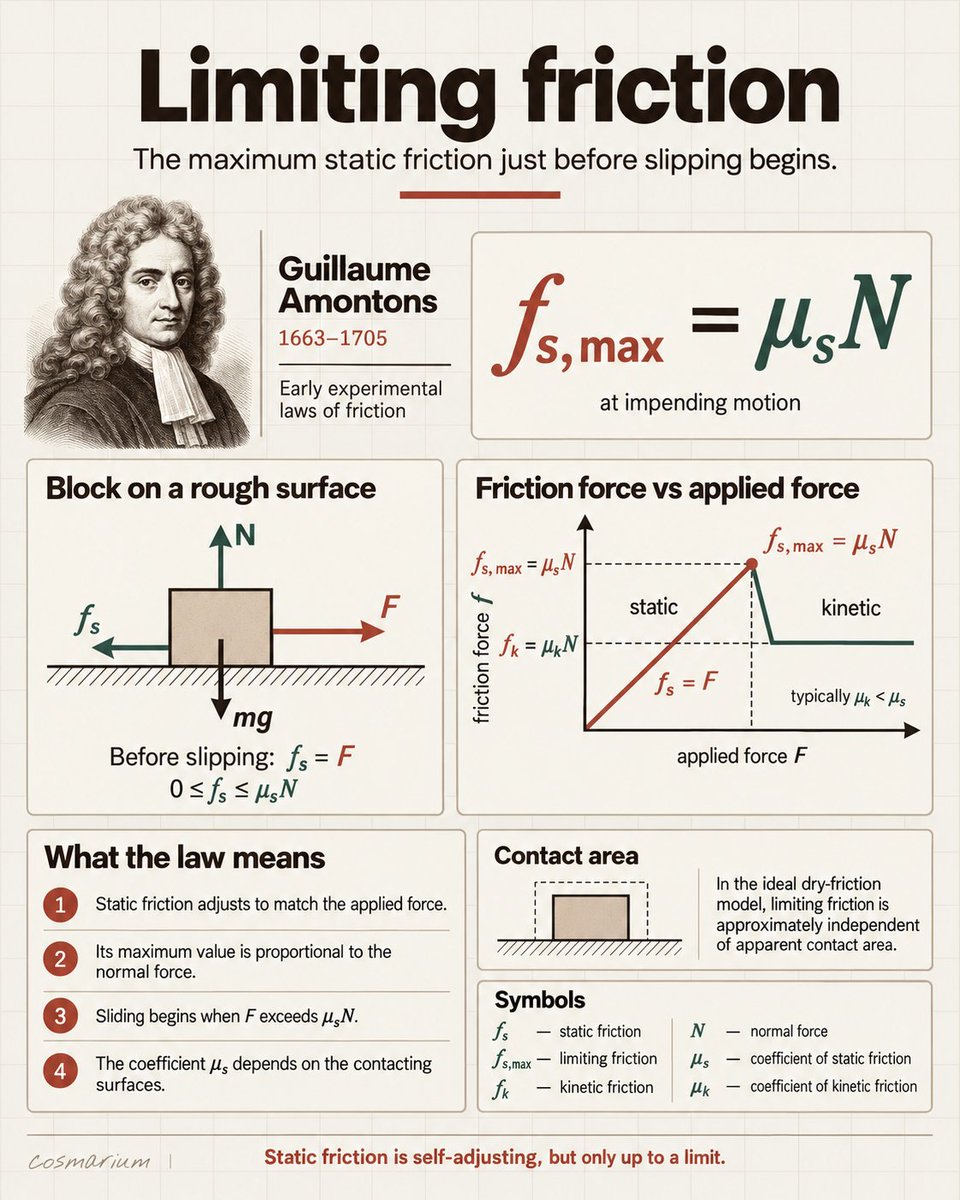
Static friction is not always equal to μₛN. It adjusts to match the applied force until reaching the limiting value fₛ,max = μₛN.
If the applied force exceeds this limit, the surfaces begin to slide. The friction then becomes kinetic and is typically smaller than the maximum static friction.
The coefficient μₛ depends on the contacting materials and surface conditions. In the ideal dry-friction model, limiting friction is approximately independent of apparent contact area.
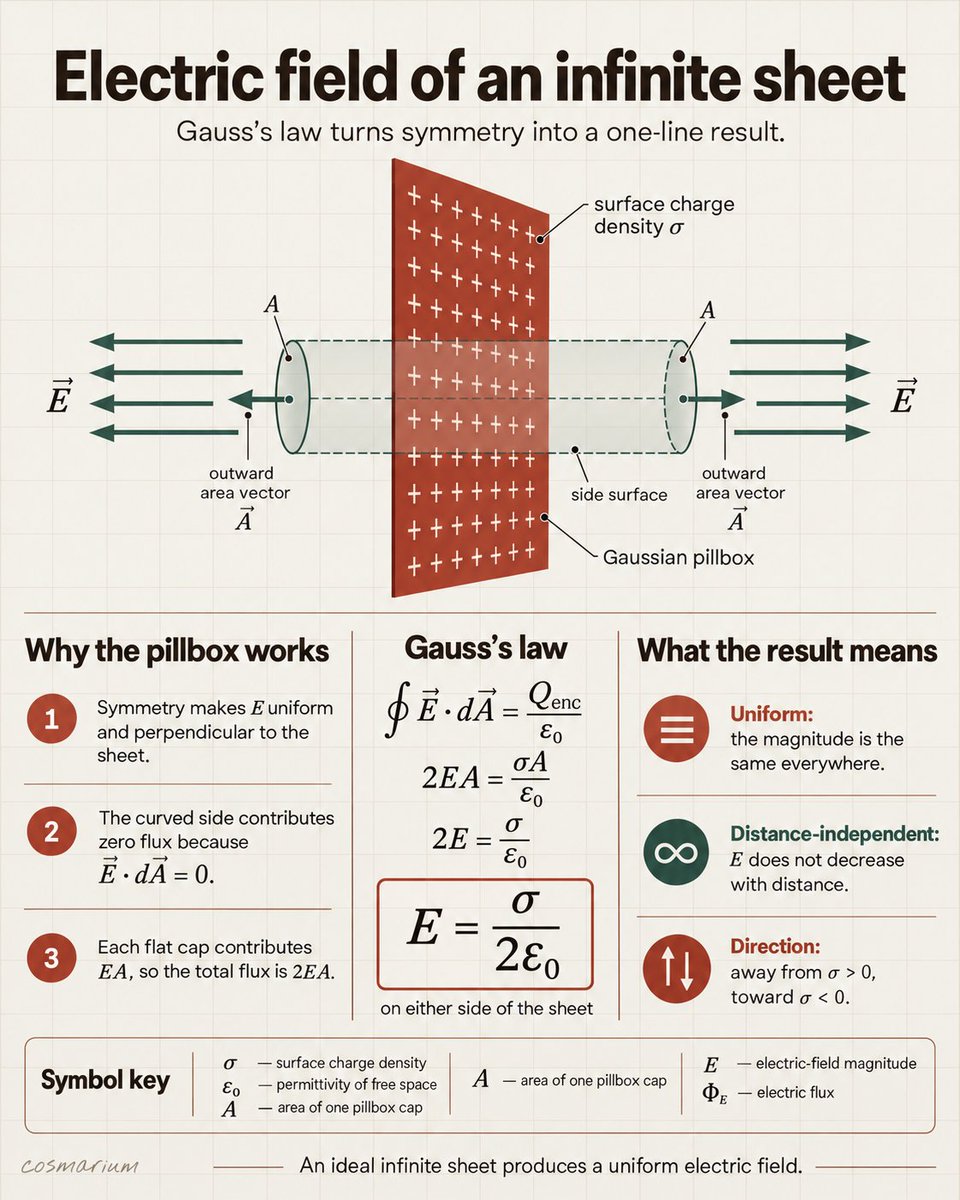
An ideal infinite charged sheet produces a uniform electric field perpendicular to its surface. Gauss’s law gives E = σ/(2ε₀) on either side.
The field points away from positive charge and toward negative charge. Unlike a point charge’s field, its magnitude does not decrease with distance.
This distance independence follows from perfect planar symmetry. Real finite sheets only approximate the result far from their edges.
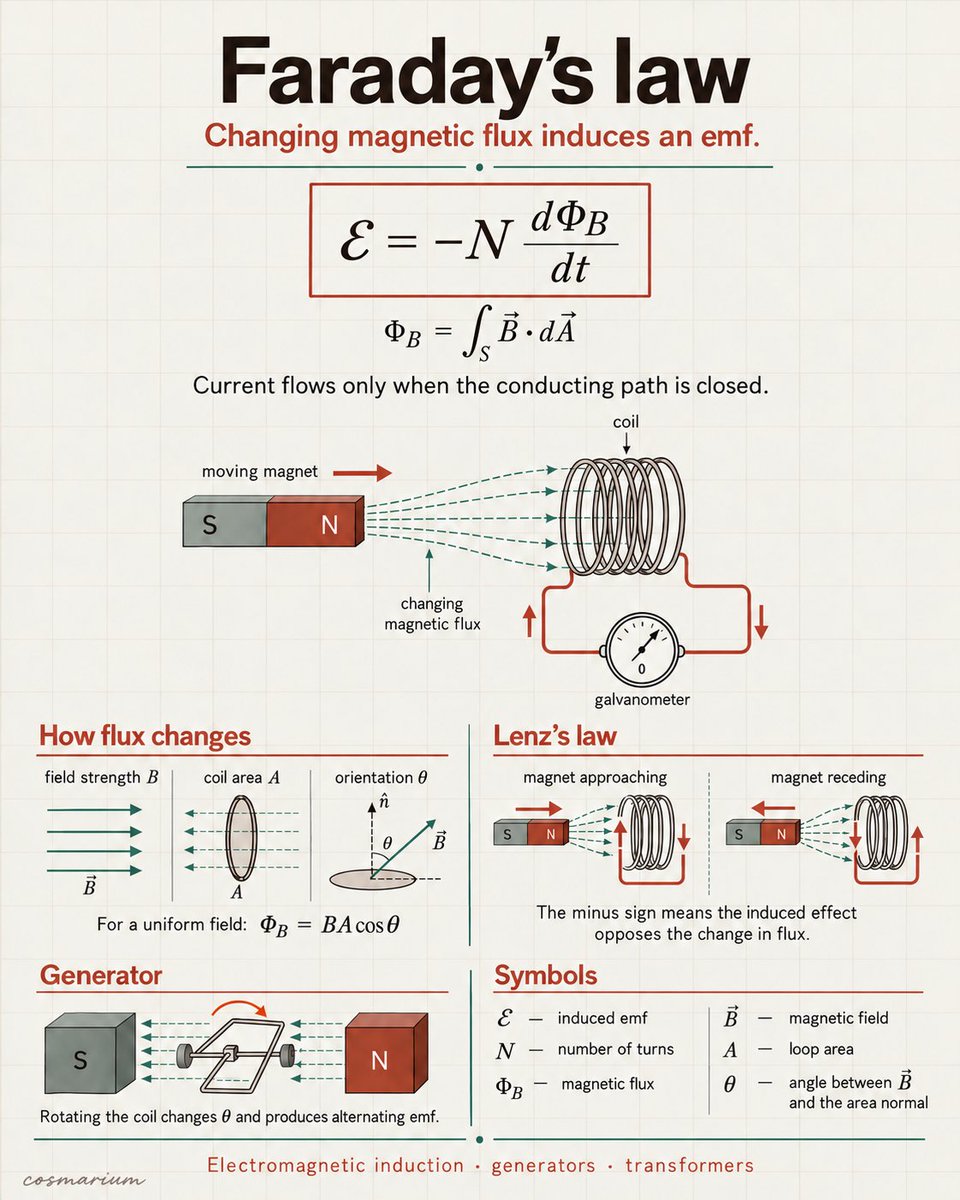
Faraday’s law states that changing magnetic flux induces an electromotive force. Flux can change through field strength, loop area, or orientation.
An induced current flows only when the conducting path is closed. Its direction opposes the change in flux, as described by Lenz’s law.
Rotating a coil through a magnetic field produces alternating voltage. This principle powers generators, transformers, and many electrical technologies.
A quantum oscillator cannot sit perfectly still, even in its lowest-energy state. Its ground-state energy is E₀ = ½ℏω.
The average position and momentum can both be zero, yet each retains a finite uncertainty. This unavoidable spread follows from ΔxΔp ≥ ℏ/2.
Zero-point energy is not ordinary classical motion or a source of free energy. It is the minimum energy permitted by the quantum state.
Huygens’ principle treats every point on a wavefront as a source of secondary wavelets. After a short time, their common envelope forms the next wavefront.
A plane wave therefore advances as parallel fronts, while a point source expands as curved fronts. The direction of travel is locally perpendicular to each wavefront.
This geometric picture explains how waves propagate, reflect, and refract. Combined with interference, it also helps describe diffraction.
Gauss’s law links electric flux through any closed surface to the net charge inside it. In vacuum, ΦE = Qenc/ε₀.
External charges can create a nonzero field across the surface, but their inward and outward flux contributions cancel. Only enclosed charge changes the total flux.
The surface’s shape does not affect this result. Symmetric surfaces simply make the electric field easier to calculate.
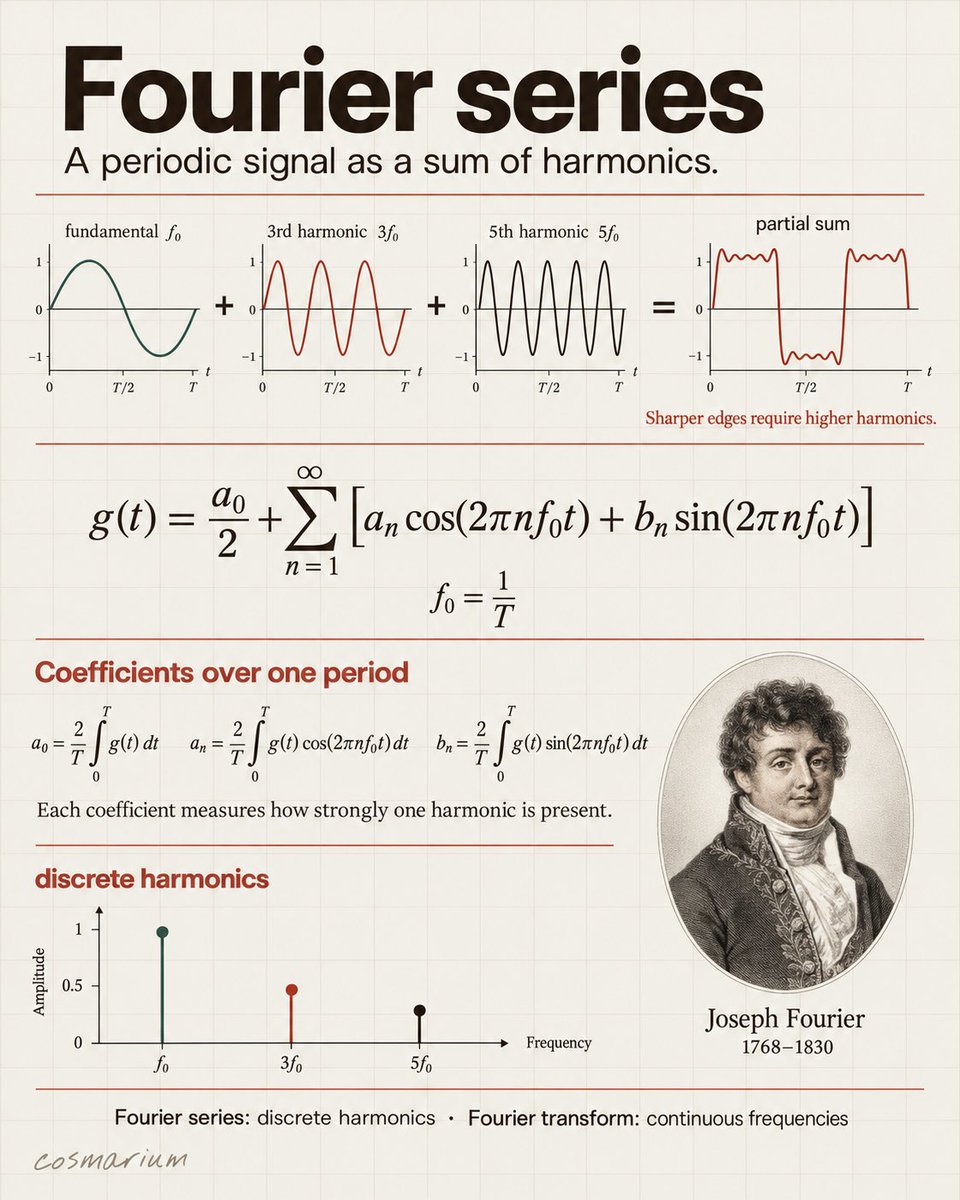
A Fourier series represents a periodic signal as a sum of sine and cosine waves. Each component oscillates at an integer multiple of the fundamental frequency.
The coefficients determine how strongly each harmonic contributes. Adding higher harmonics reproduces finer details and sharper edges.
This method reveals the frequency content hidden inside a waveform. It underlies signal processing, acoustics, communications, imaging, and quantum physics.
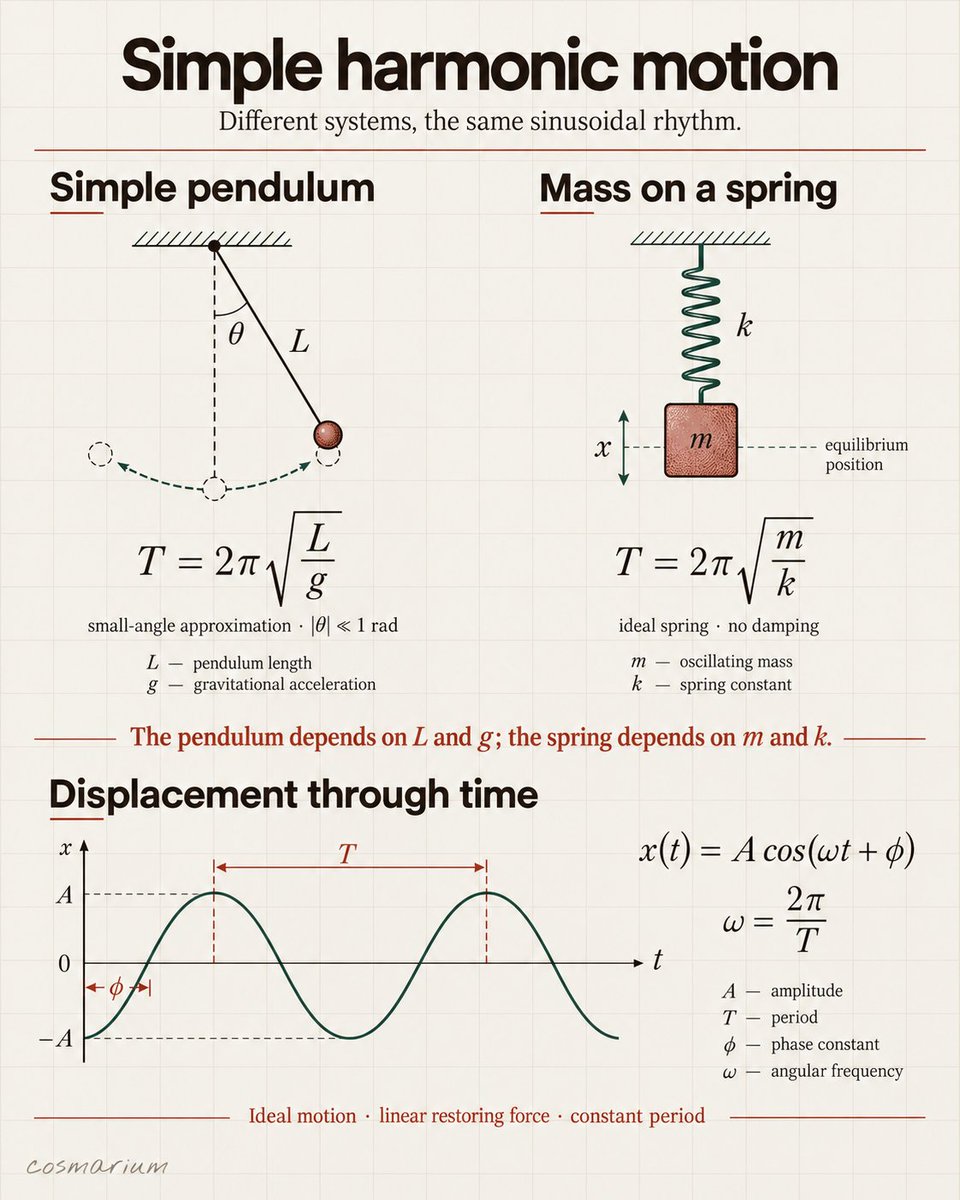
Simple harmonic motion occurs when a restoring force is proportional to displacement and points toward equilibrium. The result is a repeating sinusoidal motion.
A pendulum’s period depends mainly on its length and gravity for small angles. A spring oscillator’s period depends on the mass and spring stiffness.
In the ideal model, the period remains constant and no energy is lost. Real systems gradually slow because of friction and damping.
Earth stays in orbit because the Sun’s gravity continually bends its motion. Its average orbital speed is about 29.8 km/s.
One sidereal orbit takes roughly 365.256 days. The circular-orbit equations are useful approximations because Earth’s actual path is slightly elliptical.
Seasons are caused mainly by Earth’s 23.4° axial tilt, not its changing distance from the Sun. The tilt changes sunlight angle and day length in each hemisphere.