technical debt are converging
• platforms that are strategically important but underfunded
• AI projects that depend on weak data or integration foundations
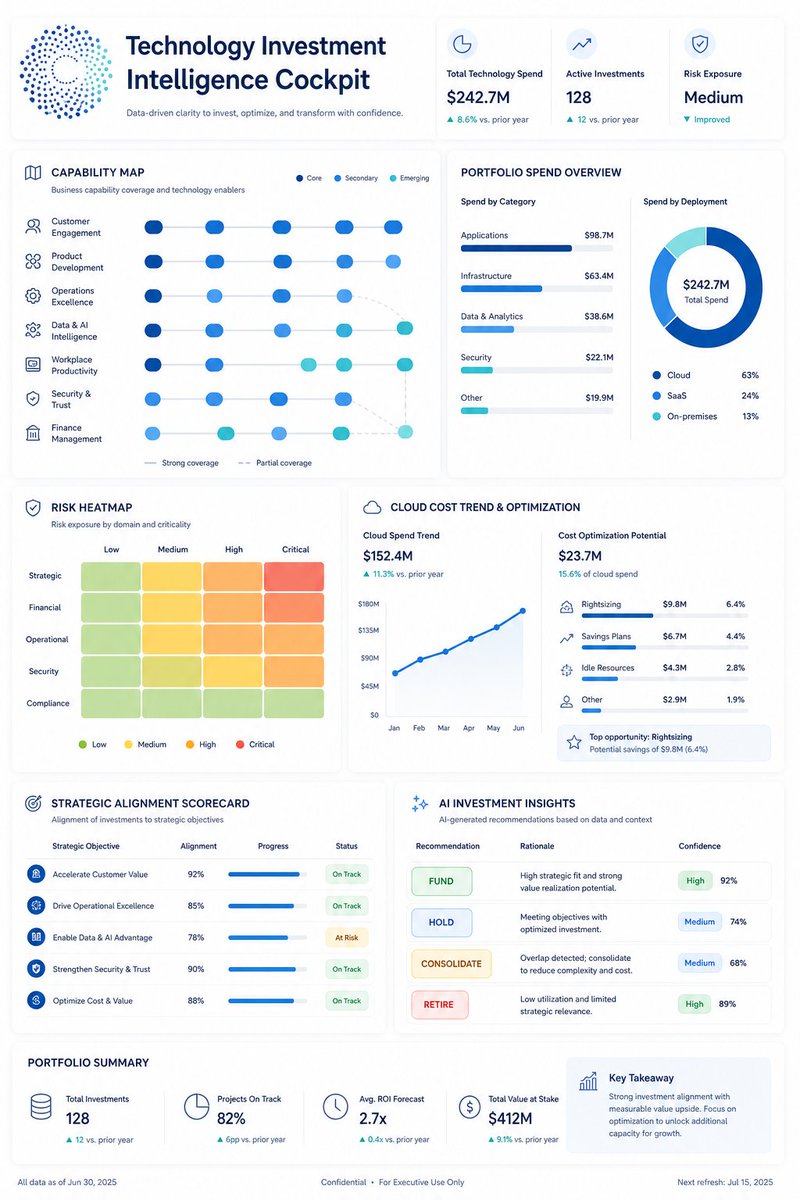
That starts to look less like a repository and more like technology investment intelligence.
It also changes the (3/6)
The most valuable EA dashboard may be the one that tells the CIO what not to fund.
Enterprise architecture creates the most value when it improves investment decisions—not when it produces the most artifacts.
Imagine combining architecture data with PMO status, cloud and (1/6)
license spend, cybersecurity exposure, delivery velocity and business KPIs.
Now add an AI layer that continuously looks for patterns:
• duplicated investments across business units
• initiatives with rising cost but declining strategic fit
• capabilities where risk and (2/6)
technical debt are converging
• platforms that are strategically important but underfunded
• AI projects that depend on weak data or integration foundations
That starts to look less like a repository and more like technology investment intelligence.
It also changes the (3/6)
The most valuable EA dashboard may be the one that tells the CIO what not to fund.
Enterprise architecture creates the most value when it improves investment decisions—not when it produces the most artifacts.
Imagine combining architecture data with PMO status, cloud and (1/6)
license spend, cybersecurity exposure, delivery velocity and business KPIs.
Now add an AI layer that continuously looks for patterns:
• duplicated investments across business units
• initiatives with rising cost but declining strategic fit
• capabilities where risk and (2/6)
technical debt are converging
• platforms that are strategically important but underfunded
• AI projects that depend on weak data or integration foundations
That starts to look less like a repository and more like technology investment intelligence.
It also changes the (3/6)
The most valuable EA dashboard may be the one that tells the CIO what not to fund.
Enterprise architecture creates the most value when it improves investment decisions—not when it produces the most artifacts.
Imagine combining architecture data with PMO status, cloud and (1/6)
license spend, cybersecurity exposure, delivery velocity and business KPIs.
Now add an AI layer that continuously looks for patterns:
• duplicated investments across business units
• initiatives with rising cost but declining strategic fit
• capabilities where risk and (2/6)
technical debt are converging
• platforms that are strategically important but underfunded
• AI projects that depend on weak data or integration foundations
That starts to look less like a repository and more like technology investment intelligence.
It also changes the (3/6)
The most valuable EA dashboard may be the one that tells the CIO what not to fund.
Enterprise architecture creates the most value when it improves investment decisions—not when it produces the most artifacts.
Imagine combining architecture data with PMO status, cloud and (1/6)
license spend, cybersecurity exposure, delivery velocity and business KPIs.
Now add an AI layer that continuously looks for patterns:
• duplicated investments across business units
• initiatives with rising cost but declining strategic fit
• capabilities where risk and (2/6)
technical debt are converging
• platforms that are strategically important but underfunded
• AI projects that depend on weak data or integration foundations
That starts to look less like a repository and more like technology investment intelligence.
It also changes the (3/6)
The most valuable EA dashboard may be the one that tells the CIO what not to fund.
Enterprise architecture creates the most value when it improves investment decisions—not when it produces the most artifacts.
Imagine combining architecture data with PMO status, cloud and (1/6)
license spend, cybersecurity exposure, delivery velocity and business KPIs.
Now add an AI layer that continuously looks for patterns:
• duplicated investments across business units
• initiatives with rising cost but declining strategic fit
• capabilities where risk and (2/6)
technical debt are converging
• platforms that are strategically important but underfunded
• AI projects that depend on weak data or integration foundations
That starts to look less like a repository and more like technology investment intelligence.
It also changes the (3/6)
The most valuable EA dashboard may be the one that tells the CIO what not to fund.
Enterprise architecture creates the most value when it improves investment decisions—not when it produces the most artifacts.
Imagine combining architecture data with PMO status, cloud and (1/6)
license spend, cybersecurity exposure, delivery velocity and business KPIs.
Now add an AI layer that continuously looks for patterns:
• duplicated investments across business units
• initiatives with rising cost but declining strategic fit
• capabilities where risk and (2/6)
faster than those artifacts.
Cloud services are added continuously. AI agents can introduce new dependencies without a conventional release cycle. SaaS contracts change. Costs move with consumption. Security posture changes daily. Business priorities shift quarter to (2/6)
A static architecture repository cannot govern a business that changes every week.
Enterprise architecture has traditionally been excellent at describing intent: target states, standards, principles, capability maps and roadmaps.
The problem is that execution now changes (1/6)