@realdanielnita Astept partea 2 de la acest video... SOC si GROAZA, Eth scade masiv si atinge 10.000$, nu mai fusese la acest nivel din 2025. Much love!!
@vaken_crypto@realdanielnita Ma uit prin toate aceste commenturi si vad atata manipulare ca nu mai stim de capul nostru. Parca este relaure la alegerile din America dc te uiti la presa clasica. Total de acord, democratia inseamna voinat poporului, fie ea "buna sau rea".
@realdanielnita@lupulalbastru1 E bine ca a asteptat sa cumpere sub 12k. Si sa il lichideze pe "putoiul de Saylor" cum il numea. Intre timp Saylor... nu mai are rost sa zic. Aici pana la final, in transee.
@realdanielnita Tare, tare!! Si ar mai fi:
Am bagat 5000 acum 3 ani.... azi am revenit pe break even si mi-am recuperat banii, am scos 5000.
Guvernul: Pai ne datorezi 10% pe cei 5000 retrasi azi, ca pe anul asta figurezi cu profit.
Tot Pamflet :)
@realdanielnita Mai mult... pe langa faptul ca a recunoscut ca s-a inselat a si spus cat se poate de clar ca BTC va ramane aici si ca este noul aur digital. Bine, noi cei implicati in fenomen stiam asta. Dar sa auzi de la Larry ar trebui sa fie validarea si pentru ultimul sceptic. HODL!!!
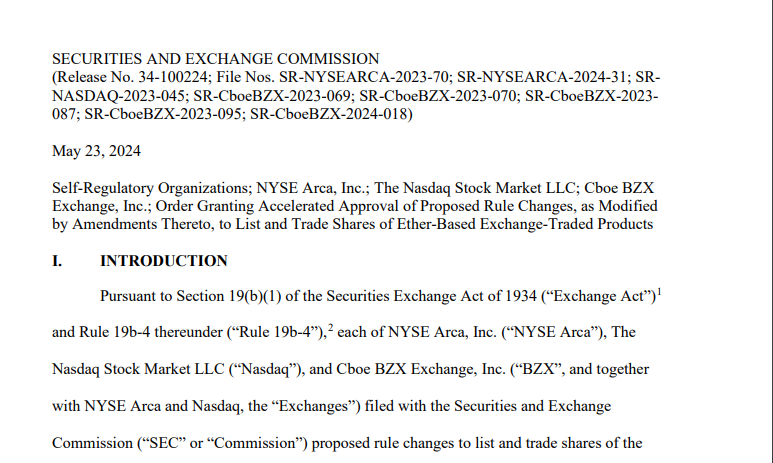
We are so thrilled to confirm that the SEC has approved, pursuant to Section 19(b) of the Securities Exchange Act of 1934, our exchange partner CBOE’s proposed rule change to list and trade a @vaneck_us spot #Ethereum ETF on the CBOE! 🥳🚀
TLDR: We expect the improved political backdrop will lead to further victories for digital asset investors & developers, via new laws & in the courts, that draw investment to #Bitcoin, Ethereum and other open-source blockchain software.
We applaud this decision, as we believe the evidence clearly shows that #ETH is a decentralized commodity, not a security. ETH’s status as a commodity has now been recognized in a variety of circumstances, including the CFTC's regulation of ETH futures, public statements by Commission officials, rulings by federal courts, and now, hopefully, this ETF.
The high degree of correlation between ETH spot prices and CME Ethereum futures prices, similar to the correlation seen with Bitcoin, proved that the spot ETH market is tightly linked to the regulated futures market. This tight linkage supports the listing of spot ETH ETFs, as it allows for the market surveillance the SEC requires. Additionally, the presence of liquid, regulated ETH futures trading on the CME and the approval of ETFs tracking those futures demonstrated to all neutral observers that Ethereum meets the same criteria as Bitcoin for an ETF holding the spot asset. The SEC approved the listing of spot Bitcoin ETFs based on these exact criteria, and we have long believed that Ethereum warrants the same treatment.
Any claim that Ethereum's move to proof-of-stake has turned it into a security, or that staking itself is a securities transaction is misguided and harmful to innovation. Proof-of-stake is simply an alternative consensus mechanism to proof-of-work mining - it does not fundamentally alter Ethereum's decentralized nature or transform ETH into a security issued by a central entity. Since the DAO hack in 2016, Ethereum has become highly decentralized, with no centralized issuer or promoter controlling a material supply or percentage of validators. The Ethereum Foundation's ETH holdings have steadily declined to just 0.30% of the circulating supply, and Vitalik Buterin holds around 0.23%. This widespread distribution of ETH contradicts the idea of it being a security issued by a common enterprise.
We have also heard arguments that Ethereum’s transition to proof-of-stake (PoS) was a securities transaction. This misunderstands the decentralized nature of Ethereum’s governance. Ethereum’s transition to PoS was driven by social consensus, involving broad community discussions, transparent development processes, and voting mechanisms within a decentralized network. This contrasts sharply with traditional financial systems, where decisions are made by centralized entities or a small group of registered stakeholders. Changes in Ethereum are proposed through Ethereum Improvement Proposals (EIPs), debated publicly, and adopted only with widespread community support, ensuring no central authority controls the network. This decentralized, community-driven process highlights that Ethereum remains a decentralized commodity, not a security, as its evolution reflects the collective agreement of its diverse global participants.
As the UK Prime Minister on this topic just recently said: “We are pro-open source. Open-source drives innovation. It creates start-ups. It creates communities. There must be a very high bar for any restrictions on open source.”
Many traditional finance market participants may not fully understand that ETH is not just a speculative asset but has extensive real-world utility underpinning a vibrant decentralized application ecosystem. Ethereum supports over 270 million unique user addresses and processes an average of 1.2 million transactions daily. On-chain value settlements exceeded $2.8 trillion over the last year, compared to global remittances of $860B, PayPal volumes of $1.5 trillion, and Visa network volume of $15 trillion. Ethereum boasts a robust developer community, with more than 2,300 monthly active developers contributing to 113,000 distinct Githib repositories. Thanks to the network effects from this decentralized community, Ethereum has become the foundational layer for a vast ecosystem of over 3,000 applications, including financial services, games and collectibles. Its smart contract functionality enables automated lending/borrowing, decentralized exchanges, NFT marketplaces, play-to-earn games, and tokenization of real-world assets. Major companies like Reddit, Ubisoft, Nike, and Visa have launched Ethereum-based projects. Regulating Ethereum NFTs differently from physical collectibles like baseball cards or Rolex watches is often absurd - both represent unique digital/physical scarcity and ownership. A Bored Ape Yacht Club NFT and a rare 1952 Topps Mickey Mantle rookie card can serve similar purposes as status symbols and stores of value. But governance structures like those enabled by Ethereum underpin much of the innovation happening in open-source databases, including real-world asset tokenization. Stifling this utility through misguided regulation would hamper technological progress and drive those talented entrepreneurs overseas.
The situation has been made even more confusing by the inconsistent stances taken by different U.S. regulators. While the SEC has recently declined to clarify ETH’s status, the Commodity Futures Trading Commission (CFTC) allowed Ether futures products to trade as commodities. The Chairman of the CFTC has stated repeatedly under oath that ETH is a commodity. Even the SEC's own guidance has stated that a digital asset may transition away from being a security as it becomes sufficiently decentralized over time, though critical details are lacking. Adding to the contradictions, just last week the U.S. Attorney's Office for the Southern District of New York unveiled an indictment that referred to Ethereum as a "decentralized" blockchain. Needless to say, this regulatory discord has fostered harmful uncertainty and, contrary to the SEC's mandate of capital formation, has inflicted a lot of pain in the market.
That’s why today feels particularly sweet to VanEck, the first traditional ETF issuer to file for both Bitcoin & Ethereum ETFs. It is so encouraging to observe the growing bipartisan support for digital assets in DC, reflecting widespread voter input, & culminating in today's ETF news and this week's congressional repeal of SAB 121, an accounting rule hostile to crypto that was enacted through unorthodox means.
We expect this improved political backdrop will lead to further victories via new laws and in the courts that draw investment to Bitcoin, Ethereum and other open-source blockchain software.
Stay tuned for further updates.
PS - we expect to go FIRST.
#ETH