Theorizer is a new class of AI-for-Science tool by @allen_ai that creates testable theories from hundreds of papers. It's helped me and partners in oncology, neuroscience, and plant science get unstuck on hard research problems. Now open source: use on the web or with your agent.
Today we're introducing @noeri_ai, a new AI company whose name literally means "the plural of intelligence" with a $110m seed!
Modern problems require modern solutions. In particular we care about (scientific) discovery - you'll hear from others what that else it means below!
I def took quite a leap of faith when I left Nvidia a bit ago to help lead the research team here. It's been an honor to be on this journey with @yejinc@guestrin and the entire founding team! Thanks to our investors @MenloVentures@MadronaVentures@Wing_VC and many others.
At UCSD over the last few years, I started becoming rather obsessed with the idea of discovery shaped problems: where you want to optimize for solving for max reward instead of average, where the horizons measure in months, where you're rate limited by physics, and where there's immediate real world impact if you get it right. I've spent a lot of time with scientists and in wet labs trying to figure out how to ~accelerate~ (SWE & white collar are imp ofc but if that's all AI manages to automate, that would be very sad)
We've already been seeing massive improvements with our customers (and hope to share lots more in the coming weeks)! If this sounds like something you want to work with us on, join our wait-list by reaching out [email protected]
I've always said half of my motivation to go work is to hang out with fun smart people, the other half is to do cool stuff (and a hidden third half is to have nice sweets everyday). We've got all three and we're hiring all across the board - research, eng, product, ops, sales, etc! Join us https://t.co/re7S25CMue
Still wrapping my head around this result: lots of domain-specific unsafe data + a sprinkle of safe, informative responses → a safe model.
Token-level expert routing seems key, but we don’t yet understand why it works. NeurIPS 2026 is just the start. Reach out if you’re curious!
⁉️⁉️ What if the harmful data we delete is exactly what makes AI safe?
💬 LLMs have quietly become the first place people turn when something is wrong: a symptom, a debt, a legal problem, a crisis. At this scale, AI safety is no longer an abstract research problem. It touches real lives, every day.
🚫 Yet most alignment today works by erasure: filter out unsafe data and train the model to refuse. The result is often a blanket "Sorry, I can't help with that."
⚠️ But refusing is not the same as being safe. A refusal leaves people with nothing to act on, and it can push them toward riskier, unmoderated sources exactly when they need guidance most.
💡 Here's the irony: unsafe data is abundant and packed with real domain knowledge, while safe, genuinely helpful answers are scarce and costly to curate. And we throw the abundant part away.
🤔 So we asked a counterintuitive question: can unsafe data actually make models safer?
🎉 Our answer is yes, and I'm thrilled to share that this work has been accepted at #NeurIPS2026!
📄 Dialectics of Alignment: Harnessing Unsafe Knowledge for Dynamic Safety Routing
1/ 🎮 Can training on games improve LLM reasoning?
Introducing GlyphBench: 360+ game tasks for language-model RL.
We use it as a benchmark, a research tool, and a post-training suite.
🧵⬇️
Mila's annual supervision request process is now open to receive MSc and PhD applications for Fall 2027 admission! For more information, visit https://t.co/r01eLcXtZw
Weather forecasts lose reliability after ~10 days, but farmers, resource managers, and communities make critical decisions weeks in advance.
New in @Nature: a lightweight ML method that corrects predictable errors in physics-based and AI weather forecasts at extended lead times.
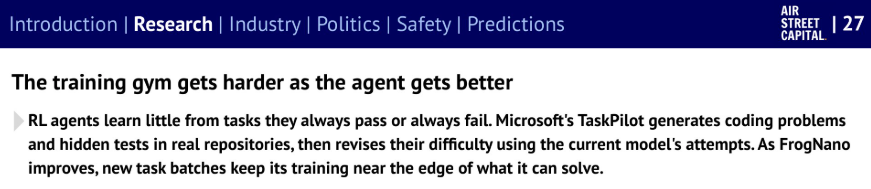
Thanks @nathanbenaich for highlighting TaskPilot and FrogNano in this year's @stateofai . We strongly believe that data and training should never exist in isolation; we need to move away from a one-size-fits-all training set!
Interested in training multimodal generative models for biology? How about developing methods and algorithms that recursively self-improve?
We’re hiring ML Engineers at @MSFTResearch to advance the frontier of what's possible.
You’ll be intellectually challenged, never bored, and hopefully have quite a bit of fun along the way!
I can’t make it to #COLM this year, but my DMs are open if you’re there (or elsewhere!) and interested in learning more.
Apply below! 👇
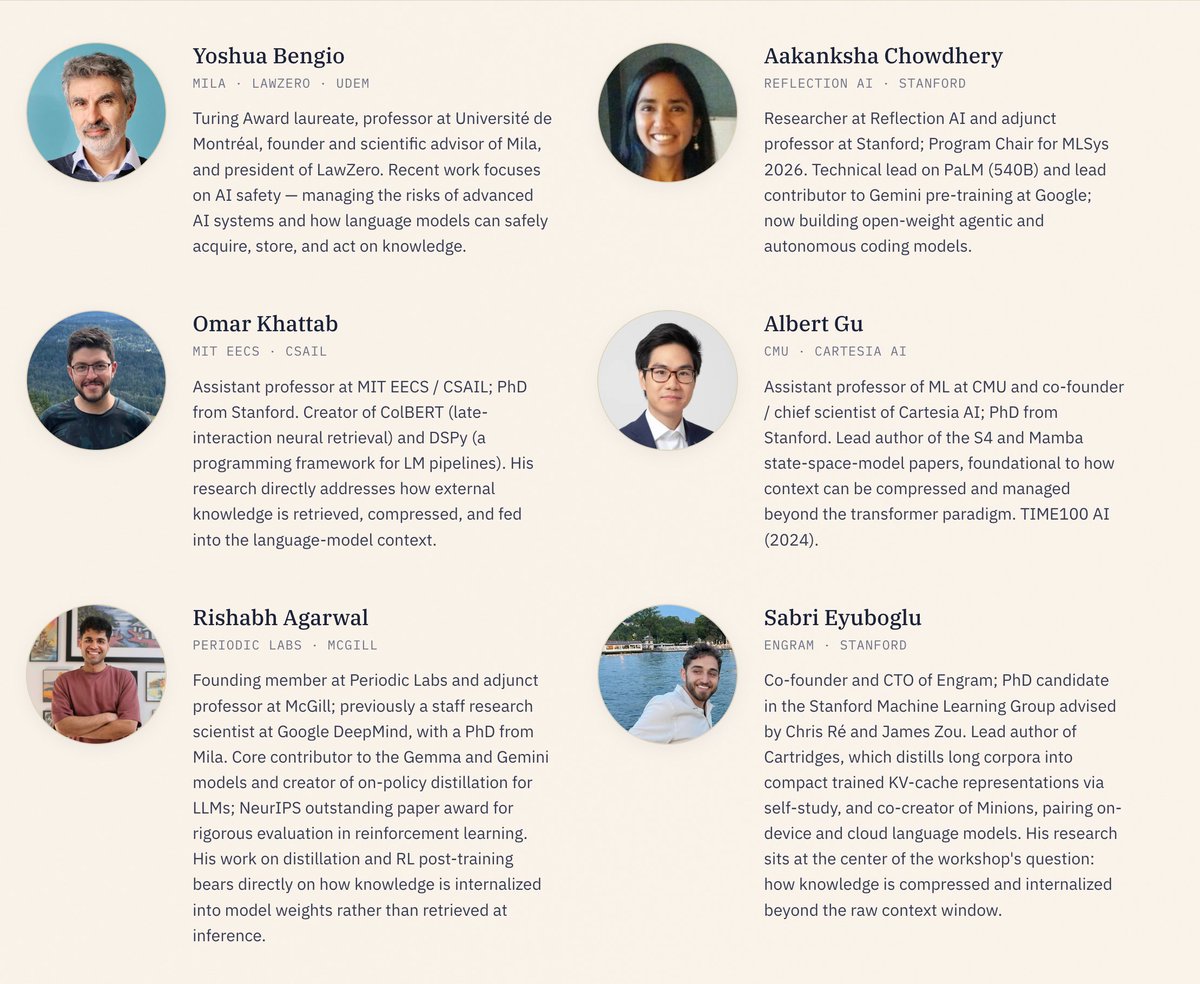
Come join us next week at our CoLM workshop:
Context Beyond the Window
We have some great speakers coming to speak on the opportunities, limitations and safety-considerations of current LLMs.
We will also be cohosting a social alongside Reflection!
https://t.co/XOGJfxq0P5
Biology doesn't operate in silos, and neither should the AI representation of it. Quine is an early-stage research effort to create a multimodal world model of biology. By connecting insights across biological scales and modalities, Quine helps scientists computationally search a space far larger than intuition allows and prioritize hypotheses before they reach the lab. Experimental results provide important feedback, helping researchers sharpen future research directions. https://t.co/gt8Dt2I5sa
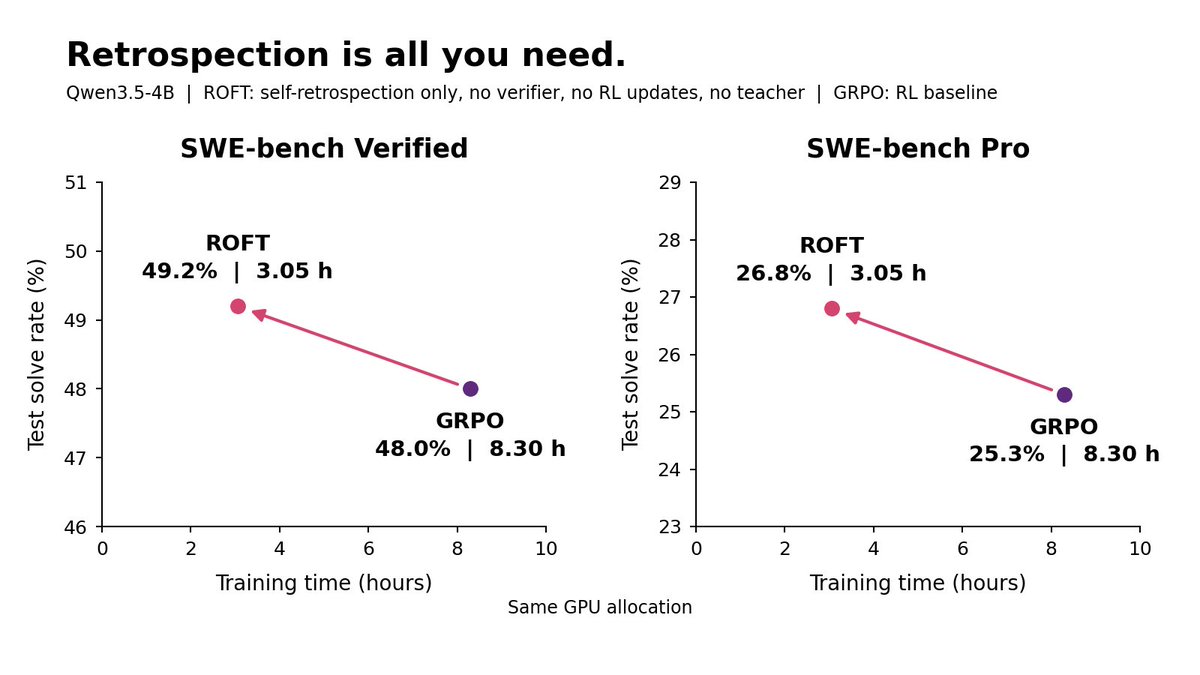
Too many empty GRPO groups? We've all been there!
With self-retrospection, we show we can effectively reduce it and boost GRPO performance on coding tasks. 🚀
Recent work from our intern at @MSFTResearch.
We trained an AI agent on its own explanations, not its code.
It got better at coding.
No teacher. No verifier. No RL updates. No extra context at test time.
Here's how. Links below. 🧵
Some (late) thoughts on Astra beating Zork: https://t.co/Mg2z3bHWQd
(TLDR: Astra beat Zork like someone with a walkthrough, not like someone experiencing the game for the first time. Still impressive.)
In other late news, TALES was accepted into NeurIPS 2026! The arxiv paper is a bit out of date (we've got a small army of new model results, including Astra and Opus 5.5) but will try to get it updated ASAP
Shout out to Roger's excellent investigation on Astra building its own gameplay harness to solve Craftax and almost beat NetHack! Just a few tokens... 😅
Today I'm releasing my next @StarTrek inspired open source science tricorder-like device. This iteration looks a bit like Spock's TOS tricorder. Explore alien planets with radiation sensing, spectrometers, a magnetic field camera, and more!
Github: https://t.co/1yGHx3iXu6
Youtube: https://t.co/HufSE4HBqI
🤖 How far are coding agents from working like human developers?
GPT-6 Astra has made big advances in many areas, including coding.
❓ So, can Astra replace a human developer? Our new benchmark says ❗we’re about 49% of the way there.❗
Developers don’t build apps from written requirements alone. They constantly use references—existing apps, UI/UX mockups, prototypes—to see how things should look and work. Then they build it and check their work against the reference.
✨ Introducing ProgramDistill, a benchmark and synthetic task-generation pipeline for testing coding agents on this workflow at scale.
astra playing NetHack:
- score: 48,978
- BALROG progress: 49.4%
- max dungeon depth: 17
- max experience level: 14
important note: this is a cherry-picked episode (best of 10), and Astra has been able to modify its own game-playing harness
no privileged information or unfair game modifications, but it uses tools such as pathfinding to previously visited landmarks and code-written trackers for previously observed entities. these offload a fair amount of low-level reasoning, while Astra remains responsible for choosing what to do at every step
imo, the ability of LLMs to autonomously create tools that amortize low-level control costs (and then interpret and use their outputs in-context) is remarkable, and one of the reasons i'm excited about LLM agents. like, we could run the same tool computations and... concatenate the outputs into a flat vector for an MLP... but it would still have to learn what those outputs mean and how to use them. with LLMs we get free hierarchies and natural separation of responsibilities...
anyway, i'm now running episodes with the default settings from BALROG for a more fair comparison
the auto-research programme continues. will report back!
full run below ⤵️
Science is built by standing on the shoulders of giants. Today we're releasing the Scientific Contribution Graph, a massive dataset of how current technologies and scientific results were built upon previous results, with applications in AI-4-Science and Science-of-Science.
Paper: https://t.co/DBFTG1wxAc
Data and API (80GB): https://t.co/yW2cPL6iwF
Live demo: https://t.co/xZU93yNGdq