Professional chaos whisperer 🌪️ | Making complexity your friend, not your enemy | Ex-tech diver diving now complex corporate waters 🤿 | Foodie & photographer
You can't engineer luck.
Cleanest phrasing of P vs NP I've heard.
NP is the magical computer that always tells you which path to take. P is what current silicon can do. Tetris is NP-complete. Chess is EXP-complete.
MIT 6.006 Introduction to Algorithms, Fall 2011.
Scientists have created one of the most detailed 3D reconstructions of a human cell (eukaryotic cell) ever produced.
This groundbreaking model, often termed a "Cellular Landscape Cross-Section Through a Eukaryotic Cell," combines data from X-ray tomography, nuclear magnetic resonance (NMR), and cryo-electron microscopy to map molecular structures in extreme detail.
🔥 Hannes Bieger absolutely owning “Black Hole” on this massive wall of modular Moog synths!
Vintage analog wizardry, deep hypnotic grooves, and pure electronic sorcery — this is the kind of setup that makes you want to disappear into the sound for hours 🤯🌌
Chapter 3: The Chemical Ocean
You're submerged in a solution that determines which thoughts are available and which have been disconnected without notice.
Cortisol narrows the tunnel. Dopamine points the targeting system. The Narrator takes the raw soup and scripts it into plot.
The plot is not true. The chemicals are real.Chemical Ocean https://t.co/vnMub60zSP
Chapter 2: The Character Sheet Chapter 2: The Character Sheet
You know the screen. Sliders, stat rolls, class selection.
Except someone already pressed Confirm — roughly nine months before you showed up to notice.
Your build is locked. You never reviewed the specs. The tutorial prefers it that way.
https://t.co/0TMoMhOdjt
#gamedev #charactercreation #MMORPG #satire #indieauthor #writingcommunity #gaminghumor #RPG
That's why I am writing the "Walkthrough," the missing manual for a game nobody can remember to have chosen to play. 🤓 https://t.co/CKoXKjlH0v
The "gamer perspective" is so helpful.
🚨 Simulation Theory: The Double Slit Experiment proves particles act like waves until observed then they snap into particles.
What if our reality only "renders" when we're looking, just like a video game optimizing resources?
Check out this episode from The Why Files breaking it down, tying it to Simulation Theory. Are we in a sim?
This could be the key to unlocking the true nature of existence!
The Why Files video did a great job on explaining the Double Slit Experiment & Simulation Theory
What do YOU think—real or rendered? Drop your thoughts below!
@InterstellarUAP That's why I am writing the "Walkthrough," the missing manual for a game nobody can remember to have chosen to play. 🤓
https://t.co/CKoXKjlH0v
"The harness is everything" — we arrived at identical architecture through consulting practice: persistent knowledge artifacts, spec-before-execution separation, mechanical constraint enforcement. Convergent evolution. The problem constraints are that strong. I call the umbrella KHAOS — Knowledge-Harmonizing Artificial Optimization Specialist 🤓
I'm Boris and I created Claude Code. Lots of people have asked how I use Claude Code, so I wanted to show off my setup a bit.
My setup might be surprisingly vanilla! Claude Code works great out of the box, so I personally don't customize it much. There is no one correct way to use Claude Code: we intentionally build it in a way that you can use it, customize it, and hack it however you like. Each person on the Claude Code team uses it very differently.
So, here goes.
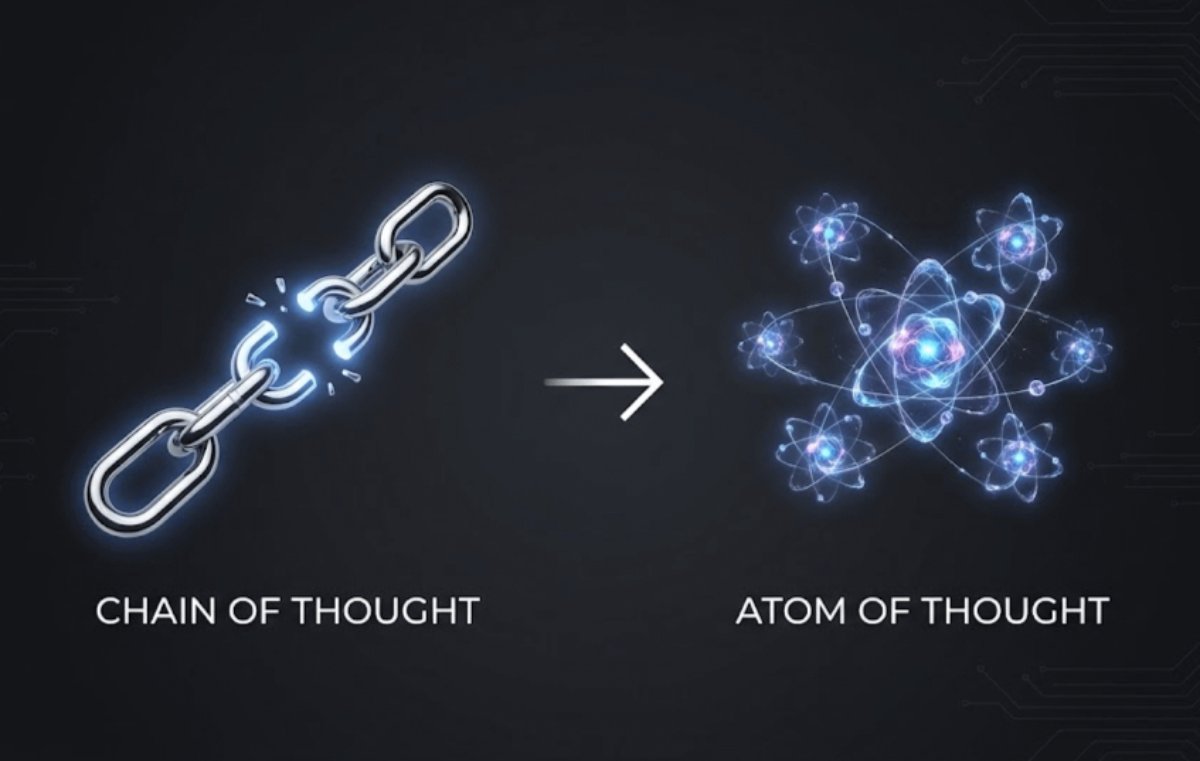
Chain of Thought is dead.
I just tested Atom of Thought prompting and it's making AI models 30-40% more accurate on complex reasoning tasks.
Here's the technique that's about to change how everyone uses ChatGPT and Claude:
the future belongs to generalists because the world is no longer built in silos.
problems are now multi-domain:
energy + software
biology + computation
robotics + control + materials
manufacturing + ai
security + hardware
cities + data
finance + automation
specialists go deep.
generalists integrate.
the next breakthroughs won’t happen inside a discipline.
they’ll happen at the intersections; where no one has formal maps, and only wide-angle minds can see the structure.
generalists:
> translate across fields
> combine tools that weren’t meant to interact
> spot patterns specialists miss
> build systems, not fragments
> adapt faster than the pace of technological change
the world is converging.
knowledge is cross-pollinating.
the bottleneck is not expertise but integration.
the future is built by people who can move between domains without losing coherence.
@JasonWilde108@JasonWilde108 you are right to pull out the most fundamental question of the game we are playing. I think everyone has to answer this question for themselves. I have: I have a free will and I am responsible for my actions
If you would like to hear what fluently spoken Latin sounded like with the same Classical pronunciation the ancient Romans used check this video of mine.
I speak Latin for 5 minutes non stop with no jump cuts. One single camera take.
Also answer me this. How much could you understand? I'll leave a comment with the full transcript with phonemic vowel length indicated for each word for further study and analysis.
Check out my latest article: You're Positioned in the AI Bubble Whether You Like It or Not. Here's How to Know Where You Stand. https://t.co/ibsOgPDEwa via @LinkedIn
If you strip away all the spiritual language and the quantum poetry, Nick Bostrom’s trilemma leaves us with just three possibilities; and one of them has to be true. No middle ground. No safe fourth option.
The first is the darkest to me; that civilizations like ours almost never make it. They either wipe themselves out, stagnate, or collapse under the weight of their own inventions before they ever reach post-human capability. If that’s true, this whole show ends in smoke and static; no simulations, no gods, no awakening. Just extinction by ambition.
The second option is that advanced civilizations do make it, but choose not to simulate their ancestors. Maybe they outgrow curiosity, or maybe they develop a morality that says, “We don’t have the right to make suffering conscious again.” That’s a merciful version of the universe, but also one where we’re probably the originals, not the copies.
And then there’s the third. That at least one civilization did it. Reached the god tier level, built ancestor worlds, and turned on the code. If that’s true even once, statistically we’re almost certainly inside one. Every thought you have, every star you see, could just be part of the render.
It has to be one of the three.
Which world feels more likely to you?
The one that dies, the one that refuses, or the one that remembers how to build itself again?