Built your MVP with Lovable, Bolt or Cursor and it's starting to creak?
I'm a backend dev (Node.js/NestJS, Postgres, Redis). I can:
→ add proper auth checks
→ fix slow queries and missing indexes
→ move secrets off the client
→ add error logging
DMs open.
@tanujDE3180 B, but the bug that actually costs money is subtle: the webhook arrives before the redirect, or arrives twice. Let the webhook (not the success page) mark the order paid, and dedupe on the provider's event ID. That's half of B's two weeks right there.
Everyone's talking about "harness engineering" for AI agents.
Look closely and it's mostly backend basics: retries with backoff, timeouts, idempotency, queues, rate limits, logging.
Backend devs, are we about to become AI engineers by accident?
@codewith55 B, with one caveat people skip: cursors kill "jump to page 37" and cheap total counts. Feeds and public APIs: cursor (keyset on created_at, id). Admin tables where people really do jump around: offset is fine with a capped depth. And keep the cursor opaque, like B does.
Hot take: vibe coding didn't kill backend skills. It made them the bottleneck.
AI ships the feature in an hour. Then it meets real traffic, a real database and real users.
What was the first thing that broke in your AI-built project?
@TanishqKhande10 Interested. Backend dev in Bengaluru, 2+ years in Node.js/NestJS and Spring Boot with Postgres, Redis and Kafka. Your DMs are closed, so could you message me or share which company it is? GitHub: https://t.co/vIY2VGSWIH
@IamAroke And size it smaller than you think. Postgres slows down with hundreds of active connections, so 10–20 per instance behind PgBouncer in transaction mode beats 200 direct ones. On serverless it's mandatory: every cold start opens a fresh connection.
@tanujDE3180 Same SQL, different reality: prod has concurrent writes holding locks, stats that autovacuum hasn't refreshed (so a worse plan), table bloat from dead rows, and a colder cache. Prepared statements can also flip to a generic plan. Run EXPLAIN (ANALYZE, BUFFERS) in prod.
@Worshipperfx Works until something sits between you and the server. PUT and DELETE are idempotent, so proxies, clients and retry libraries can safely repeat them. A retried POST can create a second order. The verbs aren't style, they tell infrastructure what's safe to retry.
@noor36758 Trick question: Supabase and Neon are both Postgres, so three of the four answers are Postgres. Pick Postgres, then the host: Supabase if you want auth and storage bundled, Neon for branching and scale-to-zero. Mongo only if your data is truly document-shaped.
@vibeonX69 Java. At 10 years, boring is a feature: long-term-support releases, mature tooling, and a big hiring pool once the original team has moved on. Go is a close second. Either way, your database schema will outlive the language decision.
@SuiBuilds The usual culprits at that point: no indexes, auth checks only on the frontend, RLS off, secrets in client code, and zero error logging. None of it is hard to fix, but it's far cheaper at 200 users than at 2,000.
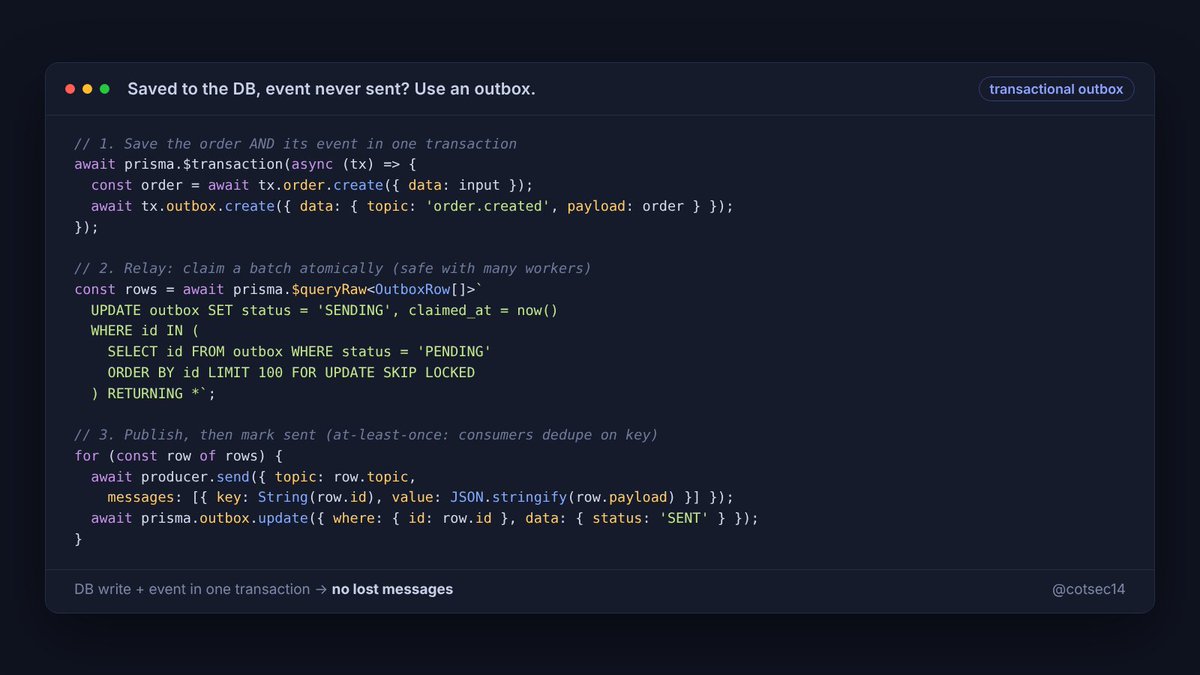
Classic microservices bug: you save the order, then publish order.created to Kafka. The publish fails. Now your DB and events disagree.
Fix: a transactional outbox.
→ order + event row in one DB transaction
→ a relay publishes pending rows
→ consumers dedupe on the event key
A slow API with normal CPU usually isn't slow code. It's waiting.
Pool of 10. One endpoint holds a DB connection while a third-party call hangs 30s. Soon every request queues for one.
Fixes:
→ timeouts on outbound calls
→ no connection held across I/O
→ watch pool wait time
@yadavji_codes The planner normally reorders joins itself, so if order matters something is stopping it: more tables than join_collapse_limit (8 in Postgres), outer joins that can't be reordered, or stale stats giving bad row estimates. EXPLAIN ANALYZE both and compare estimated vs actual rows.
@pcshipp Makes sense early on: managed platforms trade money for time. The move usually comes when the bill or a compliance ask shows up, and it's painless if the app was containerised and config lived in env vars from day one.
@samir_sawarkar LISTEN/NOTIFY is fine as a wake-up signal, but it isn't a queue: no persistence, no retries, and an offline listener just misses messages. What holds up: a jobs table + SELECT ... FOR UPDATE SKIP LOCKED, with NOTIFY only to poke workers. Kafka once you need replay.
@devXritesh Line 5: jwt.decode() only base64-decodes, it never checks the signature, so anyone can forge a token with any user id. Use jwt.verify(token, key, { algorithms: ['RS256'] }) so the signature and exp are checked and alg is pinned. Wrote a JWT thread on this today.
TL;DR: JWTs buy you stateless verification, and you pay for it with harder revocation. Design for that from day one. How do you handle logout in your APIs: Redis denylist, short TTLs, something else?