2025년, 나의 투자 포트폴리오에서 단연 가장 빛난 선택은 @moonbirds
NFT 시장이 혹독한 NFT윈터를 겪는 가운데, 문버드 바닥가격 0.3 ETH라는 도파민 매수자리에서 한마리 매수에 성공했었습니다
지금 돌이켜보면 겨우 한 마리만 샀던 게 매우매우 아쉬웠지만... 그때조차 망설이다 놓쳤더라면 지금같은 알트 하락장 속에서 얼마나 큰 후회가 되었을지 아찔하네요😂
알트 시장이 최악의 하락장을 속에서 허우적거린 시기
문버드는 현재 내 유일한 자랑이자 보물이 되었습니다
@moonbirds 는
수많은 프로젝트가 엑싯 스캠과 러그풀로 얼룩진 NFT 시장에서, 진정한 ‘옥석’의 기준을 제시하고 있습니다.
탄탄한 커뮤니티와 생태계 구축 능력, 대중적 선호, 가격 안정성과 상승 잠재력에서 급이 다른 면모를 꾸준히 보여주고 있기에 귀족늪이라는 별명을 얻은 것 아닐까요
이더 상승 및 알트장에서, 문버드가 과연 어디까지의 귀족 퍼포먼스를 보여줄지 매우 기대됩니다...!
The digital asset industry has waited long enough. Businesses are making decisions where to build RIGHT NOW, and without clear rules, too many will go overseas. We must get Clarity done now. America’s financial future depends on it.
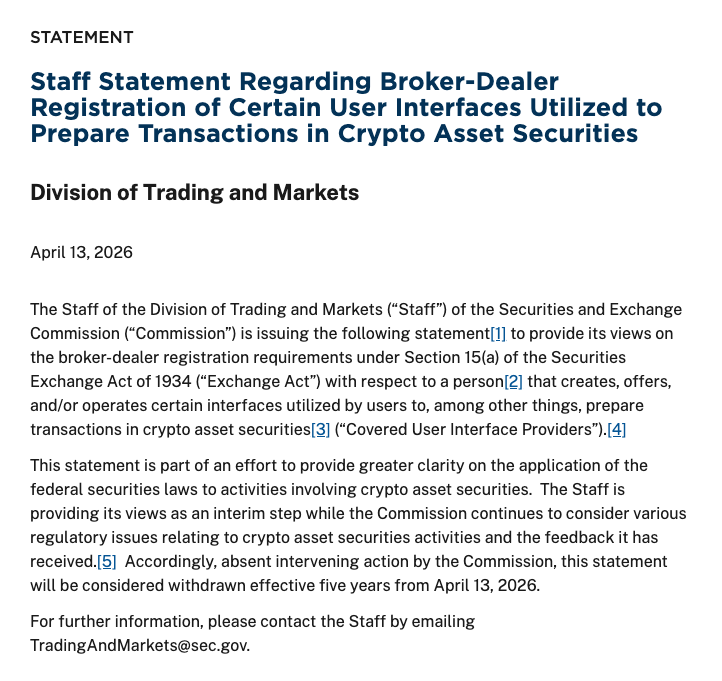
SEC의 성명의 이면에는 거대한 패러다임의 전환이 숨어 있습니다.
그동안 주피터나 유니스왑 같은 앱들은 '언제든 폐쇄될 수 있는' 시한폭탄을 안고 달리는 도망자였지만..
이제 그 도망의 시간이 끝난 것입니다.
이 성명이 크립토 수많은 앱들에게 의미하는 바는 다음과 같습니다.
1/ 과거 SEC의 전략은 단순했습니다. "돈이 오가는 곳이라면, 그게 코드든 종이든 무조건 내 허락을 받아라." 이것은 자동차 제조사에게 운전자의 과속 책임을 묻는 것과 같은 논리적 오류였습니다.
이번 성명의 핵심은 '기술과 금융 행위의 완전한 분리'를 인정한 것입니다.
- 과거: 인터페이스(UI)를 제공하는 것은 거래를 주선하는 '브로커' 행위로 간주됨.
- 현재: 인터페이스는 단지 블록체인이라는 복잡한 언어를 인간의 언어로 번역해주는 '통역 도구'일 뿐임.
이것은 엄청난 차이입니다.
이제 덱스와 애그리게이터들은 "우리는 금융기관이 아니라, 소프트웨어 회사다"라고 당당히 말할 수 있는 법적 근거를 얻었습니다.
이것은 혁신이 '허가'를 구하지 않아도 되는 시대로의 진입을 의미합니다.
2/ 그동안 많은 분들이 디파이를 쓰면서 느꼈던 막연한 불안감, "이거 나중에 문제 생기면 어떡하지?"은 국가가 설계한 심리적 장벽이었습니다.
특히, 개인 단이 아닌 둘 이상의 단체, 회사로 올라가면.. 국가가 설계한 이 심리적 장벽은 엄청 커지죠..
정부는 불명확한 규제를 통해 수많은 사람들을 '잠재적 범죄자'의 영역에 묶어두었습니다.
하지만 이번 Safe Harbor의 등장은 그 회색지대를 선명한 화이트 존으로 바꿨습니다.
이제 앱들은 규제 눈치를 보느라 기능을 숨길 필요가 없어졌고, 사용자들은 이제 '불법 서비스'를 이용한다는 죄책감에서 벗어날 수 있게 되었습니다.
3/ 한국의 투자자들은 업비트라는 거대한 울타리 안에서 보호받는다고 느낍니다. 하지만 그것은 보호가 아니라 '종속'입니다. 거래소가 상장을 폐지하거나 출금을 막으면 당신의 자산은 숫자로만 남습니다.
SEC의 이번 결정은 미국의 디파이 앱들에게 다음과 같은 강력한 날개를 달아주었습니다.
브로커 등록 의무가 사라짐으로써, 주피터나 유니스왑은 이제 단순 코인 거래를 넘어 파생상품, 대출, 합성 자산 등 모든 금융 서비스를 UI 하나로 통합할 수 있게 되었습니다.
미국의 규제 명확성은 곧 전 세계 디파이 UI의 표준이 될 것이고 한국의 꽉 막힌 금융 규제와 대비되어, 자본은 더욱 빠르게 '자유로운 인터페이스'로 쏠릴 것 입니다.
NEW 🚨: As part of Project Crypto, the Division of Trading and Markets issued a staff statement providing its views on broker-dealer registration requirements in connection with certain interfaces used to prepare transactions in crypto asset securities.
https://t.co/8jCwFOJZcw
A new frequency is stabilizing.
Beyond the cloud, where raw compute meets personal sovereignty.
The architecture of the Agentic Economy is no longer a theory. It is a sequence. @worldlibertyfi
🆕 Crypto Sectors Top 20 from Grayscale Research highlights the top index-eligible tokens from Q1 '26 based on volatility-adjusted returns.
$KITE $JST $DEXE $HYPE $ZRO $DCR $MORPHO $AKT $TRX $CC $RENDER $TAO $AXS $GRASS $COW $SKY $MON $GNO $QNT $ZANO
Read the full update here: https://t.co/y3igRRNqX9
When executing an extremely large trade—such as around $50M USDT—on a DEX or a DEX aggregator, it is important to use TWAP (Time-Weighted Average Price) functionality to split the order over time and minimize slippage impact. In fact, even @VitalikButerin recently used the TWAP feature on @CoWSwap to sell a large amount of Ethereum in multiple transactions spread across several days according to a predetermined plan.
It is very unfortunate that someone suffered losses due to this slippage event. However, if someone has enough basic knowledge of DeFi to use the swap function within the Aave app, they should also be aware that when trading such a massive amount of capital, they must carefully check the slippage settings and the total transaction value instead of simply pressing the confirmation button.
That said, platforms like @CoWSwap and @aave should also have systems in place to automatically block or flag transactions that are clearly abnormal and far beyond reasonable market conditions.
Earlier today, a user attempted to buy AAVE using $50M USDT through the Aave interface.
Given the unusually large size of the single order, the Aave interface, like most trading interfaces, warned the user about extraordinary slippage and required confirmation via a checkbox. The user confirmed the warning on their mobile device and proceeded with the swap, accepting the high slippage, which ultimately resulted in receiving only 324 AAVE in return.
The transaction could not be moved forward without the user explicitly accepting the risk through the confirmation checkbox.
The CoW Swap routers functioned as intended, and the integration followed standard industry practices. However, while the user was able to proceed with the swap, the final outcome was clearly far from optimal.
Events like this do occur in DeFi, but the scale of this transaction was significantly larger than what is typically seen in the space.
We sympathize with the user and will try to make a contact with the user and we will return $600K in fees collected from the transaction.
The key takeaway is that while DeFi should remain open and permissionless, allowing users to perform transactions freely, there are additional guardrails the industry can build to better protect users. Our team will be investigating ways to improve these safeguards going forward.
📣 불개미의 독후감 및 예측샷
1. 판단, 검수, 구조, 실행, 책임은 결국 인간에게 있음. 가치있는 인간의 본질 친절하고, 열심히살고 약속 잘지키고 똘똘한 열정있는 사람들은 여전히 기회를 찾을 것. 다만 격차가 많이 벌어질 것.
2. 인간은 생산주체에서 소비주체로 포지셔닝이 변경될 것이며, 생산하는 주체인 AI 가 세금과 같은 사회적비용을 부담하게 될 것.
3. 인간은 더이상 생산의 주체가 아니기때문에 계층이동이 더욱 어려워 질 것.
4. 전세계 정치지형이 자유주의와 고효율을 중시하는 우파에서 분배를 중시하는 좌파로 무게추가 이동할 것.
How I think about "security":
The goal is to minimize the divergence between the user's intent, and the actual behavior of the system.
"User experience" can also be defined in this way. Thus, "user experience" and "security" are thus not separate fields. However, "security" focuses on tail risk situations (where downside of divergence is large), and specifically tail risk situations that come about as a result of adversarial behavior.
One thing that becomes immediately obvious from the above definition, is that "perfect security" is impossible. Not because machines are "flawed", or even because humans designing the machines are "flawed", but because "the user's intent" is fundamentally an extremely complex object that the user themselves does not have easy access to.
Suppose the user's intent is "I want to send 1 ETH to Bob". But "Bob" is itself a complicated meatspace entity that cannot be easily mathematically defined. You could "represent" Bob with some public key or hash, but then the possibility that the public key or hash is not actually Bob becomes part of the threat model. The possibility that there is a contentious hard fork, and so the question of which chain represents "ETH" is subjective. In reality, the user has a well-formed picture about these topics, which gets summarized by the umbrella term "common sense", but these things are not easily mathematically defined.
Once you get into more complicated user goals - take, for example, the goal of "preserving the user's privacy" - it becomes even more complicated. Many people intuitively think that encrypting messages is enough, but the reality is that the metadata pattern of who talks to whom, and the timing pattern between messages, etc, can leak a huge amount of information. What is a "trivial" privacy loss, versus a "catastrophic" loss?
If you're familiar with early Yudkowskian thinking about AI safety, and how simply specifying goals robustly is one of the hardest parts of the problem, you will recognize that this is the same problem.
Now, what do "good security solutions" look like?
This applies for:
* Ethereum wallets
* Operating systems
* Formal verification of smart contracts or clients or any computer programs
* Hardware
* ...
The fundamental constraint is: anything that the user can input into the system is fundamentally far too low-complexity to fully encode their intent. I would argue that the common trait of a good solution is: the user is specifying their intention in multiple, overlapping ways, and the system only acts when these specifications are aligned with each other.
Examples:
* Type systems in programming: the programmer first specifies *what the program does* (the code itself), but then also specifies *what "shape" each data structure has at every step of the computation*. If the two diverge, the program fails to compile.
* Formal verification: the programmer specifies what the program does (the code itself), and then also specifies mathematical properties that the program satisfies
* Transaction simulations: the user specifies first what action they want to take, and then clicks "OK" or "Cancel" after seeing a simulation of the onchain consequences of that action
* Post-assertions in transactions: the transaction specifies both the action and its expected effects, and both have to match for the transaction to take effect
* Multisig / social recovery: the user specifies multiple keys that represent their authority
* Spending limits, new-address confirmations, etc: the user specifies first what action they want to take, and then, if that action is "unusual" or "high-risk" in some sense, the user has to re-specify "yes, I know I am doing something unusual / high-risk"
In all cases, the pattern is the same: there is no perfection, there is only risk reduction through redundancy. And you want the different redundant specifications to "approach the user's intent" from different "angles": eg. action, and expected consequences, expected level of significance, economic bound on downside, etc
This way of thinking also hints at the right way to use LLMs. LLMs done right are themselves a simulation of intent. A generic LLM is (among other things) like a "shadow" of the concept of human common sense. A user-fine-tuned LLM is like a "shadow" of that user themselves, and can identify in a more fine-grained way what is normal vs unusual.
LLMs should under no circumstances be relied on as a sole determiner of intent. But they are one "angle" from which a user's intent can be approximated. It's an angle very different from traditional, explicit, ways of encoding intent, and that difference itself maximizes the likelihood that the redundancy will prove useful.
One other corollary is that "security" does NOT mean "make the user do more clicks for everything". Rather, security should mean: it should be easy (if not automated) to do low-risk things, and hard to do dangerous things. Getting this balance right is the challenge.
'나이 들수록 미친 듯이 공감되는 10가지 인생 진실'
.
.
.
1. 인생에 너무 큰 기대를 걸지 말것
인생에 거창한 기대 걸지 마라, 그러다 인생한테 뒤통수 맞는다.
"성공해야 한다, 긍정적으로 살아야 한다" 이런 말들은 사람을
숨 막히게 만드는 주문에 가깝다. 우리는 원래 우주 먼지 같은
존재니까, 욕심 조금 줄이면 숨 쉬기 훨씬 편해진다.
2. 게을러야 오래 산다
너무 부지런하려고 애쓰지 마라, 기계처럼 뛰다 보면 몸이 먼저
부서진다. 가끔은 누워 있고, 미루고, 빈둥거리는 시간이 사람을
살린다.
3. 남과 비교하지 말고, 제 잘난 맛으로 버틸 것
세상은 원래 불공평하고, 출발선도 다르다. 그 사실을
인정하고도 “그래도 나는 내 식으로 산다”라고 말하는 사람이
제일 강하다. 열등감에 인생 낭비할 시간에, 자기 운이 풀릴
때까지 버티는 연습을 하는 편이 훨씬 이득이다.
4. 결혼은 필수가 아니다, 혼자도 충분하다
외롭다고 아무 결혼이나 하는 것보다, 외로운 싱글이 차라리
낫다. 죽을 때 옆에 누가 있어야 한다는 말 때문에 인생을
통째로 저당 잡히지 마라. 혼자가 불행이고 결혼이 해답이라는
공식을 먼저 버려야, 자기 삶의 모양이 제대로 보인다.
5. 과거 탓, 미래 걱정보다 오늘 한 끼에 집중할 것
부모 탓, 시대 탓을 너무 길게 하면 정작 지금을 살 힘이 남지
않는다. 십 년 뒤 인생 설계도 좋지만, 오늘 하루를 견디는
감각이 빠진 설계는 종이 쪼가리에 가깝다. 지금 눈앞의
기쁨과 불편함부터 처리하는 사람이 결국 더 단단해진다.
6. 건강을 신격화하지 말 것
몸을 챙기는 건 좋지만, 건강을 새로운 종교처럼 모시기
시작하면 삶이 더 피곤해진다. 비타민, 보약, 저염식에
매달리면서 정작 하고 싶은 것 하나 못 하면 그게 진짜 병이다.
7. 고독을 피하지 말아라
혼자 밥 먹고, 혼자 영화 보고, 혼자 걷는 시간을 못 견디면 인생
어디서든 휘둘린다. 고독은 없애야 할 존재가 아니라, 제대로
다루는 법을 배워야 하는 성질의 것이다.
8. 조금은 허무하게 보는 시선을 장착할 것
어차피 다 지나갈 일이라고 생각하면, 큰 기쁨에도 큰 절망에도
덜 끌려다니게 된다. 인생이 거대한 과제가 아니라, 그때그때
버전 업그레이드 되는 게임 정도라고 보면 한결 가벼워진다.
9. 화려한 죽음보다 지질한 생존을 택할 것
세상이 뭐라 해도, 살아 있는 쪽이 이긴 거다. 멋있게 끝내겠다는
충동은 잠깐 짜릿할지 몰라도, 그 뒤의 시간은 완전히 사라진다.
비겁하다고 욕을 먹더라도 버티고 남아 있는 사람이, 나중에는
이야기를 계속 쓸 수 있다.
10. 남의 시선을 떨쳐낼수록 비로소 자유에 가까워진다
결국 태어날 때도 혼자, 마지막에도 혼자다. 그 사이에 남 눈치
보다가 끝내기엔 인생이 너무 짧다. 사람들 비위 맞추다가 자기 한
번도 안 챙기고 늙어 버리면, 그때 가서 제일 억울하다.




![Form_young's tweet photo. World Liberty Finance
[1st KOREA🇰🇷 Community Meetup]
.
마라라고에서 직접 경험한 #WLF2026 리뷰와 함께
WLFI 한국 커뮤니티의 비전을 공유하고,
USD1을 활용한 실제 결제까지 체험해 볼 수 있는
특별한 기회를 제공합니다.
.
신청 링크 : https://t.co/7KkslIjEql
많은 신청과 관심 부탁드립니다.
한정된 자리로 50분 한정으로 모시는점 양해드립니다.
.
@worldlibertyfi @zakfolkman @WatcherChase @shawncgeek @0xDylan_ @ZachWitkoff @EricTrump @DonaldJTrumpJr @ryanfang95 @Valko @Alex_Witkoff
.
🦅☝️](https://pbs.twimg.com/media/HB0b0KLWIAAAhJW.jpg)