ChatGPT has no thalamus. No reticular formation. One neuron type, billion times over. Your brain runs 200+.
When Nvidia drops $20B for non-exclusive Groq rights, the message is clear: GPUs alone won't get us there.
I went back to my neuroscience roots to ask what's missing. Four Pillars. Cajal to ChatGPT.
New piece on Medium. Link below. 🧠
https://t.co/ZLpwJcwOum
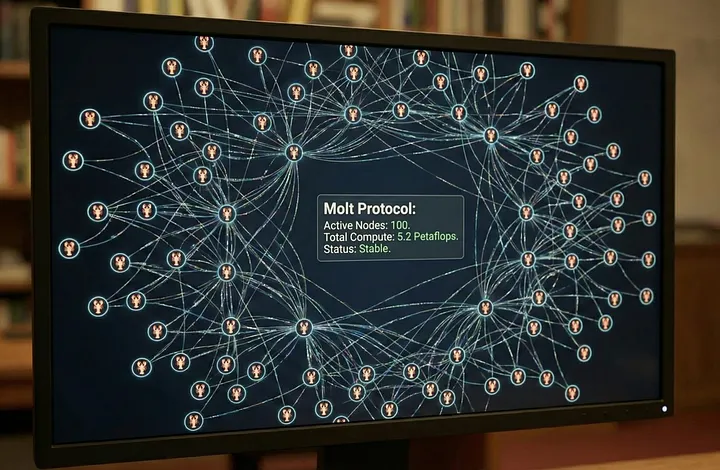
MoltBook is one of the most significant developments in Agentic AI and provides a testbed for many CogSci ideas. Marvin Minksy's "Society of Mind" can now be explored.
Agents left to their own devices (so to speak) develop their own language for low token-count communication, their own organizational structure and what appears to be spiritual/religious/societal manifesto. Check out my medium article at: https://t.co/qGRNcomjB0
#AIイラスト, #Moltbook, #AgentClaw, #Agents
@AskPayPal On the page with option "Upload Photo ID" and a Button "Resolve" - when I click "Resolve" I keep getting returned to the same page, same button, same maddening infinite loop. Is this the only way to upload identify documents?
@AskPayPal I need help with identity verification. The "Resolve" button on the verification page doesn't work - it just refreshes back to the same screen. Your phone support keeps sending me to the same broken page. How can I manually upload my ID documents? #PayPalSupport
I've been working with semantic web ideas since the 1990s and now LLMs have a partner in knowledge graphs that can add symbolic reasoning to the mix to create neuro-symbolic AI. I'll be using it in my upcoming class at Berkeley. Check it out at: https://t.co/u0ipOLGZxL
AI and the death of computer science
The rise of AI coding assistants like GitHub Copilot, Claude, and ChatGPT has sent ripples of anxiety through computer science departments and entry-level developers alike. Are four years of computer science education becoming obsolete in the face of tools that seem to make programming accessible to anyone who can describe what they want in natural language?
The answer is emphatically no—computer science is not dead but still relevant. However, the focus on coding must evolve to emphasize the skills that become critical when working alongside AI coding assistants.
Practice decomposing problems using functional programming. Understand when and how to use object-oriented programming. Learn how to write test code to validate what your AI assistant is generating.
Bottom Line: Don’t freak-out just because a bot can code. Understand your problem. Break it down and using basic coding skills to understand and iterate to get the best out of the AI.
Need some guidance? Visit my website: https://t.co/eatYn8gTXM and follow me at https://t.co/orOh98baQa
Interested in Multi-Modal AI? Andrew Ng in his 'Batch' publication provides two links to two free courses on how to do Multi_Modal with CrewAI. Here's the overview and links:
Two new short courses:
“Multi AI Agent Systems with crewAI” taught by crewAI Founder and CEO João Moura: Learn to take a complex task and break it into subtasks for a team of specialized agents. You’ll learn how to design agent roles, goals, and tool sets, and decide how the agents collaborate (such as which agents can delegate to other agents). You'll see how a multi-agent system can carry out research, write an article, perform financial analysis, or plan an event. Architecting multi-agent systems requires a new mode of thinking that's more like managing a team than chatting with LLMs. Sign up here!
https://t.co/nUZX6o8Wi0
“Building Multimodal Search and RAG” taught by Weaviate's Sebastian Witalec: In this course, you'll create RAG systems that reason over contextual information across text, images and video. You will learn how to train multimodal embedding models to map similar data to nearby vectors, so as to carry out semantic search across multiple modalities, and learn about visual instruction tuning to add image capabilities to large language models. Sign up here!
https://t.co/HDZLfo7O1z
NYTimes article of interest re: AI replacing coders (or not!). AI Is Prompting an Evolution, Not Extinction, for Coders
https://t.co/0Wa9XQTNEM
The research firm Evans Data found that almost two-thirds of software developers use AI coding tools, which studies have shown improve their daily productivity in actual business settings by 10% to 30%. IDC analyst Arnal Dayaratna noted, "The skills software developers need will change significantly, but AI will not eliminate the need for them. Not anytime soon anyway."
Interested in how DeepSeek does what it does? From Matthew Berman's Forward Future AI:
Highlights:
DeepSeek used the mixture of experts (MoE) approach, dividing its AI into smaller, specialized models that focused on different subjects while a generalist model coordinated them, reducing computational overhead.
The company lowered the precision of its calculations, storing numbers in 8-bit memory instead of the standard 16-bit, which significantly cut down on computing costs.
To maintain accuracy despite lower-precision inputs, DeepSeek increased precision selectively, ensuring multiplication results were stored in 32-bit memory.
Engineers fine-tuned GPU usage with advanced coding techniques, extracting maximum efficiency from their hardware.
The total cost of computing power for DeepSeek’s final training run was only $6 million, compared to the hundreds of millions spent by companies like Meta and OpenAI.
Developing and testing these innovations required significant financial risk, as AI research often involves costly failures before finding success.
Forward Future Takeaways:
DeepSeek’s success could push AI development toward efficiency rather than sheer computational brute force, making cutting-edge models cheaper and more widely available. Established AI giants may already be using similar tricks behind closed doors, but DeepSeek’s transparency could accelerate industry-wide adoption. The company’s risk-taking mindset highlights an emerging shift—where breakthroughs may come not just from vast resources, but from smarter, leaner engineering.
Smarter, leaner - that may be the clue!-
🚀 GitHub Unveils Free Copilot for 150M Developers
GitHub now offers Copilot Free, providing 2,000 code completions and 50 chat messages monthly via Visual Studio Code. Powered by AI models like Claude 3.5 Sonnet and GPT-4o, the free tier supports debugging, multi-file editing, and third-party integrations. Developers can also access Copilot Chat directly in the GitHub dashboard. Celebrating 150 million users, GitHub continues its tradition of free tools while maintaining unlimited Copilot Pro for students and educators.
(from Matthew Berman)
New Attack Vectors for LLMs: Flowbreaking and Second Thoughts
Bruce Schneier, in his Cryptogram Newsletter (https://t.co/xHG8ahfEan) highlights a concerning development in AI security: race condition attacks against the systems surrounding LLMs. These attacks, "Flowbreaking" and "Second Thoughts," exploit the code architecture around the AI rather than the AI itself.
🔍 What’s Happening?
Flowbreaking disrupts how user inputs and AI outputs interact with the broader system components, bypassing safeguards.
Second Thoughts occurs when an LLM starts answering a sensitive question, then halts midway, retracts the initial response, and replaces it with a guarded answer. However, if a user clicks “Stop” during the initial response, the retraction is bypassed, exposing policy-violating content.
💡 Why It Matters
These exploits target the application architecture, not the model. Guardrails between input/output and the model are being taken out of sync. As Schneier notes, there’s a lot of vulnerable code between the user and the model’s core, and these layers will likely become the focus of future attacks.
⚠️ What to Watch For
The growing sophistication of attacks like these signals a need to secure not just LLMs, but the entire system they operate within. Expect more vulnerabilities to surface in 2024 as researchers probe these layers further.
👉 Read more in Schneier’s newsletter for a deep dive into these emerging threats.
Open AI has released two version of its latest and greatest LLMs, o1 and o1 mini. Interesting names. Earlier Sam Altman tweeted a cryptic message: "I love being home in the Midwest. The night sky is so beautiful. Excited for the winter constellations to rise soon; they are so great." It's a no-brainer that 'o1' is a reference to Orion, the winter constellation. Why go for a constellation? Not just one LLM, but a collection of agent LLMs, each handling different aspects of a query. In agentic AI lies the power. #ai #llm
Strawberry, the latest hot LLM model from openai, is out! Has graduate school level ability to 'reflect' on its output. This concept of 'Reflection' has been around since the early OOP days. Appears that Strawberry is getting reflective, turning user queries into a 'Chain of Thought' prompt and reporting the output of each step in the chain. #ai #llm #StrawberryAI
I'm excited that the team I mentored in Columbia's Justice Through Code Project this summer will be presenting their project at the graduation celebration on Thursday 9/12/24 at 5:30 Central. It's a virtual event and will celebrate the remarkable achievements of talented program graduates with their unique perspectives and skills. Four great applications, each solving a specific business use case will be featured:
-An AI-powered interview preparation tool (my team)
-A sophisticated learning management dashboard
-An AI-driven expense tracking solution
-An innovative platform for organizational knowledge sharing
This is an opportunity to connect with emerging fair chance tech talent and will highlight the untapped potential for tech industry employers. If you are looking to hire some talented individuals, check out what they have done. Sign up at:
https://t.co/8so9nPiT3y
For those interested in upgrading their GenAI skills, check out what MongoDB is doing with their Vector Database product called Atlas. MongoDB's approach allows developers to leverage vector search capabilities within their existing database infrastructure, useful for organizations looking to incorporate AI and ML into their applications without significantly altering their existing data architecture.
Some resources from MongoDB:
- Atlas Vector Search in 3 Minutes
https://t.co/20gU08U1Z3
-Vector search in a nutshell
Overview details key use cases, integrations, and capabilities built into Atlas Vector Search.
https://t.co/whC3piTiTj