@thorborg Flere perspektiver i det, udover at det nok vil presse indtjeningen hos flere forsikringsselskaber pga. konkurrencen.
Men tror du at din (og alle andres henvendelser) bliver behandlet personligt af forsikringsselskabernes kundeservice, eller har de en AI agent til at svarer dig?
@thorborg Ja netop! Med al respekt for dit arbejde, så har jeg været mere bekymret for det som AI kan bruges til på negativ siden, end positiv siden. Relativ let at se al det som AI kan hjælpe med men jeg kan desværre også se alt det som AI kan hjælpe de skruppelløse mennesker med Not good
An interesting comparison of $NVO and $LLY from Barchart.
The author ultimately picks Novo Nordisk despite Wall Street currently seeing more upside in Lilly.
The argument comes down largely to growth versus valuation.
Eli Lilly is growing much faster, with EPS up 33% year over year compared with a 1% decline for Novo. But investors are also paying significantly more for that growth.
Lilly trades at nearly 32x forward earnings, while Novo trades at around 13x. Novo also offers a higher dividend yield.
The valuation gap is particularly striking considering Lilly’s market cap is around 5.5x larger, while its revenue is only about 39% higher and net income about 33% higher.
Analysts remain much more optimistic about Lilly, with a Strong Buy consensus and up to 39% potential upside, compared with a Hold rating and around 18% upside for Novo.
The author still chooses Novo, arguing that its much lower valuation, higher dividend yield and more restrained expectations offer a more attractive entry point for patient long-term investors.
Link: https://t.co/Neh0LOdB2W
#stocks #Investing
$NVO Novo Nordisk had a recent -16% pullback after the largest 3 month buying volume in company history after a bullish er.
The stock is now trading around its 2021 price and is down approximately 12% over the last 5 years, while $LLY is up 344%.
This is the same general price area Novo traded at before the stock rallied more than 240%.
Despite being widely viewed as the two dominant companies in the GLP-1 market, Eli Lilly is currently valued at approximately 5.5x Novo Nordisk's market capitalization.
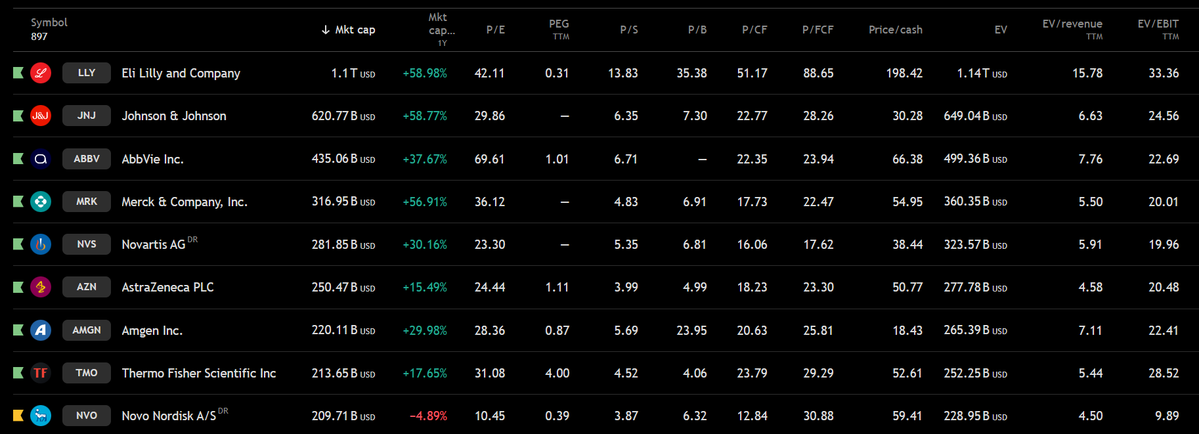
After updating my comparison across 9 of the world's largest pharmaceutical companies, I still can't believe how many key metrics Novo Nordisk ranks #1 in.
If oral GLP-1 adoption continues accelerating globally, I believe the market may be significantly underestimating Novo's long-term earnings power.
Novo Nordisk ranks #1 out of 9 in
• #1 Highest ROIC 45.29%
• #1 Highest Pretax Margin 47.52%
• #1 Highest Net Margin 37.23%
• #1 Lowest P/E 10.45x
• #1 Lowest P/S 3.87x
• #1 Lowest P/CF 12.84x
• #1 Lowest EV/Revenue 4.50x
• #1 Lowest EV/EBIT 9.89x
• #1 Lowest EV/EBITDA 8.64x
• #1 Highest CapEx $13.51B
• #1 Upside to 52 Week High 44%
• #1 Global GLP-1 Market Share
• #1 Oral GLP-1 Launch Trajectory
• #1 Weekly Oral GLP-1 Prescription Growth
• #1 GLP-1 Prescription Scale
• #1 GLP-1 Brand Mindshare
• #1 Diabetes GLP-1 Franchise
Novo Nordisk ranks #2 behind Eli Lilly in
• #2 Highest Operating Margin 45.45% (LLY 47.30%)
• #2 Highest ROA 24.14% (LLY 24.54%)
• #2 Highest Revenue Growth 16.79% (LLY 47.44%)
• #2 Lowest PEG 0.39 (LLY 0.31)
Despite ranking #1 or #2 across nearly every metric I value most, Novo Nordisk trades at the cheapest valuation multiples among these 9 pharmaceutical companies.
5-Year Performance
NVO -12%
LLY +344%
That performance gap is remarkable.
Lilly has been one of the greatest pharmaceutical investments in history and deserves a premium.
However, today's valuation gap between these two companies is one of the widest I've seen between businesses competing in the same long-term therapeutic market.
Novo is producing industry-leading profitability while trading at valuation multiples typically associated with mature, slow-growth companies.
One of the biggest reasons I'm bullish is oral GLP-1s.
In 2024, GLP-1s demonstrated enormous demand, but injections remain a hurdle for many patients.
Millions of people who may never choose a weekly injection could be willing to take a daily pill if it helps them lose weight, improve diabetes outcomes, and reduce cardiovascular risk.
Early prescription trends for oral Wegovy have been encouraging, and competitors continue investing heavily in obesity assets, reinforcing how valuable they believe this market can become.
If oral GLP-1 adoption continues scaling globally, I believe this could become one of the largest recurring healthcare markets in history.
With today's geopolitical uncertainty, I continue to favor companies with exceptional free cash flow, elite returns on invested capital, industry-leading margins, and valuations that already reflect significant pessimism.
I've been buying shares and options over the last day, and Novo Nordisk has become one of the largest positions in my other Deep Value Fund.
If I had to hold one healthcare stock through a bear market today, Novo Nordisk would still be my pick. This post will probably get like 10 likes and like most will only get coverage when the stock is up 100% + , people will say why didn't I see this before... Same with $DK $UNH $LEU $TGT $WEN $CNC $OSCR the last year in relation to value thesis stocks I bought and did DD on. lol
Market completely misreads $NVO Q2 ER
Huge upgrade of both revenue and profit.
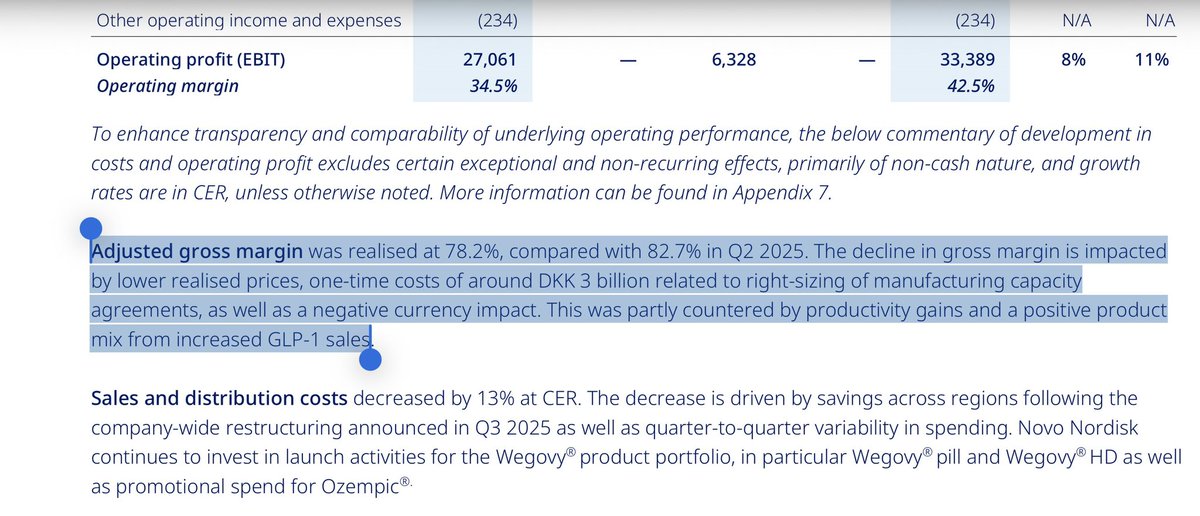
Gross margin is reported 78.2%. Down from 82.7% last year.
This could easily be miscalculated as low margin on wegovy pill.
BUT in Q2 NVO did another smaller re-org in supply chain and stoped a new capacity expansion fill finish project in Denmark. In Odense.
They took a non cash 3B dkk writ down on capacity. They don’t mention specifically the project in Odense. But it fits with timing and an amount there around.
If we deduct that 3B then gross profit would have been 82% vs 82.7% last year.
During Q2 NVO had said to analyst that wegovy pill margin would be the same as gross margin reported earlier.
Wegovy revenue hit exactly analysts concensus at 22.7B. But it was actually wegovy injections in IO (all markets except US) that surprised.
Seems as IQVIA has overstated wegovy injections in US.
But the main surprise Ozempic was up. Some adjustments on previous rebates in US. So it landed 3B dkk or 20% higher than my estimate.
But Ozempic also did better in IO. Higher volumes.
Overall the numbers are a bit “muddy”. Ozempic US does move things. But even excluding that, ER was much better than anyone had expected.
IO sales up by 10%!
One very interesting information is FDa has accepted filing of MASH indication with wegovy pill. FDA decision in Q1 2027
If wegovy pill gets MASH indication, that’s a way for many to get insurance coverage for wegovy pill. That could potentially be a boost for 2027
With this Q2 ER SP should be UP and not down.
I expect less negative reactions tomorrow morning when stock exchange in Denmark opens. And then it’s up to management to shed more light on what ever concerns investor might have.
THE CITADEL GAME THAT CAUSED LEOPOLD ASCHENBRENNER’S FORCED SALE
> Citadel sees a young man in his early twenties managing a fund worth over $45 billion, nearly twice the size of Bill Ackman’s fund, which has been in operation for 23 years.
> The fund, in just 2 years, has grown from a modest $225 million to over $40 billion, with just 8 employees and no background in asset management. The fastest growing fund in history.
> Citadel sees a weakness in the portfolio ⟶ leverage.
> Citadel knows the thesis is right: AI infrastructure is where the real money is in AI. No matter who wins in the model race, the infrastructure wins.
> Now, this young man is holding billions in these assets.
> Then July 10 came after the $SKHY trade, followed by a major selloff across all AI stocks, with most down more than 30% in 2 weeks between July 10–20.
> Leopold Aschenbrenner’s short positions starts moving up against his direction, causing more losses (he was short on software stocks), with positions worth billions of dollars.
> July 24th, Leopold Aschenbrenner sends a letter to investors calling the selloff a buying opportunity and asks for more money, with that window to be open on August 1st, the same day of his wedding. With good news that the fund is up 439% through June YTD.
Perfect opportunity:
> July 27, Citadel Securities raised a false alarm, saying the Fed is gonna do a surprise rate hike.
> July 28, retail, out of fear, the market sells off after Citadel’s report & Leopold Aschenbrenner tries to raise & borrow more money to avoid a margin call for bleeding options positions. Both long and short positions bleeding.
> July 29, banks’ margin calls began. News people spread fear, the selling continues. Perfect opportunity.
> July 30, Jane Street and other market makers bid, but Citadel’s price is better. Citadel buys the majority of his portfolio for a massive discount.
> 3rd August, Citadel Securities is up more than $3 billion in just 2 days after buying Leopold Aschenbrenner’s Situational Awareness public book.
> Same Monday, 3rd August, Citadel Securities says, “the bull market drivers are intact.”
No AI bubble news, no market top, but buying the majority of the Leopold Aschenbrenner portfolio is the AI bottom and the start of the bull market.
Sad for those who didn’t buy the bottom. Because Citadel, as a market maker, won’t sell those positions anytime soon.
The game is rigged against retail and anyone that offers retail help.
@PerNordnet@NordnetDK Og det bliver interessant at følge den næste uges tid. Hvisnikke de begynder at lukke har alle shortene så misforstået noget eller regner de tingene anderledes ud? Hvad er resten af GN forretning værd på gældfri basis?
@sonderby@sonderby enig, og din beskrivelse er fantastisk. Kan du give et par tips til hvordan jeg (M50+ med ok it færdigheder, men ikke i branchen til dagli) lærer at få disse agenter op og kører? 🙏