A quick look into remote persistent sessions with Superlogical! Not just remote sessions, but some functionality like remote directory lists, too. Superlogical can actually be a full SSH replacement (I don't run SSH on my servers anymore), and I talk about that briefly, too.
The next phase of @tensorx_ai infrastructure is on the data centre floor.
The first @Dell PowerEdge XE9780 systems, part of a ten-server, 80 GPU NVIDIA B300 deployment, arrived at our Irish data centre this week.
This is Irish-owned sovereign AI infrastructure. Every system runs private AI inference on dedicated hardware that TensorX owns and controls. Zero data retention. Full EU data residency. Built for teams in finance, healthcare, law and other regulated industries.
Sovereignty is not a promise not to look. It is a provider that structurally cannot. No US parent to compel, EU inference by design.
This adds substantial capacity to infrastructure already in production, and there is more behind it.
Deployment is delivered by our infrastructure partner ICT Services, with @Dell Technologies.
Build on dedicated sovereign AI infrastructure today: https://t.co/zsutJbhd41
#SovereignAI #AIInfrastructure #EnterpriseAI
𝗞𝗶𝗺𝗶 𝗞𝟯 𝗶𝘀 𝗹𝗶𝘃𝗲 𝗼𝗻 𝗧𝗲𝗻𝘀𝗼𝗿𝗫.
The world's first open 3T-class model:
• 2.8T parameters
• Native multimodal (text, image, video)
• 1M token context
• #1 open model on Artificial Analysis
We're running it on our own EU GPUs. Zero data retention. Frontier intelligence, sovereign by default.
Same endpoint, same key:
moonshotai/kimi-k3
https://t.co/a8uc1eA9sl
The next evolution of Hermes Agent is here!
Introducing Hermes Desktop: everything you love about Hermes, now native on your machine.
First demoed in Jensen's GTC keynote, it's now in public preview.
https://t.co/5XvCDN8eTy's GLM-5-Turbo and GLM-5v-Turbo are now live on Tensorix! 🚀🚀
Not proxied. Not routed through a third party. Both models run on Tensorix-owned GPUs in Dublin, with full zero data retention as standard.
GLM-5-Turbo: agent-ready, built for coding and agentic use cases
GLM-5v-Turbo: multimodal reasoning across code, images, documents and diagrams
Capable models shouldn't come with a sovereignty trade-off.
Go build something cool on https://t.co/YneDKxsmMY
My dear front-end developers (and anyone who’s interested in the future of interfaces):
I have crawled through depths of hell to bring you, for the foreseeable years, one of the more important foundational pieces of UI engineering (if not in implementation then certainly at least in concept):
Fast, accurate and comprehensive userland text measurement algorithm in pure TypeScript, usable for laying out entire web pages without CSS, bypassing DOM measurements and reflow
claude skills 2.0 quietly launched this week and most people missed it
anthropic shipped 3 upgrades to skills that fix the problems almost everyone runs into
here's the breakdown (and how to upgrade yours):
problem 1: you had no way to measure how well your skills were actually performing.
now you can run real evals that test your skill against multiple prompts and get a score (like 7/9 passed).
you fix what failed, retest, and repeat until it's dialed in.
•
problem 2: your skills break when models update and you don't notice.
say you wrote a skill 3 months ago when claude needed detailed instructions for landing pages.
now claude is way better at landing pages by default
but your old skill is still forcing it to follow outdated steps instead of using its own improved abilities.
now you can run a/b comparisons between your skill and raw claude
so you know if a skill is still earning its place or if you should fix/retire it.
•
problem 3: claude doesn't even use your skill half the time because the description is too vague or too specific.
now the skill creator rewrites your descriptions automatically so they trigger at the right time.
anthropic ran this on their own skills and saw better triggering on 5 out of 6.
i cooked a full step-by-step breakdown below
Let me make your life easier.
1. In claude code, codex, opencode etc.. setup this skill. https://t.co/0imgerw5EQ
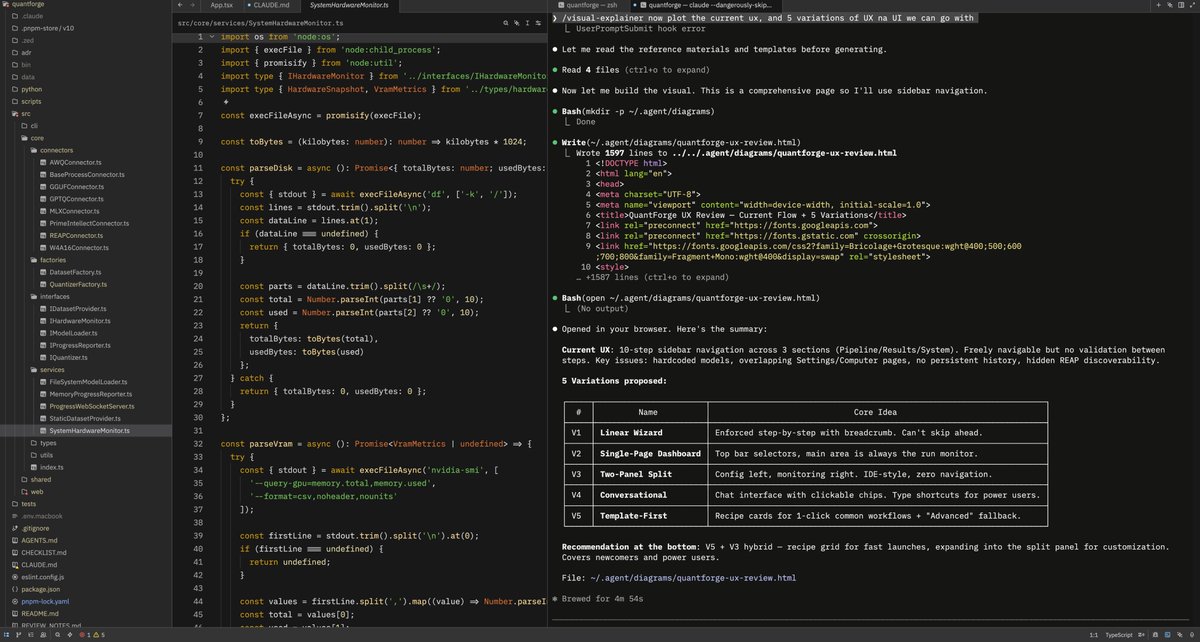
2. Instead of prompting for something in 1 way, ask the model to generate variations of what you are trying to make.
3. Use the frontend-design skill to get better UI/UX outcomes.
4. Get the model to present it's ideas via documentation, like the video you see below.
---------------
Agents love feedback cycles, having documentation like this allows you to work more HANDS OFF, you do your interview, review it's proposal, then let it execute on it.
Usually you can do this with plan mode, but the outputs of llms are typically hideous and hard to look at.
Read the plan, don't approve unless you AGREE WITH IT.
Someone open-sourced a geopolitical intelligence platform. AI-classified threats from 100+ sources, live instability indexes, ADS-B tracking, convergence alerts. In your browser. Free. MIT license.
Classified-level insight just got more accessible.
https://t.co/Hdew8Do33E
New in Claude Code: Remote Control.
Kick off a task in your terminal and pick it up from your phone while you take a walk or join a meeting.
Claude keeps running on your machine, and you can control the session from the Claude app or https://t.co/er6Blrr63e
Alibaba just dropped Zvec. A vector database that runs inside your app. No server. No Docker. No cloud bills. Built on Proxima, battle-tested at Alibaba scale. The "just embed it" era of vector search is here.
https://t.co/eSFVJQjClj
We've added a new command to Claude Code called /insights
When you run it, Claude Code will read your message history from the past month. It'll summarize your projects, how you use Claude Code, and give suggestions on how to improve your workflow.