This is so cool! I've been fascinated by the potential of graph-based AI agents for the last six months.
I started with the idea of a content generator but quickly realized the true magic lies in the fluid reasoning of LLMs and power of human in the loop. 🤯 Took the "mad scientist" path to figure out how we can build towards AGI and created Craftgen (https://t.co/grBj3aFnRs).
I totally agree: a single chat interface is key. Palantir's AIP military demo (https://t.co/4LiPOOUvfD) blew me away with its data flow and clear responsibilities. Craftgen uses a similar event-driven graph, with humans as the masterminds!
Now let's break down the pieces. Probably mine favorite paper is https://t.co/IFbClWdtRa it's showed if we give enough tools Agents are capable of coming up with skills to solve the problem.
ChatGPT code interpreter was first baby step towards this. But linear conversation and on between code generation and execution was not reliable and often times was "slow" and we didn't had tooling required to make that "fast" (function calling).
So, I wonder how we can make "thinking slow and fast" more accessible for users. Thanks to @Wattenberger's excellent article https://t.co/pNghCTB052 I am using LLM's fluid reasoning to create a rigid structure for skills.
Eventually, we ended up creating a visual programming language represented by a JSON Schema, which made it easier to debug if an agent-generated skill/workflow had bugs. This also unlocked integration with anything with an OpenAPI schema, allowing agents to self-improve.
Everything in craftgen is "Actor" (https://t.co/uYF9Whr3tC) and can run in isolation and built with only web technologies. Imagine this:
- An SEO Agent monitors your site daily.
- It spawns 1000 Page Agents to analyze your pages and Google data.
- Page Agents spawn more agents to track your competition's keywords.
- Everyone reports back, helping the SEO Agent suggest updates!
it can scale from your browser to a desktop app to the cloud! This tech is open source and event-driven by design. That's my take so far.
Ps. Seeking passionate contributors and cofounders to shape the future of AI with me. DM me!
There are many benefits to open-sourcing AI infrastructure.
Mark Zuckerberg detailed some of them in the earning call today: safety, security, efficiency, faster progress, standardization, popularity among developers and researchers, recruiting...
Hey there, GM Folks!
Guess what I've been up to for the past two days? Tackling the challenge of handling deeply nested actors.
And you know what? I nailed it.
GM @craftgenai people.
Finally, I pushed the code to https://t.co/U3xmDg7gOE.
(give a star ⭐️ if you wanna get updates for the releases)
The live demo is not up yet. I had some edge cases to handle.
So today's agenda: 👇
GM @craftgenai people!
I dedicated the entire day to shooting the 30-second video for the @OpenAI fund. I'm not exaggerating when I say it was a challenging task. Nevertheless, I have completed it. Feel free to critique it as you please. (However, I won't be reshooting it.)
Hey there, @craftgenai people!
I had a fantastic weekend away from the screen, enjoying the cool weather in the forest. It was exactly what I needed.
Yesterday, I returned, but I was excited to get some extra work done, so I didn't have time to catch up here.
For anyone who has been following along the journey of #buildinpublic the @craftgenai, I've whipped up a quick survey to gather some thoughts on it. If you've got a moment, I'd love your input to help make it even more awesome.
It's short, I promise!
Good morning, @craftgenai people!
Today is Marketing Day. I have a task at hand: nailing copy for the landing page of Craftgen. Since I decided to apply for the @OpenAI fund (not that I care about the money but exposure), I've been polishing up the pitch. It needs to be concise, just 30 seconds.
I have a reasonably solid start on the "Who" and "What" aspects, but I'm missing the "How." Therefore, the plan is to generate interest in the pitch and explain how it's executed on the landing page. I know I will procrastinate on that, so I reached out to @NapierHolland for help.
Today, I need to brain dump the vision along with some technical decisions and opinions.
Wish me luck!
Good morning, @craftgenai and everyone!
In the past few days, I've been exploring how to create a JavaScript browser-based code interpreter.
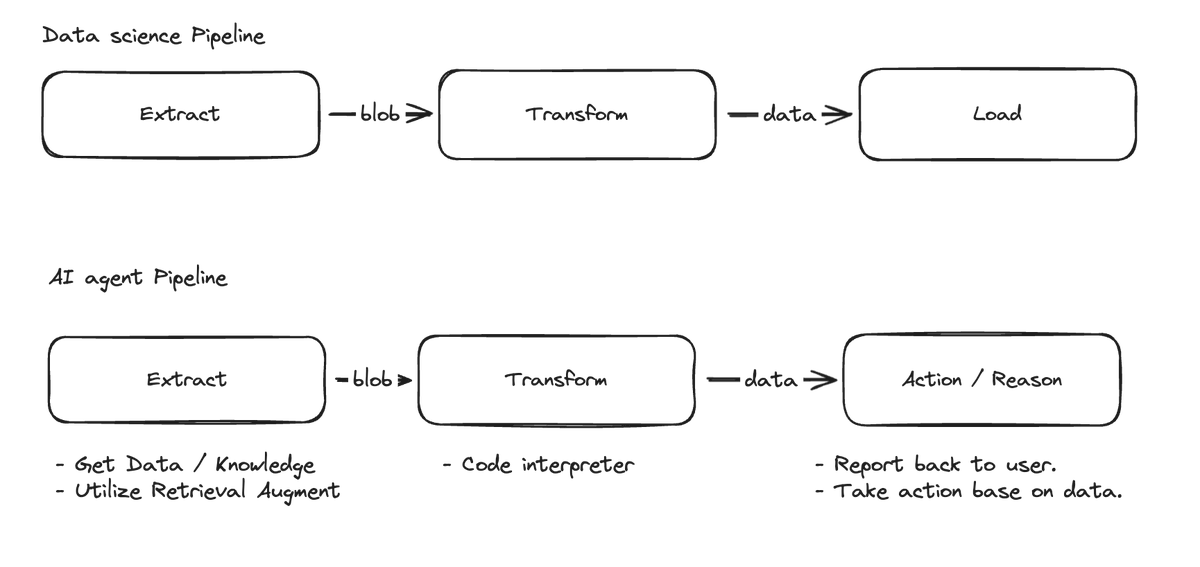
Interestingly, I've noticed that AI agents share similarities with the ETL (Extract, Transform, Load) process in data science.
What is ETL?
1. Extract relevant data from the source database
2. Transform the data so it's better for analytics
3. Load the data into the target database
4. (It is not necessarily the job of the data engineer to query the data to get meaningful analytics.)
In the Scenario of an AI agent, we can replace Load with (Action, Reason)
How do these technologies map to agent workflows today?
With Custom GPTs, we have a preliminary implementation of this idea.
We can upload knowledge in different formats: PDFs, text files, CSV, you name it.
And with a Code Interpreter, we can transform that data blob into something meaningful. Even if it doesn't make sense to us at first.
Oh, sure. I totally have faith that the best AI will miraculously write the perfect piece of code to calculate the oh-so-specific data you desire effortlessly.
How could it possibly go wrong?
Shortly, Many ways it can go wrong.
How can we improve LLM responses by combining fluid reasoning with a structured framework?
That's exactly what @craftgenai is all about.
Imagine this: We already know that we can use LLMs to generate transformer codes. But what if we want a more readable approach for everyday people?
I can ask the AI agent to retrieve data for me. The AI agent has the ability to create a tool that utilizes available resources such as @Shopify and @googlesearchc to load data. It can also write smaller pieces of code to transform the data and organize it in a graph node structure that is easy to understand.
And can return us an Actionable/Reasonable response.
We can go even further by providing tools to control resources, such as updating Shopify products and adding blog posts to enhance our SEO coverage.
What's even more remarkable is that once an AI agent creates a new tool or graph, it becomes a learned skill. The next time we ask similar questions, It won't need to reinvent the wheel; it will simply reuse the existing tools.
Exciting, right? If this resonates with you even a little bit, don't hesitate to follow @craftgenai. The early access waitlist drops soon!
Good morning, @craftgenai people!
Here's today's schedule:
- Continue implementing credentials to nodes with fallbacks to default.
- Enable a non-authenticated playground to function with local-storage values.
Good afternoon, people at @craftgenai!
Here's what I'm currently working on:
- Developing the Credentials UI 👮♀️
- If time permits, I'll also add a local storage option. I want to provide users with a way to experiment with it without having to sign up.
Good morning, @craftgenai users!
I apologize for my absence yesterday as it was #hackagu day.
I'm pleased to announce that I have completed the updates for the following functions:
- generateText
- generateStructure
Now they spawn new actors for execution.
Good morning, early @craftgenai users!
Here's what's up for today:
- https://t.co/2an6Ly0c5n is finally up after one eternity of DNS propagation. I will try to add some content that will try to answer Why and what
- I will update the logic for credentials & integrations a bit.
Good morning, early @craftgenai users!
Here's what's on today's agenda: I updated the actor reference restoration yesterday. As a result, there are now many commented codes in the code base. Today, I will go through those and clean them up.
In other words, it's Housekeeping Day





![supabase's tweet photo. Community Highlights 👥
Featuring: Hyperdome @IroncladDev, DevCanvas @abdulmuminyqn, CraftGen @craftgenai, mangosqueezy @mangosqueezy, notedown @techlism1
And more! https://t.co/8ppweaxgGZ
🧵👇 [9/11] https://t.co/ctkBfEmFAv](https://pbs.twimg.com/media/GXoUJ78WgAAcbDj.jpg)


