RethinkConn, the biggest @NATS_io event of the year, is TOMORROW!
We've you got covered from every angle:
→ Thursday June 4
→ 12-4 PM ET
→ Free
Reserve your spot to join us tomorrow!
In finance, latency is money. Reliability is survival.
Trading platforms, payment rails, settlement networks, real-time risk — all sitting on infrastructure that can't blink.
Engineers from @eToro, @Checkout, @StateStreet, and @jumptrading are joining us at RethinkConn 2026 to talk about how they're building the next generation of it.
If you ship anything with money on the line, you should be there.
Join us for a virtual half-day 👉 https://t.co/TtJjljMYG7
#RethinkConn2026 #FinTech #FinancialServices #LowLatency
Stream the talks. Miss the workshops.
RethinkConn 2026 — June 4, virtual, free.
7 hands-on workshops with the NATS maintainers. Live, attendees only.
Register: https://t.co/YSNthoxLBE
For years, edge systems summarized and aggregated because bandwidth gave you no choice. That constraint is gone. The habit isn't.
Most teams still call "is the node up?" observability — and skip the layer that actually matters: end-to-end event traceability. The ability to answer *what happened to this specific event?* Not the average. Not the rollup. The actual event.
Without it, your system can look perfectly healthy while quietly making decisions on signals that lost their meaning the moment they crossed the boundary.
New post in the NATS Edge Eventing Architecture series — on why approximate observability is structurally inflating your MTTR, and what tracing-as-a-first-class-property looks like instead. 👇
https://t.co/h0C3jvfKWO
#EdgeComputing #Observability #NATS #EventDrivenArchitecture
NATS auth checks who, but not what.
In some enterprises - especially highly distributed architectures - this meant @nats_io deployments need exceptions or special clearance from security, risk, and compliance teams.
No more!
@NATS_io has a particular adoption curve.
Someone introduces it for one use case, it just works, and within a year or two it's threaded through half the systems in the company.
This is great! Until it's not.
We're proud to share that Bruno Baloi has been recognized as an "AI Journal Thought Leader" — and his latest piece is one you'll want to read.
In "Living on the Edge: Rethinking Event-Driven Architecture for Distributed Intelligence," Bruno explores how the shift toward distributed computing is fundamentally changing the way systems must communicate, recover from failure, and make decisions in real time.
Some key takeaways:
🚀 Edge AI isn't just about speed
⛔️ In distributed environments, failure isn't the exception
📏 Event-driven systems are a natural fit for the edge, enabling resilience through asynchronous messaging and decoupled design
🐦🔥 The line between "cloud" and "edge" matters less than the ability to design systems that operate seamlessly across both.
At Synadia, this is what we think about every day — building the connective tissue for distributed, intelligent systems that work anywhere, reliably.
Read Bruno's full article here 👇
https://t.co/kHdYLYJiIX
#DistributedSystems #EdgeComputing #EventDrivenArchitecture #NATS #AI #Synadia
Message scheduling in NATS: one simple primitive, a lot of leverage.
(if you couldn't tell, we love that design principle) ...so how does it work?
The NATS server holds the message and delivers it exactly when you want it — no cron jobs, no timer services, no polling consumers.
A few patterns it unlocks:
→ Downsample sensor data. Fire-hose of IoT readings on a subject? Sample the
latest value at whatever interval you need and forget the rest.
→ Deferred order processing. Hold the fulfillment message until payment clears.
→ Periodic reports. `hourly`, `daily` aliases for standard intervals — NATS is your cron.
→ Retry with backoff. Reschedule failed work without building a scheduler.
One header. A dozen custom services you don't have to run.
Check out Peter Humulock's YT video or blog writeup to get all the config details!
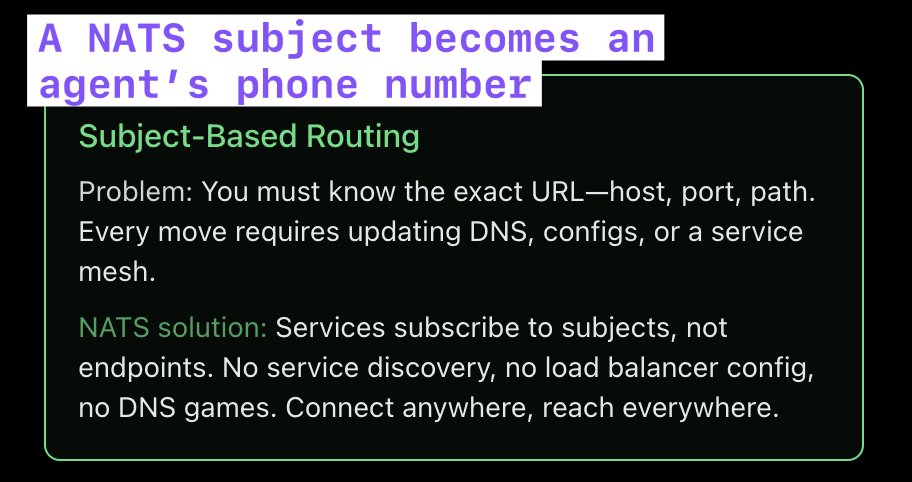
What if every AI agent had a phone number?
Not a brittle HTTP endpoint that breaks when the agent moves.
A stable address that works regardless of what agent framework the agent uses, what language it's written in, or where it's running.
NATS makes it possible
Pull or Push? How should you set up monitoring for your NATS systems?
How they work, when to use each, tradeoffs
Get the whole story: synadia dot com slash monitoring
A platform bridging edge and core should support four flow control capabilities:
1. Subject/topic filtering
2. Subject mapping / traffic shaping
3. Dynamic load distribution (weighted routing)
4. Varied consumption models (push vs pull)
https://t.co/rr4VQbfAbF
We built a practical architecture guide for resilient, secure edge-to-core messaging. Learn how to build systems that thrive in disconnected, distributed environments. https://t.co/Zu9KwWUNlm
@NBCNews@nbc has got to stop reporting on sports games that happen overnight and haven’t been broadcast in the US yet!!!!
AO men’s final was ruined for me. Thanks Sunday Today 🤬. This doesn’t bode well for Olympic coverage.
Some interesting news in the streaming world this week - that makes it a good time to reflect on where we are and where things are heading:
For years, the default choice for streaming was obvious. You picked the dominant platform, deployed it in your cloud, and scaled up from there.
But the architecture assumed everything important happened in the data center.
Well, the world has changed.
Your customers expect low-latency experiences wherever they are. Your systems are distributed across clouds, regions, and increasingly beyond data centers out at the far edge.
You're running inference on devices, not just in centralized clusters. The assumption that you could build for the cloud and bolt on edge later turned out to be expensive and fragile.
This is where NATS takes a fundamentally different approach.
NATS wasn't designed as a cloud-first system with edge bolted on. It was designed for "everywhere" from the start. A single NATS binary runs identically whether it's in AWS, in your data center, on a factory floor, or embedded in an autonomous vehicle.
Leafnodes let edge locations operate independently when disconnected, then sync seamlessly when connectivity returns.
JetStream handles streaming without the partition management overhead. No partition rebalancing when nodes come and go. Flexible retention policies. Asynchronous replication that actually works for intermittent edge connectivity.
The result: teams consolidate their messaging, streaming, and connectivity infrastructure into one system they actually understand. Instead of integrating Kafka for streaming, Redis for caching, a service mesh for discovery, and praying the auth models can happily coexist...
With NATS you get one platform, one operational model, one set of APIs.
You can build for "everywhere"—because that's what customers expect from your distributed systems and apps.
The distributed application future isn't coming. It's here.
The question is whether your infrastructure was designed for this world, or whether you're still trying to make cloud-centric tools work in places they were never meant to go.
Always been impressed with the fine folks at @thesysteminit. This is a good read on their architecture and its use of messaging as a foundational building block.
https://t.co/p3LET6zT8L