With everything we are hearing right now about ticks this seems like good information to share.
“Here’s what I’ve learned after more ticks than I care to count.
First, whatever your uncle told you, forget it. No matches. No nail polish. No Vaseline. No soap on a cotton ball. All of those do the same terrible thing, they stress the tick out, and a stressed tick empties its gut back into the bite before letting go. Which, if you think about what that actually means for a second, is literally how Lyme and the rest get transmitted so you’re not speeding up its exit. You’re making it throw up into you.
Fine-tipped tweezers. Grip right where the mouthparts enter the skin, not the body, the head. Pull straight up, steady, no twisting, no jerking. It’ll feel like it’s resisting because it is, the mouthparts are barbed. Just keep the pressure on and it lets go in a few seconds. If a piece breaks off in the skin, leave it alone. Your body pushes splinters out. Digging around with a needle does more damage then the fragment ever would.
Clean it with alcohol or soap. Wash your hands.
Now here’s the part most people skip: don’t flush the tick.
Tape it to an index card. Clear packing tape right over the body, write the date and where on your body it was, and stick the card in a drawer. If you come down with anything weird in the next 30 days, rash, fever, joint pain, that flu-that-isn’t-flu feeling, that tick goes with you to the doctor. Some labs will test the tick itself, which is faster and often more reliable than waiting for antibodies to show up in your own blood. A dated tick taped to a card is one of the most useful things you can hand a doctor who’s trying to figure out what’s wrong with you.
The other thing worth saying out loud: if the tick was engorged when you pulled it, and you can’t swear it was off your body within 24 hours, call your doctor that same day. Don’t wait for a rash. Fewer than three out of four Lyme cases even produce the classic bullseye. A single preventive dose of doxycycline within 72 hours of a deer tick bite cuts the Lyme odds way down, and most docs in tick country will write that prescription without giving you a hard time, especially if you walk in with the tick taped to a card and a clear timeline.”
A walk in a natural environment was associated with about a 7% reduction in rumination and decreased activity in the subgenual prefrontal cortex, a brain region linked to repetitive negative thinking and self-focused withdrawal.
In contrast, a comparable walk in an urban setting did not produce significant changes.
WHAT WALKING ACTUALLY DOES
Your heart isn't the problem. The pipes are.
Most cardiovascular disease starts with stiff, resistant blood vessels forcing the heart to push harder against mounting pressure. The pump itself works fine until the system wears it down.
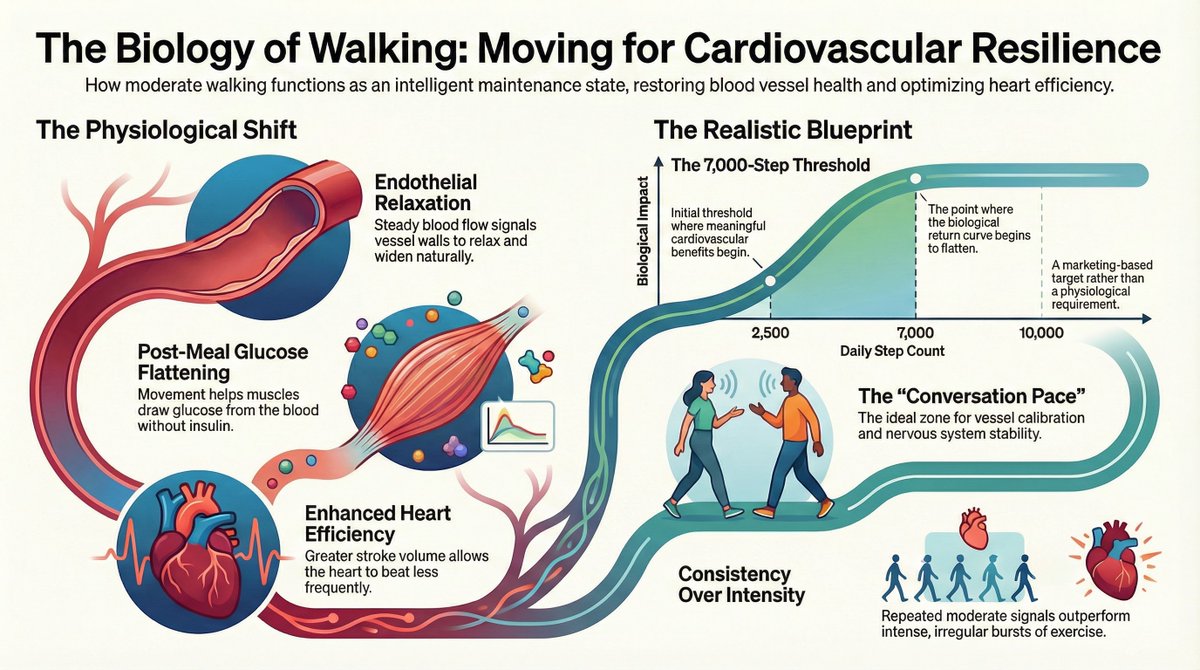
Walking fixes this at the source through steady flow stimulating vessel walls to relax and cooperate.
Blood vessels have an inner lining called endothelium. When blood flows consistently past it, the endothelium releases signals that make vessels widen.
No force required. Just regular use preventing stagnation. As vascular resistance drops, each heartbeat becomes less strained. The heart stops fighting its own infrastructure.
This happens fast. Within minutes of walking, blood flow patterns shift. Vessels detect the change and begin adjusting. Not dramatically. Quietly.
The nervous system stays calm because the body doesn't interpret moderate movement as threat. You're not triggering alarm responses. You're entering an intelligent maintenance state where efficiency improves without drama.
THE STEP COUNT FALLACY
Biology doesn't care about 10,000 steps. That number is marketing, not physiology.
Large observational studies show meaningful cardiovascular benefits starting around 2,500 to 2,700 daily steps. For sedentary people, that tiny increase produces disproportionately large gains.
First steps carry the highest biological return. The curve flattens past 7,000 steps, where the cardiovascular system gets most signals it needs for flexibility and resilience.
This matters because fixation on arbitrary targets creates unnecessary pressure. People cycle between intense bursts and burnout instead of building sustainable rhythms.
The body doesn't track your calendar. It integrates signals over time. Even hitting higher step counts one or two days weekly offers protection compared to nothing.
Walking stops being a task and becomes collaboration with your own biology. That's where durable benefits emerge.
PACE TEACHES PRECISION
How you walk matters nearly as much as how much. A moderately brisk pace creates gentle challenge space where heart and vessels must coordinate more precisely while staying fully controlled. Not suffering. Calibration.
Faster cadence produces stronger, smoother blood flow. Vessel walls expand more dynamically. The heart fine-tunes rhythm and contraction strength to maintain stability.
With repetition, the cardiovascular system learns to handle above-normal conditions gracefully, preparing infrastructure for peak loads while everyday operation remains quiet.
A pace allowing short conversation signals the ideal adaptive zone. In this range, the cardiovascular system receives clear learning signals while the nervous system stays stable enough to support recovery.
Advanced, highly efficient walking is interval walking, where a faster pace alternates with an easier pace.
THE POST-MEAL WINDOW
After eating, blood glucose rises and the body redirects flow toward digestion. For people with metabolic dysfunction or sedentary habits, this becomes quiet vascular stress. Sharp glucose spikes directly affect endothelium, creating less favorable environments for vessel function.
Light walking after meals intervenes remarkably gently. No intensity needed. Movement allows muscles to draw glucose from blood through insulin-independent pathways, flattening post-meal peaks and reducing metabolic stress on vessels. Blood flow redistributes evenly. The endothelium receives its familiar signal: steady, moderate flow without shock.
This protects vessels at their most vulnerable moment. Even healthy people experience cumulative stress from repeated daily glucose spikes. Walking after meals doesn't erase modern eating patterns but softens metabolic edges enough to reduce unnecessary cardiovascular strain over years.
It uses a window that already exists. A few minutes of movement after eating sends a powerful biological message. The system is supported, not overwhelmed.
WHAT CHANGES OVER TIME
Consistent walking produces measurable traces. Blood pressure drops modestly, but over years this reduces cumulative vessel strain and translates into tangible cardiovascular risk reduction.
Resting heart rate lowers not pathologically but because each beat becomes more efficient. With greater stroke volume, the heart beats less often to meet resting demands.
Large population studies show walking habits correlate with lower rates of cardiovascular events and all-cause mortality at moderate activity levels. Not extremes. Biological consistency.
The deeper change is harder to chart. Everyday movements trigger less alarm. Heart rate rises less dramatically for the same effort. Breathing steadies faster after exertion. Stress recovery improves as the cardiovascular system becomes flexible and confident rather than locked in prolonged alert mode.
These aren't flashy shifts. They quietly reshape how heart, vessels, and nervous system coordinate daily. From that stable foundation, the most durable cardiovascular health builds through intelligent repetition, not intensity.
THE EVOLUTIONARY FRAME
Humans evolved moving frequently at moderate intensity throughout the day. Not to train. To survive. Our cardiovascular systems optimized for that environment: steady movement, manageable demand, minimal prolonged alarm.
Walking is the closest modern behavior to that evolutionary template. It doesn't trigger excessive survival responses or force the heart into battle. Instead it sends a familiar signal: environment safe, demand reasonable, efficiency preferred.
Modern science confirms what intuition suggested. From sustained blood pressure reductions and lower resting heart rate to improved vascular flexibility and faster stress recovery, walking doesn't just improve numbers. It re-educates how the cardiovascular system responds to life itself.
A body not constantly over-activated recovers better, tolerates stress more effectively, ages more slowly. Walking doesn't grant immortality but allows systems to operate as designed. That alignment is the foundation of long-term health.
Perfection isn't required. Not 10,000 steps. Not pain. Not force. Just small, correctly timed, repeatedly delivered signals. Biology rewards consistency, not extremes.
Walking is a daily message to heart and vessels that the world is manageable. In an era defined by chronic pressure, that message might be one of the most powerful forms of medicine we still underestimate.
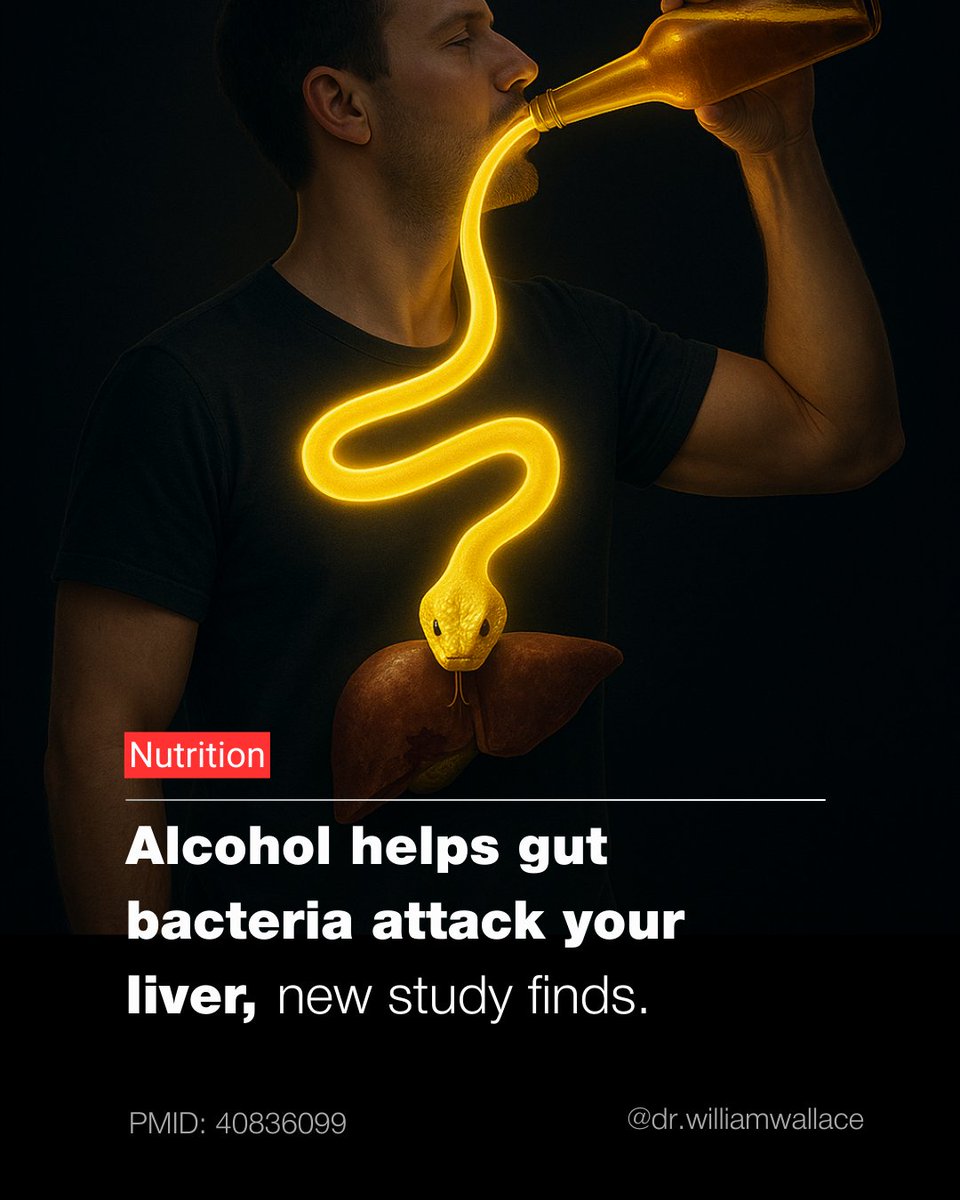
Excessive alcohol consumption is a leading cause of liver disease and liver transplantation. Yet the exact mechanisms behind why alcohol accelerates liver damage have remained incompletely understood.
A 2025 study in Nature (PMID: 40836099) demonstrated a gut–liver pathway that helps explain this vulnerability. Researchers found that chronic alcohol use downregulated the muscarinic acetylcholine receptor M4 (mAChR4) in the small intestine. This impaired the ability of goblet cells to form goblet cell–associated antigen passages (GAPs), specialized structures that train immune cells to recognize and control gut microbes.
Without GAPs, gut bacteria translocated into the liver, where they worsened alcohol-induced injury. In both human biopsies and mouse models, alcohol reduced mAChR4 expression and disrupted antimicrobial defenses, leading to unchecked bacterial infiltration.
Findings:
✳️ Alcohol → ↓ mAChR4 → ↓ GAP formation → impaired antimicrobial immunity
✳️ Bacterial leakage from the gut into the liver worsened alcoholl-induced steatohepatitis
✳️ Restoring GAPs signaling reactivated immune defenses and blunted bacterial translocation
✳️ In mouse models, directly stimulating mAChR4 in goblet cells was sufficient to protect against ethanol-induced liver damage
Limitations: These results come primarily from preclinical models, with human data limited to small biopsy sets. No therapeutic targeting of mAChR4 or gp130 has yet been tested in clinical trials for alcohol-associated liver disease.
Chronic alcohol use disables a gut immune “gatekeeper,” allowing bacteria to invade the liver and worsen damage. Restoring this defense, via mAChR4 or gp130 pathways, may offer a new therapeutic approach for alcohol-associated liver disease.
Physical activity is the most effective intervention available for promoting brain health and longevity. Recent research demonstrates that regular exercise, even in modest amounts, is effective for enhancing brain volume, improving memory, and reducing the risk of neurodegenerative diseases. Beyond its cognitive benefits, moderate physical activity also contributes to extended lifespan and better overall health outcomes.
Even regular walking has shown to have powerful impacts on brain structure and function:
*️⃣Activity levels equivalent to 4,000 steps per day have been linked to measurable increases in gray matter and white matter volumes (PMID: 38073389)
*️⃣A 2011 study showed that 40 minutes of walking, three times per week lead to a 2% increase in hippocampal volume over one year, effectively reversing 1–2 years of age-related atrophy and enhancing spatial memory performance (PMID: 21282661).
*️⃣A more recent study suggests that activity levels equivalent to walking just under 3 hours daily for the least active populations could extend lifespan by 11 years on average (doi: 10.1136/bjsports-2024-108125).
Even walking is an accessible, non-pharmacological intervention for promoting brain health, reducing disease risk, and enhancing longevity.
Somatic Therapy is a revolutionary new method to reverse depression, anxiety and fatigue.
It combines neuroscience, psychology and biology to rewire the brain.
Here's what it is and how to do it: 🧵
High-intensity exercise can help fight cancer
It doesn’t just burn calories—it "stirs the biological soup," triggering powerful changes in the body that reduce cancer risk
By flooding the bloodstream with immune cells, lowering cancer-fueling hormones like insulin and IGF, and ramping up anti-inflammatory markers, intense workouts create a hostile environment for cancer to develop
The harder you push, the stronger the protective effect
Metastasis—the spread of cancer to new organs—is responsible for 90% of all human cancer deaths.
Exercise—particularly high-intensity exercise—increases blood flow and shear stress in blood vessels. This mechanical force makes it harder for circulating tumor cells to survive, spread, and form metastases.
Several lines of evidence support this anti-cancer mechanism:
- In vitro studies show that exercise-equivalent levels of shear stress kill up to 90% of circulating tumor cells, including highly metastatic and drug-resistant breast cancer cells.
- In animal studies, mice who exercise have fewer circulating tumor cells and a 50–60% lower rate of metastasis and tumor growth.
- In humans, higher physical activity levels are linked to reduced cancer recurrence, possibly due to lower metastatic spread.
The powerful force of blood flow achieved during exercise actively disrupts cancer spread, which is just one of the ways exercise benefits the long-term health and survival of cancer patients.