The numbers behind Nigeria's disaster response failure. Every single one of these can be changed. But not without the right infrastructure.
Share this post and follow Grandview Grids for the full story.
#Grandviewgrids#G2#nigeriatech
Nigeria's $1 Trillion Economy Has a $600 Billion Location Problem
"Every country that scaled a digital economy built the same layer first. Nigeria has the ambition. It is missing the foundation."
The arithmetic is not secret. Nigeria's GDP stands at approximately $400 billion, rebased in 2024 by the National Bureau of Statistics. President Tinubu's Renewed Hope Agenda has declared a target of $1 trillion by 2030. [1] [14] That is not a rounding error of ambition. Reaching $1 trillion from $400 billion in five years requires compounded annual growth of 17.6 per cent. The International Monetary Fund, in its April 2026 World Economic Outlook, upgraded Nigeria's 2025 growth forecast to 3.9 per cent.
The gap between 3.9 per cent and 17.6 per cent is not a communication problem. It is not a policy sequencing problem. It is a structural problem – and its name is almost never spoken in the documents that describe the $1 trillion target.
The People the Digital Economy Cannot Reach
Nigeria has approximately 220 million people. More than 130 million of them remain offline. [2] [4] That is not a technology access problem that faster broadband solves. It is a verification problem. The formal economy – the digital economy, the payment systems, the credit infrastructure, the logistics networks – cannot serve a population it cannot verify, cannot precisely locate, and cannot consistently reach.
The National Bureau of Statistics Labour Force Survey for Q4 2025 shows that 92.4 per cent of employed Nigerian youth are in the informal sector. [3] UNICEF's Nigeria Digital Skills Report, published in 2025, found that 78 per cent of Nigerian youth lack essential digital skills. [5] The African Institute for Development Policy estimates that Nigeria loses between $11 billion and $14 billion annually to this skills deficit. [6] The National Information Technology Development Agency has set a target of 50 million digitally skilled Nigerians by 2027. [7]
These are not competing statistics. They describe the same structural problem from different angles. The people most needed to drive Nigeria's digital growth are the people the formal digital system was not designed to find.
The National Communications Commission has initiated what it describes as a historic overhaul of Nigeria's telecommunications infrastructure – a process expected to create two million jobs and generate an additional NGN 2 trillion in annual tax revenues. [15] The ICT sector's contribution to GDP reached 16 per cent in 2024, with a national target of 21 per cent by 2030. [4] The ambitions are real. The institutional will is present. What is missing is the layer on which these investments must sit to reach beyond the population they currently serve.
What India Built Before Everything Else
India's digital economy transformation is frequently cited as the benchmark – and it should be. But the lesson is misread when it focuses on apps, on UPI, on payments, on digital public infrastructure as a product ecosystem. The JAM Trinity – Jan Dhan bank accounts, Aadhaar biometric identity, and mobile connectivity – was not India's digital economy. It was India's foundation for a digital economy.
The Jan Dhan Yojana programme has opened more than 560 million bank accounts. [8] The Direct Benefit Transfer system, which runs on Aadhaar verification, has transferred the equivalent of Rs 43 lakh crore directly to verified beneficiaries. The government's own records indicate savings of Rs 3.48 lakh crore in previously documented leakage – money that, in prior systems, would have been absorbed before it reached the intended recipient. [9]
The scale of India's return is not explained by the payments architecture. It is explained by the identity-location layer that made every account, every transfer, and every verification precise. When the system knows who you are and where you are, every investment built on top of it reaches further.
What Brazil and Rwanda Found at the Same Address
Brazil's Bolsa Familia programme, one of the most studied social transfer mechanisms in the world, reaches 14 million households. Its instrument is not sentiment. It is the Cadastro Unico – a geocoded household registry that assigns each beneficiary family a precise location in the formal system. [10] Brazil's Pix payment network, which now has over 140 million users representing approximately 65 per cent of the population, runs on top of a population registry that knows where those users are. [11]
Rwanda's case is, in some respects, the most instructive. After 1994, Rwanda rebuilt its national identity infrastructure from near destruction. The National Identification Agency (NIDA) system, which was created, is now one of the most geocoded population registries on the African continent. Rwanda did not start with a development agenda and add identity later. It started with verified identity and location, and the development agenda followed. [12] Foreign direct investment, which Rwanda attracts at rates disproportionate to its market size, consistently cites institutional precision and address-verified infrastructure as differentiating factors.
Indonesia, with over 17,000 islands and a population exceeding 260 million, deployed its e-KTP biometric identity card to every citizen. [13] The country did not solve location verification after it achieved digital growth. It solved location verification as a precondition for digital growth.
The Principle Nigeria Has Not Yet Applied
There is a pattern here that is not coincidental. India, Brazil, Rwanda, Indonesia – countries with different histories, different geographies, different institutions – all made the same investment before their digital economies scaled: a sovereign, geocoded, verifiable record of who is where and what belongs to whom.
Nigeria's challenge is not the absence of ambition. The NIPSS report to the President, the NCC overhaul, the NITDA skills programme, the ICT sector targets – these are not empty declarations. The challenge is that each of them is being built on top of a population that the formal system cannot precisely locate. Every digital economy initiative that bypasses the location-identity layer will serve the population it already serves very efficiently. The ceiling on Nigeria's $1 trillion target is not an aspiration. It is architecture.
The principle that connects India to Brazil to Rwanda to Indonesia is not technology. It is trust infrastructure – the verified, sovereign record that tells the formal economy exactly who and where its citizens are. Every economy that built this layer saw investment returns that could not be explained by any other single factor. Every economy that skipped it found that its digital growth concentrated in the population already visible to the system.
What Comes Next
The arguments for building Nigeria's sovereign trust layer are not theoretical. They are documented in the economic histories of four countries with development trajectories comparable to Nigeria's. The infrastructure that closes the gap between 3.9 per cent and 17.6 per cent begins not with the next app, not with the next digital skills programme, and not with the next connectivity target. It begins with a precise answer to two questions: Where exactly is each Nigerian? And who exactly do they have the right to be?
We are building the case for Nigeria's sovereign trust layer. One argument at a time.
Follow @grandviewgrids on all social media platforms for more updates.
TECESM & DAWN Commission One-Day Roundtable
The TETFund Centre of Excellence in Security Management (TECESM), University of Ibadan, in partnership with the Development Agenda for Western Nigeria (DAWN) Commission, invites the general public to a One-Day Roundtable on Constitutional State Policing in Nigeria: Opportunities, Challenges and Implementation.
Date: Wednesday, 13th May, 2026 | Time: 10:00 AM | Venue: Trenchard Hall, University of Ibadan, Nigeria.
Lead Speaker: Dr. Adesina Ayodele Fagbenro-Byron
Chairman/CEO, Mothergold Limited & Mothergold Consulting, Lagos
@UniIbadan@TETFundNg@depshsipssui
Kunle Soname @ 60: Nigeria’s First European Club Owner Proving Private Investment Can Transform Nigerian Football
Kunle Soname didn’t just invest in business—he built systems that turn talent into opportunity, from Ikenne to Europe, from football to aviation.
How do you go from community kickabouts to owning a European club and building one of Africa’s biggest platforms?
Read the full story: https://t.co/taXA5m9ZTI
Something is coming. And trust us — you'll want to be there for this one.
If you've experienced the Yoruba Historical Conversation before, you already know what to expect — but this year is different. This year is special.
And if you've never been? There's no better time to start than now.
Join us on May 5th, 2026, for the Special Centenary Edition — a moment that will be talked about for years to come.
Venue: Carlton Gate Xclusive Hotel, Agodi, Ibadan || Time: 11 am
Can't make it in person? Register here to attend virtually: https://t.co/9UWrWS8Fw0
#YorubaHistoricalConversation #PaFasorantiAt100
On this Workers' Day, we honour the commitment and resilience of every worker contributing to the development of Southwest Nigeria. Your efforts do not go unnoticed.
Thank you.
#WorkersDay2026
To every Muslim celebrating today, near and far, in every corner of the world, Eid Mubarak!
May Allah accept your fasts, your prayers, and your good deeds. May this day be the beginning of a year filled with mercy, health, and happiness.
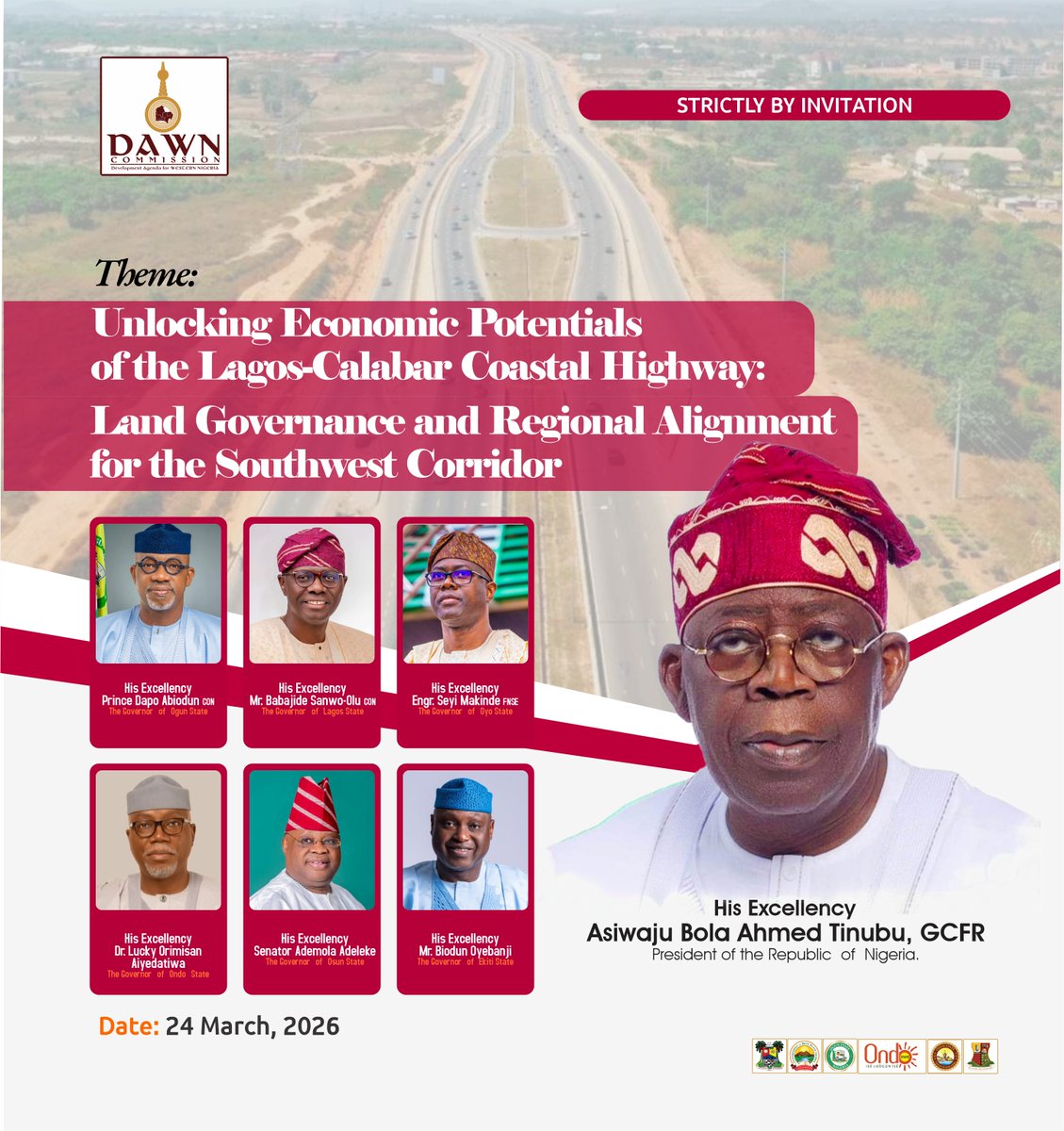
The DAWN Commission convenes a roundtable themed:
"Unlocking the Economic Potential of the Lagos-Calabar Coastal Highway: Land Governance and Regional Alignment for the Southwest Corridor"
The session brings together Southwest Governors under the patronage of His Excellency, President Asiwaju Bola Ahmed Tinubu, GCFR, @officialABAT, to deliberate on land governance and regional alignment regarding the Lagos-Calabar Coastal Highway.
Date: Tuesday, 24th March, 2026
Strictly by Invitation
@FeedbackOYSG@ekitistategov@Osun_State_Gov@OGSG_Official@followlasg








![GrandviewGrids's tweet photo. Nigeria's $1 Trillion Economy Has a $600 Billion Location Problem
"Every country that scaled a digital economy built the same layer first. Nigeria has the ambition. It is missing the foundation."
The arithmetic is not secret. Nigeria's GDP stands at approximately $400 billion, rebased in 2024 by the National Bureau of Statistics. President Tinubu's Renewed Hope Agenda has declared a target of $1 trillion by 2030. [1] [14] That is not a rounding error of ambition. Reaching $1 trillion from $400 billion in five years requires compounded annual growth of 17.6 per cent. The International Monetary Fund, in its April 2026 World Economic Outlook, upgraded Nigeria's 2025 growth forecast to 3.9 per cent.
The gap between 3.9 per cent and 17.6 per cent is not a communication problem. It is not a policy sequencing problem. It is a structural problem – and its name is almost never spoken in the documents that describe the $1 trillion target.
The People the Digital Economy Cannot Reach
Nigeria has approximately 220 million people. More than 130 million of them remain offline. [2] [4] That is not a technology access problem that faster broadband solves. It is a verification problem. The formal economy – the digital economy, the payment systems, the credit infrastructure, the logistics networks – cannot serve a population it cannot verify, cannot precisely locate, and cannot consistently reach.
The National Bureau of Statistics Labour Force Survey for Q4 2025 shows that 92.4 per cent of employed Nigerian youth are in the informal sector. [3] UNICEF's Nigeria Digital Skills Report, published in 2025, found that 78 per cent of Nigerian youth lack essential digital skills. [5] The African Institute for Development Policy estimates that Nigeria loses between $11 billion and $14 billion annually to this skills deficit. [6] The National Information Technology Development Agency has set a target of 50 million digitally skilled Nigerians by 2027. [7]
These are not competing statistics. They describe the same structural problem from different angles. The people most needed to drive Nigeria's digital growth are the people the formal digital system was not designed to find.
The National Communications Commission has initiated what it describes as a historic overhaul of Nigeria's telecommunications infrastructure – a process expected to create two million jobs and generate an additional NGN 2 trillion in annual tax revenues. [15] The ICT sector's contribution to GDP reached 16 per cent in 2024, with a national target of 21 per cent by 2030. [4] The ambitions are real. The institutional will is present. What is missing is the layer on which these investments must sit to reach beyond the population they currently serve.
What India Built Before Everything Else
India's digital economy transformation is frequently cited as the benchmark – and it should be. But the lesson is misread when it focuses on apps, on UPI, on payments, on digital public infrastructure as a product ecosystem. The JAM Trinity – Jan Dhan bank accounts, Aadhaar biometric identity, and mobile connectivity – was not India's digital economy. It was India's foundation for a digital economy.
The Jan Dhan Yojana programme has opened more than 560 million bank accounts. [8] The Direct Benefit Transfer system, which runs on Aadhaar verification, has transferred the equivalent of Rs 43 lakh crore directly to verified beneficiaries. The government's own records indicate savings of Rs 3.48 lakh crore in previously documented leakage – money that, in prior systems, would have been absorbed before it reached the intended recipient. [9]
The scale of India's return is not explained by the payments architecture. It is explained by the identity-location layer that made every account, every transfer, and every verification precise. When the system knows who you are and where you are, every investment built on top of it reaches further.
What Brazil and Rwanda Found at the Same Address
Brazil's Bolsa Familia programme, one of the most studied social transfer mechanisms in the world, reaches 14 million households. Its instrument is not sentiment. It is the Cadastro Unico – a geocoded household registry that assigns each beneficiary family a precise location in the formal system. [10] Brazil's Pix payment network, which now has over 140 million users representing approximately 65 per cent of the population, runs on top of a population registry that knows where those users are. [11]
Rwanda's case is, in some respects, the most instructive. After 1994, Rwanda rebuilt its national identity infrastructure from near destruction. The National Identification Agency (NIDA) system, which was created, is now one of the most geocoded population registries on the African continent. Rwanda did not start with a development agenda and add identity later. It started with verified identity and location, and the development agenda followed. [12] Foreign direct investment, which Rwanda attracts at rates disproportionate to its market size, consistently cites institutional precision and address-verified infrastructure as differentiating factors.
Indonesia, with over 17,000 islands and a population exceeding 260 million, deployed its e-KTP biometric identity card to every citizen. [13] The country did not solve location verification after it achieved digital growth. It solved location verification as a precondition for digital growth.
The Principle Nigeria Has Not Yet Applied
There is a pattern here that is not coincidental. India, Brazil, Rwanda, Indonesia – countries with different histories, different geographies, different institutions – all made the same investment before their digital economies scaled: a sovereign, geocoded, verifiable record of who is where and what belongs to whom.
Nigeria's challenge is not the absence of ambition. The NIPSS report to the President, the NCC overhaul, the NITDA skills programme, the ICT sector targets – these are not empty declarations. The challenge is that each of them is being built on top of a population that the formal system cannot precisely locate. Every digital economy initiative that bypasses the location-identity layer will serve the population it already serves very efficiently. The ceiling on Nigeria's $1 trillion target is not an aspiration. It is architecture.
The principle that connects India to Brazil to Rwanda to Indonesia is not technology. It is trust infrastructure – the verified, sovereign record that tells the formal economy exactly who and where its citizens are. Every economy that built this layer saw investment returns that could not be explained by any other single factor. Every economy that skipped it found that its digital growth concentrated in the population already visible to the system.
What Comes Next
The arguments for building Nigeria's sovereign trust layer are not theoretical. They are documented in the economic histories of four countries with development trajectories comparable to Nigeria's. The infrastructure that closes the gap between 3.9 per cent and 17.6 per cent begins not with the next app, not with the next digital skills programme, and not with the next connectivity target. It begins with a precise answer to two questions: Where exactly is each Nigerian? And who exactly do they have the right to be?
We are building the case for Nigeria's sovereign trust layer. One argument at a time.
Follow @grandviewgrids on all social media platforms for more updates.](https://pbs.twimg.com/media/HMExhw4XcAAbNCM.jpg)