Imagine building the answer before the regulator even wrote the question.
$ABXX did exactly that. 🔥
Today at #FIABoca, the new CFTC Chairman laid out the future of American commodity markets—and it reads like an Abaxx product roadmap:
✅ T+0 collateral mobilization
✅ Critical minerals price discovery
✅ On-delivery physically settled contracts
✅ Western-built commodity infrastructure = national security
✅ FCM access reform to unlock new participants
This isn't speculation. Today, it became national policy.
Built in Singapore.
Blessed in Boca. 🇺🇸🇸🇬
The market still hasn’t fully connected the dots.
But smart money is watching. 👀
$ABXXF #ABXX #FIABoca #CriticalMinerals #Commodities #SmarterMarkets #29ers
@CFTC@abaxx_exchange@JoshCrumb@JoeRaia5@JuanZenZiros
Who else sees the alignment? Drop a 🔥 if you're long the vision.
https://t.co/hPu4jvs94Z
@abaxx_tech, majority shareholder of Abaxx Singapore, the owner of Abaxx Commodity Exchange and Clearinghouse, announced that Abaxx Exchange will expand its #LNG futures suite with three financially-settled contracts. #ads https://t.co/8d93uxgy2G
What Josh Crumb @JoshCrumb has built is one of many emerging and essential components that facilitate the transition from the hegemonic dollar system to a more trustworthy and sustainable commodity trading and settlement architecture.
CHINA'S LONG GAME: ENERGY, GOLD AND THE FUTURE OF GLOBAL COMMODITY TRADING
I've been following China's growing influence in global commodity markets for years, as many of you know, and an interesting story is developing that I believe deserves more attention.
To understand what is happening, let's go back to November 2022.
China's state-owned Sinopec signed a landmark 27-year agreement with QatarEnergy to purchase 4 million tonnes of liquefied natural gas annually.
The agreement was reportedly valued at approximately $60 billion, making it one of the largest LNG supply deals announced at the time.
Just weeks later, Chinese President Xi Jinping travelled to Saudi Arabia.
During that visit, Xi encouraged Gulf nations to use the Shanghai Petroleum and Natural Gas Exchange to conduct oil and gas trade in Chinese yuan.
This was an important development.
China was not simply securing long-term energy supplies. It was also encouraging its trading partners to conduct more commodity transactions in its own currency.
Then came March 2023.
China's CNOOC completed a landmark LNG transaction with France's TotalEnergies through the Shanghai exchange.
The shipment involved approximately 65,000 tonnes of LNG originating in the United Arab Emirates.
What made the transaction particularly interesting was that it was settled in Chinese yuan rather than U.S. dollars.
Later that year, China introduced export licensing restrictions on gallium and germanium, two strategically important metals used in semiconductor manufacturing.
These were separate developments, but together they highlighted how commodities were becoming increasingly important to China's economic security and international financial ambitions.
Now, fast forward to November 2026.
Abaxx Exchange, owned by a subsidiary of TSX-listed Abaxx Technologies, announced that it will launch its first offshore Chinese renminbi-denominated LNG futures contract on November 16.
The new contract will allow market participants to hedge international LNG prices in offshore Chinese yuan while remaining linked to a U.S. dollar-denominated physical LNG benchmark.
Why is this significant?
For decades, international energy trading has been built predominantly around U.S. dollar-denominated prices and financial contracts.
China, meanwhile, has spent years expanding its role in global energy markets while encouraging greater international use of the renminbi.
Abaxx is now introducing something that connects these two worlds.
Its new contract will allow international market participants to hedge LNG prices in offshore Chinese yuan through an exchange in Singapore.
But there is an important detail.
The contract is linked to Abaxx's existing physically deliverable North Pacific Asia LNG futures benchmark, which provides for LNG delivery at ports across China, Japan and South Korea.
In other words, Abaxx is creating a renminbi-denominated financial instrument connected to a physical international energy market.
That is an interesting development for a commodity that has historically been traded predominantly in U.S. dollars.
And it raises a larger question.
As China continues expanding its presence in international commodity markets, which exchanges and financial institutions will provide the infrastructure needed to connect those markets?
There is another interesting connection to gold.
Abaxx Exchange already operates physically deliverable gold futures in Singapore, with trading volume increasing significantly in recent months.
In October alone, its gold futures recorded nearly 600,000 contracts traded.
According to Abaxx CEO Josh Crumb, the exchange is also planning to introduce a Chinese yuan-denominated gold futures contract.
If launched, that would extend Abaxx's approach across two important commodity markets:
Gold and LNG.
Physical commodity benchmarks, financial futures and contracts denominated in both U.S. dollars and offshore Chinese renminbi.
These are different instruments, but together they illustrate how international commodity exchanges are developing more flexible ways to connect physical markets with financial trading.
There is another development worth mentioning.
On the same day as Abaxx's announcement, Singapore announced a new gold vaulting service for foreign central banks, with capacity for up to 500 tonnes of bullion.
The two initiatives are separate, but both reflect Singapore's growing ambitions as a global commodity and financial centre.
For decades, the U.S. dollar has dominated international energy and commodity trading.
That dominance remains firmly established.
But the system is not standing still.
Countries are reconsidering how they secure critical resources, which currencies they use in international trade and where they hold their monetary reserves.
Meanwhile, financial exchanges are developing new ways to trade, hedge and settle commodity exposure across different currencies.
I believe this is one of the more important developments to watch in the years ahead.
Because the future of global commodity markets will not be determined solely by who produces the LNG, oil, copper or gold.
It will also be influenced by who builds the financial infrastructure through which those commodities are priced, traded and settled.
Disclosure: I am a shareholder of Abaxx Technologies Inc. (TSX: ABXX). This is not financial advice.
Promises made...
"Late last year the company was hinting at doubling the contracts listed in 2026. We’re not close, so a product backlog seems to be forming"
#29ers
👇👇👇
https://t.co/cI3MVe4IWw
Looks like a ton of new products on the pipeline.
I wonder if they're waiting for the Tier 1 Bank/FCM to onboard before launching or not?
We will see Soon™...
#29ers $ABXX.TO
h/t to @Plecotus on noticit DOT net
In British Columbia, I was shocked when David Eby, actually said that EVERYTHING you earn BELONGS to the state, and they DECIDE what you are allowed to keep.
Many politicians don’t say it this plainly, but it is what they truly believe. This is the dark side of human nature that even the Ten Commandments sought to guard against.
A woman from St. Louis booked a single day of fishing in Canada, her first time ever on that river, and pulled up a fish her guides think is more than 100 years old.
It's over 11 feet long, and it'll never make the record books. In British Columbia it's illegal to lift a sturgeon that size out of the water, so nobody can put it on a scale.
The official world record is a 468-pounder from 1983.
This one got sized up with a tape measure instead. Sixty inches around the middle, run through a length-and-girth formula, comes out to roughly 1,100 to 1,200 pounds. It had also never been caught or tagged before, so it spent its whole life in a busy fishing river without anybody landing it.
If the age guess is right, it hatched into a river that had just been gutted. In 1897 the Fraser gave up about 1.1 million pounds of sturgeon. By 1905 the catch was down to around 44,000. The canneries were after caviar, so the big females went first, with some of the roe shipped to Russia of all places. Problem is, a Fraser female doesn't spawn until she's about 26, and after that only every 4 to 10 years. Every egg-heavy fish they pulled was a quarter century of growing the river couldn't replace. First Nations fishermen warned the cannery owners it would crash, and by 1905 it had.
That fish then made it through decades of commercial nets until B.C. banned keeping sturgeon in 1994. A female that hatched the year of the ban would've only hit her first spawn around 2020.
Funny thing is, nobody can actually prove the age. You age a sturgeon by slicing a fin ray and counting rings like a tree stump, and when USGS researchers tested that on fish whose real ages were known, the readers' consensus matched only about 31% of the time, and got worse the older the fish was. So "over 100" is an educated guess on a fish nobody had ever measured.
Sturgeon outlasted the asteroid that killed the dinosaurs, and Fraser River caviar almost got them in eight years.
I am excited to be an investor in trade(xyz) as they partner with ICE to bring 24/7 perpetual futures on Hyperliquid to the United States. As a market participant, I am looking forward to to using their innovative product to enhance my investment process.
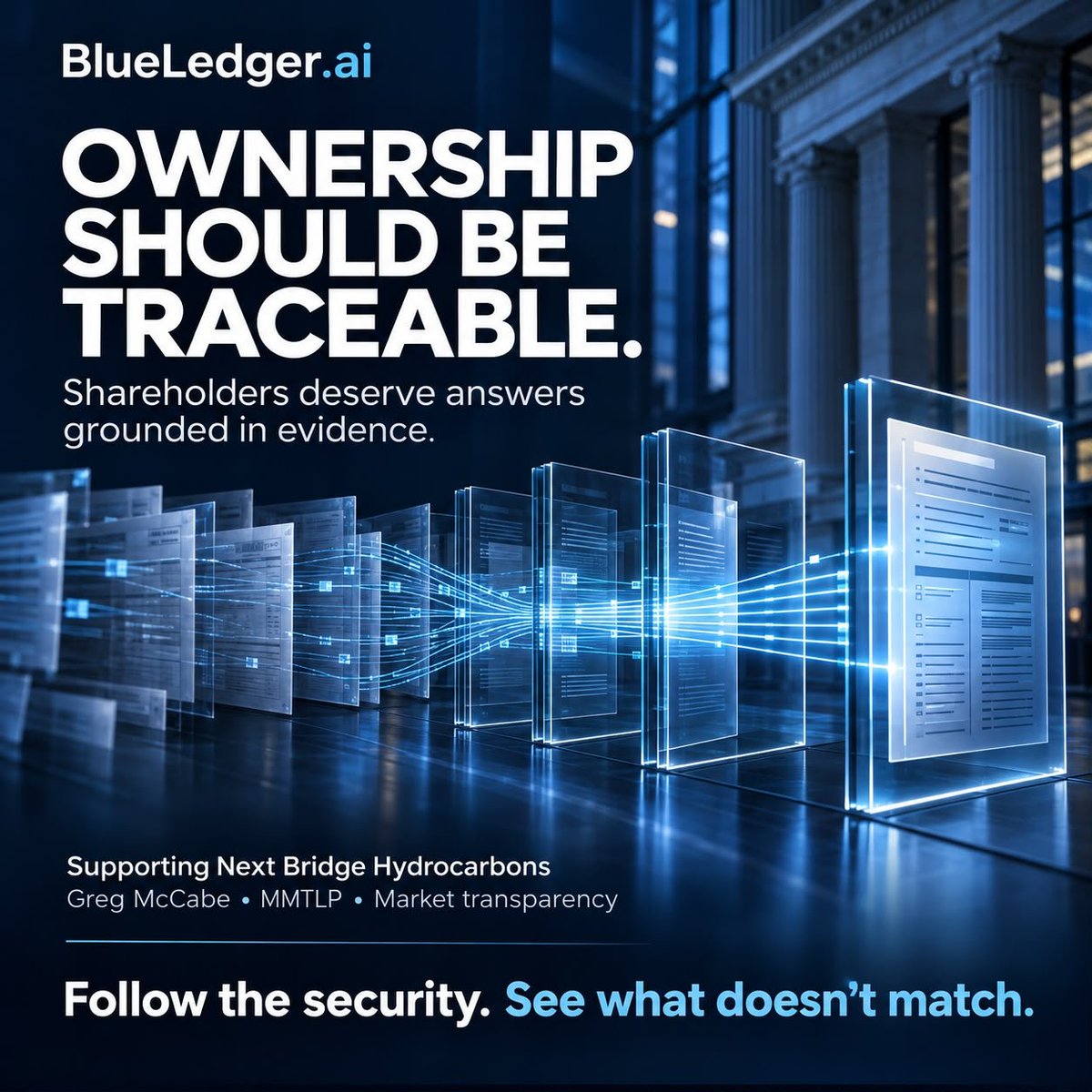
We are proud to welcome Next Bridge Hydrocarbons [@nbhydrocarbons] as BlueLedger's first issuer client, engaging us to provide an independent analysis of fragmented securities records and investigate potential discrepancies in their security's global trading.
As Next Bridge Hydrocarbons Chairman and CEO Greg McCabe joins Charles Payne [@cvpayne] on Fox Business to discuss MMTLP, BlueLedger supports the call for greater transparency and accountability in public markets.
On July 28, Next Bridge published transfer-agent records identifying shares registered to brokerage firms. Those figures raised an important question: whether registered holdings reconcile with the positions reflected in shareholders' brokerage accounts.
But identifying a potential discrepancy was only the beginning. Understanding it requires tracing records across institutions, corporate actions, security identifiers, and timelines while accounting for how different systems record ownership.
This is the challenge BlueLedger is actively solving for public companies.
Our current investigative work applies an evidence-led methodology to examine fragmented securities records, trace inconsistencies, and distinguish documented facts from unresolved questions.
We are developing an AI-powered platform designed to connect market records across venues and jurisdictions, identify discrepancies, reconstruct a security's history, and preserve traceable evidence for further investigation.
Nearly four years after the December 2022 trading halt, MMTLP shareholders deserve meaningful answers grounded in verifiable evidence. A shareholder should not need a television interview to get clarity on what they own.
And this challenge extends far beyond one security.
Issuers should be able to understand what happens to their securities throughout their lifecycle. Shareholders deserve confidence in the integrity of the systems recording their investments. Regulators, legal counsel, and investigators need evidence they can independently examine.
We support Greg McCabe and Next Bridge in bringing these concerns to a wider audience. Our responsibility is to follow the evidence - wherever it leads.
Market transparency should not depend on CEOs and shareholders spending years piecing together fragmented records.
Follow the security. See what doesn't match.
https://t.co/HVWqSnQjvx
#MMTLP #NextBridge #MarketIntegrity #ShareholderRights #BlueLedgerAI
It happens everyday, it's happening right now... it's probably happening to $ABXX.TO as we speak.
Thanks you @cvpayne for following up on the #MMTLP saga!
#29ers
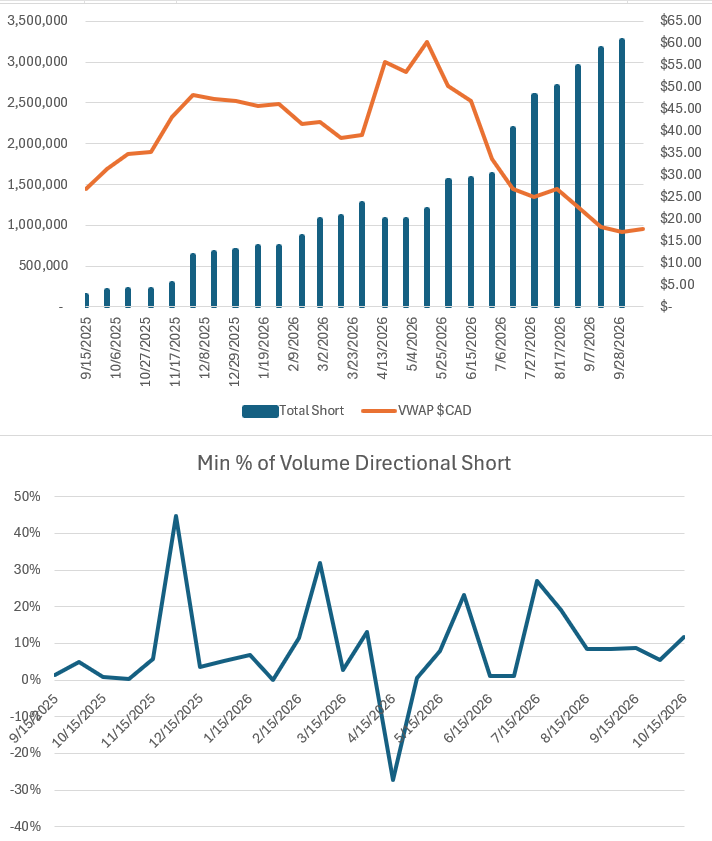
Shorts' arms have to be getting tired at this point...
Now, across official TSX and OTC reporting (not even including however many shares are sold short on the Frankfurt listing), 3,499,686 total shares sold short.
In other words, regardless of the price of the next financing, if there even is one, there's already 3.5M shares worth of blind buying.
At today's close of 15.34 CAD, 10.94 real dollars, that's
$53.69M CAD or $38.3M USD, basically the entire financing amount that was oversubscribed at , just 5 months ago at 3.5X the price.
I'll say it again:
Every single future share in an offering at today's price is already accounted for by a group that has to buy the shares, indiscriminate of the offering price.
Assuming there even is another public raise, and assuming it's not already spoken for by people who actually want to invest long in the company.
Since August 15, on average 181K shares have been sold every 15 calendar days. 8.65% of all shares sold was a new net short.
Extrapolate that from now until June (or later) of next year, apply an interest rate for borrowing fees, and you'll see exactly why the shorts haven't "won" shit yet.
Staring at a pretty mark to market that brings you nothing but a monthly margin bill, that the shares don't even exist for you to cover with...
This is gonna be fun™.
$ABXX.TO $ABXXF #CallingAllWannabeFundManagersAndCIOsandFinanceyGuys #LNGDeliveryThisFall #2X80KVolumeDaysInARow
#HoldingABeachballUnderWater #ShouldHavePaidAttentionToBernoulliInPhysicsClass
@dailydirtnap Everyone so fucking lazy - stop drinking booze, eat meat, Throw some dumbbells around, do a few pushups - think about progress in years - walla
An LA hospitality group runs 25 bars, many of them right by Dodger Stadium. Every extra playoff game means packed bars. An early exit means lost revenue they were counting on.
So they hedged it. They put $60,000 on Kalshi on the Dodgers *not* making the World Series.
The Dodgers lost the NLCS to the Brewers. The position returned nearly 2x, helping cover the playoff business that *never* came.
A Columbia law professor told Fortune it works like “a form of bespoke insurance.”
Read the full story here: https://t.co/dErQA7mvzK