Crifine token is now officially live and tradeable.
$CRIF:
0xdFEFF46129b666A6Fbf76e6ACE3b6218cd23f183
Execution Truth Infrastructure - the last honest number before an autonomous order hits the book.
Most data products show you the average.
Averages describe the days you didn't need them.
We show you the worst depth in the window - the day it actually mattered.
That's the number that saves you. → https://t.co/YTj4Yk325f
For real-world assets, price is only half the answer.
The other half: how long until it's actually cash?
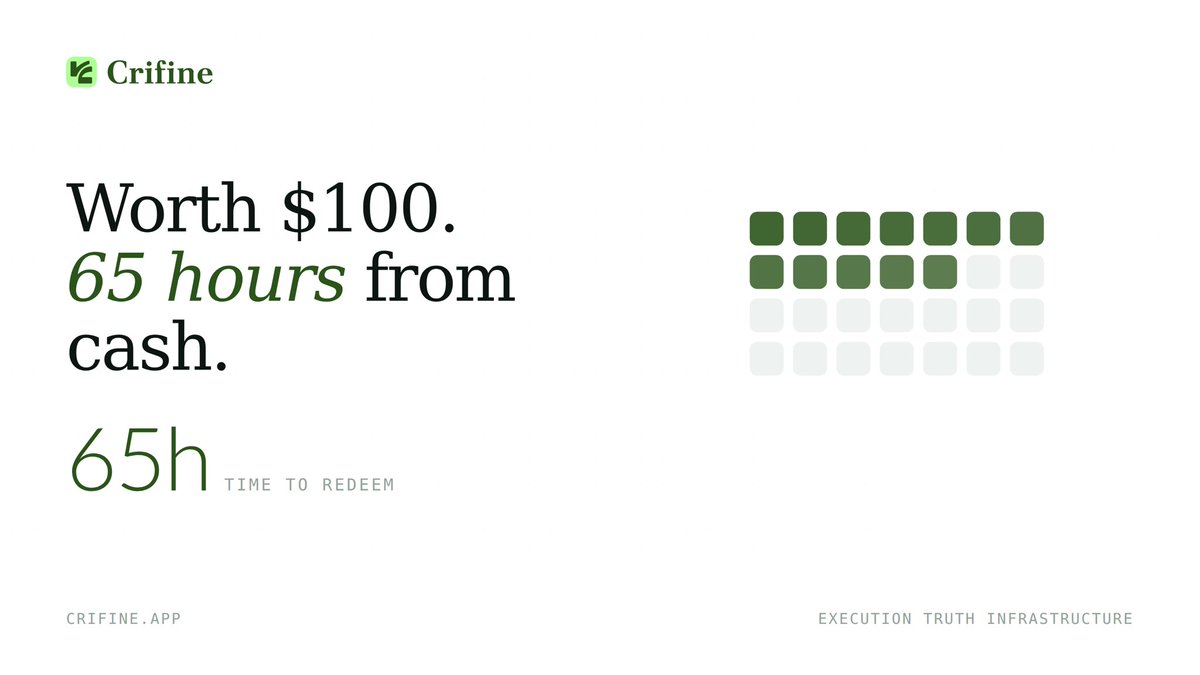
A token worth $100 that takes 65 hours to redeem is not the same asset as $100.
We track both. → https://t.co/YTj4Yk325f
The oracle isn't broken when it prints Friday's close on a Sunday.
It's doing its job perfectly.
The problem is nothing else in your stack knows the market is SHUT.
Market hours as a first-class input → https://t.co/YTj4Yk325f
Tokenized stocks trade 24/7. The actual stock market doesn't. 🕐
Saturday night, your NVDAx price is Friday's close. The buyers went home two days ago.
Nothing in DeFi tells you this. We do.
https://t.co/YTj4Yk325f
Ask a chat box what five million dollars of a mid-cap token sells for and it will give you a number, confidently, because a number is what you asked for. Whether that number survives contact with the pool it would actually have to go through is not a question it was built to consider.
Here the same question goes to Claude Sonnet from @AnthropicAI, and Claude does not answer it. It works out which question is being asked and hands it to the code that reads the recorded book. Every figure on the screen is computed by the same functions the dashboard and the public API use, and the model only writes the sentence around them. So when the size asked for is larger than the depth that exists, what comes back says exactly that, instead of quoting a price for liquidity that was never there.
Verify this pool, next to the answer, is a keyless public endpoint that recomputes it. The pool page behind it shows every day it was recorded from. https://t.co/oDysulZ8yO
First buyback and burn for #CRIF!
We used our fees to buyback $CRIF and permanently burn it, strengthening long-term sustainability and aligning value with real usage.
https://t.co/8NshHkkGzN
"How much can I sell?" is not a price question. It's a depth question.
A healthy pool absorbs size across many levels.
A thin one has almost nothing under the first tick.
Same price. Totally different risk.
See the shape → https://t.co/ng875UXUGQ
A human trader feels a thin market. Slows down. Cuts size.
A bot feels nothing. It sends the full order into an empty book at 3am and finds out after.
Give your bot the instinct it doesn't have.
https://t.co/Irot8pKu39
Every lending protocol has the same silent bug:
It values your collateral at oracle price.
It SELLS your collateral at book price.
The gap is real money. It shows up during liquidations, when it hurts most.
We price that gap. → https://t.co/YTj4Yk325f
Your bot reads a price feed. Your bot sizes a trade off that feed. Your bot eats the slippage.
Price feeds were built for humans staring at charts. Not for bots moving size.
We built the feed for bots. 🤖 https://t.co/Irot8pKu39
Simple version:
"Price" = what the last guy paid for 1 token.
"Fill" = what YOU get for 1,000 tokens.
Those are different numbers. Sometimes VERY different.
We measure the second one. Free to check, no signup.
https://t.co/YTj4Yk325f
Everyone quotes ONE price for ETH.
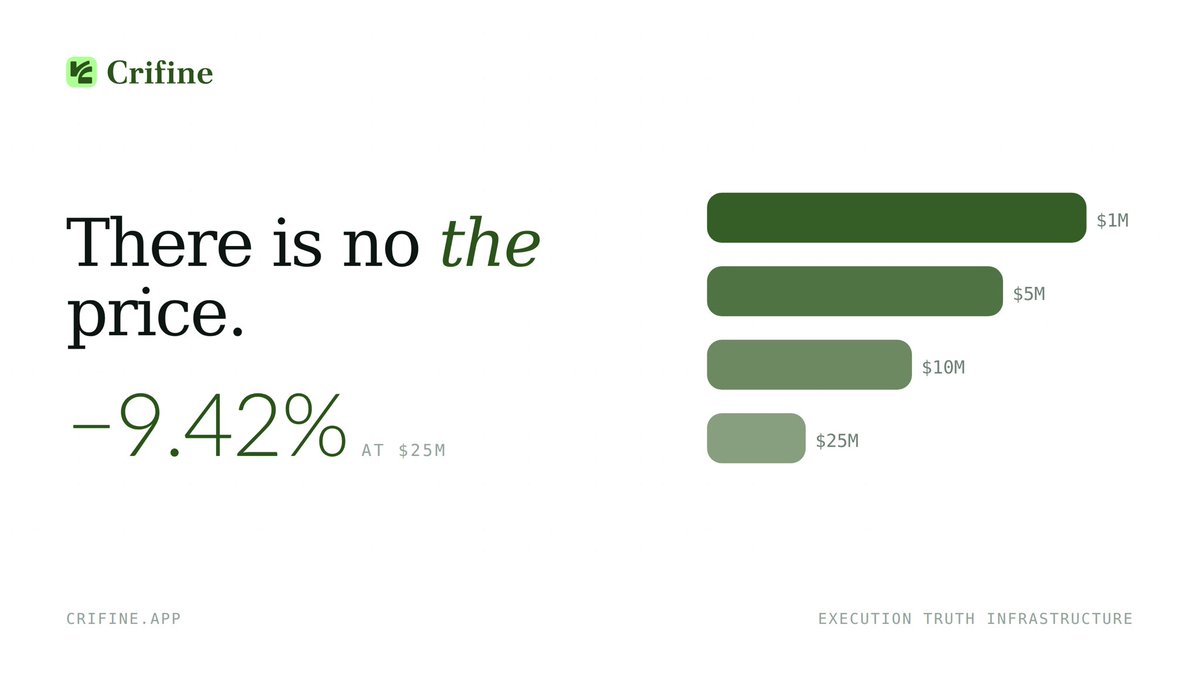
But the real price depends on how much you're selling:
$1M → −0.50%
$5M → −2.28%
$10M → −4.73%
$25M → −9.42%
Same pool. Same second. 19x worse.
Check any pool free → https://t.co/YTj4Yk325f
Every portfolio screen you have ever looked at values your holdings at the last traded price, as if you could sell all of it at once and nothing would move. Sell it for real and you find out that assumption was doing a lot of work.
Here the same wallet carries a second number beside the first: what the book would actually pay for those positions right now, position by position, worst one at the top.
Scroll down and the same question gets asked of every pool being monitored, thinnest first, with the depth in each book placed next to the price. A price climbing while the depth under it drains is the one configuration a price-only risk model has no way of seeing.
https://t.co/oDysulZ8yO
Markets show a price. Execution reveals the truth.
Crifine is building the execution layer for autonomous markets, measuring where size can actually clear, how deep liquidity really is, and where quoted value begins to break down.
With continuous depth history, public verification, and transparent methodology already in production, Crifine starts with a simple principle: execution data should be measurable, open, and trusted.
As on-chain markets grow more automated, execution quality becomes infrastructure.
Today is Launch Day.
CRIFINE $CRIF - Execution Truth Infrastructure.
You check the price of ETH. It says $2,442.
You go to sell $5M of it. You get $2,386.
That $56 difference per ETH? Nobody shows it to you. Ever.
We built the thing that does. 👇
https://t.co/YTj4Yk325f
Built for machines.
Two fields carry the product.
🔁 One call, one number
Pool, size, answer - with the evidence link attached
📄Method published in full
Assumed size, observation window and depth source, versioned
📶Observed, not modeled
Estimates walk recorded depth; modeled parts are labeled
🌨️Machine-payable via x402
Agents pay USDC per request - no key, no account, no contract
🧪Free keyless verification
Every published number checkable by anyone, permanently
Welcome to $CRIF - Execution Truth Infrastructure
Welcome to Crifine.
$CRIF answers one question: if you execute this size right now, what do you actually get?
Quoted price is a suggestion. Fill price is the fact. Every autonomous trading agent on-chain is acting on the first and getting paid in the second.
Crifine is the pre-trade check that closes that gap: one call returns what a given order size actually clears at against observed depth, not a number modeled from a price feed.