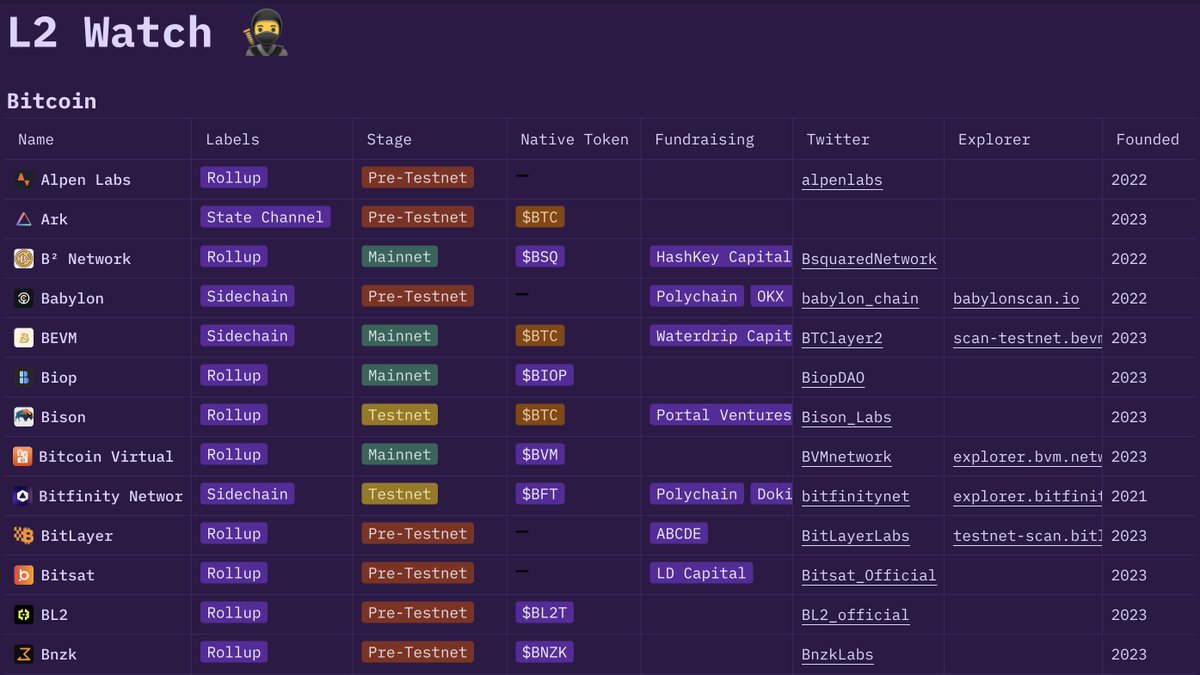
We're launching https://t.co/WfNe7GGOzV🥷 — a full list of existing and upcoming L2s on Bitcoin! Currently listing 55 of them and constantly working on enriching the data!
Also we'll be managing a Twitter List where you can follow all of them at once: https://t.co/9MZ1pENSxF
Today, a post all about Ethereum and EIPs -- Ethereum Improvement Protocols. Read ahead to learn more!
---
What are EIPs?
EIPs, or Ethereum Improvement Proposals, are ideas submitted by the Ethereum community to suggest improvements or set standards for the ecosystem. These proposals undergo a rigorous process of discussion, vetting, and approval by various participants in the Ethereum community, ensuring that only the most beneficial and widely agreed upon improvements are implemented.
EIPs are categorized into three types:
- Informational EIPs: Offer guidance on Ethereum's design and practices without requiring implementation. For example: EIP-2982, which defines an early phase of Proof of Stake for Ethereum.
- Meta EIPs: Propose modifications to Ethereum's processes or its development environment, requiring community consensus without direct codebase changes. For example: EIP-1, which outlines the EIP process itself.
- Standard Track EIPs: Encode changes that directly affect the Ethereum protocol, including core adjustments, networking improvements, and ERC standards for tokens and applications. For example: ERC-20, the standard for fungible tokens.
Where Did ERC (Ethereum Request for Comment) Come From?
The term ERC is inspired by the early internet's RFCs (Request for Comments), which have documented protocols, specifications, and technologies vital to the internet's development since 1969.
In the Ethereum context, an improvement proposal that outlines potential standards for tokens or applications is categorized as an ERC. Commonly encountered ERC standards include:
- ERC-20: Defines fungible tokens used in various applications, like Wrapped Bitcoin and Chainlink.
- ERC-721: Establishes the standard for non-fungible tokens (NFTs), supporting unique digital assets such as Bored Apes and Pudgy Penguins.
- ERC-1155: Introduces a flexible standard for semi-fungible tokens, enabling assets that merge NFT characteristics with fungible token properties.
Important Upcoming EIPs:
One noteworthy EIP on the horizon is EIP-4844, known as "Shard Blob Transactions" or proto-danksharding. This proposal aims to introduce a new transaction type for handling large data volumes, significantly reducing gas costs for roll-up chains. Instead of posting data directly onto the Ethereum Virtual Machine (EVM), EIP-4844 facilitates storing data on a separate channel. This change, expected with the Dencun upgrade on March 13th, promises to enhance efficiency and scalability for the Ethereum network.
Engaging with the EIP Process:
The open-source ethos of EIP development underscores Ethereum's commitment to community-driven growth and improvement. Anyone interested in contributing can start by visiting the https://t.co/VuuhZMnYQm and submitting a proposal through a GitHub pull request.
As the community continues to submit and refine EIPs, the Ethereum network evolves, mirroring the collaborative spirit that has driven the internet to its usage today. This ongoing process of innovation and collaboration within the blockchain space will propel Ethereum to new heights, benefiting users and developers alike.
I made a GPT model built to help designers make more functional @webflow projects and creative @figma designs.
I hope it helps and let me know how I can improve it with more custom configurations 👇
https://t.co/m2XvJFQzpl
@BennyGiang @0xFiftySix has been working in the space for years, pioneered an alternative form of composable NFTs @CapsuleNft , and is genuinely just infectious & fun to talk with