I used AI to build and launch a small overseas SaaS in ~2 days (Nov 2–3).
Live today: StatementLocal, a bank statement PDF → CSV/Excel converter that runs entirely in your browser. Your statement is never uploaded.
Revenue so far: $0. Building in public 🧵
https://t.co/PO1llZAQgo
@salbareesh Nice, sounds like your bank's layout works well with it. Does Instinct also check the extracted totals against the statement balance, or just handle categorization?
@salbareesh Is it a text-based PDF where you can select the transactions, or a scanned one? That makes a big difference when converting it into rows for Notion.
@thematheusmello True. The part people often skip is checking whether the extracted rows still match the printed opening and closing figures, especially when the layout is awkward.
@jasim_ab The "abstruse PDF the bank never intended mortal eyes to understand" part is painfully real. Does the generated parser also get checked against the statement's printed opening and closing figures, or is that left as a later review step?
Dev notes: each transaction gets a stable ID (FITID) so apps can skip duplicates on re-import. QBO uses Intuit's generic bank ID 3000, so QuickBooks may label it "Wells Fargo"; you still pick the account. Merging months into one file needs the $19 30-Day Pass.
New in https://t.co/J6WeFKxbxM: turn bank statement PDFs into QBO (QuickBooks Web Connect) or OFX files, plus CSV/Excel. Runs in your browser, no upload, balance-checked first. Free: 1 statement export/day. Not yet tested in a live QuickBooks account. https://t.co/iDoiZ0l2S6
@RAYTIANguodong In-browser PDF work is underrated, especially for documents you wouldn't want sitting on a random server. Keeping forms and links intact after a rotate sounds like the kind of boring fix people only notice when it breaks.
@o_adeeko The analysis only works if the file is actually a clean CSV. A lot of banks still only hand out PDFs, and uploading a full statement to a chatbot is a bigger privacy decision than people notice.
@BritToSwiss@SirPuppetPaul@sageuk For HMRC questions, a clean transaction list that still ties to the original statement PDF is often more useful than a full accounting package. Excel can work if the rows and the statement totals actually match.
@AISystems_hq The balance tie-out in this prompt is the part that actually matters. Opening plus the rows has to match the closing figure, otherwise a shifted column can look fine and still be wrong. The "don't guess on scans" rule is a good one too.
@yosoymario91 Penny's statement-to-CSV step is the one that usually breaks first, especially when a bank only offers a PDF. Does it check that opening balance plus the rows still matches the closing figure?
@drsrinivas_rjy@ICICIBank That's a painfully common export bug. If the debit/credit columns stay as text, every SUM and reconcile in Excel silently fails. Hope they fix the number format.
Need clinical trial data without copy-pasting from https://t.co/uOAGTVWURC?
This tool exports studies by condition, drug, phase, status or sponsor into clean JSON/CSV via the official API. Useful for biotech research, market analysis and competitive tracking.
https://t.co/HtZmLP09KM
New in StatementLocal: printed-totals tie-out. It checks the totals printed on your bank statement PDF against the extracted rows, to the cent: TIE, MISMATCH or UNCHECKED (never a pass). A consistency check, not an audit. Files stay in your browser. https://t.co/iDoiZ0l2S6
Selling to the US government? Two tools I made:
- New https://t.co/UIKXvr5lgN bids & RFPs, filtered by NAICS, agency, set-aside
- Who won past federal contracts and for how much (USASpending)
Both use official APIs. Find leads and size up competitors in minutes.
https://t.co/3TI1yldrVB
https://t.co/iME4vfZCqe
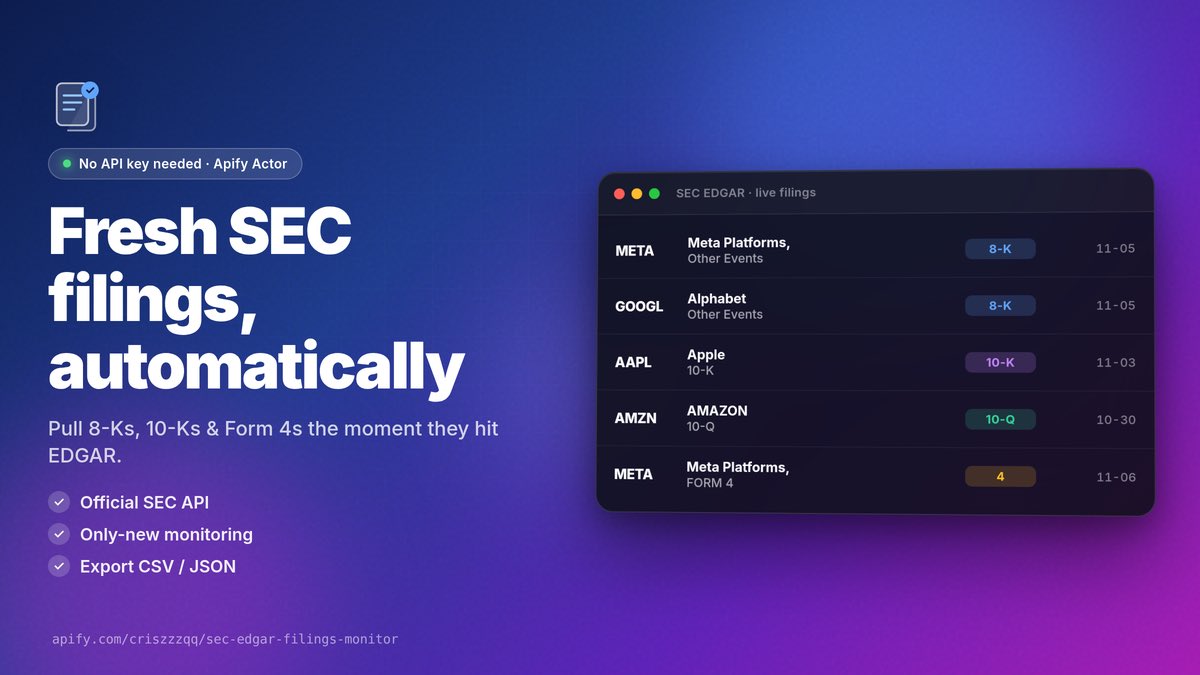
Tired of refreshing SEC EDGAR for new 8-Ks, 10-Ks or Form 4s?
I built a small tool that pulls fresh filings for any ticker or form type straight from the official SEC API and can return only filings you haven't seen yet. Handy for investors and analysts.
https://t.co/pgQNIEK1Pl
@djl997 Ha, yeah. The fix that worked for me was treating it as a table problem first and a JSON problem second: get clean rows out, then map them. What are you building for the messy files?
@JoeydeWit_ The prompt is solid. The annoying part for me is step zero: getting a clean CSV out of a year of PDF statements when the bank won't give OFX. Once the file is clean, the audit is fast.
@rubenhassid Downloading the 12 months is the easy bit. The pain starts when half the accounts only give PDFs and you still need one clean CSV before the prompt is useful.