Economista, Msc en Pol. Públicas UNU-MERIT, ex-asesor Min. Hacienda. Ahora intentando entrar en docencia. Pienso, busco hechos y luego escribo. Andaluz en Bilbo
Hoy os voy a demostrar que los paises con el nombre más largo son más ricos, de la misma manera que el índice EFW demuestra que los paises con estado más pequeño son más ricos.
¿No me creeis?
Pues agarraos porque con un índice se puede demostrar cualquier cosa! 🧵
A post about Pope Leo XIV's encyclical on AI. Why the Pope is right, but perhaps not right enough.
Artificial intelligence is reshaping the world in front of our eyes: how we communicate, how we access information, how we work, how income and status are distributed among us, and soon how we fight and kill each other. Yet the public conversation about AI remains stuck on the minutiae of competition between labs, or on a false dichotomy between AI as a “stochastic parrot” with no real capabilities and AI as an alien superintelligence poised to take command of humanity.
The more important questions are about what we want from AI, and whether our current mindset, institutions, and control mechanisms are equal to the task of steering it toward our welfare.
It is refreshing, then, that a bold and powerful voice has weighed into this debate: Pope Leo XIV. As an economist who has long argued that technology is a matter of choice rather than fate, I find Leo’s intervention welcome and, on most points, on target. But on the most consequential question of what AI should actually be designed to do, Leo stops short.
Secular readers may bristle at the encyclical’s opening invocation of the Tower of Babel. They would be mistaken to stop reading there. Leo goes much further than most pundits, journalists and policymakers in the United States by recognizing that what happens to AI, and hence to humanity, is a under our control. There are multiple possible paths for AI, and which one we take will have sweeping consequences. He is also ahead of many commentators when he writes forcefully and unequivocally that “technology is never neutral, because it takes on the characteristics of those who devise, finance, regulate, and use it.”
These were the central themes of the book I wrote with Simon Johnson, Power and Progress: Our Thousand-Year Struggle over Technology and Prosperity. It is heartening to hear them taken up by a voice with Leo's reach.
The Pope is also right to question the current trajectory of AI in warfare and law enforcement. What was taboo only a few years ago – AI-driven mass surveillance, algorithms selecting targets for killing – has become routine. Many in Silicon Valley are now calling openly for a new military-algorithmic complex centered on AI as an instrument of American hard power. Leo captures something deep and too often ignored: “Any technology that facilitates attacks without seeing the face of human beings lowers the moral threshold of conflict.”
His call for the “disarmament of AI” follows directly from these observations. As he explains, disarming AI means “freeing it from the mentality of ‘armed’ competition, which today is not limited simply to the military context, but is also an economic and cognitive phenomenon.” His moral clarity in stating that “there is no algorithm that can make war morally acceptable” should be a warning to technologists rushing to design new weapons of mass destruction.
Underneath these specific concerns lies a more fundamental claim: that what is technically feasible is not the same as what is good for humanity, and that the difference depends on who controls the technology and what ideology and interests guide them.
Leo edges toward what I take to be the most important point about AI's future when he observes that “while AI promises to boost productivity by taking over mundane tasks, it frequently forces workers to adapt to the speed and demands of machines, rather than designing machines to work with those who work.”
But here he does not go far enough. He stops short of questioning the prevailing design philosophy of AI itself: a philosophy centered on mimicking human capabilities and automating human tasks, with the ultimate goal of artificial general intelligence (AGI) that can do everything a person can.
This philosophy rests on a mistake. It assumes that artificial intelligence and humanintelligence are fundamentally similar, and therefore machines should naturally take over whatever humans currently do. Yet these intelligences are fundamentally different.
Humans are “one-shot” learners. We form hypotheses from a few examples, mentally simulate possibilities, and refine our understanding through a social process of trial and error. This is how children learn language - imitating a few words, generalizing, and adjusting based on how others respond. We are not, however, very good at absorbing massive volumes of information or sifting through unstructured data for relevant patterns.
AI models are almost the opposite. They thrive on enormous training sets and excel at pattern recognition at scale. But they have, as yet, no genuine creativity, no real-world embodiment, and no capacity for trial-and-error learning grounded in interaction with the physical and social world.
When two things are different – you shouldn’t, and typically you couldn’t – use one to mimic the other. If you did, you would end up with suboptimal, disappointing results. It would have been a colossal mistake, and the Chicago Bulls’s legendary coach Phil Jackson would have gone down in the annals of basketball as one of the worst coaches in history, if he decided in the 1990s that because Michael Jordan was the better player, Jordan should mimic everything that Scottie Pippen and Dennis Rodman were doing in the team. The team went from championship to championship because these players worked together and complemented each other.
The same applies to AI and human skills.
The more productive path is complementarity – using AI to do what humans cannot, so that humans can do what they do best. An electrician aided by AI diagnostics, a nurse supported by AI in interpreting symptoms, a teacher using AI to personalize instruction for each student; these are the contours of a different AI future, one that raises rather than displaces human capability.
Optimists and industry insiders will respond that automation-first AI can still benefit everyone, provided redistributive policy keeps pace. But this argument has a poor track record. Forty years of digital automation have already concentrated gains at the top, hollowed out middle-skill work, and produced disappointing aggregate productivity growth. There is little reason to expect that an even more powerful round of automation, deployed by even more concentrated firms, will end differently. We can and must demand a different design.
The global stakes from the future of AI are even larger than those we can see around us in the United States. For the developing world, where billions still depend on the prospect of decent jobs as a path out of poverty, an automation-centric AI agenda is not merely suboptimal. It is simply transferring to foreclose the most important route to broad-based prosperity.
The biggest failing of today's AI industry is its refusal to recognize any of this. It is guided instead by an ideology of control (the industry’s own over humanity) and by a conviction that machines are uniformly better than humans.
As Leo rightly notes, this failure is enabled by the fact that a handful of companies now command the future of AI.
What we need is a combination of moral clarity and a serious, society-wide debate about what AI can do and what we want it to do. That debate must move beyond exhortation toward concrete choices: antitrust action against the dominant platforms, public investment in human-complementary AI, regulation of surveillance and autonomous weapons, and meaningful rights for workers and citizens over the data on which these systems are built.
The Pope's intervention makes such a debate a little more likely today than it was before.
It is now up to the rest of us to carry it further than he was willing to go.
Portugal es un país más rico que Chile. Pero las elites chilenas ganan más que las elites portuguesas. En cambio, el 10% más pobre de Portugal gana 40% más que los pobres chilenos.
En Latam, las elites tienen ingresos no lejanos a sus contrapartes europeas (incluso a veces mayores), pero los pobres viven mucho peor.
Este es el audio incautado por la policía española a Villarejo contándole al nº2 del ministerio de interior que Bárcenas le pagaba todos los meses 10.000 euros a Rajoy de dinero proveniente de comisiones corruptas.
¿Por qué no vale para imputarlo y lo que viene de EEUU sí?
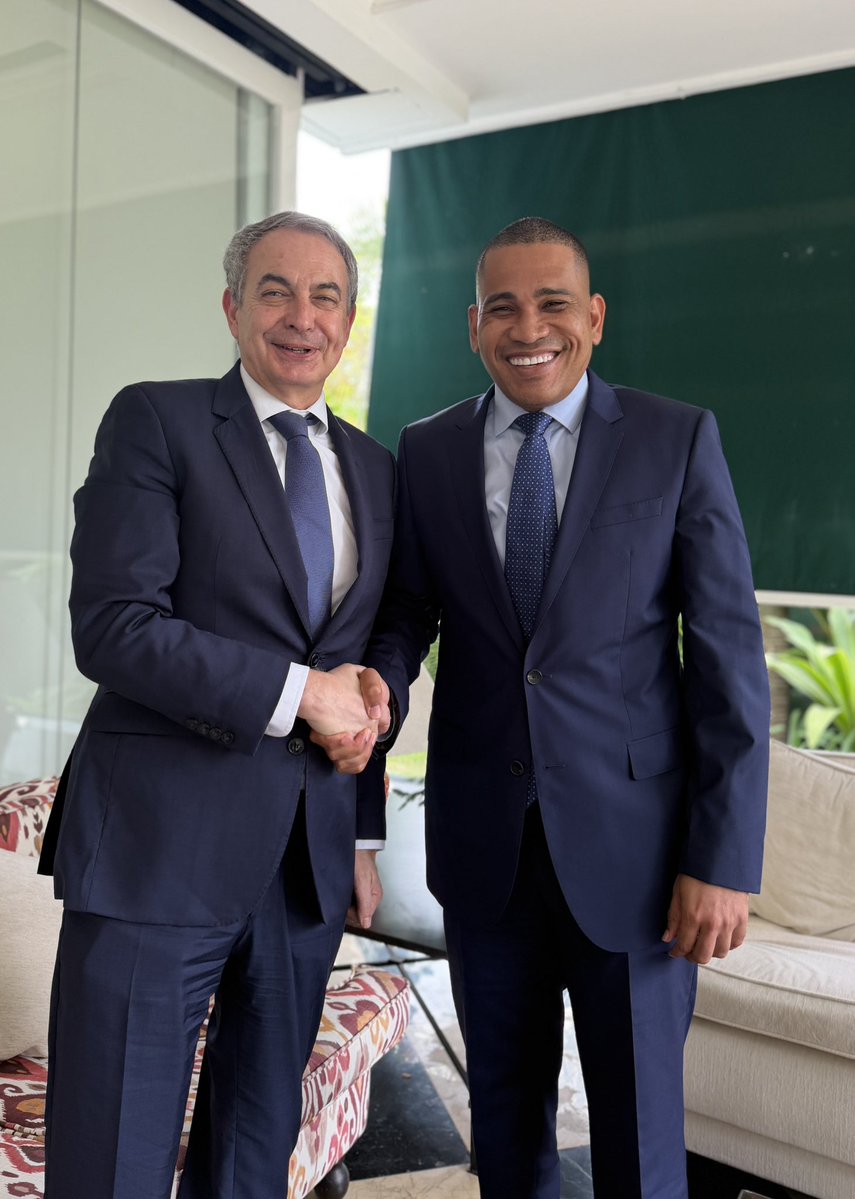
El expresidente Zapatero viajó a Venezuela para buscar a personas que estaban enterradas en las mazmorras carcelarias del régimen. Nos sacó de prisión a Yon Goicoechea —quien recientemente ha regresado a Venezuela—, a Henrique Márquez (candidato presidencial), al general Rodríguez Torres, a un tal Superlano y a mí. Si no hubiera sido por él (y en mi caso también por el embajador estadounidense Roger Carstens), seguiríamos en esas mazmorras.
Otros liberados fueron:
• Rocío San Miguel (abogada y defensora de DDHH con doble nacionalidad venezolano-española). Su familia agradeció específicamente las gestiones de Zapatero.
• Enrique Márquez (ex candidato presidencial y exdiputado).
• Biagio Pilieri (político, colaborador de María Corina Machado, con doble nacionalidad ítalo-venezolana).
De mí, Jorge Rodríguez decía que yo era “algo más que terrorista”, y lo mismo con los demás. Ninguno éramos afines ideológicamente al expresidente; sin embargo, no cejó en su empeño. Creyó que éramos inocentes sin siquiera leer los expedientes.
En mi caso, sí he leído el suyo: en el auto del juez no encontré en ninguna página una instrucción, grabación de reunión, voz, cheque o transferencia que pruebe semejante acusación.
En España, de donde salgo en este momento tras una visita privada de dos días, tengo más amigos en el PP que en el PSOE. Pero la verdad es que España está tomando un camino peligroso, lleno de irrespeto a las instituciones. Uno puede hacer oposición, pero no apología del delito.
Hace poco visité el diario El Debate. Lamenté que Bieto, que me conoce y sabe que soy un perseguido político y practicante del diálogo, censurara la entrevista a la que él mismo me había invitado porque no le gustaron mis afirmaciones o no encajaban con su agenda. Eso no es periodismo ni política, es manipulación y una canallada.
El jefe de Relaciones Exteriores del alcalde Almeida me hizo una invitación a la que desistí, en los mismos términos que contesté a la oficina de Ayuso: “Mucha suerte en su agenda sobre Venezuela”.
Escribo esto como acto de protesta ante la política del PP hacia Venezuela, que considero absolutamente infantil. Un partido como el PP no puede permitirse eso.
Ninguna democracia, y menos España, va a salir fortalecida con este tipo de actuaciones, como tampoco salió fortalecida Venezuela cuando inventaron toda una patraña contra Carlos Andrés Pérez con una partida secreta que jamás pudieron probar.
@FranNunesEcon@EconoCabreado@Jongonzlz Tienes bastantes estudios como para saber que en ningún momento ha intentado derribar argumentos atacando a la persona. Solo ha dicho, que diga lo que diga, dado el cargo y los intereses que tiene el BBVA, debe decir el puesto y las funciones que ocupa en dicha institución.
Israel está muy nerviosa respecto a España. Pero la razón de fondo no se explica bien. Tal como recalca @Felguerinos Es geopolítica. Hay una lucha por ver quien se convierte en el Hub energético de Europa.
@martinvars Lo suyo es Ignorancia o Maldad. Seguramente, maldad porque usted se ha paseado más que yo por muchas ciudades de los EEUU y habrá comprobado que hay verdadera indigencia masificada que aquí en España es casi imposible encontrarla.
Tenéis que ver esta auténtica maravilla de Vaya Semanita.
La extrema derecha crece en todo el mundo, menos en Euskal Herria, para ello han montado un nuevo parte de atracciones.
La reserva de la fachosfera.
Jajajaja.
Cuidado que empiezan los nazis del misterio y se ponen muy nerviosos.
Jajajaja jajajaja.
Enormes.
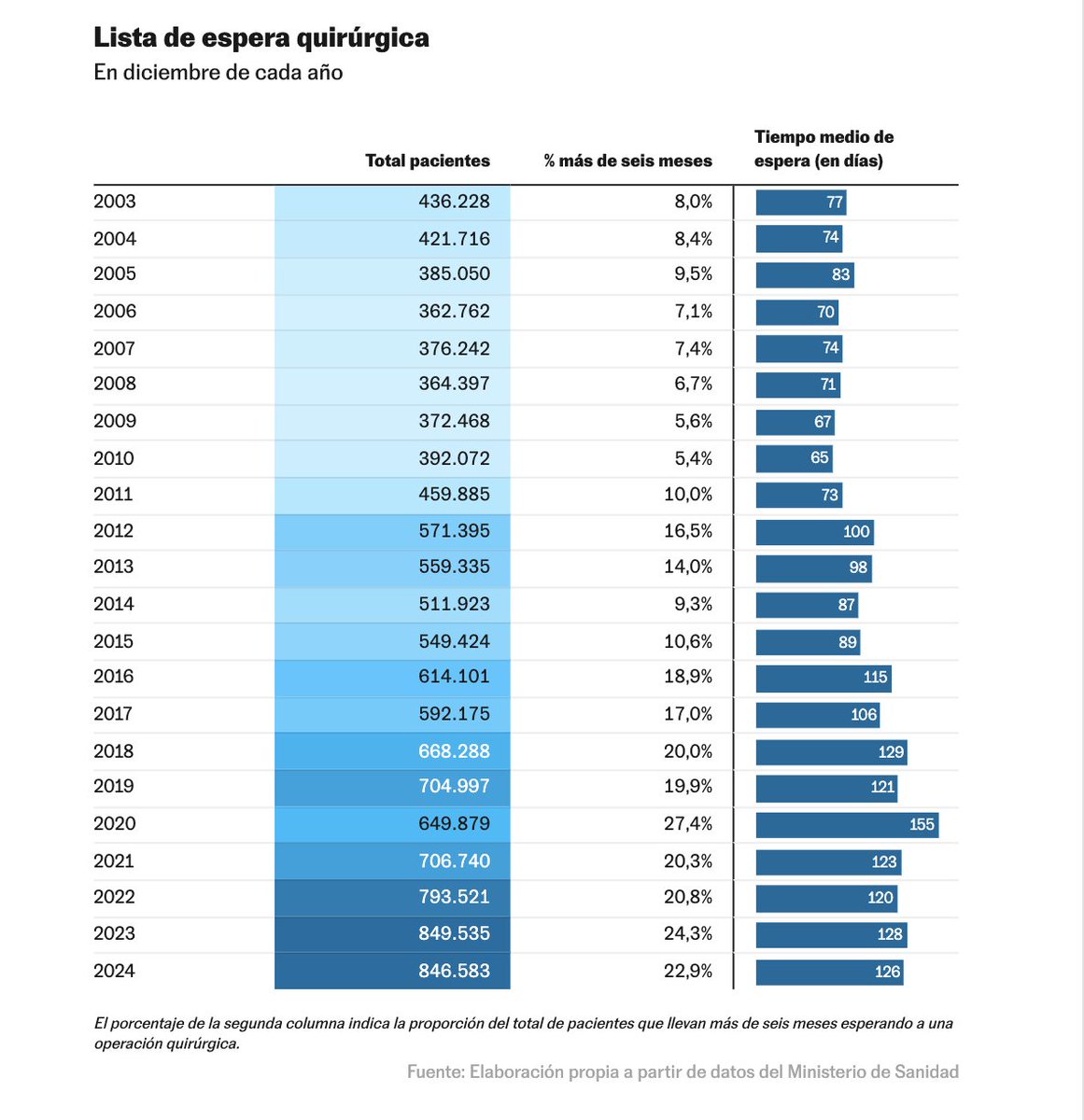
El tiempo medio de espera para ser operado en la sanidad pública ha aumentado un 70% en 20 años. El porcentaje de personas que deben esperar más de seis meses para ser operado se ha (casi) triplicado.
Sobran explicaciones.
https://t.co/EQxdiNAWo1
"¿Por qué no tiramos una bomba nuclear sobre Irán? Mataremos a la gente pero los edificios quedarán en pie. Lo digo de forma simple, debemos arrasar Irán".
El psicópata genocida de Ben Gvir, ministro de Seguridad Nacional, fantasea entre risas en TV con exterminar a Irán y admite que su postura política es borrar de la faz de la tierra a Irán.
Que estos asesinos supremacistas tengan armas nucleares, es la mayor amenaza que existe para toda la humanidad.
El mundo español de las ideas es muy estrecho. Son grupos de amigos hablando de ellos mismos, apoyándose entre sí y comentando lo buenos que son los mismos autores extranjeros. Tienen una pequeña relevancia cuando están adscritos a redes mediáticas.
Es parte de la pobreza intelectual española, que se manifiesta también en el entorno político y económico. Nuestras élites se han dedicado a reproducir con alborozo los mitos de la época. Su fuente de referencia ha sido y es lo que se hacía en Nueva York o Londres: si funcionaba allí, lo haría aquí. No se trataba de pensar, sino de adaptar. España se fue convirtiendo en un país intelectualmente improductivo: sol, playa, restaurantes e ideas foráneas.
España es un país colonizado intelectualmente que ha aceptado su posición. En consecuencia, Nuestras élites, políticas, económicas e intelectuales simplemente quieren defender el mundo del ayer y, si no es posible, integrarse en el que viene lo mejor posible, es decir, sin hacer ningún ruido y de manera sumisa.
Absolute bombshell on Al Jazeera. The US and Israel have deliberately bombed over 30 universities across Iran, assassinating professors in their homes and massacring over 60 students. Washington is systematically trying to destroy Iranian scientific progress.
1. Claro. Es más, estando de baja nadie quiere incorporarse a trabajar.
2. Cuando la baja es por enfermedad común o accidente no laboral y de uno a tres días el trabajador/a no cobra nada (salvo convenio).
Si la baja dura entre 4 y 20 días, cobra el 60% de la base reguladora.
Desde el día 21 cobra el 75% de la base reguladora.
3. Cuando la baja es debida a un accidente laboral o enfermedad profesional
Se cobra el 75% de la base reguladora desde el primer día.
Esta señora miente y es una agente de quienes pretenden instaurar el marco normativo y de sentido común de tener que trabajar sufriendo una enfermedad y/o de que sufrir un accidente o una enfermedad anule tu derecho a la subsistencia.
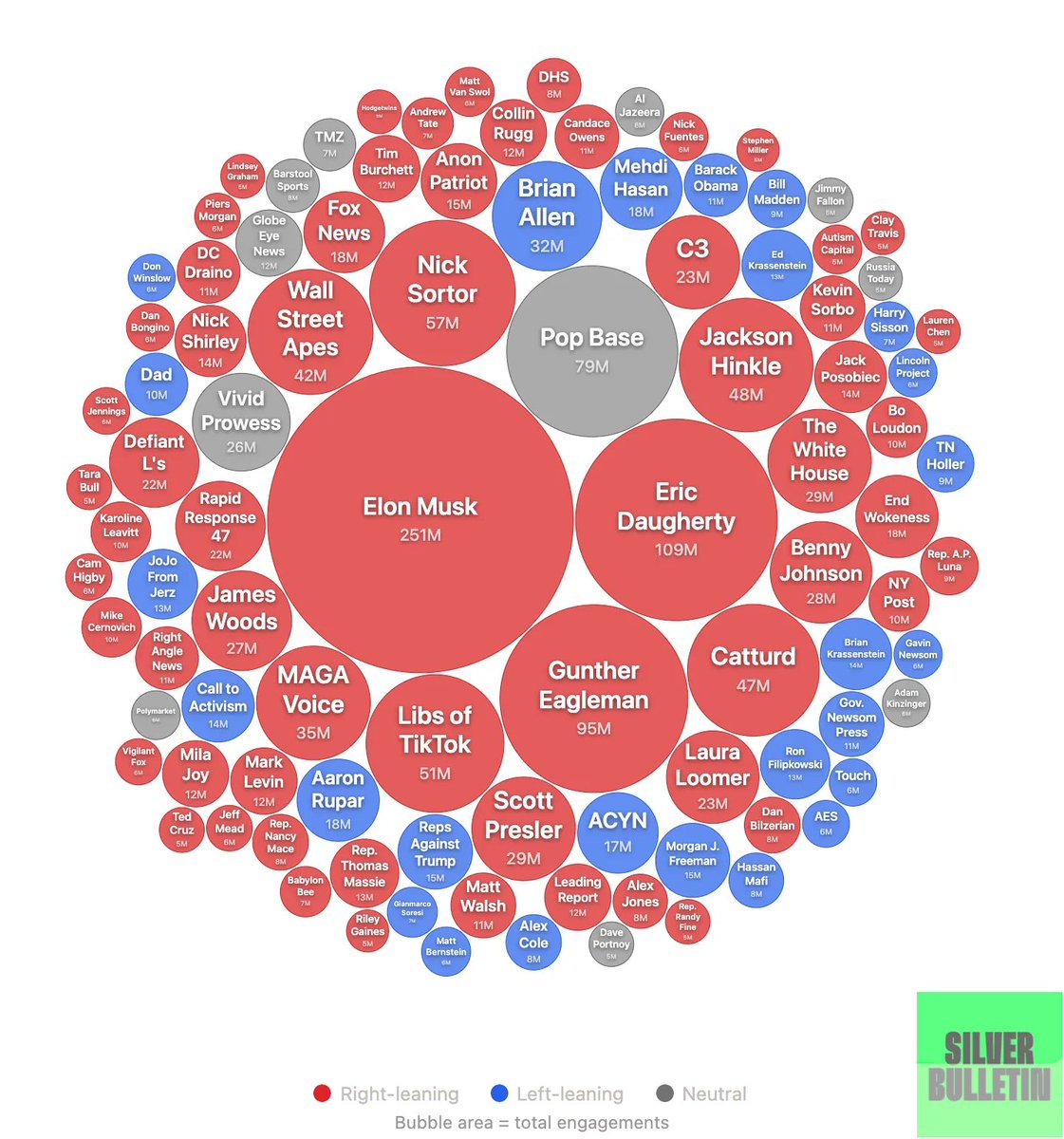
These are the Twitter/X accounts with the most engagement so far in 2026. I suppose I had some intuition for how bad it was, but jeez, this is what you get when the ecosystem is broken.
The Financial Times is reporting something that should be front-page news everywhere.
Pete Hegseth didn’t just help design the Iran war. He championed it publicly, cheered it on, and sold it to the American people. And according to the Financial Times, while his own department was in the final stages of preparing to launch it, his broker at Morgan Stanley was attempting to make a multimillion-dollar investment in the defense companies that build the weapons we used to fight it.
The investment didn’t ultimately go through, but only because the fund wasn’t yet available on Morgan Stanley’s platform. Not because anyone stopped it.
If these reports are accurate, the Secretary of Defense was positioned to profit from a war he helped start, using information no private investor could ever have. That is a profound betrayal of every service member he commands, and of every American who trusted this Administration with their national security.
No one should be cashing in on privileged information while lives and national security are on the line.
🚨 NO, no es Broma
Pastor Cristiano en plena Pascua en la Casa Blanca dice que Dios creó a Trump para matar a iraníes musulmanes por el bien del pueblo de Israel...