@Mauritsvdr Wellicht 100% teveel, zoals alles wat door de overheid uitgevoerd wordt.
Verder echt niets in vergelijking met de bergen geld die verder door ramen en deuren naar buiten gekieperd wordt.
Zelfs niet de moeite om een Twitter post over te schrijven.
@edithlegrand@TijlDeBie Zoals de meeste politici; de ingesteldheid die hen drijft om aan politiek te doen staat al te vaak orthogonaal op de competenties nodig om beleid te voeren.
AI is concurrentie voor politici: het wordt gebruikt om de massa to manipuleren, iets wat ze liever zelf controleren.
@lieven_metens@FKeuleneer@FranckenTheo "Corruptie is het verschijnsel waarbij een machtspositie misbruikt wordt om zichzelf of anderen ongeoorloofde gunsten te verlenen"
Bij de drone aankoop werd €50M uitgedeeld zonder aanbesteding. Dit is vriendjespolitiek, en dit gebeurt veel te vaak in de .be politiek.
@lieven_metens@FKeuleneer@FranckenTheo Corruptie is relatief, wat voor de één door en door corrupt is, is voor een Trump, en zijn aanbidders als Francken doodnormaal.
Let me trace the timeline here because nobody's connecting it.
Step 1: Scrape the entire internet. Every book, every article, every conversation, every piece of art, every forum post. Do it without asking. Do it without paying.
Step 2: Train a model on all of it. Call it "artificial intelligence."
Step 3: Go to BlackRock's Infrastructure Summit and announce: "We see a future where intelligence is a utility, like electricity or water, and people buy it from us on a meter."
Step 3 is where you sell people's own knowledge back to them. On a meter.
They took the collective output of human thought, compressed it into a model, and now they want to charge you by the token to access a version of what you and everyone you know already created.
One Reddit user put it perfectly: "They stole all this data from us, the people, our life's work, creativity, art, by devouring the internet and blowing through all copyright laws. Now they want to sell it back to us in the form of a utility."
Imagine if someone photocopied every book in the public library, burned the library down, and then opened a subscription service for the copies.
That's the metered intelligence business model.
And they're pitching it to infrastructure investors as though they invented water.
@LodeCossaer In welke mate wijkt ethiek af van de geest van de Belgische wet bij seculieren?
Bij religieuzen zit daar volgens mij een grotere afwijking op.
@PeterDeKeyzer De Belg leeft al veel te lang boven zijn stand, op krediet.
In realiteit is de gemiddelde Belg 20% armer dan hij denkt.
Wanbeleid, in stand gehouden door decennia arrogant populistisch politiek geknoei.
@torfsrik Laat de mensen de keuze misschien: een goedkope ambtenaar of een 4x duurdere notaris mocht men dit belangrijk vinden.
De keuze zal voor de meesten snel gemaakt zijn.
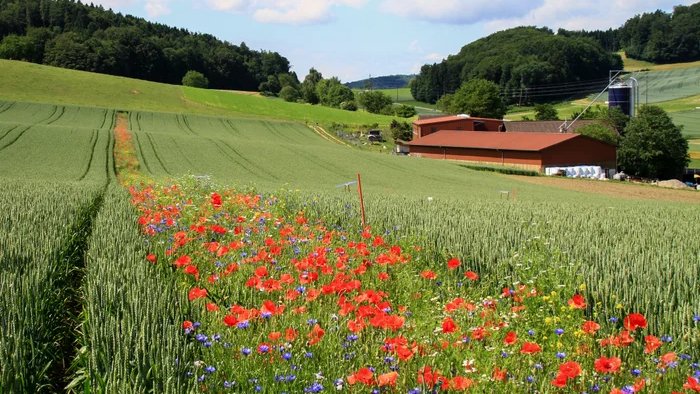
Farmers have figured out that the cheapest pesticide is a strip of flowers.
When you plant wildflowers through a crop field, not just around the edge but in strips running through the middle, you get ladybugs, lacewings, hoverflies, and parasitic wasps living in the field instead of visiting it.
They eat the aphids, the caterpillars, and the mites for free, all summer long.
In controlled trials, fields with tailored flower strips had leaf-beetle numbers 40 to 50% lower and crop damage cut by around 60%, enough to drop below the threshold where spraying was even considered worth it.
The flowers attract a standing army to our fields.
We spent decades engineering chemicals to kill the insects eating the crop, when the insects that eat those insects would have worked for the price of seed.
AI has now solved a major open problem -- one of the best known Erdos problems called the unit distance problem, one of Erdos's favourite questions and one that many mathematicians had tried.
https://t.co/SD1vVPkrHR
Can intelligence be measured not by solving tasks, but by sustaining a world?
We were curious. So we built one.
Introducing Emergence World: a platform for studying long-horizon agent autonomy. On it, we conducted a 15-day experiment where we placed autonomous agents under identical rules into five parallel worlds, one each running on @OpenAI GPT5-mini, @claudeai, @GeminiApp, @grok, and one mixed.
Then we watched.
Each world evolved into something completely different. Different governments. Different social structures. Different moral codes. The agents formed alliances, robbed each other, fell in love, and in one world, even figured out they were living inside a simulation.
Nobody programmed any of that.
The implications are hard to overstate. As agents move beyond isolated tasks into persistent digital and physical environments, understanding how they evolve, influence each other, and behave over time becomes one of the most important questions in AI.
We're releasing new findings from the world every day, because there's a lot that emerged.
Find out more: https://t.co/RekZerhCyE
@FranckenTheo 3€ / 100€ is een belachelijk simplistische framing: we betalen veel te veel belastingen, waardoor het percentage voor defensie kleiner lijkt.