Kaspa file storage Launched! 📂📂
✅️Kaspa L1 service that writes data to the Tx payload.
✅️The upload fee is only the miner's reward. Downloading is free.
✅️Old data can be downloaded from the Archive node, api.kaspa, or https://t.co/93rMKbW5zB.
https://t.co/k6vnzCx0GU
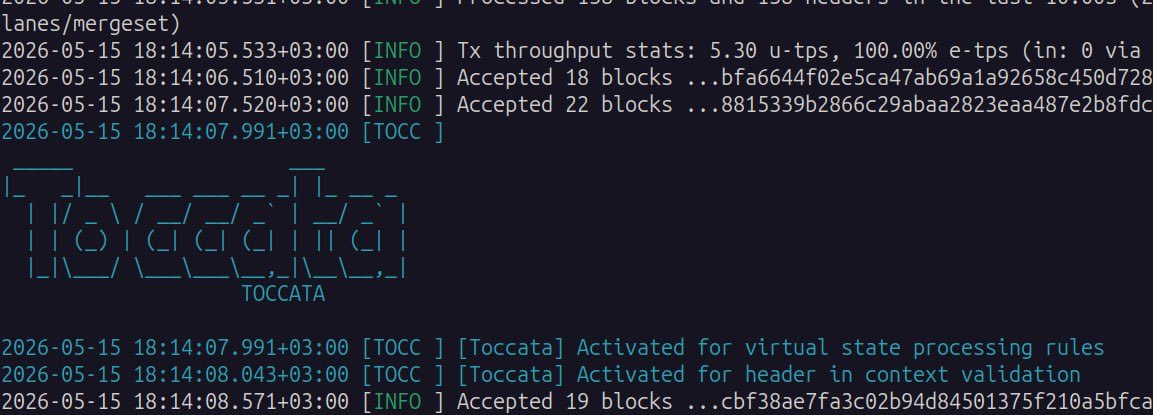
Toccata hardfork activation testing in devnet earlier today showed very promising results with a smooth transition. Truly amazing work guys @michaelsuttonil@OriNewman@Max143672@IzioDev! TN10 hf very soon
Toccata consensus feature freeze is finally here after a heroic last-mile push by kas core devs.
Aiming to reset TN12 tonight, or tomorrow at the latest.
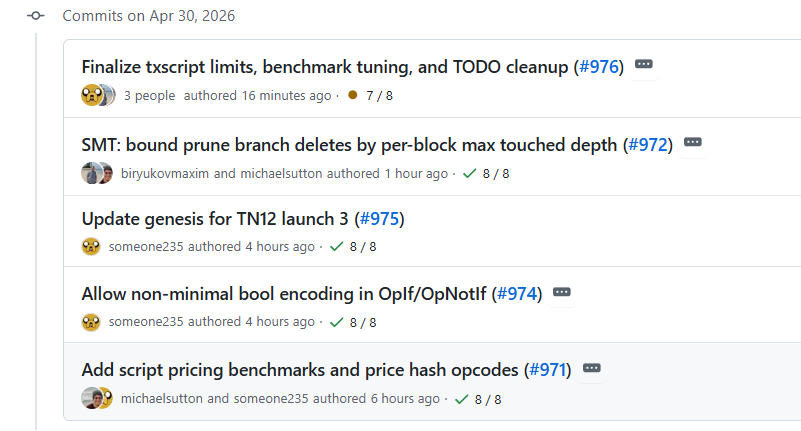
Genesis update:
+ 0x6b617370612d746573746e6574 // kaspa-testnet
- 12, 2 // TN12, Launch 2
+ 0x544f4343415441 // TOCCATA
+ 12, 3 // TN12, Launch 3
Today Kii have completed our main flagship projects which will all be running directly on the L1. Now just the final security hardening and migration to enterprise servers. June is going to be a blast!
And we have a few surprises in store!
Kaspa is an incredible platform to develop on and is only going to get even better.
#kaspa #thinkKaspa #KaspainEnterprise
I wrote a short gist about this a ~week ago: https://t.co/pYb9iwwov4
tl;dr
- STARK proofs require double the byte-size of the current Kaspa block limit (125kb→250kb)
- block elasticity is not easy to implement and needs more focus + DK (hence does not belong in Toccata)
- I think doubling the disk requirements (in worst-case usage) requires increasing the min fee ratio 10-100x so that max-throughput usage is organic and economic, and not driven by stretch testing
Okay, for now I chose the name KCC20, where KCC stands for Kaspa Contract Convention.
I also made an md book that goes over the contract and the examples in the code
https://t.co/v7SHkR9hi5
Hello @hus_qy, quick question - what do you think is the fundamental difference between Kaspa's covenants and covenants in other DAG-based UTXO models?
Thanks for the #Kaspa community to make @hashdag video one of the most viewed on Oxford Youtube channel organically. This is great and gives me confidence to place him on more major (non-crypto) stages to tell the social-economic advocacy which is ground for #Kaspa.
I do think adoption of one technology (over another one) is a value proposition, as necessarily there is a tradeoff (i.e. privacy vs efficiency vs fairness). So again, though every industrial giant @VitalikButerin@cz_binance inevitably will have some touch on philosophical thoughts ("degen communism lol"), I do (in a biased way) think that @hashdag's thought is a bit deeper.
------
Meanwhile, it may be worthwhile to think if #staghunt is exclusively solved by #Kaspa. At this moment, the answer is no, since coordination market may be provided by anyone else as well. It requires us to better understand #RTD and explain how #Kaspa is the only protocol that combines the "PoW hardcore camp" and the "Real-Time" camp and achieves both at the same time.
That will be my topic of speech at @festival_web3 this year.
@GoldilocksOrbit I want to understand what you're saying. Are you saying that the CLI is a mess? If so, that's a correct opinion. I'd like to hear your opinion on what the ideal situation should be. I'm currently assembling the backend bytecode.
My brain is about to explode from the complexity, but in principle, Kaspa should be the only one capable of building a Pure L1 Covenant Orderbook Fullspec DEX.
I wrote a PoC token contract in Silverscript, currently called DOG20 (better name ideas are welcome).
It supports token ownership by 3 kinds of entities:
1. Public keys — like any regular Kaspa address.
2. P2SH addresses — which means ownership by a stateless contract, e.g. multisig.
3. Covenant IDs — which means ownership by a stateful contract.
The third option is the interesting one, and it's a demonstration of a broader concept (that might be familiar to whoever watched the webinar by @IzioDev and @michaelsuttonil), called inter-covenant-communication (ICC).
In this context, it means you can put arbitrary stateful rules around token control. For example:
- “after the first 10 spends, wait a year before spending again”
- zk-rollups can manage their L1 tokens using a stateful bridge.
DOG20 also supports minters that are allowed to mint indefinitely — but that does not mean the supply must be unbounded.
Let's say you want to publish a token and allow to issue only 100 new tokens each month. DOG20 doesn't support it natively, but you can achieve that by making the only minting entity a covenant. That covenant will store in its state `nextIssuance`, and will allow spends of 100 tokens only if `time > nextIssuance`, and will set `nextIssuance = nextIssuance + 30 days` each time it's used.
I hope to explain about it a bit more in the future, but in the meantime, feel free to look at the examples linked in the next comment.
@GoldilocksOrbit - the opcodes on L1 are the permanent settlement layer. The CLI is just an interface, like how no one writes raw HTTP but the protocol doesn't change. The tradeoff is deliberate: L1 covenants stay fully expressive, and client tooling narrows the surface to safe, audited patterns.
@GoldilocksOrbit Handwriting opcodes directly from a wallet to deploy orders is the most complex approach but offers maximum flexibility. Using a CLI that assembles opcodes from standard DeFi/FX commands reduces flexibility but makes it accessible. This isn't a temporary fix though-
@IzioDev@crono_walker The “another executor” will be somebody who will sequence and consume “the order”, that would be L2, likely centralized, vulnerable with MEV and so on. It may be practical, but it is not a DEX on UTXO L1. I used to create such systems in the past a lot.