Carl Hendrick's most recent article is dense in the best way — it connects vocabulary, knowledge, fluency, and comprehension in a way most PD never really does. Read this to stop confusing the symptoms of comprehension failure with the cause.
https://t.co/GzEvnYmZkw
Size ≠ representativeness. Here's how bias enters:
1️⃣ Opt-in panels attract parents already engaged enough to sign up — systematically over-representing the online-active, more educated, and more opinionated. That bias is structurally embedded before data collection even begins.
2️⃣ Post-hoc weights for income, race, marital status, and geography were applied to compensate — but weighting assumes the unsampled subgroups within each demographic cell behave the same as those who were sampled. That assumption doesn't hold when participation itself is the variable that differs.
3️⃣ 23,000 is a large national sample — but the report's value proposition is its state-by-state comparisons, and that's precisely where the sample thins out. Distribute 23,000 across 51 jurisdictions and several states have fewer than 400 respondents. The report presents those findings in precise four-tier color-coded maps that suggest a level of certainty the data cannot support.
You can weight a non-probability sample, but you can't weight away the self-selection that defined who showed up in the first place.
@karenvaites@FiftyCAN Whose ideas are really represented here? Methodology matters. There are 63 million parents in the United States with children under 18. This is a sample of 23,000 parents from national opt-in consumer research panels over a 2 month online collection period.
💯➡️Oral reading fluency is one of the strongest predictors of comprehension because it reflects the integration of accuracy, automatic word recognition, and processing speed. 🔥The fire is lit 🔥
If I can get two students to 112 words per minute in eight weeks, my class reaches 100% on ORF grade-level benchmark. Professional learning should change what happens in the classroom.
Data → action → growth.
https://t.co/mxpbxOF903
@thismomloves@sstollar6
@NateJoseph19 K-5 teachers — In this era of "Do this...and this...oh, and make sure to add this," instructional time matters more than ever. Read THIS if you want to prioritize what actually moves comprehension forward and protect the reading block from initiative overload.
@MmeLockhartLDS@TrentUSoE Great share. Love seeing more focus in teacher prep on how to conduct an effective read-aloud. Too many fall flat due to weak prosody—misplaced expression, awkward phrasing, and intonation that's completely missing—the small nuances that shape comprehension. Kudos to you.
@KJWinEducation You can’t lead instruction from behind a desk. If a principal isn’t in classrooms, then they’re guessing. Schools that make the strongest achievement gains are led by principals who spent most of their days in classrooms and PLCs. Presence isn’t micromanagement. It’s leadership.
I've been hacked and shut out of my old Twitter/X account @P_A_Kirschner. Please stop following that account and follow the real grumpy old man @New_Old_Paul
PLEASE spread the word on your social media and retweet this message.
Here's some proof that I'm me😂
@joeignition@MrDanielBuck@JamesAFurey The missing ingredient is follow-up. Too often, the strokes are introduced, students practice for a few weeks, and then it disappears. If we want fluency, cursive has to consistently show up—on the board, in slides, in everyday writing—from that point forward.
Tech gurus: AI will revolutionize the future!
Media: Who needs teachers when kids have AI?
Govt. leaders: AI in all classrooms!
Apple: Gemini is the best choice for the future of our tech.
Huh. Ok. Hey Gemini! Here’s a question for you…
😳 Nailed it!
Great routine. One tweak you may want to consider: Instead of a different sentence stem for each conjunction, try using the same sentence stem and having students finish the sentence 3 ways using because, but, and so. That shift will push them to think about the concept from three angles: cause (because), contrast (but), and result (so).
Advanced humanoid robots often utilize bipedal legs because they are designed to move through environments built for humans, like stairs.
Advanced humanoid robots often utilize bipedal legs, but maintaining balance requires complex sensors and frequent adjustments.
Advanced humanoid robots often utilize bipedal legs, so they can perform tasks in spaces designed for humans without needing major changes to buildings or tools.
Explain that in this type of activity, the conjunction so should not be used to explain a cause (that part was already handled with the conjunction because). It’s to show the effect/result.
This one simple change will increase the complexity of the task.
A clear example of how designing lessons with student success in mind can turn something that once felt insurmountable into something that students approach with confidence.
My blog this week explains why I shifted to explicit instruction in teaching literary analysis. Instead of expecting students to figure out claims independently, I now provide pre-written claims and guide them systematically through finding evidence, discussing connections, and writing analysis. Research shows this approach reduces cognitive overload and promotes equity by giving all students access to academic conventions.
https://t.co/ZCgvjr0kLA
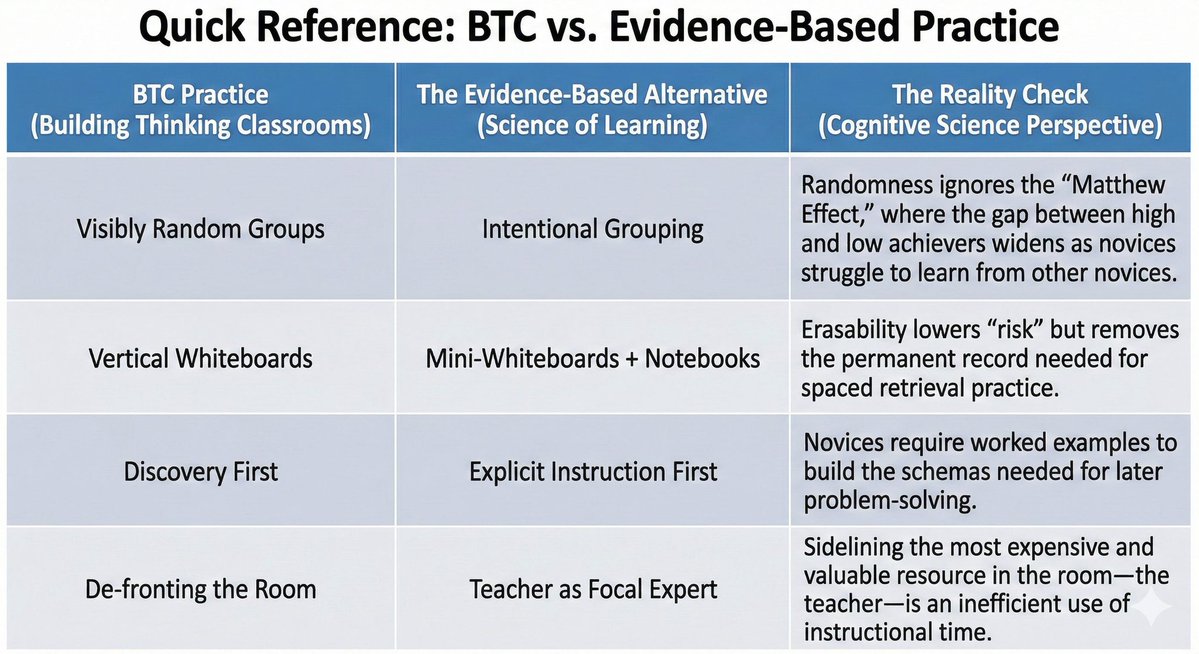
The vertical whiteboards and "productive buzz" of Building Thinking Classrooms (BTC) are sweeping through schools, but engagement is not achievement. Experts like @rastokke , @MrZachG , and @greg_ashman are sounding the alarm that we are trading mathematical mastery for a classroom aesthetic.
The shift toward "de-fronting" the classroom often ignores Cognitive Load Theory, leaving novice learners to flounder in unproductive struggle while major publishers drive implementation ahead of the scientific evidence. Success breeds engagement, not the other way around. If we want students to love math, we must ensure they are actually competent at it.
"The Aesthetic of Engagement: Why Building Thinking Classrooms Might Be a Cognitive Dead End"
https://t.co/sEVBIu1V2T
@TeachersOnFire Not everything worth knowing gets the spotlight. This gem (1983) has lived on in Direct Instruction circles for a reason—practical, durable advice that has outlasted every trend.
Has anyone else noticed how annotation is increasingly used as a stand-in for explicitly teaching complex sentence structures, often at the cost of giving students uninterrupted time to just read and make sense of text?
@MmeLockhartLDS The lacing cards, dot to dots, mazes, tracing of dotted lines & other fine motor skill development activities that we had kicked out of K/1 classes in the early 2000s as being too low-level are starting to make a much-needed comeback in classrooms. Now we understand the why.