CascadiaJS 2026 is a wrap! Thank you to our speakers, sponsors, staff, attendees and everyone who supported us along the way to make this event happen. Photos and talk videos will be published shortly ❤️
We put 💯 Blind Bird tickets for CascadiaJS 2027 on sale, grab one before they sell out and lock-in your spot for the best web + AI conference in the PacNW! 🌲
https://t.co/75feKvhe9v
I can't share the website itself (it has my home address 😅) but here's the process:
1. Connect agent to Netlify MCP / Connector
2. Build your RSVP page, specify Netlify
The agent will create the project and create the Form.
Once you're happy with your RSVP page, download it from your agent as a zip and upload it to your project. Done. ⚡️
Just noticed in my holiday planning that @Netlify + Netlify Forms is a fully functional replacement for Evite, Partiful, etc.
Interestingly, I couldn't use @claudeai Artifacts here because they require a logged-in Claude user in order to submit a form.
There is no end game for software, folks.
It would be like imagining there's a perfect, final book that could be written.
The closer you are to users & UI, the clearer this is.
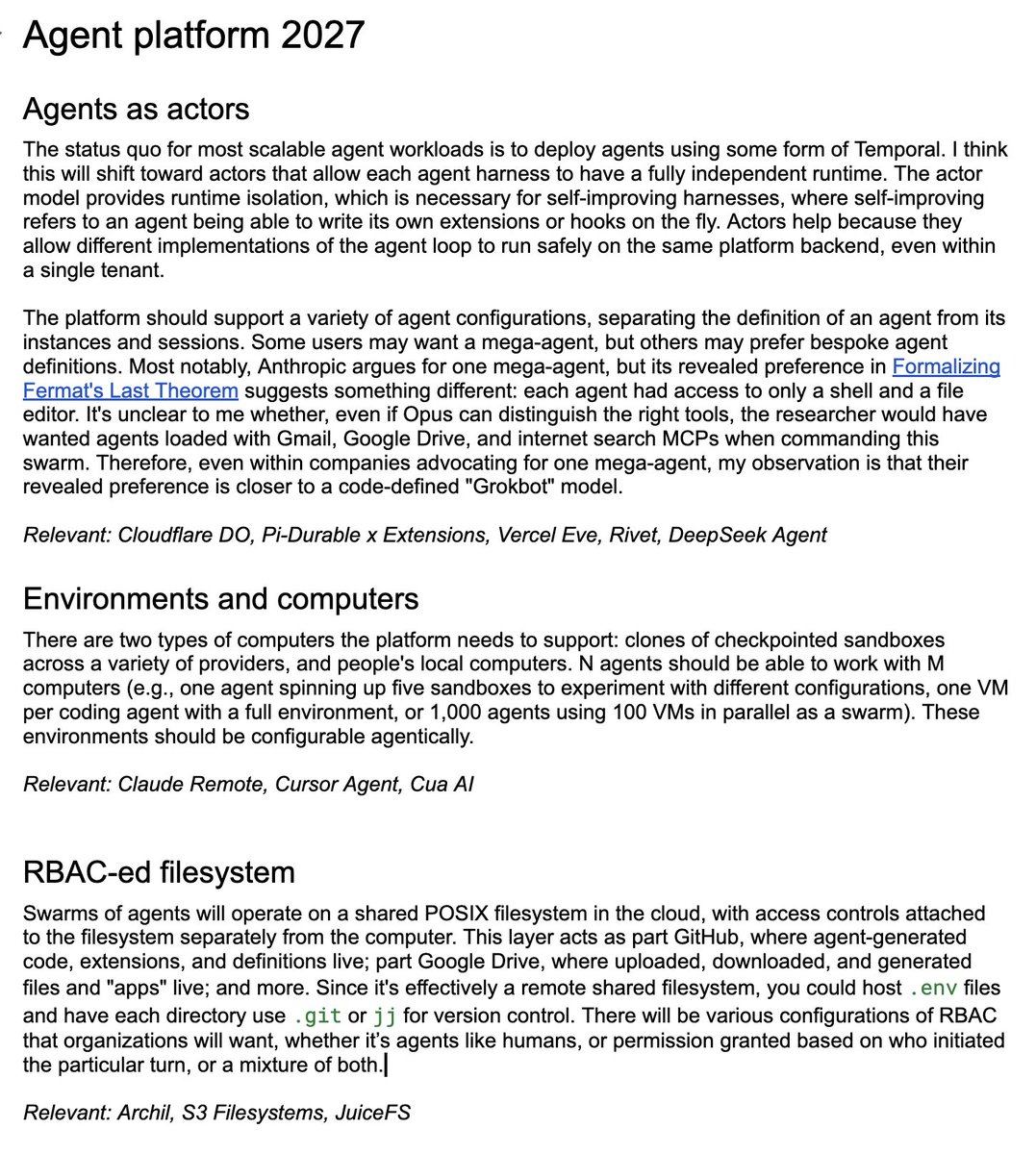
Agent platform of 2027.
This is the end game. This is the blueprint for the one and only application layer software that will exist. Every other software will effectively become databases for this layer, the everything agentic operating system for the million agent swarm to work on top of.
This is obviously the end game vision for the application layer of ChatGPT and Claude. I have reasons to believe that an independent company will own this product layer. But most ADE, "enterprise agent platform", or vertical saas companies, are focused on the wrong things far too narrowly, not technically competent, and do not have the product / technical vision to see this inevitable future.
The correct agent platform that wins will function like the base of a garden, from which customers will plant their unique "seeds" to grow their own plants and trees, managed and evolved by agents, humans, and signals from the sensors of the business. This presents a clearer picture than "factory of a factory" imo.
If you're shipping a very simple app — sure.
But I'm not simply not seeing this in real life. Yes, PMs can ship high fidelity prototypes. And Engineers can generate nice-looking UIs.
But their actual jobs remain:
PM = what to build
Eng = how to build it
pretty sure PMs and engineers are converging into the same role from different starting points.
writing code is basically free now. the job now is deciding what to build and thinking through every edge case.
@andupoto Easiest way to illustrate that this isn't correct:
Try to one-shot Stripe or eBay.
The intuition here supports this. While LLMs have ingested millions of TODO apps and other open source examples, most large systems are not OSS.
Watching people twist themselves into knots trying to get their agents to operate off of "exhaust" like Linear, Slack, etc when the answer is as old as the PC.
Files are all you need.
The core ideas in this post resonated with me. Effectively:
- Agents need company context to solve problems
- Current default is to give agents access to existing data from standard tools (e.g. Slack, Notion, Linear)
- Sometimes, a knowledge base is also maintained, which the agent has access to (e.g. a wiki)
- But often, the above are just 'digital exhaust' of how the work got done. When handed to the agent, agents get some benefits, but still have to 'fill in the blanks' on how to do actual work, thus have limitations and cannot do all the work effectively at high quality.
- Many important company SOPs are effectively implicit, require tacit knowledge spread across many individuals, or 'can be done' but 'not described' - similar to how you might be able to drive somewhere in a car by memory, you might not be able to tell someone how to get there.
- Thus, a key improvement would be to turn all this implicit / tacit process-specific instructions into a format more legible to an agent.
- But this is a very time consuming process, extremely hard, and not often a priority for individuals and companies under deadlines, etc.
- So, finding some good UX pattern, tool, etc. to make these SOPs legible -- without introducing a lot of friction, makes a lot of sense. I have no tie to Scribe and have never used it, but I have definitely tried to piece together things that do this in the past. I know Loom has a similar idea embedded as well, and the foundation model tools have the 'record my screen' functionality now, to turn whatever you record into a skill. As someone doing applied AI with companies, even recording and transcribing a discussion with someone while they are doing their task, asking them questions about it, and then turning that into an SOP / Skill, can go a long way.
- Whatever the case, solving for this is both a UX problem, but also mostly an organization / operational problem. You have to decide it's worth the time to step away from the day-to-day work, in order to build these types of assets that will be valuable to your agents, and allow you to scale / build automated work.
It was also cool to see the results from the experiment here, where *adding* access to the wiki degraded performance. Very much agree that context is a very sensitive and weird thing. Lots to still learn here on best practices, but I would make a bet that this category of work will become much more important - particularly as more enterprises realize AI is here to stay and they need to figure it out.
It was fun to launch our CFP with agent-only submissions via MCP!
But we are a WEB conference after all, so we spun-up @factory & put it to work on building out a web interface.
Shared components, same @auth0 email log-in, check it out:
https://t.co/11BbmC5Cy5
This is an excellent blueprint for enterprises whose core product is knowledge work (think: legal, finance).
One thing I think we'll see (over time) is the blurring of "skills" and "knowledge", both in terms of where they are stored and how agents leverage them as context.
all our agents at langchain (internal GTM & content agents, LangSmith Engine) have a learning loop with similar pieces
wrote about what we think makes up a "knowledge factory" https://t.co/xaAZb5i79q
@johnnyrodgersis Pricing was based on seats and usage was effectively unlimited. Hand to God! Send as the messages and upload all the custom emojis you like!
🚨 Attention all builders: we need your help to put together @LangChain's 2027 State of Agent Engineering Report!
Help us take the pulse of the industry by telling us what agents you're building and how you evaluate their behavior.
You could win some limited edition swag!
Check it out here👇
https://t.co/zgESLrI71c