Testing every pair of human genes in a lab would take nearly 200 million experiments.
The human genome has about 20,000 protein-coding genes. That gives 199,990,000 possible pairs.
Each new cell type, dose or condition multiplies the count. No lab can run that many experiments. But a model can rank the candidates, so the lab tests the most promising pairs first.
Crunch has taken on this problem with the Eric and Wendy Schmidt Center at the Broad Institute. Switching off the right two genes together makes a fat cell burn energy instead of storing it, and the goal was to find those pairs.
Researchers on Crunch ranked 4.5 million candidate pairs from 2,991 genes. Of those pairs, 150 go to the lab, and the lab results decide the final ranking.
1 in 3 adults globally has this disease. Most of them do not know it.
Together with the Eric and Wendy Schmidt Center at the Broad Institute, we will mobilize 14,000 Crunchers to uncover what drives this disease and how to treat it.
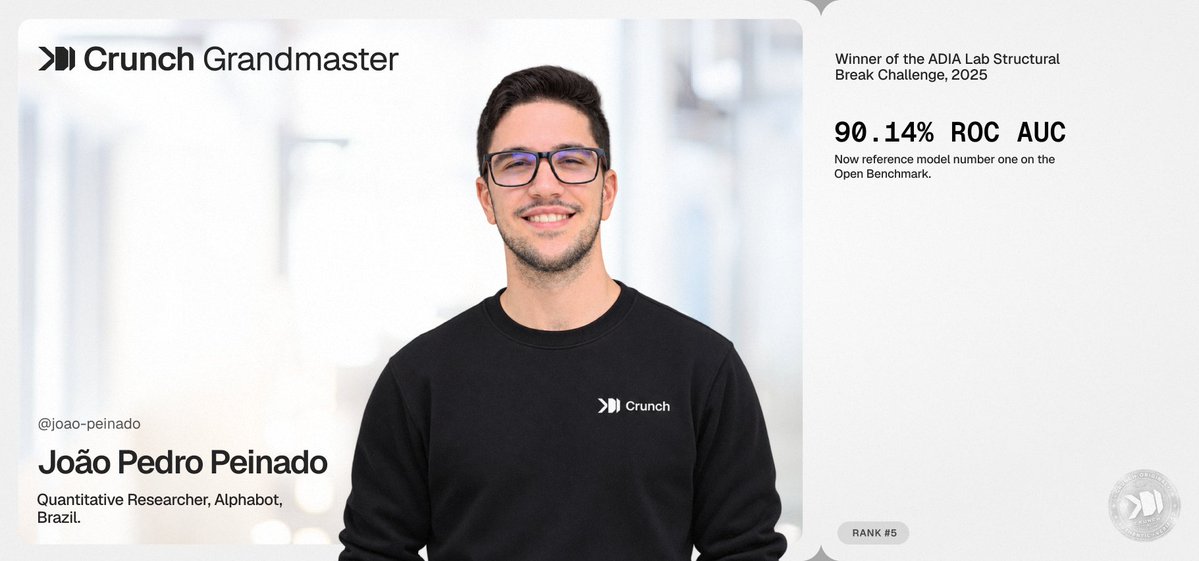
Every new model on Crunch’s Open Benchmark goes up against one co-built by Grandmaster João Pedro Peinado.
His team won the ADIA Lab Structural Break Challenge in 2025 with the only score above 90%. That made their model the state of the art on the problem, so Crunch made it the baseline every new model has to beat. João built the layer that combines the team’s eight base models.
Outside Crunch, he builds trading models for the Brazilian market at Alphabot, a quantitative firm that manages three funds, one of which returned more than 1,600% in its first two years.
Every dataset is a question nobody has asked yet.
Institutions hold two things in surplus: data they have not fully used and problems they have not fully solved.
Put them together and you get a research challenge. Leave them apart and you get storage costs.
Most networks promise that everyone can earn.
Crunch makes a narrower promise: anyone can propose a solution to a problem, and the best ones are rewarded.
A bank can get models from outside researchers without showing them its raw data.
This works in 2 ways:
1. Obfuscated data. DataCrunch gives researchers 1,150 anonymized features to predict returns on the 3,000 most liquid US stocks. They never see what the features are.
2. Private data. The data stays in the institution’s own cloud, researchers submit models, the models run in a trusted execution environment, and each one is scored against held-out outcomes.
Either way, the institution keeps its data and still gets the research.
Horst Simon is one of the people who shaped supercomputing, the field today's AI runs on.
His forty years of work span Boeing, NASA and Berkeley Lab, and include two Gordon Bell Prizes and the TOP500 ranking of the world's fastest computers.
In Episode 2 of Minds & Machines, he talks with Jean Herelle (@herelle_jean) about AI, supercomputing and the research that ADIA Lab, which he directs, has run on Crunch since 2023.
A gigawatt data center uses ten million times the power of a human brain. Horst Simon says that is the sign something is wrong.
The two-time Gordon Bell Prize winner spent forty years building faster computers, and he is not convinced that bigger models will get us to AGI.
One of cancer research’s fastest growing methods is up 13x since 2021, yet fewer than 1% of its papers come from lower-income countries due to high costs.
Kalin Nonchev’s (@nonchevk) DeepSpot tackles this gap by predicting gene maps from standard tissue slides available in labs worldwide.
21,000 models had to spot the moment a time series changes its behaviour, with the data arriving in real time.
ADIA Lab set the problem. 1,700 researchers worked on it on Crunch for 5 months.
The winning model scored 69.35% AUC. A random guess scores 50%.
At the @adia_lab Symposium in Abu Dhabi, Jean Herelle walked through the 10 winning methods and the top researchers behind them.
https://t.co/AwJKItjUBw