They did, however, also carry with them the landed estate ideal
“When the English began colonization in North America in the early seventeenth century, they brought over their customs, their values, their religion--and their land laws. In particular, except for the Puritans, they brought over the English estate ideal. They did not bring over feudalism because feudalism had been dead in England since at least 1500. What the upper class carried mentally was the ideal of family ownership of vast acres that were cultivated by tenant farmers who employed cheap labor,” Huston notes in The British Gentry, the Southern Planter, and the Northern Family Farmer
🧵In 1984, a man sat down in a black box. He was handed sealed coordinates. He had no idea what he was about to describe.
When the session ended, the paper was opened. It said:
Mars. 1,000,000 BC.
And what he saw changes everything.
👇
A rundown of my epistemology:
Direct experience > old wive’s tales > anecdotes > ancient texts > logical propositions > peer reviewed studies > anonymous posters > things the government admits to from more than 50 yrs ago > the media > things the government says about today
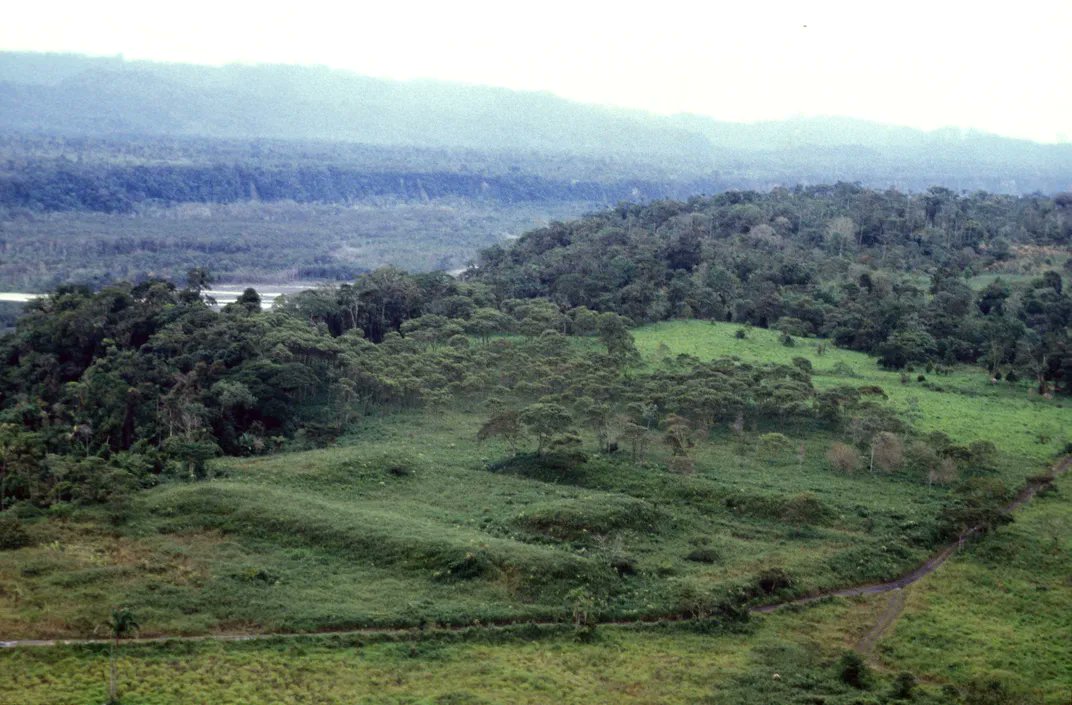
NEW ANCIENT CIVILIZATION JUST DROPPED 🧭
It has long been theorized there was a large civilization in the Amazon. Francisco De Orellana's Expedition wrote of it in 1542.
Breaking Down the Discovery and Significance in this Archaeology Thread 🧵
Facing Facts, even fraught ones: the quest for proto-Indo-Europeans in 2023 https://t.co/7qrylzgPuN Today, over three billion humans distributed across every continent claim Indo-European languages as their mother tongue. This status is the outcome of myriad documented historical events, and an even greater mass of shadowy circumstances we can only intuit, which thousands of years ago catapulted an obscure tribe of Eurasians into position as the direct genetic ancestors of hundreds of millions of people alive today, not to mention the cultural pathbreakers to billions more. The rise and spread of the British Empire and Spain’s New World conquest were two key phenomena instrumental to the vast historical spread of the Indo-European languages, English and Spanish. But Indo-European languages were already widespread long before the modern rise of Western imperialism.
Before Rome, before Greece, even before Sumer, five millennia ago, Indo-Europeans were sowing their genes and memes across Eurasia’s width and breadth. By 3300 BC, warlike nomads from the Pontic steppe north of the Black Sea had exploded out of their homeland, pounding east to Mongolia’s Altai mountains. Five hundred years later, their successors shot in the opposite direction, reaching Denmark and the North Sea, and circling the Baltic from north to south. For thousands of years, Indo-Europeans expanded to new domains under cover of unlettered darkness; unrecorded and dimly recalled. Europe’s first decipherable writing, Linear B dates to 1400 BC in Greece. But by then, on the edge of prehistory, Indo-European languages had long since spread across the Mediterranean’s whole northern shore, sweeping Iberia and the Italian peninsula in the west, and thrusting far to the southeast, all the way to India’s Gangetic plain, 5,000 miles as the crow flies. While Old Kingdom Egypt built the massive pyramids and set in place the fundamentals of what it meant to be civilized for later cultures, primitive and illiterate nomads blasted their way beyond forbidding mountain ranges and trekked doggedly across rugged uplands, from the Pyrenees to the Pamirs. Through sheer force of numbers, this unstoppable people demographically flooded Eurasia’s ancient farming civilizations, everywhere from Britain to India.
The puzzle of the Indo-Europeans reflects the reality that Indo-European languages’ early spread occurred in darkness, far from any recorded texts’ illuminating light. There was no one to inscribe for posterity narratives and names, to make incarnate those fervid moments of conquest for us. Long after the rise and fall of civilizations, genuine history remains alive to us, indelibly inhabited by lively dramatis personae. But of course even absent writing, fragments of past realities persist into the present. The consistently shared lineaments of their received mythos, from Hindu scripture to Greek mythology, tell us Indo-European societies were patriarchal and dominated by powerful men who deftly directed the volatility and violence of young warriors outward, against enemies and allies alike. And yet we can name no lyrically depicted heroes from their age of conquest, not even the likes of the semi-historical Sumerian Gilgamesh or China’s Duke of Zhou. Nor can we summon the names of grand and epic cities, for the early Indo-Europeans built none. Their ancient temples were the vast open landscapes of the steppe itself, the abode of the sky god known to the Romans as Jupiter, the Greeks as Zeus Patēr and the Indian Aryans as Dyáuṣ Pitṛ́.
Until the development of computational phylogenetic tools in the 1990s, at best, inferences about the rise and spread of Indo-Europeans had to be pieced together from innumerable shards of pottery left scattered and inert by otherwise mute prehistoric ghosts. Painstakingly reconstructed back-projections of shared vocabularies cobbled together from modern and dead languages were our only other eloquent clues to ancestral linguistic, sociological and cultural histories; a too-secret past more conjectured than discovered. Though genomic technologies, which allow for the assay of hundreds, thousands and even millions of genetic markers at a time, were essential to unlock a motherlode of fresh data, the real inflection point was the synergy with the new field of ancient DNA after 2010. This fledgling discipline, also called paleogenomics, allowed for precise and quantitative measurements of human population dynamics through space and time, an accurate genealogy of the past orders of magnitude more informative than what we knew even of contemporary populations just decades earlier. Though we can never hope to invent a time machine to hear the languages those first nomadic herders on the Eurasian steppe spoke, we can with astonishing fidelity now trace the rise and spread of whole peoples and the flourishing or extinction of lost races. The archaeological and linguistic theories of the last two centuries of scholarship were generally, by definition, woefully short on data. Still, they were rich in hypotheses, and the population genomic framework of the 21st century can finally crown the worthiest contenders from that sample space of ingenious theories that had for so long remained at best-strained speculations.
We now know that there were mass migrations out of the steppe, whole folk movements where one people replaced another in totality on a scale unimagined a generation ago. The patriarchal mythology of the Indo-Europeans we inherited reflected the true patriarchal organization of their societies; ancient DNA documents the star-like expansion of singular male lineages across centuries and then their successive obliteration in the face of younger, more vigorous competitor lines. In places like Bronze Age Germany and Poland, paleogenomics can also attest to the assimilation of foreign women into villages dominated by a single male founder’s lineage. Isotope analysis of chemical profiles in bones that serve as a signature of local mineral content, record a wide distribution of birthplaces for the women. While the men in the villages shared the same Y chromosome, the women brought diverse mtDNA lineages, confirming the male-centered culture of these early migrating Indo-Europeans. In vast regions of Northern Europe, the Bronze Age steppe herders replaced earlier farming societies, the invaders unceremoniously sweeping away all before them, which often meant the extermination of indigenous male-dominated elites (ancient DNA studies show that Neolithic farmers too structured their societies around male kin-groups). However, there was some notable variation in the interaction between newcomers and older populations they conquered. Scandinavia and Britain retain almost no imprint of the Neolithic people, evidence of steppe merciless steppe pastoralist ferocity. In contrast, Greece and India’s invading nomads remained a substantial minority who reshaped the conquered people in their own image while being ineluctably altered by them, resulting in synthetic new cultures (the indigenous name for India, Bhārat, literally comes from an Aryan tribe).
Despite accumulating victory upon victory, the Indo-Europeans were not, crucially, civilization-bearers. Their pastoralist world flourished atop the smoldering ruins of worlds lost, cultures that left behind hulking rough-hewn stone monuments and the faint outlines of vast villages that were once the loci of sophisticated civilizations. The early Indo-Europeans were barbarians par excellence; their arrival ushered in an age of animal competition, kill or be killed. In places like Spain, Italy and Scandinavia whole paternal lineages disappear upon their arrival, wholly replaced by patrilines which still define the peninsulas today. Though they left their legacy in flesh, archaeologically the early Indo-Europeans are ghosts, their primary material legacy being graves. They emerged out of darkness, beyond the view of history, and they brought darkness to many lands they conquered, a process only finally reversed by civilization’s creeping spread. More than 1,000 years after Neolithic Europe and its grand megaliths fell to the barbarian nomads, the two traditions would fuse to set the stage for the eventual rise of Greece, Rome and the world of the Celts.
In every public statement, the coup leaders of Mali, Burkina Faso, and Niger say that NATO sponsorship of terrorists in Libya destroyed their countries.
Unfortunately, correspondents for AP, Reuters, AFP, and BBC are a little hard of hearing and never report this.
🧵 The Sopranos and Therapy
1/
The Sopranos is one of the thematically richest texts of the late American empire. "Tony I" would make a great Shakespeare play (but that's a different thread)
And one of its best themes is its merciless critique of Late American Therapy Culture
Videoconference starts
“Report progress, Agent Long Dong Silver.”
“It is done, mein Führer”
“Ausgezeichnet. I haven’t been this impressed with a negro since I shook Jesse Owens’ hand”
“I live only for the glory of the Reich”
🧵Gonna talk about female cops and the three varieties of them you may encounter. I've both supervised and worked both under women, and whatever your ideology tells you about female units, they are completely different from men in this job.
The Bro - The Hoe - The Bitch