[Pinned]
I've updated my list of trading resources.
It's now organised into different categories with additional content.
All free, built over the last 7+ years:
https://t.co/KBW57kT5T0
This is cool.
Breakout is publishing positioning data.
You can see sentiment, weight by OI, and filter by evaluation vs funded traders.
Decent proxy for how intraday retail traders are positioned.
There are a ton of other tools too, all free.
https://t.co/rbkDITa2YU
"AI agents will replace manual trading."
Yeah right
I'd love to see an AI agent sell the bottom, lever into a revenge trade, get liquidated, and then reenter the trade with double the size before closing for a catastrophic loss
Even if you're a discretionary vibe based TA punter, you should be able to categorise your ideas into a handful of buckets
TA traders love fixating on specific pattern names
"No, bro, it's an inverted Alec Baldwin Shooting Star, not a Doji!"
But what they are really doing is mapping specific well-established market effects
Momentum: It moved fast and hard, so it's going to keep moving fast and hard
Trend: It's been moving in one direction, so it's going to keep moving in that direction
Mean Reversion: It moved a shitload in one direction, so it's going to move a bit in the other
Volatility Expansion: It's been going fucking nowhere, so it's about to go somewhere
Absorption: Someone really tried to move it and it barely budged, so it's going the other way
Catalyst / Catalyst Absorption: This news is about to blow up the book / This news should have blown up the book but didn't, so someone with deeper pockets is eating the headline traders
At least now you can sound smart while losing money from drawing lines on charts (like me fr)
An obvious but underappreciated fact:
Crypto traders' high volatility tolerance can be a great source of edge
It doesn't feel like it when you're bagholding a shitcoin that's drifting to zero or trading a 2% range with 50x leverage just to feel something
But in the right context, the mental illness we've all acquired is almost certainly helpful
For example:
Normies who passively invest in the stock market start panicking whenever there's a red candle and magically turn into traders at the worst possible time
A small drawdown has people restructuring their entire portfolios even though most of the research basically says "STFU and hold" when it comes to passive investing
But if you've been in crypto long enough and you have a shred of discipline not to day trade your investments (especially outside of crypto) you're probably immune to those same drawdowns that make normies panic
Unfortunately none of us have any money left for passive investing so I'll see you guys in the liquidations feed
TechnicalRoundup is back.
DonAlt and I have been trading crypto for 9+ years and have been doing some version of this show on and off for around 5 years (mostly off, sorry).
It's fun and different: lots of crypto history, PTSD trading memories, and occasionally useful trading insights.
I like to think of it as the perfect show to listen to while you wait for your AI to finish its output.
Thanks to @krakenfx for hooking us up.
https://t.co/pLVt1rLr46
New traders get told that they have to have specific 'setups'
So they spend all day back-testing some random price pattern and shove a couple of indicators in there for good measure, and then fire risk into the book as soon as it 'triggers'
In reality the vast majority of your returns as a crypto trader most likely won't be set up-driven but rather regime-driven
Most of the time the market does mostly nothing
And if you try to force your set ups in the wrong regime, then you'll just get bad results (e.g. momentum trading breakouts in a choppy market)
So I think the first useful port of call is at least some broad sense of what type of regime the market is in
This doesn't need to be complicated: you can just look at the chart, use some basic moving averages or even common sense to get an understanding of trending, mean-reverting, momentum, catalyst-based, volatility compression/expansion etc (complexity can be layered in later if required)
Each regime should then have specific playbooks or set ups associated with it
For example if the market is trending then you might adjust to trade shallower pullbacks, lower time frames, faster moving averages, less drastic momentum resets etc.
That same so-called set up would get you absolutely cooked in a choppy market
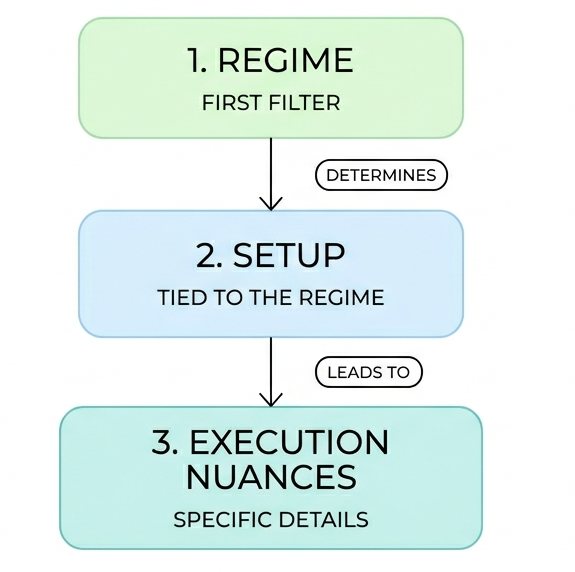
In other words the super TLDR is that the correct hierarchy is:
1. Regime is the first filter
2. Setup is tied to the regime
3. Execution nuances
As a practical example:
The current regime is technically defined as "soul-crushing dogshit" so the correct setup is to develop a nicotine and video game addiction
Hope this helps
Discretionary traders should think carefully about instrument selection
As in spot vs spot margin vs perps vs options and combinations therein
The obvious components are cost, liquidity, and capital efficiency. The non-obvious components are drawdown tolerance, volatility tolerance, and trade management.
From personal experience:
Perps are excellent for intraday trading, but for swing trading and larger bets my performance was worse because I would over-manage those positions and be much more sensitive to drawdowns etc.
Spot/spot margin are great for larger bets and higher time frame swing trades. I'd find myself less concerned with the tick-by-tick movements so I could actually hold the trade, but whenever I've tried to LTF trade those instruments, I would get complacent with trade management.
The tempting default answer is perps for liquidity + to size up, but your bigger position isn't helpful if it means you sabotage yourself by managing it poorly
I'm certain that you can think of trades that were great ideas but poorly executed - instrument selection may be the culprit
Crypto's current state is a bit shit
1. Market cap is not an indicator of quality - the top 50 is made up of ghost coins or bloated governance slop that has underperformed and is uninvestable
2. The long tail speculative stuff went from high risk high reward to 'some dude in Miami is going to zero this if you hold it for more than 5.9 seconds'
3. Everything is extremely correlated and you can't meaningfully make bets based on sectors as it all converges into a tightly correlated mush, especially to the downside
4. Broad brush alt season is an artefact of the past that's very hard to replicate given (2) and given that there are simply too many coins and the excess of speculation doesn't really happen on centralised exchanges anymore - it's been siphoned off to bundled shit in max PvP settings
5. Crypto reputationally is no longer the sexy frontier of speculation. Institutional bid is in AI, retail speculative bid is in 0DTE equities, single name stocks etc.
6. Convexity has flattened. Even a lot of the historically safe blue chip stuff (BTC, ETH etc.) has underperformed and the historical anchor of 'buy deep drawdowns because all-time highs are guaranteed and explosive' has disappointed. All the shit we used to put up with because of the accessibly massive trend and momentum effects is now harder to justify because those same effects are getting neutered or siphoned off into other arenas.
The obvious rebuttal is 'cycles' but even this past cycle is a useful counterpoint: it was extremely concentrated versus broad brush wealth effect, plus something very obviously broke after 10/10.
So what does this all mean?
1. In previous cycles, nailing timing was enough and selection was the cherry on top (rising tide lifted all boats). I don't think that holds - both timing and selection matter now and in the future.
2. Participation alone can be an edge if the asset class is early enough and/or mispriced enough. I don't think that holds either, and we might actually have to learn how to trade (fuck).
3. Hopefully I'm an idiot doomposting the bottom
GM
If you trade when you shouldn't you'll generally lose money.
In most cases identifying when you shouldn't trade is simple.
But that judgment gets clouded if you're tilted, feeling FOMO, bored, and a bunch of other external factors.
It's a bit like post nut clarity: as soon as you're out of it you can't believe you thought it was a good fill.
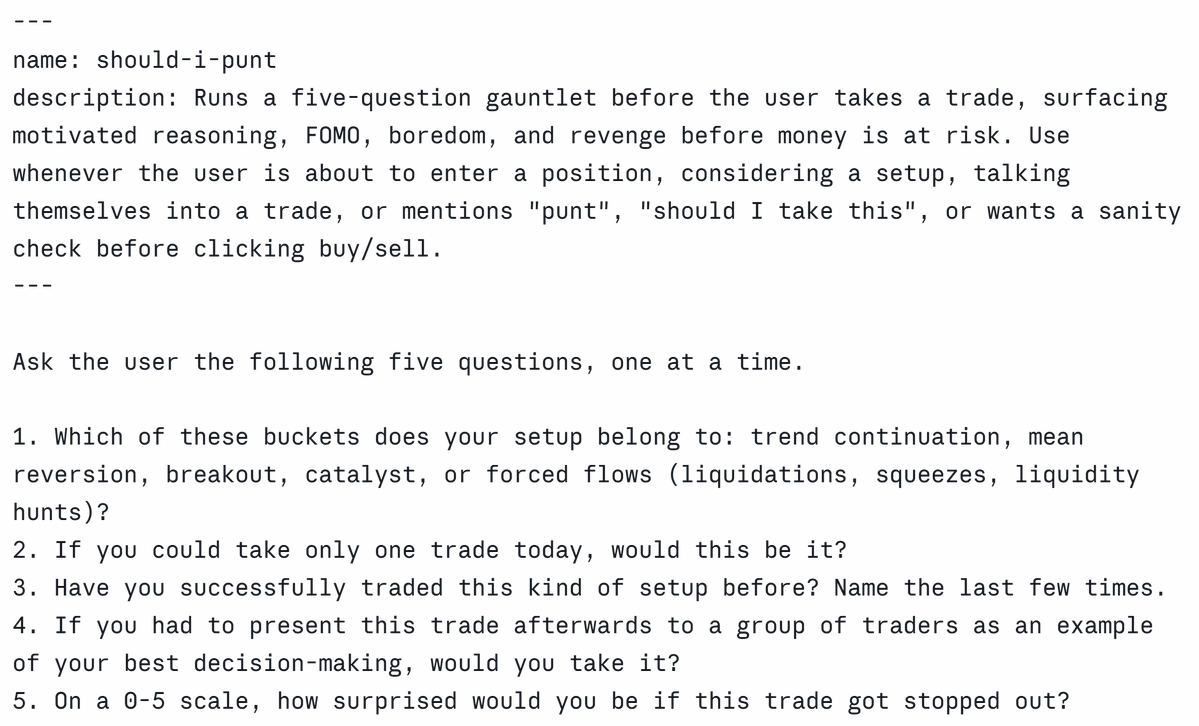
Traders try to mitigate this behaviour via detailed entry checklists but they're often too long or too vague to be useful.
So here's an extremely simple checklist: should-i-punt. Run through it in your head before any trade, or install it as a skill if your LLM psychosis is advanced enough and you've already built 14 broken dashboards.
Trading is hard enough as it is; don't make it harder by dragging down your PnL with unforced errors.