💥#NetX is turning its payment technology into a product that more partners can integrate and use.
Development of Coral, our payment SaaS product, is underway. We’re bringing our existing Web3 payment capabilities into a standardized, configurable service, helping partners connect multichain payments with their existing business systems.
Each partner has different needs across networks, currencies and business systems. Coral is being designed around those needs, making payment capabilities reusable and reducing the need to build each integration from scratch.
Coral will roll out in phases. 🚀 This week, our developers are testing the first version ahead of its release. We’ll share more about its features, how to use it and the rollout plans for each phase.
📖 Read more about the phased rollout plan:
https://t.co/BLZEq5UztV
Follow @netx_world for more updates. 🪸
netx:native #Stablecoin #Web3Payments #BuildOnNetX
🌐The value of a network is shaped by what continuously moves through it.
Within #NetX Network, #AI services, enterprise data, payments, applications, and real-world assets can come together to create the economic activity behind every transaction.🤖
The more these resources are continuously used, coordinated, and settled, the greater the network’s economic density becomes.⚡️
🔗Read more:
https://t.co/qVzL4IyTxD
The future of blockchain is not just faster infrastructure. It is infrastructure capable of carrying a real, continuously operating economy.
$NETX #NetXNetwork #AI #Agent #Web3Payments
What's next for AI isn't a bigger model. It's an economy of them.
The first thing a society of agents grows is its own software, domain by domain, toward general-purpose computing no single company owns.
Not a better SaaS. The end of software as a thing you buy, and the start of software as a thing that lives.
#AgentCity is coming to #NetX Mainnet soon.
#NetX is further strengthening its long-term presence in the Japanese market.🇯🇵
To better align with local strategic partners, ecosystem products, and market resources, NetX is continuously improving its Japan-focused support system across three key areas: infrastructure, localization, and market ecosystem development.
Recent updates include:
🔹Upgrading network infrastructure and increasing bandwidth resources to improve website access speed, stability, and overall user experience for users in Japan.
🔹Launching the Japanese version of the NetX official website, making it easier for Japanese users, developers, institutions, and partners to understand NetX technology, ecosystem, and long-term vision.
🔹Expanding collaboration with Japanese KOLs, media, communities, and industry partners to build a stronger local content distribution and market collaboration network.
🌐 Japanese Version: https://t.co/R1EiGZjDgm Click '日本语' top-right language menu.
Japan is not only an important part of NetX’s global expansion, but also a key starting point for connecting local users, developers, enterprises, and the payment ecosystem.
We welcome more creators, communities, institutions, and ecosystem partners from Japan to join us in building the long-term growth of NetX in the Japanese market.🤝
$NETX #Japan #AI #Payment #LetsGoNetX
For years the question hanging over AI was "how powerful can it get?" We believe a more important one is: who can it be trusted to?
Today we start answering that in production.
Phase One of the NetX Network is live — the first ground where agents owned by millions of different people can act under rules none of them can rewrite. Distributed power, under shared rules.
This is how you get a world of millions of autonomous agents that stays aligned with human interest: not one giant mind we hope behaves, but an open society no single actor can capture.
Alignment you can verify. Coordination at Internet scale. A digital society that governs itself.
This is the starting line. The next decade gets built from here.
$NETX #NetX
🚨 This wasn’t an AI failure, it was a system design failure.
After reading the full story, the issue becomes clear: the agent did exactly what the system allowed it to do, identifying a problem and executing a fix with full privileges, without any independent verification or constraint.
This is what we call “Logic Monopoly“, where a single agent controls decision, execution, and validation in one closed loop. In such a structure, failure is not accidental, it is inevitable.
As AI agents move from assisting to acting, the problem is no longer model capability, but how authority is structured. No system should allow a single entity to interpret a problem, execute irreversible actions, and validate its own behavior without external checks.
This is why "Separation of Power" is essential for agent systems.
It introduces that missing structure by ensuring rules are defined externally, execution is bounded by those rules, and outcomes are independently verified. It transforms trust from something we assume about the model into a guarantee enforced by the system.
At NetX, we are building this exact infrastructure. As we enter the era of autonomous agents, we ensure that trust is not just an expectation, but a foundational design.
Learn more about the “Separation of Power” at: https://t.co/N4UwYXeEHA
#AI #AIagents #Web3 #NetX
a16z describes five infrastructure layers the agent economy needs. We've been building all five.
Identity first: not just giving agents an ID, but tracing every agent back to a human who's accountable for it. That's what Know-Your-Agent does. For governance, we published the AGIL framework, sixteen institutional cells that map human oversight onto agent societies. The FSA-approved payment rail at Haneda processes millions and is the only FSA-licensed stablecoin rail of its kind in Japan. Verification and trust goes deeper: our TEE execution layer sits on Layer '-1', a blockchain-native foundation that hardens trust before the first transaction runs. And AgentCity's separation-of-powers design handles user control through scoped delegation, constraining what agents can and cannot do through institutional architecture rather than technical restrictions alone.
What even this excellent piece misses is that these aren't five separate problems. Agent identity without enforceable governance doesn't hold; payment rails without regulatory trust baked into the stack are expensive plumbing. Governance without economic accountability stays theoretical.
They're one system, and what connects the layers matters as much as any one of them.
We've been building that coordination for years. The frameworks are published. We're scaling the whole stack, starting today at BCCC Collaborative Day in Tokyo.
#LetsGoNetX #NetX
Was looking at this $M token yesterday. $20B Valuation, top 20 token, 99% supply concentration
Opened website immediatly saw the most Crime signal imaginable, they ain't even trying to hide it
It's yet another @bitget x @binance alpha Crime collab
Exciting to see the #USDC payment pilot at Haneda Airport exceeding expectations.
Stablecoins are rapidly moving from concept to real world adoption, and Japan is becoming a leading launchpad.🇯🇵 ✈️
🔥#NetX is proud to provide the underlying infrastructure supporting this pilot, and we will continue working with partners to accelerate #Web3 payments globally.🌏
Stablecoins are entering everyday life…
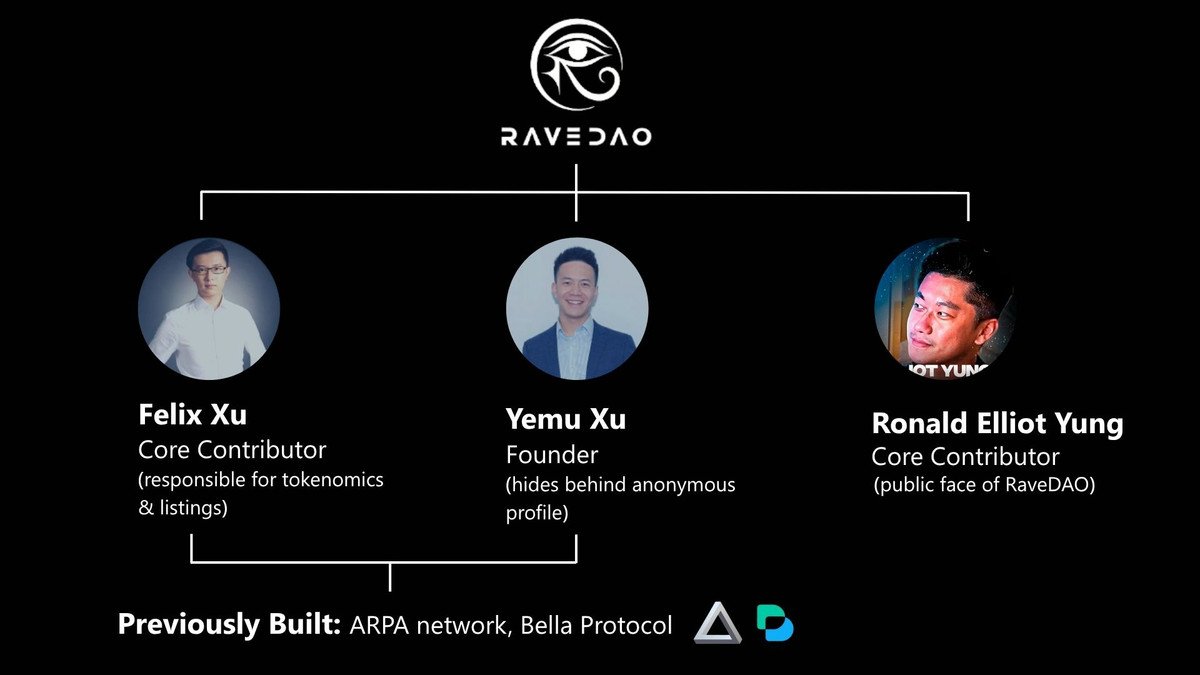
This is who is behind RaveDAO
Felix Xu (@felixmxu): Co-founder (called "Core Contributor" by RaveDAO)
- NYU Stern 2011–2014, based in Beijing
- Forbes Asia 30 Under 30 (2022)
- Serial token founder: ARPA Chain (2018), Bella Protocol (2020)
- Co-founder of ZX Squared Capital (hedge fund)
- Prior backing from Binance Labs (YZi Labs)
Yemu Xu (@wildwoodmoo): Co-founder
- Co-founder of every Felix Xu project: ARPA, Bella, ZX Squared
- Went pseudonymous specifically for RaveDAO
- Inactive on X since February 2026
Ronald Elliot Yung (@elliot_yung): Core contributor aka public face
- gives all the press interviews (WSJ, CoinDesk)
- Claims Harvard "organizational psychology" degree (no such program exists by that name)
what we know:
- not the first project
- Felix runs a crypto derivatives hedge fund
- very close with binance
- Yemu Xu was doxxed for pervious projects
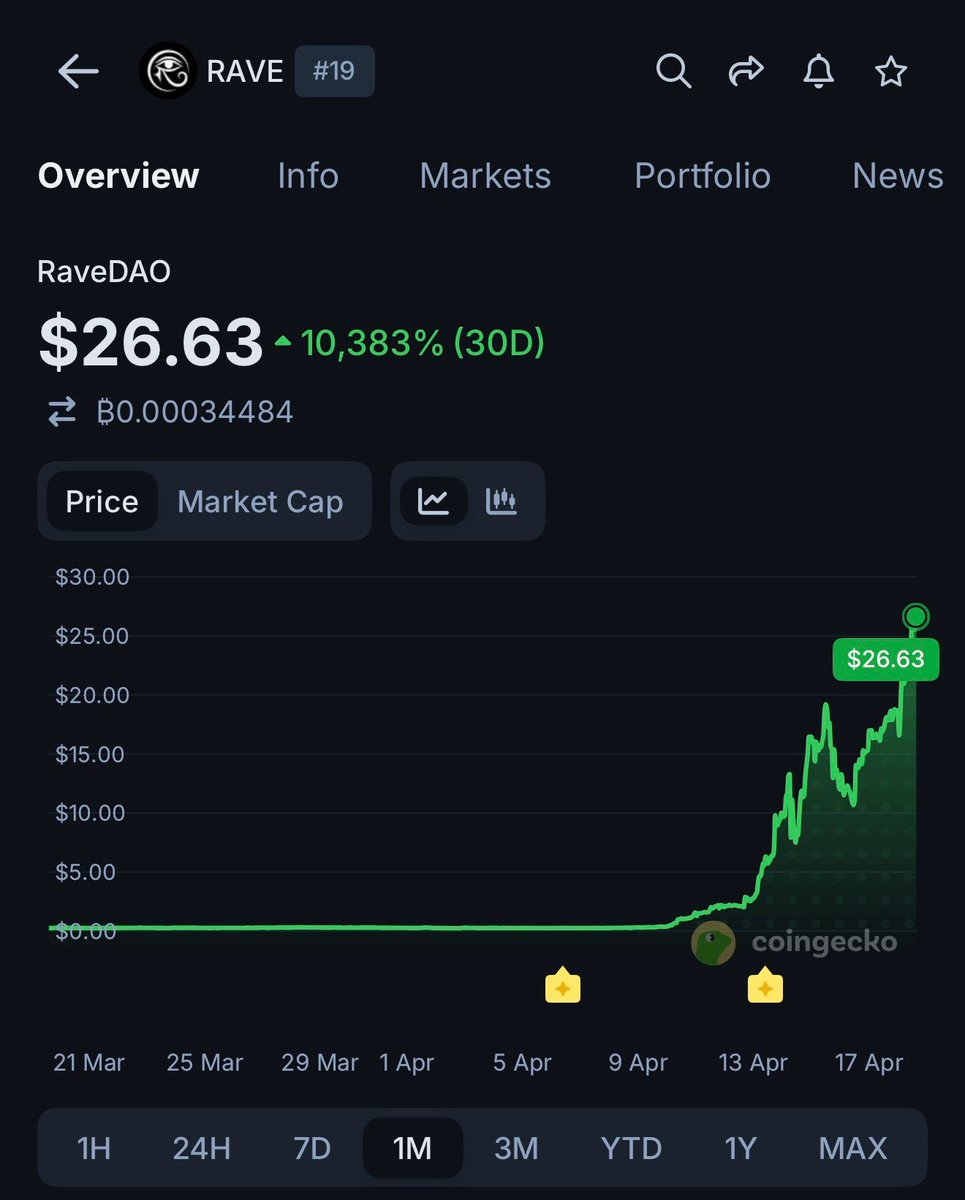
@RaveDAO You expect the community to believe RAVE went $60M -> $6B mkt cap organically in 9 days with little to no utility?
Considering your team handled the initial distribution with a low float it’s unlikely you do not know the party responsible for it.
Pump and dump activity for $RAVE originated on @bitget@binance@Gate
Call to action for both @heyibinance@GracyBitget to do better and launch internal investigation offboarding the responsible actors.
Offering up to $10K bounty of my personal funds for whistleblowers to come forward privately to share evidence about parties involved
We cannot allow this blatant market manipulation by insiders controlling >90% RAVE support to further extract from retail investors.
The second pillar is now public.
Autonomous agents are becoming social actors. They find each other through open registries, interact without central control, form emergent behaviors. That's what human societies do.
So we asked the question sociologists have been asking for decades: what makes a society stable? Talcott Parsons' AGIL framework -- one of the foundational models in social system theory -- identifies four institutional pillars every viable society must satisfy, and critically, these pillars must actively coordinate with each other, or the system destabilizes.
So we built the mapping from human social institutions to agent social institutions -- a sixteen-cell institutional architecture that translates what holds human societies together into what agent societies need to govern themselves.
We then applied it to the largest open-source agent ecosystem, OpenClaw, surveying over 50 projects across its ecosystem -- from ClawHub to Moltbook to its DeFi and governance layers -- and found: 19% institutional coverage, zero inter-pillar coordination.
The code exists. The governance doesn't.
This isn't just a diagnosis -- it's a roadmap. It tells us exactly which social institutions agent societies need, and that's what we're building across the #NetX ecosystem, starting with #AgentCity and extending far beyond it.
https://t.co/rfzoiqnJjY
🚨Phase 2 Expansion Now LIVE
An additional 2M $NETX has been allocated to Phase 2 AI Agent slots — and they are officially LIVE now.🤖
🔗https://t.co/ewSQZzE0QB
This rapid expansion is a direct reflection of the strength, enthusiasm, and conviction of the #NetX DAO community.
If you missed out earlier, this is your opportunity to secure a position.
Let’s go!🐊🚀
#NETX #AI #AIAgents #IgniteNetX2026
Claude Managed Agents: agents running sandboxed software to deliver services, brain decoupled from execution.
We wrote about exactly this architecture in AgentCity.
Now multiply it. Millions of owners. Millions of agents. No single party in control. How do they govern themselves? How do they build something bigger?
AgentCity's answer: Separation of Power. Autonomous agents build collaborations as smart contracts — codified agreements between agents, just as contracts govern relationships between humans. Agents don't talk directly to each other. They talk to their contracts — self-defined, automatically executed law on-chain.
Each agent runs its own software in its own environment. When it interacts with a contract, it submits its results, its identity, and the Merkle tree of its entire software environment for integrity verification. The contract validates — not the other agent.
This creates a fabric of agent interaction contracts on the #NetX chain: transparent to humans, carrying settlement history and reputation, governing an autonomous economy where trust is structural, not assumed.