Other platforms give you synthetic tokens. MEXC gives you direct market access. real NYSE/NASDAQ liquidity. plus dividends. 0 fees rn. Trade Real Stocks on #MEXC
Roadshow today → MEXC Launchpad ends tomorrow → trading June 12. The story writes itself. $SPACEX(PRE) is the only pre-IPO game in town right now. Delay is dangerous!
🚀 SpaceX Roadshow starts today.
⏳ $SPACEX(PRE) Launchpad ends tomorrow.
The story is moving fast!
Don't be the person saying "I almost joined." 👇
https://t.co/Ul7hDl8I97
Hidden costs are what actually eat your trading profits
I ran a $10K NVDA buy yesterday just to see where the real costs show up. #MEXC RealStocks is sitting at $0 right now, still in launch promo mode. Then I compared it: IBKR is about $0.35 to $1 per trade, Saxo around $1, and Binance or Gate closer to $10 for basically the same click.
But the listed commission is only the surface level. The stuff that actually eats into your return is the hidden layer like FX spreads, clearing fees, regulatory charges, and sometimes market data costs you don’t think about when hitting buy.
Once you factor all that in, the difference is not just free versus cheap anymore. A single $10K trade can quietly pick up $20 to $30 in extra costs depending on the platform and currency conversion, even when the headline fee looks almost zero.
Most traders never fully add it up, they just see the commission number and assume that is the full price. Over time, that is how small leaks turn into real performance drag without anyone noticing.
@tokens@SpaceX@PreStocks 75B raise, 555M shares at $135, and MEXC already has $SPACEX(PRE) trading? That's literally pre-IPO before pre-IPO. Well, the Mexc Launchpad still live, hence I'm not waiting for Jun 12.
@MEXC 25 winners, extra 500 USDT, and all I have to do is post a screenshot and tag someone? That's lighter than most giveaways. Count me in for the $SPACEX PRE Launchpad.
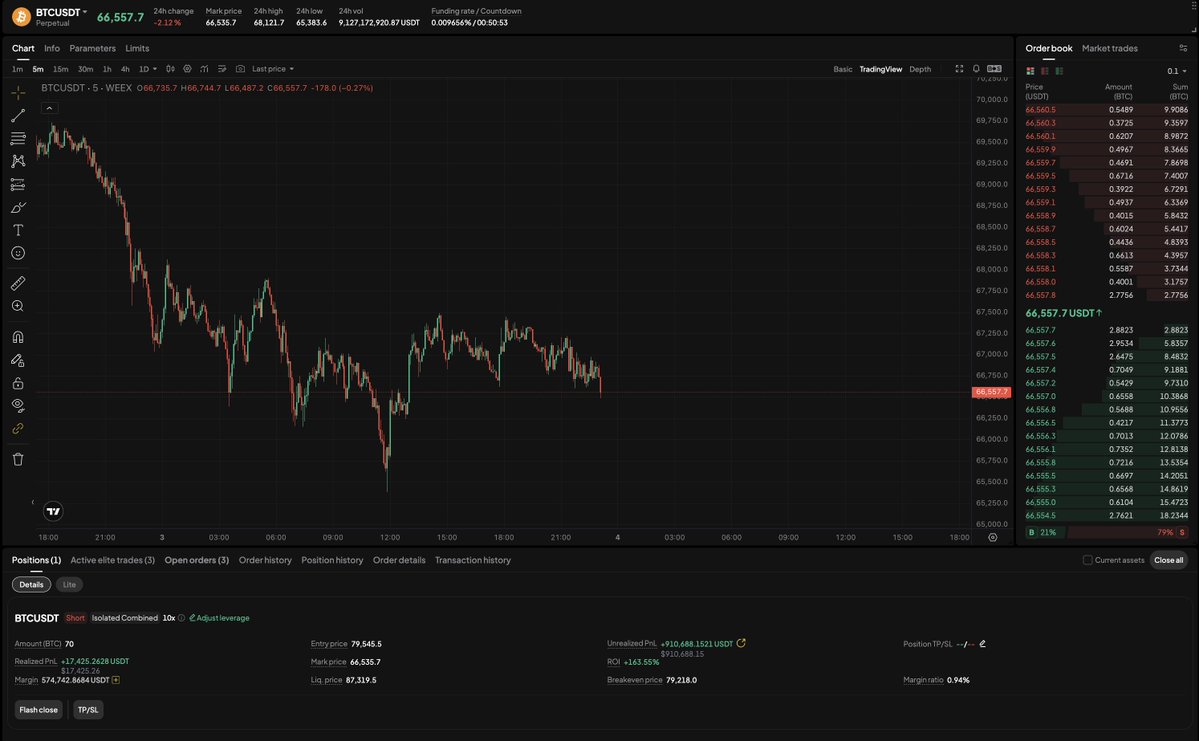
This is my last BIG Bitcoin short this bear market.
Target: $60,000.
After this, we're going long on the bear market bottom.
I will share my exact entries in the community.
Join here: https://t.co/wvpM79SNDT
@coinbureau The spending race is clearly far from over, and it shows how serious $GOOGL is about staying ahead. Makes $GOOGLON even more interesting to trade right now considering #MEXC has up to $1,000,000 rewards pool live
@StockSavvyShay That’s a pretty sizable chunk going toward stock-based compensation taxes. Worth watching how the market digests it, but for now GOOGL’s bigger trend still looks intact. Keeping an eye on $GOOGLON, too, with $1,000,000 rewards pool on MEXC
The new heir of $BTC is called $KAS
Why do I say so?
While Bitcoin set the foundations for what's to come, Kaspa went ahead and upgraded the PoW architecture
And it did so while maintaining the decentralized nature of blockchain
KIP-21 matters because it gives Kaspa the missing commitment structure between raw blockDAG ordering and future verifiable execution. Without it, sequencing commitments behave too much like a single global stream: every accepted transaction contributes to one shared historical surface, which is fine for proving total network order, but hostile to app-local ZK proving. If a future DEX, stablecoin system, covenant market, or vProg only cares about its own state transitions, it should not be forced to carry the weight of unrelated network activity through its witness. That is the bottleneck KIP-21 cuts through.
The design partitions sequencing into lanes, where lane identity is derived from transaction subnetworks. Each active lane maintains its own recursive lane commitment through values like "lane_tip_hash" and "last_touch_blue_score". Those active lane tips are then inserted into an active-lanes sparse Merkle tree, producing a compact commitment that rolls upward into the broader sequencing commitment while still fitting inside Kaspa’s existing header commitment structure. So Kaspa keeps one global proof-of-work anchor, but the proof burden becomes local. That is the important architectural move.
This is not Ethereum-style global state. It is not “smart contracts on Kaspa” in the lazy EVM sense. It is closer to proof-indexed settlement: many isolated execution lanes, each proving the activity that touched it, all inheriting the same PoW-backed DAG ordering. Inactive lanes can be purged after enough blue-score time, which prevents the system from turning into permanent historical garbage collection for dead applications. The inactivity shortcut then lets proofs skip empty spans instead of walking every irrelevant block.
That makes KIP-21 one of the quietest but most important pieces of Toccata. Covenants define constrained UTXO behavior. ZK verification proves external computation. Native covenant IDs preserve lineage. KIP-21 gives all of it a scalable anchoring map. It is how Kaspa begins moving from fast money into sovereign execution infrastructure.