What’s become clear in the digital asset space is that the finance function is no longer just a back-office function. It has become one of the core pieces of infrastructure that determines whether companies can scale, satisfy regulators, support commercial growth and build institutional trust.
At #CryptoFinanceForum London, Marek Walendowski from EY moderated a discussion with Teresa Cameron from Clear Junction, Philipp Prince from BCB Group, Julian Kelly from Bitwise Europe and Nathan Pearman from Copper on how finance teams are evolving across digital asset businesses:
⚖️ Philipp described the shift from “growth at all cost” five or six years ago to a market where regulation is now at the forefront – and where compliance can become a source of customer trust, not just a constraint.
🏦 Julian gave a very real example of that regulatory reality: Bitwise Europe’s first centrally cleared, physically backed Bitcoin ETP took around 15 attempts to get its prospectus approved by BaFin.
📊 Teresa captured the changing role of finance: from the outside, Clear Junction is a payments business; from the inside, it is a risk-management business. In her words, risk and compliance are the only way to sustain the business long term.
🔐 Nathan brought the trust point back to first principles: whether the audience is regulators, investors, auditors or future public-market stakeholders, everything needs to be documented and followed through. At Copper, that means client balances being reconciled to the blockchain every minute.
🤖 And looking ahead, Philipp pointed to AI as a way to move beyond static IPO-style sensitivities – using it to identify which variables a business is most exposed to, and to improve forecasting, disclosure and decision-making.
Watch the highlights below.
Cryptio integrates with LMAX Digital.
Finance and operations teams can bring activity from LMAX into Cryptio’s reconciled data layer, enabling automated classification, reconciliation, cost basis calculations, gain/loss reporting and ledger workflows across their digital asset operations.
The integration expands Cryptio’s coverage across the digital asset ecosystem, helping firms maintain audit-ready records with the data quality, reconciliation and ERP workflows required for regulated finance.
Stablecoins may have begun as a way to preserve value and move liquidity inside a volatile crypto ecosystem.
But their next phase is about something much bigger: how money moves across banks, FX markets, payment networks, treasury systems and enterprise infrastructure.
Joy Adams from @DeutscheBank, Alex Dunn from @Visa, Karan Shah from @openfx_ and Benoit Marzouk from @tokenGBP joined us at #CryptoFinanceForum London to discuss.
Joy captured the end-state well:
“You have a really good product when a billion people can use it and have no idea.”
Alex shared what Visa is already seeing in stablecoin settlement:
“Every month the flow comes through. I’m shocked at the growth of this.”
Karan showed what happens when stablecoin flows reach institutional size:
“To execute a $50 million USDC to MXN transaction, you cannot send that flow to one single counterparty. You need to slice it, dice it, execute it across multiple different venues.”
Benoit pointed to the UK’s shifting regulatory tone:
“The FCA and HMT are pro-stablecoin… We have no issues onboarding even systemic banks.”
And Karan captured the enterprise reality well: corporates do not care about stablecoins for their own sake. The job to be done is moving money – with ERP integrations, TMS systems, liquidity, compliance and true connectivity end to end. OpenFX uses stablecoins where they work well, and reverts to fiat rails where they don’t.
The panel’s take-away was that stablecoins will not win because they are new. They will win where they make money movement faster, cheaper, more connected and more useful.
📖 Read the full recap with panel recording below ↓
https://t.co/OnbapHYCgJ
Cryptio integrates with @BitMartExchange.
Finance and operations teams can bring activity from Bitmart into Cryptio’s reconciled data layer, enabling automated classification, reconciliation, cost basis calculations, gain/loss reporting and ledger workflows across their digital asset operations.
The integration expands Cryptio’s coverage across the digital asset ecosystem, helping firms maintain audit-ready records with the data quality, reconciliation and ERP workflows required for regulated finance.
Tokenization is no longer just about putting assets on-chain.
The more important question is what changes around them: ownership records, collateral, wallets, settlement, reporting and the operational infrastructure that makes financial markets work.
That was the focus of the opening panel at #CryptoFinanceForum London, where our VP of Institutional solutions Jeff Rundlet moderated a discussion with Kim Hochfeld from @StateStreet, Robert Crossley from @FranklnTempletn, Nadine Teychenne from @Citi and Amor Sexton from @BlockdaemonHQ.
Robert put the challenge clearly:
“As an industry, we talk a lot about tokenizing real world assets. We don’t talk a lot about unlocking real world benefits.”
Franklin Templeton has already spent five years measuring settlement cycles in seconds across tokenized money market infrastructure, running 24/7, 365 across 10 public chains and one private chain.
But the panel’s bigger point was that tokenization alone is not enough.
Amor compared it to the containerization moment in shipping: the real transformation did not come from the container itself, but when ports, ships, processes and surrounding infrastructure adapted around it.
The same is true in finance. Nadine framed one of the key institutional questions: what is the tokenized asset legally, what does ownership mean, and where is the golden record – the off-chain transfer agency book, or the on-chain record?
And Kim highlighted what tokenization can bring to institutional investment products: 24/7 access, collateral mobility, instantaneous settlement and distribution into the wallet infrastructure where investors are moving.
The message from the panel was clear: tokenization is past proof of concept, but scale will depend on the legal, operational and reporting infrastructure around it.
📖 Read the full recap with panel recording below ↓
https://t.co/YbaLl68pL0
Cryptio integrates with @Bitpanda.
Finance and operations teams can bring activity from Bitpanda into Cryptio’s reconciled data layer, enabling automated classification, reconciliation, cost basis calculations, gain/loss reporting and ledger workflows across their digital asset operations.
The integration expands Cryptio’s coverage across the digital asset ecosystem, helping firms maintain audit-ready records with the data quality, reconciliation and ERP workflows required for regulated finance.
Tokenization is no longer just a question of what can be brought on-chain.
It is a question is what needs to change around it: settlement, collateral, ownership records, wallets, interoperability, reporting and control.
At #CryptoFinanceForum London, our VP of Institutional Solutions Jeff Rundlet moderated a discussion with Kim Hochfeld from @StateStreet, Robert Crossley from @FranklnTempletn, Nadine Teychenne from @Citi, and Amor Sexton from @BlockdaemonHQ on what tokenization changes for issuers, investors and operators.
A few points that stood out:
📈 Franklin Templeton has already spent five years measuring settlement cycles in seconds across tokenized money market infrastructure, running 24/7 across 10 public chains and one private chain.
📦 Kim Hochfeld framed tokenization as the next evolution of the financial wrapper – adding 24/7 access, collateral mobility and instantaneous settlement.
🧾 Nadine Teychenne framed one of the key institutional questions: what is the tokenized asset legally, what does ownership mean, and where is the golden record – the off-chain transfer agency book or the on-chain record?
🚢 Amor Sexton compared tokenization to the containerization moment in shipping: the full transformation came not from the container alone, but when ports, ships, processes and infrastructure adapted around it.
🔗 Interoperability will be critical. Without it, tokenization risks creating new islands of liquidity rather than a more connected financial system.
The panel made one thing clear: tokenization is moving beyond proof of concept, but scale will depend on the operating infrastructure around it.
Watch the highlights below.
Cryptio supports Hyperliquid.
Institutions and digital asset enterprises operating on Hyperliquid can use Cryptio to transform on-chain activity into reconciled, audit-ready records for accounting, reporting and operational control.
The integration expands Cryptio’s coverage across the digital asset ecosystem, helping finance teams manage multi-chain operations with the data quality, reconciliation and ERP workflows required for regulated finance.
Cryptio supports Tempo.
Institutions and digital asset enterprises operating on Tempo can use Cryptio to transform on-chain activity into reconciled, audit-ready records for accounting, reporting and operational control.
The integration expands Cryptio’s coverage across the digital asset ecosystem, helping finance teams manage multi-chain operations with the data quality, reconciliation and ERP workflows required for regulated finance.
Cryptio supports @CantonNetwork.
Institutions and digital asset enterprises operating on Canton can use Cryptio to transform on-chain activity into reconciled, audit-ready records for accounting, reporting and operational control.
The integration expands Cryptio’s coverage across the digital asset ecosystem, helping finance teams manage multi-chain operations with the data quality, reconciliation and ERP workflows required for regulated finance.
Introducing Cryptio Fund Administration.
Following our $45m Series B, we shared our vision to build the data transformation and ERP platform for regulated digital assets.
Today, we’re taking the next step in that vision.
As digital asset funds mature, fund administrators are being asked to support increasingly complex strategies across spot markets, derivatives, DeFi, staking, tokenized assets, and hybrid fund structures – often fragmented across custodians, exchanges, and on-chain environments.
Existing systems were not designed for the realities of digital asset fund accounting and NAV operations.
Cryptio Fund Administration is built on the same reconciled, PwC audited SOC 2-compliant data foundation already trusted by 400+ institutions globally – including Circle, SG Forge, Laser Digital, Uphold, Securitize and Gemini.
It enables fund administrators and fund issuers to:
-Aggregate digital asset activity across on-chain and off-chain environments
-Perform digital asset fund accounting and strike NAV daily or intraday
-Support hybrid fund structures, multi-entity setups, feeder funds, creations/redemptions, and complex strategies
-Automatically identify discrepancies between administrator records and shadow books across positions, transactions, and valuations
As digital asset funds scale, fund administration infrastructure needs to evolve with them.
Watch below to find out more.
Crypto Finance Forum London 2026 is in full swing at Landing 42.
With panoramic views over the City and a full house of 200+ CFOs, COOs, auditors and finance leaders, the atmosphere is buzzing with sharp insights, thoughtful questions and candid conversations shaping the future of regulated digital assets.
This morning began with The tokenization of equities and funds: what changes for issuers, investors and operators?, featuring Kim Hochfeld (@StateStreet), Nadine Teychenne (@Citi), Robert Crossley (@FranklnTempletn) and Amor Sexton (@BlockdaemonHQ), moderated by Jeff Rundlet (Cryptio) – exploring what tokenization changes in practice for the institutions issuing, investing in and operating these products.
Next, Banking in the age of stablecoins brought together Joy Adams (@DeutscheBank), Alex Dunn (@Visa), Benoit Marzouk (@tokenGBP) and Karan Shah (@openfx_), moderated by Antoine Scalia (Cryptio) – unpacking how stablecoins are beginning to reshape payments, liquidity, treasury operations and the relationship between digital asset firms and the banking system.
Some early highlights from the stage:
-Amor compared tokenization to the container revolution in logistics. The shipping container did not just make goods easier to move; it changed the infrastructure around global trade, from ships and ports to trucks and storage systems. In the same way, tokenization will only reach its full potential when the surrounding infrastructure for issuance, custody, settlement and servicing evolves to take full potential of the benefits of these new asset wrappers.
-Joy highlighted that banks are taking both stablecoins and tokenized money market funds seriously. The firms best positioned for the next phase will be those that understand how these instruments relate to each other, and how they may interact across payments, liquidity, settlement and investment ecosystems.
-Alex was candid that Visa sees stablecoins as both a threat and an opportunity. Integrating with stablecoin infrastructure is partly defensive, but it is also a major strategic opportunity for institutions that understand where digital money is heading and move early to shape how it enters mainstream payments.
And the day is far from over.
🎤 Live on stage: Finance Leaders Outlook: Managing the dynamics of the industry, with Philipp Prince (@BCBcrypto), Julian Kelly (@Bitwise), Nathan Pearman (Copper) and Teresa Cameron (@ClearJunction), moderated by Marek Walendowski (@EYnews).
Still to come: Institutionalization of crypto prime brokerage & lending, with Daniel Elsawey (@Bitpanda), Myles Harrison (@AMINABankGlobal), Al Turnbull (@blockchain) and James Harris (@tesseract_fi), moderated by Hemant Pandit (Cryptio).
And finally, a fireside chat with Sumeera Younis, Chief of Operations, Crypto Task Force at the SEC, and Antoine Scalia, Founder & CEO of Cryptio.
Stay tuned, the conversations continue.
TODAY’S THE DAY: Crypto Finance Forum London is here.
The wait is over. 200+ CFOs, COOs, auditors and finance leaders are gathering at Landing 42 to have the conversations shaping the future of regulated digital assets.
From the tokenization of equities and funds to banking in the age of stablecoins, finance leaders managing the dynamics of the industry, and the institutionalization of crypto prime brokerage and lending, today’s sessions will unpack the questions, operating models and market structures at the heart of institutional crypto finance, alongside a fireside chat with the SEC’s Crypto Task Force.
We can’t wait to welcome:
@SECGov • @DeutscheBank • @FranklnTempletn • @StateStreet • @Citi • @Visa • @Bitwise • Copper • @BCBcrypto • @blockchain • @Bitpanda • @AMINABankGlobal • @ClearJunction • @BlockdaemonHQ • @openfx_ • @tesseract_fi • @tokenGBP • @EYnews – and many more.
📅 TODAY | 09:00 – 18:10
📍 Landing 42, 122 Leadenhall Street, London EC3V 4AB
Follow along here for updates throughout the day.
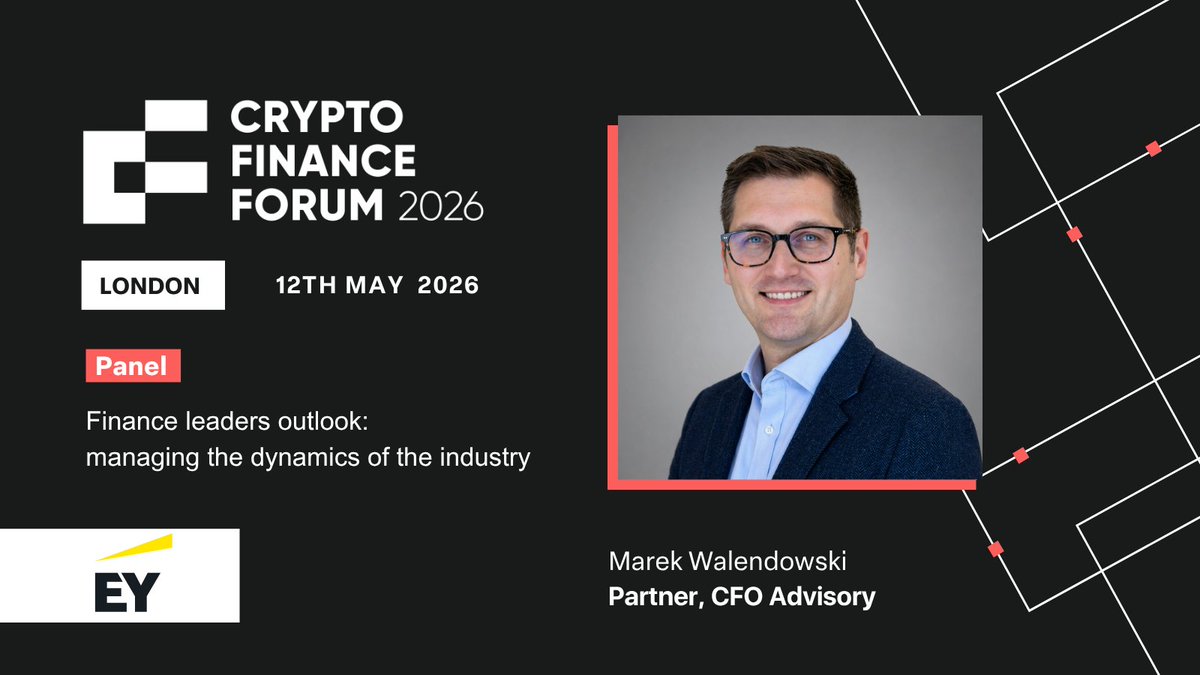
MODERATOR ANNOUNCEMENT: Marek Walendowski, Partner, CFO Advisory at @EYnews, will moderate the Finance Leaders Outlook: Managing the dynamics of the industry panel at Crypto Finance Forum London.
EY works with financial institutions and digital asset businesses across accounting, assurance, tax, regulatory, risk and transformation challenges in digital assets. Its work spans practical areas including on-chain/off-chain reconciliation, audit readiness, controls, governance and financial reporting as institutions build more mature digital asset operating models.
As finance leaders navigate changing market conditions, regulatory expectations and institutional adoption, Marek will help guide a discussion on how CFOs, controllers and finance teams are managing risk, reporting, controls and operating models in a maturing digital asset industry.
📅 12 May (09:00 – 18:10)
📍 Landing 42, 122 Leadenhall Street, London EC3V 4AB
🔗 Secure your spot: https://t.co/zq4xIALtAU
SPEAKER ANNOUNCEMENT: James Harris, Group CEO at Tesseract, will speak at Crypto Finance Forum London.
Tesseract is a European digital asset lending and DeFi yield platform, with over $500M in AUM, $1B in loans originated and $20M+ in yield generated for clients. In 2025, the firm secured a MiCA licence from Finland’s FIN-FSA, becoming MiCA-authorised to offer actively managed DeFi yield strategies under a portfolio management permission. More recently, Tesseract launched Dedicated Client Vaults, individually segregated on-chain vaults giving institutional investors regulated access to DeFi yield strategies with clear asset segregation at the client level.
James will share his perspective on how institutional crypto lending and yield markets are evolving, and what market participants now require from risk management, collateral frameworks and regulated operating models as prime brokerage and lending models mature.
📅 12 May (09:00 – 18:10)
📍Landing 42, 122 Leadenhall Street, London EC3V 4AB
🔗 Secure your spot: https://t.co/zq4xIALtAU
🚨 1 WEEK TO GO – CFF LONDON 2026
Crypto Finance Forum London is nearly here!
On May 12, 200+ CFOs, COOs, auditors and finance leaders, alongside speakers from the @SECGov, @DeutscheBank, @FranklnTempletn, @StateStreet, @Visa, @EYnews, @krakenfx, @Bitwise, Copper, @BCBcrypto, @blockchain, @ClearJunction, @Bitpanda, @AMINABankGlobal, @BlockdaemonHQ, Tesseract and @openfx_, will gather at Landing 42 to share their perspectives on the future of regulated digital assets.
Topics on stage:
Fireside chat with the SEC • The tokenization of equities and funds • Banking in the age of stablecoins • Institutionalization of Crypto Prime Brokerage & Lending • Finance leaders outlook: managing the dynamics of the industry
Join senior leaders across banks, market infrastructure, asset managers and digital asset firms for a full day of discussion and connection.
🗓️ May 12, 2026 | –
📍 Landing 42, 122 Leadenhall Street, London EC3V 4AB
🔗 Secure your spot: https://t.co/zq4xIALtAU
SPEAKER ANNOUNCEMENT: Karan Shah, Founding Partner at @openfx_, will speak at Crypto Finance Forum London.
OpenFX is building stablecoin-powered FX and cross-border payment infrastructure for fintechs, neobanks, payroll providers, remittance platforms and global businesses. In March 2026, the company raised $94M to accelerate its global expansion, after scaling annualized payment volume from $4B to $45B in a year - a signal of growing demand for faster, lower-cost alternatives to legacy FX and correspondent banking rails.
Karan will share his perspective on what banking looks like in the age of stablecoins, and how stablecoin-based infrastructure is already reshaping cross-border payments, FX liquidity and treasury operations for institutions operating across markets.
📅 12 May (09:00 – 18:10)
📍 Landing 42, 122 Leadenhall Street, London EC3V 4AB
🔗 Secure your spot: https://t.co/zq4xIALtAU
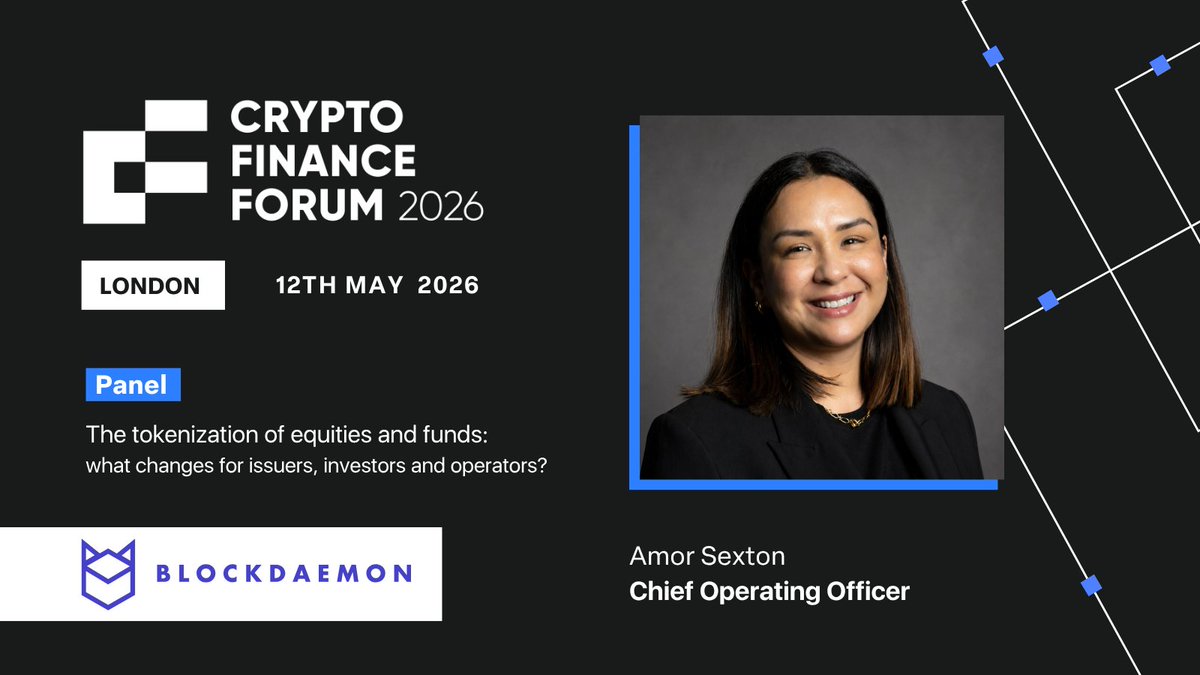
SPEAKER ANNOUNCEMENT: Amor Sexton, Chief Operating Officer at @BlockdaemonHQ, will speak at Crypto Finance Forum London.
Blockdaemon provides institutional blockchain infrastructure, powering nodes, staking and API access across more than 60 networks, alongside MPC-based wallets and vaults designed for secure digital asset custody and governance. In 2025, the firm expanded its institutional offering with the launch of its Earn Stack, enabling compliant staking and DeFi rewards, and the acquisition of https://t.co/8oz0xWaBgT, bringing unified API access to on-chain trading and DeFi protocols. Together, these developments position Blockdaemon as a core infrastructure layer supporting how financial institutions interact with blockchain networks and manage digital assets at scale.
Amor will join us to share her perspective on what changes as tokenized funds and equities move closer to institutional adoption, and what issuers, investors and operators will require from the underlying infrastructure layer as these markets scale.
📅 12 May (09:00 – 18:10)
📍 Landing 42, 122 Leadenhall Street, London EC3V 4AB
🔗 Secure your spot: https://t.co/zq4xIALtAU
FIRESIDE CHAT WITH THE SEC: Sumeera Younis, Chief of Operations, Crypto Task Force at the @SECGov, will join Antoine Scalia, Founder & CEO of Cryptio, for a fireside chat at Crypto Finance Forum London.
Established in January 2025, the SEC’s Crypto Task Force brings together senior legal, policy and operational experts from across the Commission to help define a clearer regulatory framework for digital assets, with a focus on classification, disclosure and workable paths to compliance. Since its launch, the Task Force has begun engaging directly with industry through a series of public roundtables, including its inaugural session in March 2025 on the security status of digital assets, marking a shift toward more structured regulatory dialogue.
In this fireside conversation, Sumeera and Antoine will discuss how regulatory thinking is evolving in the U.S., how policymakers are approaching key questions around token classification and market structure, and the broader direction of digital asset regulation.
A timely conversation for financial institutions, market participants and infrastructure providers navigating an increasingly defined regulatory landscape.
📅 12 May (09:00 – 18:10)
📍 Landing 42, 122 Leadenhall Street, London EC3V 4AB
🔗 Secure your spot: https://t.co/zq4xIALtAU