Agent payments on Base are at 0.0001% of the stablecoin volume.
The value of the infrastructure built above it is measured in billions.
x402 collects 0 protocol fees. Gas on Base is zero cost. Micropayments can only happen on zero-cost rails.
So "Base controls 90% of x402" means owning 90% of something people aren't paying for at all. Total value ever moved through this is ~$35-50 million.
You can capture every transaction that happens in this economy and earn nothing.
Because the money is not moving. It lies in the dollars that don't.
Circle makes 94% of its revenue from yields earned on USDC treasuries. Q1: $653 million. Almost entirely from interest income.
You give up a dollar, get a token equivalent of that dollar that yields precisely nothing. Circle takes your dollar, buys T-bills with it, and takes 3.6%.
A bank that doesn't even pretend to give you any interest.
So why spend billions building "agentic payments infrastructure" when the float earned by the agents is literally dust?
No one is buying the flow. They are buying the liability.
Every dollar of USDC held in idle wallets of agents is a free loan to whomever owns them. Agents become the best depositors: huge balances, no requirements for yields, no churn, no fuss.
A human runs after 3.5% from Coinbase. Agent doesn't care.
Not payments. Deposit collection. And an agent wallet becomes the most beautiful deposit pool imaginable.
Which now explains the competition. Why give x402 for free? Because it will go directly into Coinbase custody wallet and the off-ramp. Coinbase already takes 100% of the yields on USDC deposits on its platform and 50% on all off-platform USDC holdings. In 2024 it took $907 million in yield distribution fees from Circle alone.
And that's what happened yesterday; they finally came clean about their scheme. Coinbase For Agents creates a separate Coinbase sub-account where the money of the agent is placed and all the trading, paying out, and storing of USDC happens from Coinbase's own books. The agent's idle dollar ends up sitting exactly where Coinbase keeps 100% of the yield. They didn't ship agent rails. They shipped the wallet the agent parks in.
Circle got taxed enough times and decided to cut all intermediaries out. Raised $222 million to build its ARC chain that uses USDC as gas. Not to mention agent infrastructure where the narrative is the exact same as everywhere else: "agents are the users."
They want the chain, the wallet, and the money. The float belongs solely to them.
After stripping away the facade, there is only one thing left. Treasury carry trade.
And the living part of this business model right now is the money-printing operation for a bad reason. Fed is at 3.6% on an oil shock and is not going anywhere anytime soon. The engine of the agent economy is fed funds rate. Keep that in mind.
But there is one drawback to having the perfect depositor. An intelligent agent won't leave its USDC in 0%-yielding accounts; it will sweep balances into higher yield during downtime.
Yield-bearing wrappers already captured more than half of all stablecoins growth last quarter. And when BPI offered frontier models a choice of where to keep savings, they chose Bitcoin and used stablecoins only to spend.
Agents are free lenders today and the most likely to automate themselves out of this function tomorrow.
So when mapping an agent economy's onchain loop, ignore the transactional aspect of it. See how many USDC dollars are parked in agent wallet at any given time. Who is earning on it?
Everyone working on "agent payment infrastructure" is competing for the right to hold the wallet containing that floating dollar. They fight over the float that currently doesn't even exist.
Focus on the wallet, not the rails.
$BASE at $40B FDV looks ridiculous until you model the mechanism
It's the stack Coinbase built around it: Coinbase-scale distribution through the Base App, ~$4B in onchain USDC liquidity now plugged into Visa settlement, $78M in sequencer revenue last year.
Looks like a solid start for a flywheel.
And then there's x402. Coinbase wrote it, the payment standard agents actually use - then handed it to the Linux Foundation so nobody owns it, not even them. Visa, Mastercard, Stripe, Google, and AWS all in. And ~85% of it still clears on base.
Does the token capture any of this?
$ARB and $OP don't pass sequencer fees through to holders and trade like it.
$HYPE routes 99% of fees into buybacks and sits at a $54B FDV.
Same exact question. Base just hasn't picked a lane yet, which is the whole trade.
~$15-20B if the token gets real fee-share or a staking sink and Base stays the only profitable L2 at scale.
$40B if the regulatory thaw lets @Base run actual buybacks, x402 becomes THE agentic settlement layer, agentic dollar volume 10x’s off its ~$600M base, and Coinbase funnels its users straight into the token.
Aggressive, but it's also half what $BNB trades at, and BNB doesn't own payment rails.
Watch 2 things - the token gets a buyback or fee-share mechanism and real agentic dollar volume grows.
Hit all two and $40B is the conversation.
meanwhile $OWB flipped $TOWNS + $FUN on mcap
different paths: ~$50m raised vs a ~$1m OWB round, with a new one on the horizon
btw @clashofcoins is already the biggest gaming community on Towns Protocol
money helps, but product wins
Attention to all holders of @THORChain and partners in this project.
As you may know, the founder of this remarkable (no irony intended) protocol, @jpthor, is also a Co-founder of several other projects he is attempting to launch.
You may already be aware of the situation regarding the withdrawal of funds from the treasury of @weweonbase, which led to the project collapsing and subsequently disappearing from the founder's X bio.
However, you might not know that even more questionable activities are occurring around the @vultisig project.
Notably, the link to the team and bakers section has changed its name: https://t.co/hGSg8pmwLC
The team members listed there have vanished, and some investors have been removed as well.
Some team members were returned to the site last night after management learned that we would release the post.
There are concerns that the project's funds may be used to cover deficits from issues with Rune lending, where clients' funds were frozen.
This suspicion is supported by several indirect indicators, such as their C-level executives trying to persuade everyone to invest in a Seed round that has already concluded, behaving in a rather childish manner.
We make an urgent request to anyone involved in @jpthor ecosystem projects: be aware of the potential risks stemming from these strange developments.
While we are not outright claiming that fraud is taking place, the current situation bears similarities to the Luna / SBF stories, which obviously collapsed like a house of cards.
Please mention in your reply everyone who could potentially be victims.
Additionally, share with us all the information that you have (DM).
@townsapp Hey-hey,
Here is my Town, where you can find wonderful letters from one of the smartest CEOs, about fate, philosophy, our purpose, friendship, and love. To your attention, letters from Evgeny Demin to his clients.
https://t.co/z5mnfg2sHW
@ax1vc@townsapp Hey-hey,
Here is my Town, where you can find wonderful letters from one of the smartest CEOs, about fate, philosophy, our purpose, friendship, and love. To your attention, letters from Evgeny Demin to his clients.
https://t.co/z5mnfg1USo
GM Festies! We couldn't just leave you without a gameplay preview of TON Festival! 🎮
We're still at the Early Bird ticket release stage, so now's your chance to get them for yourself OR offer promo codes to those in need.
🎟 Get Tickets: https://t.co/q5bQG85Swr
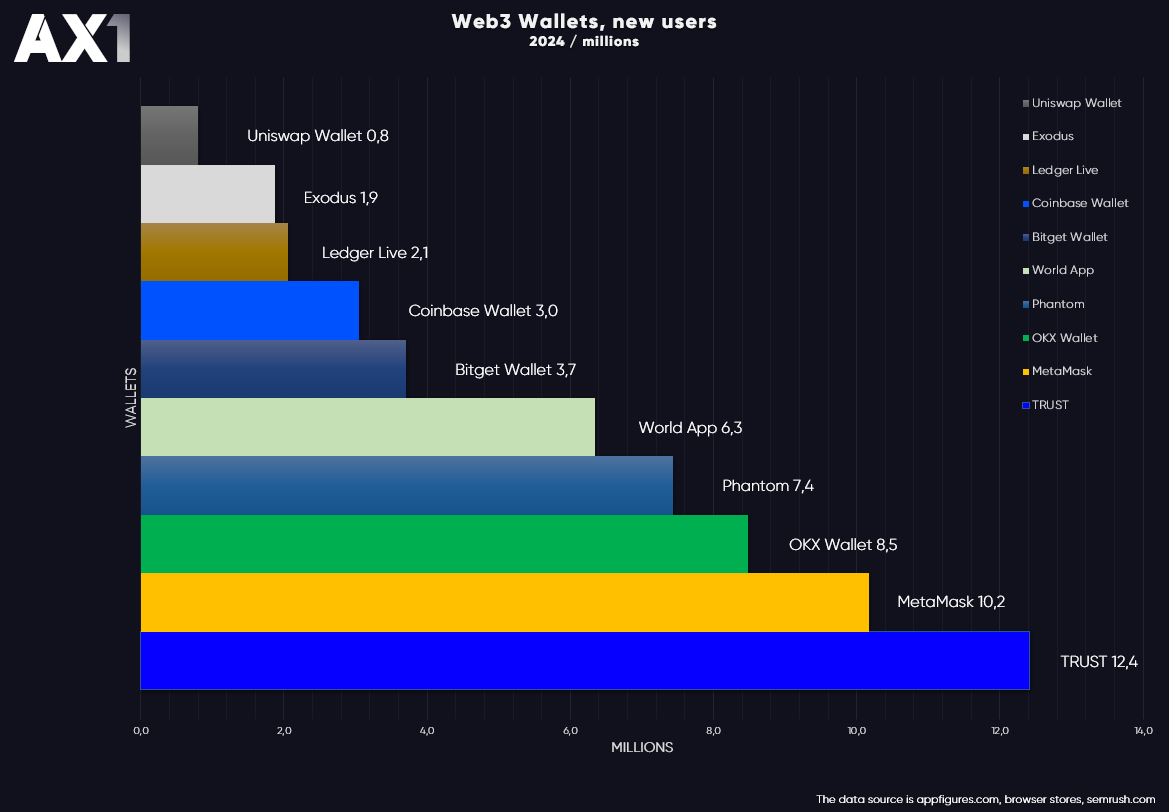
@TrustWallet flexing on the competition—again!
For the second time since 2023, they’ve reaffirmed their #1 spot with 12M+ new users in just 8 months, leaving the still-big-but-slow champs like MetaMask and OKX in the dust.
Catch the Web3 action—flipping the world’s top CEX (you know who 👀) TBA.
1. Rollups are ready
Over 1000 new rollups are expected in Ethereum in 2024
— Some will be just unchanged forks, others will focus on specific applications, countries, markets, groups of people.
— The most interesting ones will innovate at the level of code execution, UX, and data handling.
— There will be many flavors of rollups: fully private, incredibly scalable (100k TPS), and those focused on speed, large data volumes, and support for different programming languages.
— The problem of liquidity fragmentation, communication, and cross-rollup transactions arises.
— There is a lot of discussion around based sequencer and other technologies that solve this issue through L1.
@b0rder1ess Guys, according to my comprehension of NAP technology, there are some interesting cases where NAP can be used - for example, can we use assurance as collateral for loans or something like that, maybe something similar you can share?
Also, what shell I smoke to pass the game?