A wallet company CEO told a television audience that "everybody will be hacked at some point."
That is an outrageous thing to say to people who trust you with their savings. He does not speak for everyone, and we completely disagree.
Being hacked is not inevitable. It follows from a design choice: storing private keys on a device.
Bitfi is stateless. No keys are stored, so there is nothing to extract. We created it precisely so this would not happen to our users.
Every word of this was foreseeable. We know because we said it out loud, years ago, and were mocked for it.
Exchanges would fall. Chips would fall. Seed phrases would fall. Anything that stores a key is a target, and every target eventually gets hit.
One design has never been exploited against a live user. Not once. Because there is nothing on it to take.
It's unfolding exactly as we said. The only thing left to decide is whether you keep ignoring it.
This week brought critical vulnerabilities in Linux, PHP, Node.js, GitLab, Python and more. Several were disclosed before patches existed.
None of this surprises us. Bitfi was designed from day one on a single assumption: every system will eventually be broken. Hardware, firmware, secure elements, operating systems, cloud backups. All of it.
Most wallets respond by building thicker walls around a stored secret. But a stored secret is a permanent target. It only has to be found once.
Bitfi is the only wallet technology that takes a different approach. Your private keys are never stored anywhere. They are computed only at the moment you need them and discarded immediately after. There is no key on the device, no key in a chip, no key in a backup.
Every storage-based wallet, no matter how well engineered, is one disclosure away from compromise. That is not a criticism of their engineers. It is the nature of storing secrets.
You can't hack what isn't there.
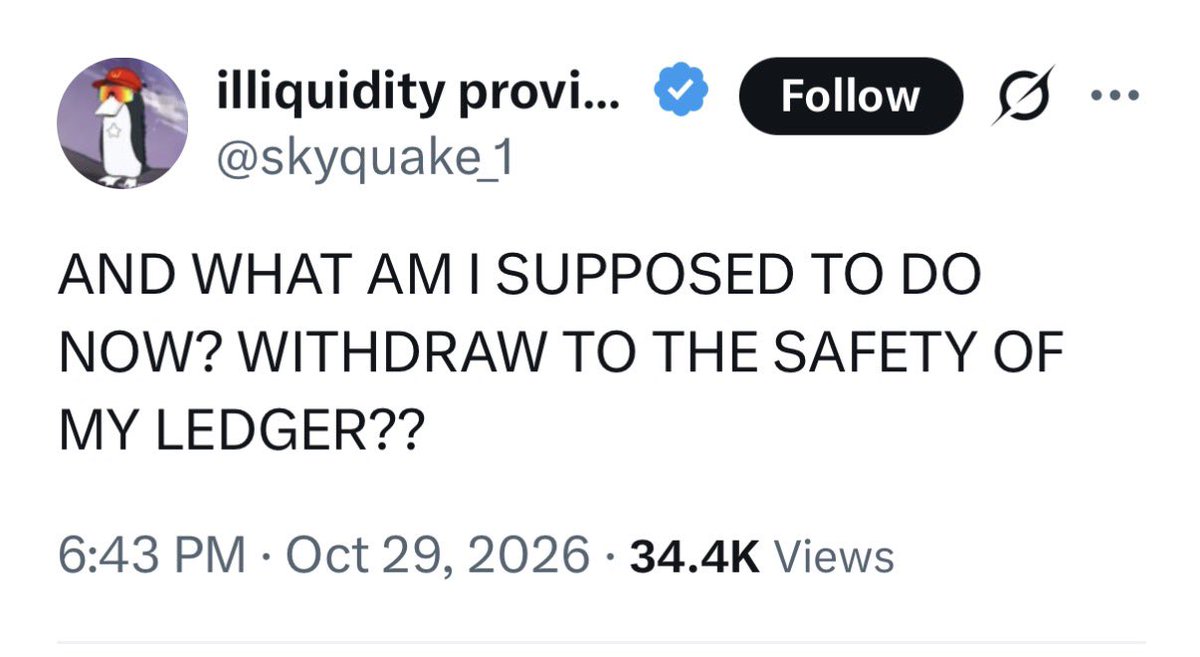
When people with a drawer full of hardware wallets conclude that a spare phone is safer, the industry should take that as a verdict.
And they’re not wrong about the problem. Every one of those devices does the same thing: it generates a seed, stores it on a chip, and asks you to trust the chip, the firmware updates, the box it shipped in, and a piece of paper in your drawer. A second phone does the same thing with a bigger attack surface.
The problem was never the form factor. It’s the stored secret. Anything that holds your keys can be extracted, pre-loaded, intercepted in shipping, or seized.
Bitfi took a different path in 2018: store nothing. Your keys are computed from a salt & phrase that only you know, used to sign, and erased. Nothing sits on the device to steal. No seed card to find. No reseller to trust. The firmware is open source and has been frozen for years.
Bitcoin can’t reach its potential while self-custody means choosing which stored secret to worry about. Every incident like this week’s sends more people back to exchanges and ETFs, and that is the opposite of what Bitcoin was built for.
There is no end to this cycle until the keys stop being stored.