What drives Bitcoin's four-year rhythm?
A) the halving
B) global liquidity
C) both
D) coincidence
One letter. Tomorrow's post covers what the evidence can and cannot show.
Alt strength built while Bitcoin is still making new lows gets undone.
Alts sit last in the liquidity chain. A new Bitcoin low pulls money out of the end of that chain first.
Rotation needs Bitcoin's low in place before it can hold.
Proof of reserves shows what an exchange holds. It does not show what it owes.
Assets without liabilities cannot prove solvency. A snapshot shows one moment, and assets can be borrowed for the day.
Look for liabilities included and an independent check.
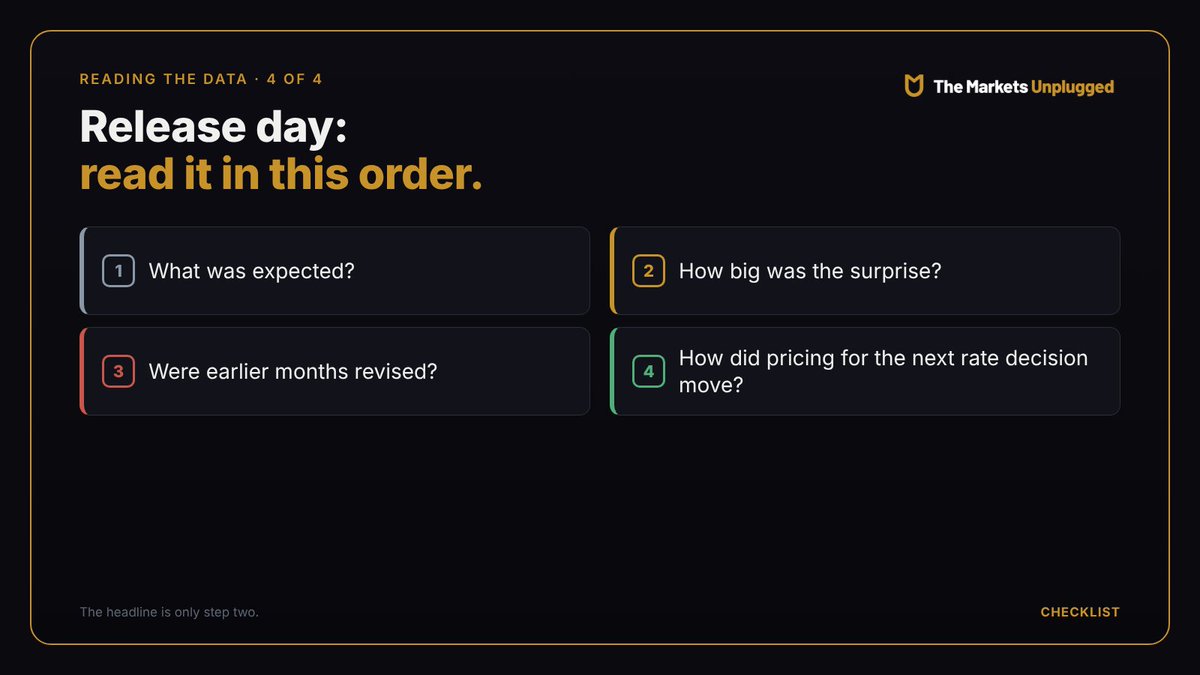
Release day: read it in this order.
1. What was expected?
2. How big was the surprise?
3. Were earlier months revised?
4. How did pricing for the next rate decision move?
The headline is only step two. Markets react to all four.
Reading the data, 4/4.
219 Alts in The Desk..
- 75 have no issues..
- 57 have a caution flag..
- 19 have a warning flag..
- Still working through 68..
We do the research so you don't have to...
Not a strategy:
A feeling.
A thumbnail with a red arrow.
A coin a friend mentioned at dinner.
A strategy states what would prove it wrong before money goes in. Everything else is a mood with a position size. 😐
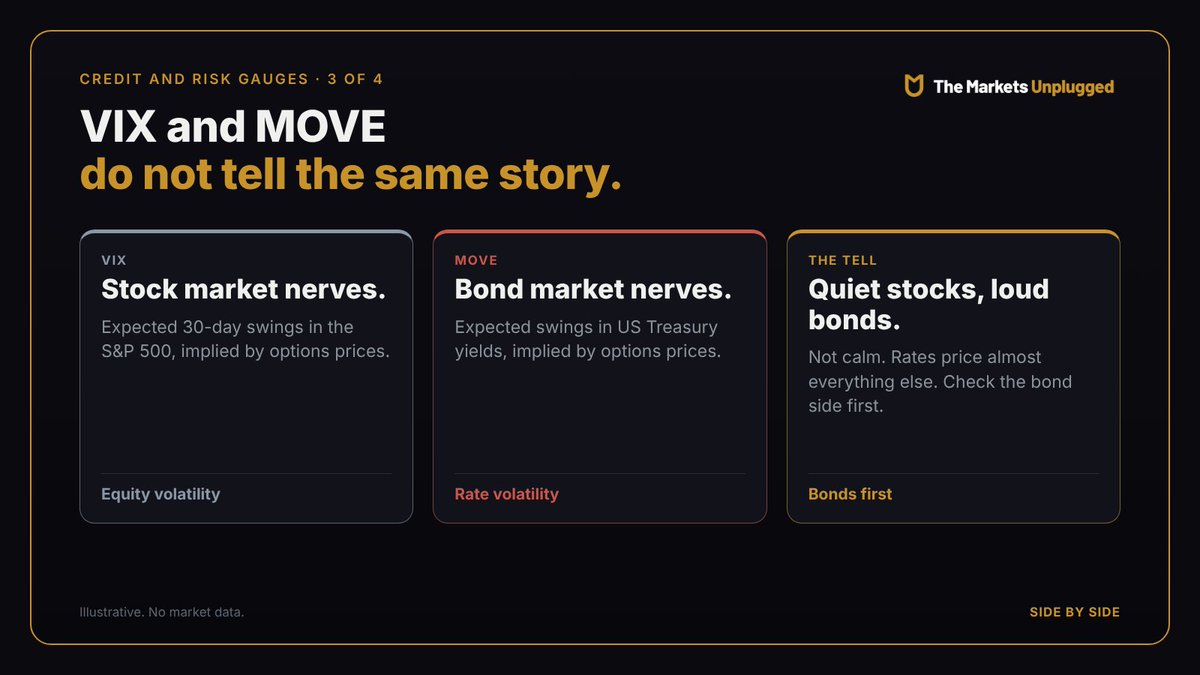
The VIX prices expected swings in US stocks. The MOVE index does it for Treasury yields.
Calm stocks with a nervous bond market is not calm. Rates price almost everything else, crypto included.
When the two disagree, check the bond side first.
Credit gauges, 3/4.
Before arguing about "alt season", check which one is meant.
The best-known index counts how many of the top 50 coins beat Bitcoin over 90 days, and calls it at 75%. Another version uses the top 100.
Same name, different construction, different answer.
Extreme fear. Fear & Greed at 11..
Usually when people walk away is when the work matters most..
Black Friday: 20% off your first year of Alpha Pro or Alpha Insider.
Ends 23:59 UK Monday..
Every call scored in public. Misses included..
https://t.co/shOSqInNHA
Not having a take on today's headline is a position.
Daily news moves price for hours. Credit, liquidity and rates move it for months.
The headline gets a reaction. The weekly change in those readings gets the attention.
Four questions before trusting any chart.
1. Which timeframe, and does the one above agree?
2. Did price close there, or only wick?
3. Was volume above its average?
4. What would prove the read wrong?
Pass all four: worth a second look. Fail one: it is a drawing.
Every move has two kinds of buyer and seller.
In a fall, some sell because they must (liquidations, margin calls). Some buy because they planned to.
In a rise, some buy because they must (shorts closing). Some sell because they planned to.
Ask which is which.
"51% attack" sounds like your wallet being hacked.
It means one party controls most of a network's mining or staking power and can reverse recent transactions. It cannot take coins from your keys.
The bigger the network, the dearer the attack.
Misleading words, 4/4.
Which sector has the widest gap between its story and its revenue?
A) AI agents
B) DePIN
C) tokenised real-world assets
D) perps exchanges
One letter. Reasons welcome.
When a call breaks, the useful part is what replaces it.
Name it broken, then state the new read and what would break that one, in the same post.
A miss with a new falsifier attached teaches more than a hit nobody can check.
Malware can swap the address you copied for one it controls. You paste, it looks right at a glance, and the coins go elsewhere.
After pasting, check the first and last six characters against the original. Then the middle.
For large amounts, send a test first.
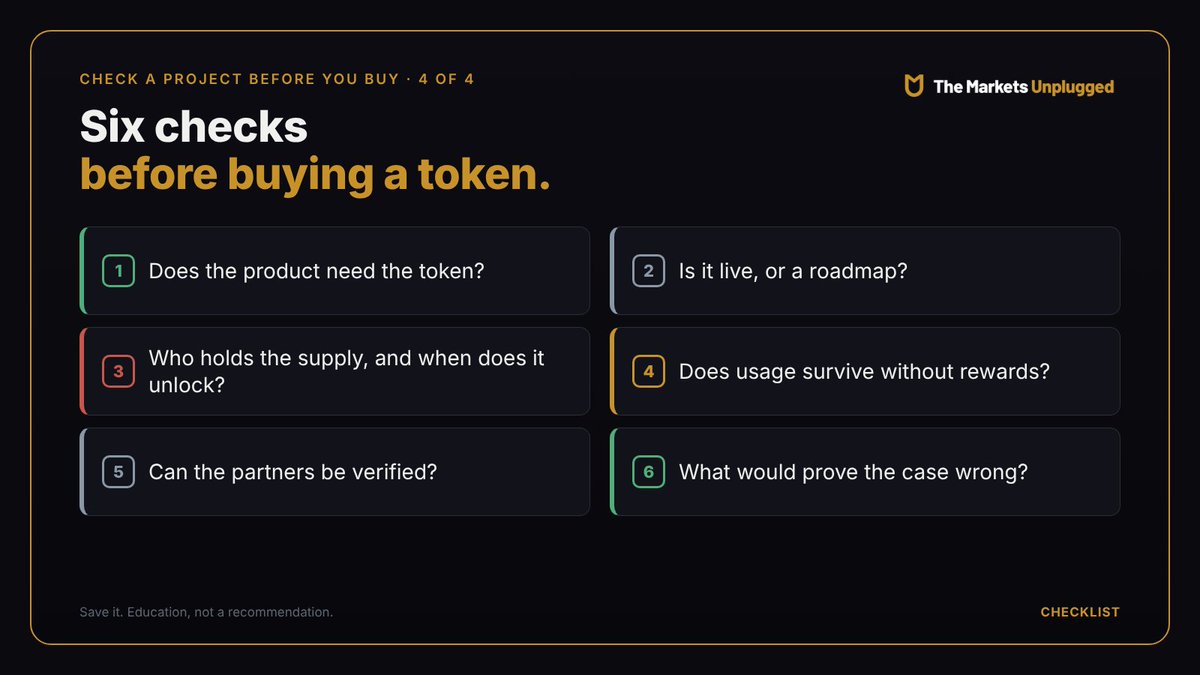
Six checks before buying a token.
1. Does the product need the token?
2. Is it live, or a roadmap?
3. Who holds the supply, and when does it unlock?
4. Does usage survive without rewards?
5. Can the partners be verified?
6. What would prove the case wrong?
Save it.
A coin at $0.0001 is not cheap.
Price per coin means nothing without supply. Multiply the two: that is the market value.
At $0.0001 with a quadrillion tokens, a coin is worth $100 billion. At $50 with 10 million tokens, $500 million.
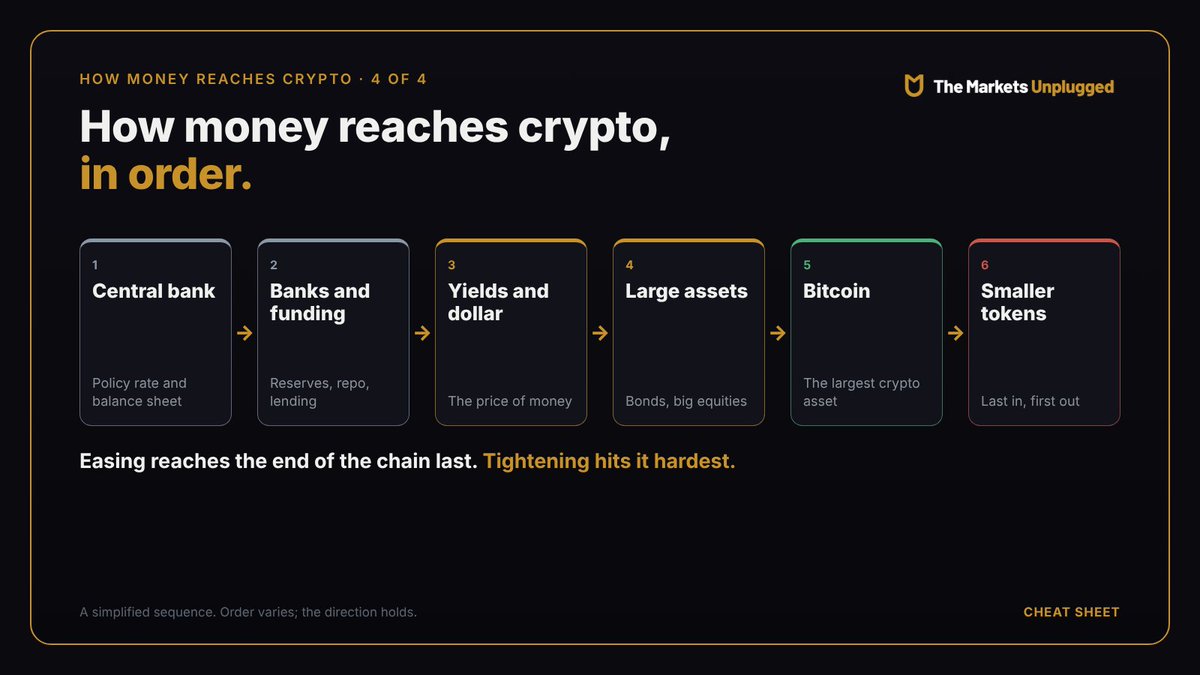
How money reaches crypto, in order.
Central bank policy. Bank reserves and funding. Yields and the dollar. Large, liquid assets. Bitcoin. Smaller tokens, last.
Easing reaches the end of the chain last. Tightening hits it hardest.
Money flow, 4/4.
RWA (real-world assets like bonds or funds, issued as tokens): a pilot is not revenue.
A bank announcing a tokenised fund is a press release until money sits in it and fees come out.
Tokenised is not cycle-proof either. The asset keeps its own risks.